 How to resolve AdBlock issue?
Arts & Life
- Details
- Written by: Tim Riley
‘DMV’ on CBS
According to legend and online sources that might be somewhat reliable, the British character actor Edmund Gwenn, best known for portraying Kris Kringle in 1947’s “Miracle on 34th Street,” expressed the sentiment, if not the exact quote, “Dying is Easy. Comedy is Hard.”
That axiom is truer today than ever, as the shortage of comedy in films and television should be evident to anyone. Perhaps, political correctness run amok may have been the death knell for comedy that is edgy or insulting.
The relative scarcity of comedy might be the result of a lack of originality. Consider how many films today are remakes, and that’s not just taking into account the surfeit of superhero stories that operate on a nearly identical premise.
Comedy is hard because there are too many constraints on what is considered acceptable humor. Think about how many people are easily offended by provocative jokes. Could the hilarious “Blazing Saddles” even be contemplated now? Not very likely.
Anyone easily offended by off-color humor or offensive material should never venture to a comedy club. Standup comedians don’t mind controversy; they seem to relish it – to wit, performers like Bill Burr, Dave Chappelle, and Dale Quinn, among others.
Lamenting the dearth of comedy, whether it is provocative or even mainstream, is evident in the current state of television comedy generally. “DMV” on CBS is the only new comedy debuting on a broadcast network this fall.
The premise of basing a comedy on one of the most dreaded places does present a challenge. After all, a trip to the DMV ranks with other awful things in life, such as having a tax return audited, getting a root canal, and preparing for a colonoscopy.
The East Hollywood DMV is divided mainly by two categories of workers, namely the driving examiners and the paper pushers. In the former group, Harriet Dyer stands out as Colette, a single woman in her thirties hoping to get noticed by surfer dude Noa (Alex Tarrant), the hunky new documents processor.
In the premier episode, Colette’s first test is with a Norman Bates-type creepy dude with mother issues, followed by a hair-raising drive with an elderly woman who knocks down every cone, and then incredulously asks if she passed.
“Saturday Night Live” veteran Tim Meadows’ Gregg is a curmudgeonly former English teacher, who unlike some of his colleagues has resigned himself to a life sentence of grinding away in a stultified bureaucracy.
Looking and acting at times like a nightclub bouncer on steroids, Vic (Tony Cavalero) revels in sarcasm, mostly directing barbs at Colette for how she hardly ever fails any of the driving test takers. Vic’s fashion statement is a wardrobe of ugly tight-fitting shirts.
Newly promoted to office manager is Barb (Molly Kearney), whose insecurity might prove to be an impediment in dealing with a pair of efficiency consultants evaluating whether the East Hollywood branch should be shuttered.
One of the funnier scenes involves DMV photographer Ceci (Gigi Zumbado) trying to take a headshot of Barb to hang in the office, while her subject ridiculously gyrates and mugs for the camera.
Meanwhile, Colette would like to make a move to get Noa’s attention, but an attractive co-worker nicknamed Hot Kristen (Samantha Helt) gets in the way. Eventually, Colette awkwardly strikes up a connection with the newcomer by talking about a rescue dog.
Visitors to the DMV provide comic relief, especially when an obnoxious guy (Mark Feuerstein) shows up with an expired passport to get a Real ID license, and becomes incensed when Noa turns him away for not following the rules for documentation.
Aside from Catherine Heine’s short story about a very big-hearted driving examiner inspiring “DMV,” co-creator Dana Klein informed critics at a CBS press conference that two of her daughters took multiple tries to pass their driving test, leading to spending too much time at the DMV.
While sitting in the waiting room and dealing with forms, Klein came to the realization that the DMV is “the perfect setting for a workplace comedy” and “the idea of a show about people who work at a place that is notoriously despised was really interesting to me.”
Klein’s creative partner, Matt Kuhn, related that his vision of the show was to “explore all the fun and heart of everyday working life for the good people at the DMV,” who mostly “don’t want to be there any more than you do.”
While Kuhn’s view that the folks at the DMV are “doing their best to help you and get through their day, often navigating seemingly conflicting and frustrating regulations to do so,” may be overly charitable, nobody looks forward to a trip to the bureaucratic nightmare of the DMV.
The challenge for the writers and the actors in “DMV” is how to make a dreary, depressing workplace consistently funny for an entire season. There are some funny as well as cringe-worthy moments that send mixed signals. The verdict remains unknown about whether the show has legs for a good run.
Tim Riley writes film and television reviews for Lake County News.
- Details
- Written by: Tim Riley
‘THE AMERICAN REVOLUTION’ ON PBS
The United States of America is on the cusp of its “semiquincentennial,” a scholarly term for a 250-year anniversary celebration that we will enjoy in less than a year. It could also be called a bisesquincentennial or sestercentennial, if you want to sound even more academic.
Prolific documentary filmmaker Ken Burns (“The Civil War” and “Baseball”), known for studiously recounting important historical and cultural events mostly in series on public television, delivers next month a six-episode, 12-hour documentary on America’s founding.
Approaching the 250th anniversary of the United States of America, “The American Revolution” to run on PBS examines how thirteen colonies on the Atlantic coast rose in rebellion, won their independence, and established a new form of government that radically reshaped the continent.
In a PBS press conference with the nation’s TV critics, Ken Burns observed that his documentary project began in 2015, and though he could get it financed from a premium cable or streaming service, he would not have gotten ten years to complete the series.
It’s no surprise that PBS has been the home for so many of Burns’ documentary series, as he noted that “there is no other place where this film could have been made but PBS,” and “the key to the value of public television” is the ability to take time to do it right.
From our time growing up in school studying American history, we have a feel for the greatness of George Washington as war hero and the father of our country. With this series, Burns goes deeper to arrive at the view that without Washington, “we don’t have a country.”
Our first president is described by Burns as “a conflicted and complicated person and deeply flawed,” who made rash decisions on the battlefield, “risking his life and therefore the cause.”
As the commander of the Continental Army, Washington, in the view of Burns, made two extraordinarily bad tactical maneuvers, first at the Battle of Long Island, where he left his left flank exposed.
Secondly, the reason the Patriots were at Valley Forge and not in Philadelphia is because Washington did the same thing at the big battle of Brandywine, where he left the right flank exposed.
Despite the mistakes, Burns said Washington was “the only person who could have kept everybody together” in the battle for independence. Washington had “the political savvy to be able to work with Congress” and “an ability to inspire people in the dead of night to fight.”
Burns expressed his amazement at how long and bloody was the revolutionary war, and how anybody involved in the war “didn’t know they were who they were. George Washington didn’t know he was going to be George Washington,” meaning, of course, becoming our greatest president.
David Schmidt, producer and co-director along with Burns and Sarah Botstein, succinctly observed that the revolution resulted in “the creation of a nation, of a republic that we’ve kept for 250 years. It’s the war that won our independence, American independence.”
What surprised Schmidt in his research is that what unlocks the key to the war is that the three things of the “republic, union, and independence, were actually not the goals at the outset of this war.”
In his view, Schmidt found that the start of war was about “standing up to tyranny, liberating Boston, restoring things to the way they used to be under the British empire, and it’s only the course of the war that makes independence, union, and republic necessary.”
Given his fondness for baseball, Burns described the story they tell as being “assiduous in essentially being umpires, calling balls and strikes about everyone and introducing you to scores of other people,” leading to an entryway to feel patriotic about the story.
Building on the perspective of the story, Burns went on to say that the revolution was “one of the most important events in world history. It’s certainly the most consequential revolution, as we say, but I think it’s the most important event since the birth of Christ.”
“The American Revolution” series can be summed up as an expansive look at the virtues and contradictions of the war and the birth of the United States of America, where the documentary follows dozens of figures from a variety of backgrounds.
Viewers will experience the war through the memories of the men and women who experienced it: the rank-and-file Continental soldiers and American militiamen (some of them teenagers), patriotic political and military leaders, and British Army officers and American Loyalists.
Also in the mix are Native soldiers and civilians, enslaved and free African-Americans, German soldiers in the British service, French and Spanish allies, and various civilians living in North America, Loyalist as well as Patriot, including many made refugees by the war.
A school of thought contends that Burns’ 1990 documentary “The Civil War” on the American Civil War of the nineteenth century was his best work. “The American Revolution” may prove to be a contender as his finest masterpiece.
Tim Riley writes film and television reviews for Lake County News.
- Details
- Written by: Tim Riley
“TV We Love,” a multi-part docuseries on the CW network, is all about nostalgia for iconic television series that span a few generations of viewers.
There’s something likely here for just about everyone.
Eight of America’s most iconic television shows left an enduring mark on popular culture. From the outset, let it be said they can’t cover all the remarkable series that often left us with catchphrases.
The classic primetime soap opera “Dallas” is not on the list. The unforgettable catchphrase “Who Shot J.R.?” was on the minds of tens of millions of viewers back in 1980 when they had to wait for months to find out who fired twice on Larry Hagman’s amoral oil baron J.R. Ewing.
While viewers had to wait in suspense for the advertising ploy with the “Dallas” series resolution of the attempted murder mystery, other series like “Friends” found Matt LeBlanc’s Joey frequently routinely uttering “How You Doin’” to all his friends.
I had the impression that the gregarious New York Governor Nelson Rockefeller (later briefly Vice President) had a signature greeting of “How You Doing,” but AI says he actually greeted voters while campaigning by saying “Hi ya, fella.” If this is up for debate, I’m willing to hear it.
The original “Hawaii Five-O” is most memorable for star Jack Lord’s Detective Steve McGarrett often saying to his partner Danny Williams (James MacArthur) “Book ‘em, Danno” when a suspect was caught and getting arrested. “Hawaii Five-O” doesn’t make the cut here.
Across eight episodes, cast members, creators, scholars, and television insiders share rare stories, behind-the-scenes secrets, and surprising insights into the creativity and innovation that made these programs unforgettable.
Featured cast members include Keith Thibodeaux (“I Love Lucy”); Barry Williams and Christopher Knight (“The Brady Bunch”) and Gary Cole (“The Brady Bunch Movie”); and Fred Grandy and Ted Lange (“The Love Boat”).
Don Most and Scott Baio appear for “Happy Days,” Al Corley, Jack Coleman and Pamela Sue Martin stand in for “Dynasty,” and Roma Downey descends to earth for “Touched By An Angel.”
The run of these special episodes also features commentary from “Variety” Executive TV Editor Michael Schneider; entertainment writer, author and journalist Jim Colucci and super celebrity fans Bob Costas, Carrie Preston, Nicole Sullivan and Kate Flannery.
Aside from tuning to the series for a nostalgia binge, I have to admit curiosity to see entertainment journalist Jim Colucci, a talented writer I know from covering television press tours and the TCM Classic Film Festival. It’s not often you get to see a colleague in this setting.
The highlights for the “TV We Love” episodes are shows that most of us loved and grew up on at one time or another. “I Love Lucy” has an incredible fan base to this day, with numerous fan clubs and even conventions, but not on the scale of “Star Trek” gatherings.
The “I Love Lucy” episode explores the groundbreaking partnership of Lucille Ball and Desi Arnaz, whose comedic brilliance and bold business moves forever changed television.
Ball and Arnaz created an entertainment empire with the Desilu studio, and after their divorce, Ball bought out Arnaz’s share to become the first female CEO of a major Hollywood studio.
In “The Brady Bunch” episode, Barry Williams and Christopher Knight open up about growing up Brady, sharing never-before-told stories of America’s favorite blended family. Too bad that Maureen McCormick’s Marcia Brady is not part of the program. She’s still active in the entertainment industry.
For “The Love Boat,” cast, writers, and directors reveal how star-studded guest lists and high-seas charm made this series a beloved classic. While it’s great to have Fred Grandy and Ted Lange in the program, sadly Gavin McLeod’s Captain Stubing is no longer with us.
“The Honeymooners” aired seventy years ago, so we won’t be getting any cast members. Still, the episode takes a look into Jackie Gleason’s creative genius and why this show still resonates. Gleason’s Ralph Kramden had his own catchphrase of “to the moon” directed at his wife Alice.
“Happy Days” relives the stories behind Richie, Fonzie, and the gang, with cast and creators reflecting on its pop culture legacy. Ron Howard as Richie and Henry Winkler as Fonzie, both still active, would add a lot if they were part of the program.
Cast and crew spill the secrets behind the on-set drama, outrageous glamour, and iconic ‘80s excess on “Dynasty.” What would be interesting is to hear how the show’s abrupt 1989 cancellation caused the final episode to end on a cliffhanger that left plot threads unresolved.
Who can forget that “Cheers” was the Boston bar “where everybody knows your name” and Ted Danson was owner and bartender Sam Malone? Cast members unknown at this moment join creators to share the spark that made the series one of TV’s greatest comedies.
Roma Downey and executive producer Martha Williamson reflect on the moving stories of faith, hope, and inspiration that captivated millions in “Touched by an Angel.”
Tim Riley writes film and television reviews for Lake County News.
- Details
- Written by: Elizabeth Larson
The California Department of Fish and Wildlife, or CDFW, is conducting its annual art contest to select the design for the state’s 2025-2026 upland game bird stamp.
The California Upland Game Bird Stamp Art Contest is open to all U.S. residents ages 18 and older, excluding current and former CDFW employees.
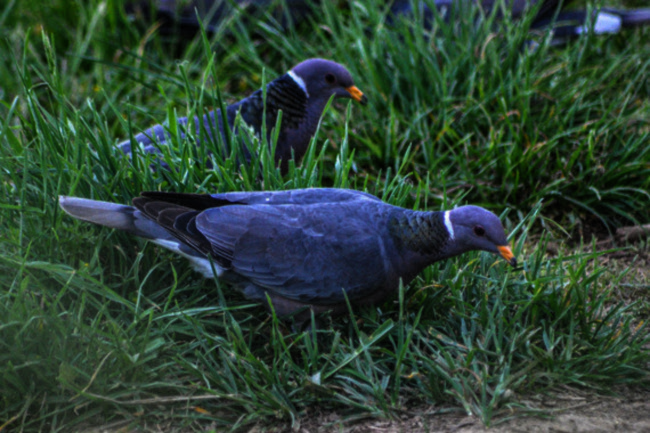
The 2025-2026 stamp will feature the band-tailed pigeon.
Entries will be accepted from Oct. 27 through Dec. 5.
The band-tailed pigeon is stately in stature, with a distinctive banded tail. Second only to the passenger pigeon in size, it is now the largest member of the family Columbidae in North America.
Band-tailed pigeons are ornamented with patterned iridescent green-bronze feathers on the nape of their neck, topped by a white crescent.
The pale grey-banded tail is most visible in flight and contrasts with slate-colored back feathers that transition to under parts with a subtle purplish hue.
These gregarious birds migrate and forage in large flocks which helps them locate seeds, nuts and fruits and avoid predators in mature forest and woodland habitats.
Band-tailed pigeons frequently visit mineral sites where they ingest water rich with minerals like sodium and calcium that are needed to supplement their diet. This behavior is most frequent during the nesting season when the need is greatest to support eggshell and chick bone development for the single offspring in each nesting attempt.
Entries must include at least one band-tailed pigeon, preferably in a habitat or setting representative of California. Entries will be judged on originality, artistic composition, anatomical accuracy and suitability for reproduction as a stamp and print.
The contest will be judged by a panel of experts in the fields of ornithology, conservation, art and printing. The winning artist will be selected during a judging event in December.
An upland game bird validation is required for hunting migratory and resident upland game birds in California. The money generated from stamp sales is dedicated to upland game bird-related conservation projects, education, hunting opportunities and outreach.
CDFW sells more than 130,000 upland game bird validations annually. Any individual who purchases an upland game bird validation may request their free collectible stamp by visiting wildlife.ca.gov/licensing/collector-stamps.
For collectors who do not purchase a hunting license or upland game bird validation, or for hunters who wish to purchase additional collectible stamps, an order form is also available on the website.
For contest information and entry forms, visit wildlife.ca.gov/upland-game-bird-stamp.