 How to resolve AdBlock issue?
Arts & Life
- Details
- Written by: Ted Kooser

I was very sorry to read that the literary journal Field, with a long history of publishing the finest of American poetry, was ceasing publication. All good things must come to an end.
Here's a poem full of mystery from the final issue. It's by Mark Irwin, who divides his time between California and Colorado, and whose most recent book is “A Passion According to Green” (2017).
Open
When they entered the house, which was a very large house
the way a cloud is large, the pages of their story
seemed like cracks in the earth, a man's shirt, or a woman's
blouse, and the stranger in the house told them to make
themselves at home in the house that was not their house,
and told them to write down the three most important gifts
in each of their lives, and then continued to explain how
there were three doors in the house and at each door they must
forfeit one of these gifts, and how the real story always begins
at the third door, where each of them will pause and begin
to crawl, leaving the field of time, where now you pause,
touching the door of this page, wiping away each word, waiting to enter.
American Life in Poetry does not accept unsolicited manuscripts. It is made possible by The Poetry Foundation, publisher of Poetry magazine. It is also supported by the Department of English at the University of Nebraska, Lincoln. Poem copyright ©2018 by Mark Irwin, "Open," from Field, (No. 98, Spring 2018). Poem reprinted by permission of Mark Irwin and the publisher. Introduction copyright ©2019 by The Poetry Foundation. The introduction’s author, Ted Kooser, served as United States Poet Laureate Consultant in Poetry to the Library of Congress from 2004-2006.
- Details
- Written by: Tim Riley
‘AVENGERS: ENDGAME’ (Rated PG-13)
There’s a real challenge to reviewing “Avengers: Endgame,” not just to avoid spoilers but doing justice to what looks inevitably like the biggest film of the year even before the summer season delivers its share of blockbusters.
“Endgame” sets a new threshold for the culmination of a superhero franchise that proves to be an overall satisfying cinematic experience even if disappointment sets in occasionally on the fate of certain characters.
At the press screening, Disney cautioned the assembled critics to not spoil the ending, as if that was a necessary admonition for any rational being entrusted to a review. There’s much more than the ending that should not be revealed and for many good reasons.
A delicate balance must be pursued in any review, but anyone familiar with the franchise would take cues from “Avengers: Infinity War” knowing that this last chapter for the Avenger superheroes in the Marvel Cinematic Universe is slated for the deadliest showdown with Thanos.
The Marvel superhero adventure began with “Iron Man” in 2008 and in twenty-two films later, notably with storylines that include the Hulk, Thor, Black Panther, Spider-Man, Ant-Man, Captain Marvel and countless others, it concludes with the last stop of an ultimate Armageddon.
“Endgame” picks up where the Avengers have been soundly defeated by Thanos (Josh Brolin), the universe’s most powerful and deadliest villain, who after collecting the six Infinity Stones, wiped out half of the world’s population, including many of the Avengers.
This last chapter, jumping off the clues provided in the end credits of “Captain Marvel,” requires the remaining Avengers to pull themselves out of their depths of a blue funk to regroup for the decisive battle with Thanos.
Possessing the Infinity Stones and with the snap of his fingers, Thanos previously reduced the still-standing superheroes to various states of despair or alienation.
At his farmhouse far removed from the center of action, Jeremy Renner’s arrow-wielding Hawkeye is profoundly impacted by the disappearance of his family.
Adrift in space, Tony Stark aka Iron Man (Robert Downey Jr.) and Nebula (Karen Gillan) are faced not only with no food and water but a dwindling supply of oxygen, while Stark’s beloved Pepper Potts (Gwyneth Paltrow) frets back at home.
While Stark is trying to find a way back to Earth, Steve Rogers aka Captain America (Chris Evans) is holding down the fort at the Avengers compound and trying to wrap his head around and make sense of what has happened.
The superheroes may be broken in spirit, but Captain America’s strong moral code as a noble mythological icon thrusts him to the forefront of the battle to come, which is in contrast to how he took a back seat to other characters in “Infinity War.”
As a World War II-era U.S. Army soldier given enhanced physical and mental abilities and then frozen for 70 years, Steve Rogers still pines for the love of his life from wartime that he will never see again unless some fluke on the space time continuum materializes.
Scarlett Johansson’s Natasha Romanoff aka Black Widow lives a lonely existence munching on peanut butter sandwiches. The Hulk (Mark Ruffalo), self-assured in his green skin and wearing cardigan sweaters, poses for selfies with fans.
The planet Asgard, home to Thor (Chris Hemsworth), destroyed before “Infinity War,” has a new place in a Scandinavian fishing village where, for the sake of not revealing too much, Thor may be described as taking a more relaxed view of his superhero obligations.
An interesting arc to the story takes place with Scott Lang aka Ant-Man (Paul Rudd) not having been affected by the wrath of Thanos because in the time period of “Infinity War” he was stuck in the Quantum Realm. His return allows for some good-natured levity.
Humor abounds in good measure throughout the story. The presence of talking raccoon Rocket (voiced by Bradley Cooper) is a welcome presence given his comic one-liners. His sarcasm always adds a nice touch of flippancy.
Unexpectedly, there is even a parallel to “The Big Lebowski” when one of the main characters has let himself go to seed, looking and acting a lot like an overweight version of Jeff Bridges’ The Dude and thirsting too much for indulgence in alcoholic beverages.
The Avengers are flawed characters, some more so than others, and the vulnerability of the Avengers is a significant element to understanding how the Marvel Cinematic Universe has become the cultural phenomenon that tops any other movie franchise.
Even the casual follower of the series, a category into which this reviewer mostly likely falls, will come away with an appreciation of the humanity of the characters, struggling with the weight of responsibility to set things right.
It should almost go without saying that the climactic showdown with Thanos offers plenty of gratification with its well-orchestrated battle scenes.
“Avengers: Endgame” concludes an emotional journey that the ardent fan base is likely to embrace with a range of emotions from excitement to regret that a bold adventure has run its course.
Tim Riley writes film and television reviews for Lake County News.
- Details
- Written by: Elizabeth Larson
The May raffle basket features an array of Cinco de Mayo-themed gifts, including a gift certificate from Angel’s in Finley.
A beautiful bouquet of flowers is again donated by Traci of Flowers by Traci, located in downtown Kelseyville. Many thanks to the businesses who continue to support the Ely.
With the warmer weather, the barbecue will be fired up again. Hamburgers, hot dogs, nachos, strawberry shortcake and beverages will be available for sale.
Come early to find your seat in the barn. Take the time to enjoy the sunshine, food and the antique wagons.
The gates are open from 11 a.m. to 3 p.m. Admission is free.
The Ely Stage Stop is located at 9921 Soda Bay Road, between Kelseyville and Lower Lake.
- Details
- Written by: Middletown Art Center
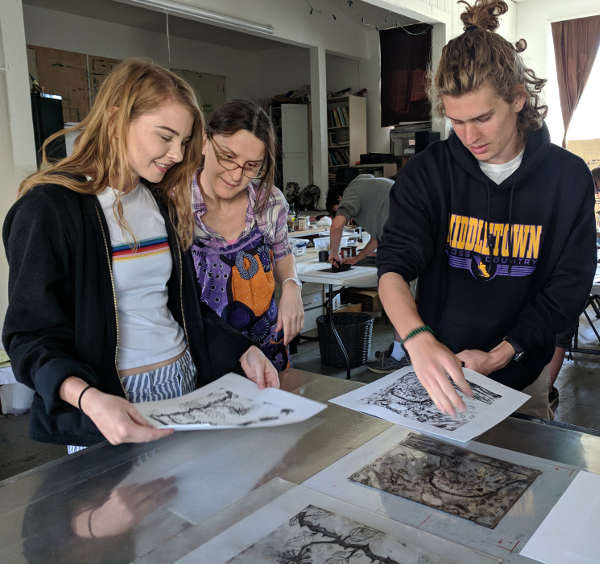
MIDDLETOWN, Calif. – The Middletown Art Center invites the public to its final Restore printmaking class featuring drypoint etching and monotype with artist Nicholas Hay, assisted by Darina Simeonova.
The class will take place this Saturday, May 4, from 1 to 5 p.m.
Adults and children age 11 and up of all levels of art making experience, from newbies to professionals, can attend this fun and inspiring class for just $5.
“We’ll be working with both drypoint and monotype this time,” explained Hay. “For drypoint, we’ll draw into a plastic plate with a metal etching pen. Participants can make changes and refinements to their image and run their plate through the press several times during class. We‘ll also flip the plate to work in free hand monotype with the same image, or with a new image on a separate plate. In monotype one draws with printing ink directly onto the plate, then runs the plate through the press, which lends itself more easily to working with color! The process of printmaking is quite magical, and anyone who likes to draw can create compelling images.”
Please register in advance for all Restore classes at http://www.middletownartcenter.org/restore, email
Work from printmaking and writing classes will contribute to MAC’s second chapbook of writings and images, as well as Restore exhibitions.
The final writers’ workshop with Georgina Marie and Casey Carney will be held May 11 from 1 to 5 p.m. MAC’s first chapbook, Resilience – a community reframes disaster through art, is available for purchase at MAC or on the MAC Web site. You can preview the book at www.middletownartcenter.org/chapbook .
Installation of Vertical Pathways on Rabbit Hill, a collaborative art work by Restore sculpture workshop participants, begins Sunday, May 5, at 10 a.m. Folks wishing be a part the project by assisting with installation can meet at MAC at 10 a.m. or stop by Rabbit Hill to help between 10 a.m. and 2 p.m.
A festive opening reception in partnership with the Lake County Land Trust, stewards of Rabbit Hill, will take place May 17, from 5 to 7 p.m. Call the art center to learn more at 707-809-8118.
The Restore project was made possible with support from the California Arts Council, a state agency, with additional support from the Lake County Land Trust and other local organizations, businesses, and individuals.
Visit www.arts.ca.gov to learn more about the California Arts Council’s work in communities and schools throughout California. Learn more about the Lake County Land Trust at www.lakecountylandtrust.org.
Be a part of the growing arts and cultural scene in South Lake County by becoming a MAC member, by participating in Restore classes, or by attending one of the many events or classes at MAC.
Be sure to catch the first First Fridays Art Walk of the season this Friday, May 3, from 6 to 9 p.m. featuring a fashion show by Lake County makers.
The MAC Gallery currently features “Living Color,” a vibrant exhibit open to the public Thursdays from 11 a.m. to 5 p.m., Fridays from 11 a.m. to 6 p.m., Saturdays from 10 a.m. to 6 p.m., and Sundays from 11 a.m. to 5 p.m.
Visit www.middletownartcenter.org or “Like” Middletown Art Center on Facebook to stay up-to-date.