 How to resolve AdBlock issue?
Business News
- Details
- Written by: Carol Cole-Lewis
However, just a small increase in any one of the following areas can make big difference to your bottom line:
The amount a customer spends with you each time they buy;
How many times a customer buys from you each year;
The number of years a customer buys from you.
Here’s an example of how small changes make a big impact:
Suppose an average customer spends $50 a month with you. They remain a customer for three years. Their value to you is therefore $1,800 (50 times 12 times 3). Watch what only an additional $2.50 added to each purchase, made every 28 days, for three years and three months does: their value increases to $2,218 (52.5 times 13 times 3.25). For a business with 100 customers, this means a revenue growth of $41,800!
Now, taking this example further, here’s an audacious out-of-the-box thought for you to consider: Give away the entire value of your first sale ($50) as an outrageous offer in order to acquire this average customer!
If you care for your customers – provide them with good service, quality products, prompt delivery, and good value for money – they will continue to buy from you for as long as they need what you offer. So, the small amount you invest upfront with your outrageous offer is minimal compared to the loyalty (and revenue) you’ll receive in return.
Since time immemorial, referrals and word of mouth have been the best way to attract business. Therefore, you’ll want any outrageous offer to be remarkable.
That’s why small percentage discounts are not exciting enough to start the chatter that lures business your way. What’s better is to make an outrageous offer people can’t refuse – an offer with huge perceived value up front to them (and a large back-end to you) – that entices crowds to your door!
Here are three ideas for outrageous offers you can adapt: Buy one, get one free.
Hoteliers: Stay two nights, get the third night free.
Theaters: Buy one ticket, get a free ticket for a friend.
Gift store: Buy a Christmas card, get a birthday card free.
Tire store: Buy a new set of tires, get the tires repaired free.
Hairdressers: Get a free haircut with every hair color.
Have your customers buy an item that is slower moving and use as a “giveaway” – a popular item that has a higher perceived value to your customer, but is lower in cost to you. Give away something for free (or at a low cost) that needs to be purchased with something else.
For example:
Grocers: Give spaghetti (what’s spaghetti without the sauce and the hamburger?).
Hardware store: Give a gallon of paint (which needs a paint brush, drop cloth – and the other 4 gallons of paint!).
Bar owners: Give potato chips (need I say more?).
Real estate agents: Give a free housewarming set of pots and pans to first time homebuyers.
Let customers buy more up-front at a discount:
Auto repair shop: Sell a 10 oil-change card for the price of 8 oil changes.
Photographers: Sell a “family package” – a professional photo of their kids taken every year for five years – for the price of four photo sessions.
Computer repair: Buy 10 hours of service up front for the price of nine hours.
How can you apply these ideas to your business? See how I have: you can find details of my outrageous offer (“Basic Web site + Blog + 1 year hosting for $400”) on my Web site (http://c-cole-lewis.com/outrageous-offer/ ).
The “Shop, Stay and Play” program by the Lake County Chamber of Commerce seeks to encourage Lake County residents to shop local by using this principal (http://shopstayplay.com ). Why don’t you sign up now while it’s free if you’re a business owner and denizen of our county – and don’t forget to post your outrageous offer there!
Dare to be outrageous – your customers (and business) will thank you!
Carol Cole-Lewis, Internet Marketing Consultant, helps Lake County businesses grow though a better Internet presence. You can reach her by calling 707-587-4277, by email at
- Details
- Written by: Editor

LAKE COUNTY – Skelton’s Christmas Trees, well known for 27 years of providing fresh-cut trees for the community, reminds us that real trees are environmentally friendly.
An acre of Christmas trees provides watershed protection and wildlife habitat, as well as the oxygen needs of 18 people. Some of Skelton’s trees come complete with last summer’s bird’s nests.
Environmentally conscious people need not be concerned when Christmas trees are cut, because only the upper part of the tree is harvested, leaving the lower branches to nourish the stump while another Christmas tree grows. This is called "stump culture."
"All of our trees are grown as a crop on tree plantations locally and in the Pacific Northwest," said owner Rod Skelton.
Real, fresh-cut Christmas trees are also environmentally friendly because they are biodegradable. Artificial trees, which are made from petroleum and metal and manufactured mainly in Korea, Taiwan or Hong Kong, will not deteriorate when disposing of them.
Skelton’s Christmas Trees is adding a new service by mechanically shaking each tree to dislodge old needles which have been caught in the branches. Because their trees are especially dense, this is a real plus for their customers.
"We try to provide the best service possible," said Skelton. "Attendants are happy to tie trees to the top of vehicles."
The trees are also displayed in water bowls to maintain freshness.
Fresh, handmade wreaths will also be offered for sale, and there will be free boughs available also.
Skelton’s Christmas Trees will be at their previous location across from Kmart garden center, behind Mackey Tire, in the parking lot of the New Hope Fellowship Church, and will be open Monday through Saturday from 10 a.m. to 6 p.m. and Sundays from 1 p.m. to 6 p.m.
"Again this year, every 100th customer will get their chosen tree free. This was very popular last year, so we decided to continue again this year," said Skelton. "The winners will be announced after Christmas."
The tree lot features a bargain Area where they sell "Charlie Brown" trees – some priced under $15.
“We offer a tree for every home & budget,” Skelton said.
- Details
- Written by: California Board of Equalization
The BOE sent a special notice by email informing them of this new federal regulation, according to Chairwoman Betty T. Yee.
Under federal law, these products can no longer be manufactured, imported or sold in the United States and could be seized by federal, state or local law enforcement authorities.
Cigarettes and RYO products banned by the FDA have been and continue to be removed from the California Tobacco Directory by the California Attorney General and the California Department of Justice.
This federal ban prohibits a cigarette or any of its component parts (including the tobacco, filter, or paper) from containing, as a constituent (including a smoke constituent) or additive, an artificial or natural flavor (other than tobacco or menthol) or an herb or spice, including strawberry, grape, orange, clove, cinnamon, pineapple, vanilla, coconut, licorice, cocoa, chocolate, cherry, or coffee, that is a characterizing flavor of the tobacco product or tobacco smoke.
For general information regarding the FDA’s Tobacco Program and the ban on flavored cigarettes and RYO products, please refer to the FDA’s Web site at www.fda.gov/TobaccoProducts/default.htm .
To access the product listing on the California Tobacco Directory, please refer to the AG’s Web site at http://ag.ca.gov/tobacco/directory.php .
It is illegal for distributors to affix a California tax stamp on packages of cigarettes or pay the tax on roll-your-own product unless the manufacturer and the brand family are listed in the California Tobacco Directory.
For more information on other taxes and fees in California, visit www.taxes.ca.gov .
- Details
- Written by: Rick Gunier
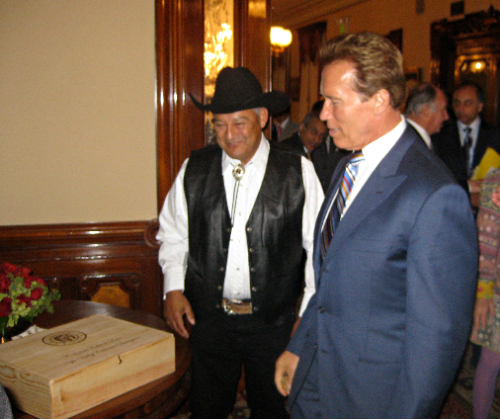
SACRAMENTO – Lake County wines received additional recognition Nov. 2 by being the exclusive wines poured at a state luncheon hosted by Gov. Arnold Schwarzenegger.
Ricardo Martinez, deputy director of the Environmental Protection Agency and personal advisor to the governor, has long been a fan of Reynaldo Robledo and his “rags to riches” story. Martinez was instrumental in getting the wines poured at the luncheon that was attended by over 70 state representatives, media and other dignitaries.
The Lake County wines that were poured include the 2008 Lake County Robledo Family Seven Brothers Sauvignon Blanc and the Robledo Family Red Hills Lake County Cabernet Sauvignon.
“This is such a great honor for me, my family and Lake County.” said Reynaldo Robledo “To come from such humble beginnings and to wind up pouring our wines for the California Governor is truly a dream come true.”
After the luncheon Robledo was on had to present to the governor a gift box containing special vintages from his winery.
Robledo’s accomplishments in the wine industry span four decades, and his story illustrates passion, commitment and dedication to the art of winemaking.
Reynaldo Robledo Sr. came to the United States in 1968, traveling from the state of Michoacán, Mexico. He started work in the fields the very next day.
Robledo overcame his humble beginnings as an immigrant field worker to become one of the most successful vineyard consultants and winery owners in California Wine Country.