 How to resolve AdBlock issue?
Business News
- Details
- Written by: Editor
With the Community Economic Resilience Fund, the Governor is proposing a robust investment program to provide direct support to regions across the state as they build strategies not only to recover from the economic hit of the COVID-19 pandemic but also lean into the transition to a carbon neutral economy.
The fund will provide direct planning grants to every region of the state to build collaboratives including business, labor, local and regional government, and community, to allow these stakeholders to work together to map regional strengths and opportunities and design Regional High Road Transition Strategies.
Building toward the High road includes investing in industries that will thrive in a carbon-neutral future, while creating high-quality jobs and clear pathways into those jobs, including for those often left out of traditional economic development strategies.
The bulk of fund dollars will focus on providing competitive grants for implementation of key elements of these strategies.
This major investment supports California’s diverse regions to succeed in the global transition to carbon neutrality and leverages infrastructure and workforce investments across the governor’s proposed budget.
These include not only investments in clean energy technologies and systems, but also in climate resilience projects that recognize that the state’s increasing impacts from climate events like wildfires and drought must be part of any sustainable economic strategy.
“Built on principles of job quality and sustainability, the Fund will address regional and economic inequality,” said Julie Su, Secretary for the Labor and Workforce Development Agency. “The governor’s proposed $750 million investment in the Community Economic Resilience Fund is a high road transition strategy that pays close attention to the needs and interests of workers and communities affected by the economic shock of the pandemic, globalization, automation and climate change.”
The fund will harness American Rescue Plan Act, or ARPA, dollars to equip the state’s diverse regions with the tools and financial support to ensure that COVID-19 recovery moves California toward a more sustainable, resilient, and inclusive future.
“California’s diverse and distinct regions and its entrepreneurial spirit have always been the foundation of our economic vitality and resilience,” said Dee Dee Myers, director of the Governor’s Office of Business and Economic Development. “This investment in our regional planning will set the table to further California’s competitiveness and ensure all our regions drive business and quality job growth for decades to come.”
The fund will support two major programs:
High Road Transition Collaboratives: Grants to each of California’s diverse regions to bring labor, business, and community together with local government, philanthropy, and education stakeholders to design the region’s inclusive and sustainable economic future.
High Road Transition Implementation Grants: Competitive grants awarded to regions on a rolling basis as their transition planning results in clear implementation strategies.
“Transitioning regional economies to meet a climate-resilient, carbon neutral, and equitable economic future requires bottom-up planning and implementation of high road economic growth strategies,” said Kate Gordon, director of the Governor’s Office of Planning and Research and the Governor’s Senior Policy Advisor on Climate. “This fund responds to that need in a way that recognizes and builds on existing industries, regional diversity, and current and emerging workforce.”
The California Comeback Plan outlines a comprehensive recovery package tackling the most persistent challenges facing California, including immediate relief for Californians recovering from the pandemic, which includes the largest state tax rebate in American history in the form of direct checks to Californians and the largest small business relief program in the nation; a $12 billion plan to tackle the homelessness crisis, the largest investment of its kind in California history; $20 billion in proposed investments to transform public schools into gateways for opportunity; and a $5.1 billion package supporting the state’s drought response and water infrastructure, improving the state’s resilience to climate change. Under Governor Newsom’s $100 billion plan, California will come roaring back from the Covid-19 pandemic.
- Details
- Written by: Editor
The EBBP is a temporary program being administered by the Federal Communications Commission.
It provides eligible new or current customers with up to $50 off their monthly internet service bill. Program eligibility is defined by the FCC.
“Mediacom’s participation in the FCC’s Emergency Broadband Benefit Program is one more way we ensure that reliable broadband is available to families and individuals who have been adversely affected by the COVID-19 pandemic,” said Mediacom Senior Vice President Ed Pardini. “In all Mediacom service areas, our team will encourage eligible individuals and families to use this temporary benefit to stay connected to loved ones, and to access online education, healthcare and employment resources.”
Enrollment for EBBP began May 12.
Those interested in the benefit must pre-qualify for the program through the National Verifier. After customers are verified, they may opt into the program by choosing Mediacom as the participating internet service provider. The monthly credit of up to $50, applies only to broadband services.
Information about the EBBP can be found online at the websites below or by calling 855-330-6918 (toll-free).
www.getemergencybroadband.org
www.fcc.gov/broadbandbenefit
www.mediacomcable.com/ebb
- Details
- Written by: Elizabeth Larson
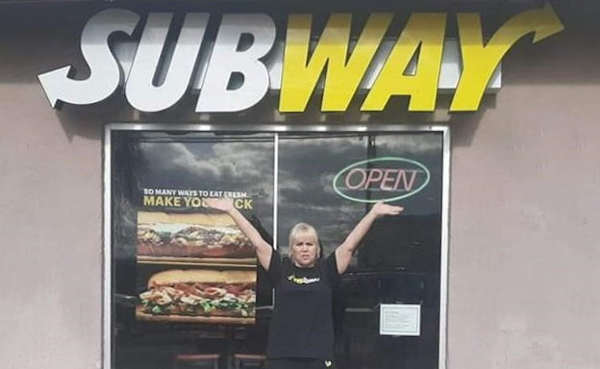
LUCERNE, Calif. – Across the country, news of restaurants closing for good due to the COVID-19 pandemic has been widespread.
Even as COVID challenges continue, Lucerne resident Cynthia Epperson has put it all on the line to own her first Subway franchise.
As a widow, mother and grandmother, Epperson never imagined she could own her own business. Living in a small town with a population of less than 3,000, there weren’t many job opportunities available. Epperson worked various roles throughout her life, including a teacher’s aide and a manager at Foster Freeze, the only other franchise restaurant in town.
When her husband passed away in 2011, she knew she needed to find a stable job to support herself. She applied to the local Subway restaurant down the street from her house and has been working there for the past 10 years. Epperson steadily worked her way up and was promoted to manager.
A few months before the pandemic, Epperson was given an exciting offer: the opportunity to take over the store, and own her first Subway franchise. She would work with mentors over the next several months to finalize the process. It felt like a dream.
Then the pandemic hit.
Like many throughout the country, Epperson was fearful of what COVID-19 would bring. The store she managed – but did not yet own – was forced to close initially to reassess its business plan. As manager, she was privy to the decline in sales and its effects on the store. Despite the uncertainty, Epperson pushed through and continued with her mission to own her first store.
“Purchasing a franchise during COVID was a huge leap of faith,” said Epperson. “With so many restaurants closing, I was afraid our store might be next. While I had my reservations initially, I felt this was a once-in-a-lifetime opportunity, and I needed to take advantage of it.”
Over the next several months, she worked closely with her district manager Himanshu Patel, the vice president of operations Alia Ganem, and her area development director and local franchisor Akki Patel, to advance the process of owning her own store. While she had no prior business experience, she felt very supported by the company and knew she was making the right decision.
“When they initially offered me the store, I thought they were crazy,” said Epperson. “I had no experience owning my own business, but Letap Group’s team have been very supportive throughout this whole process. Whenever I need anything, I can easily call Akki and he will send his best people to help, no expenses spared.”
“Cynthia is the perfect example of what we look for in a Subway franchisee,” said Akki Patel, president of Letap Group, which supports hundreds of locations throughout northern California and Nevada, and also is a franchisor for Subway. “She is hard working, determined and is following her dream. While she’s been dealt a difficult first hand, we know Cynthia has what it takes to adapt and persevere through the pandemic.”
The Letap Group and Subway have been helping first time franchisee buyers and store managers achieve the American dream of owning their own business for the past 16 years. Akki Patel, who bought his first Subway franchise at the age of 20, leverages his life lessons and can-do spirit into helping others build their own businesses; providing business counseling, financing, training and operational support as they launch within the Subway family.
“Every year I personally meet with qualified managers at each Subway franchise to present them the opportunity to own their own business,” said Akki Patel. “Many of them are content with their current jobs but a few, like Cynthia, seize the opportunity to become a successful business owner and achieve their dreams.”
As manager, Epperson worked tirelessly with her team to keep the store afloat as sales declined from pre-pandemic levels. She was able to successfully keep all of her staff on board by changing the store hours and adjusting schedules around individual needs. Today, sales at the store are up close to 20 percent from her most difficult months, and Cynthia sees increasing signs of growth.
In December 2020, Epperson officially became the new owner of the Lucerne Subway franchise. While she hasn’t owned the store for very long, she has already started thinking about the future.
“Everything that I am doing, I am doing for my family,” said Epperson. “As a mother and grandmother, I want to make sure that I am setting my family up for success, and I have the ability to do that now. I know they are proud of me and I hope to make them proud by leaving this legacy behind for them.”
Epperson’s Subway store is located at 6272 E Highway 20 in Lucerne. It’s open from 10 a.m. to 8 p.m. daily.
- Details
- Written by: Elizabeth Larson
The board is composed of 12 voting members, each representing an establishment with a valid California License to Sell Nursery Stock. No two members shall represent the same organization.
Members will represent a wide spectrum of the nursery industry, and the Board will be geographically representative of the nursery industry in California.
The term of office for board members is four years. These positions are mid-term appointments and the terms end on Jan. 31, 2025.
Members typically meet twice per year, but can meet more frequently if needed. The members receive no compensation but are entitled to payment of necessary traveling expenses in accordance with the rules of the California Department of Human Resources.
In addition, the board includes up to nine nonvoting ex officio members from the County Agricultural Commissioner and Sealers Association, the University of California, and groups affiliated with the nursery industry.
The mission of the Nursery Advisory Board is to grow and maintain a strong relationship between CDFA and the nursery industry in order to secure the industry’s future. The board facilitates communication between state and federal regulators and the nursery industry, and it advises CDFA’s Nursery Services Program on policies, fees, and other issues concerning nurseries and nursery stock.
Individuals interested in being considered for this Board appointment should send a brief resumé to Board Manager Juan Koponen by May 17 at California Department of Food and Agriculture, Pest Exclusion Branch, 1220 N St., Room 344, Sacramento, CA 95814, Attention: Juan Koponen.
For additional information, you may contact the Nursery Services Program at 916-654-0435.