 How to resolve AdBlock issue?
Business News
- Details
- Written by: California Department of Food and Agriculture
Funds awarded through this competitive grant process will be distributed to Resource Conservation Districts, the University of California Cooperative Extension, and nonprofit organizations with demonstrated technical expertise in designing and implementing agricultural management practices to support CDFA’s 2019 CSA incentive programs.
Eligible organizations may request up to $120,000 to provide technical assistance to applicants and awardees of the 2019 Alternative Manure Management Program and the 2019 Healthy Soils Program.
A description of the technical assistance program and links to the application materials can be found at https://www.cdfa.ca.gov/oefi/technical/index.html . Applications are due Aug. 30 at 5 p.m. PT. Late applications will not be accepted.
“Our technical assistance partners have proven so valuable to the success of the Climate Smart Agriculture Programs,” said CDFA Secretary Karen Ross, “I’m pleased we can expand their roles, continue to use their expertise and provide ongoing technical assistance for three years to farmers and ranchers in California.”
- Details
- Written by: Elizabeth Larson
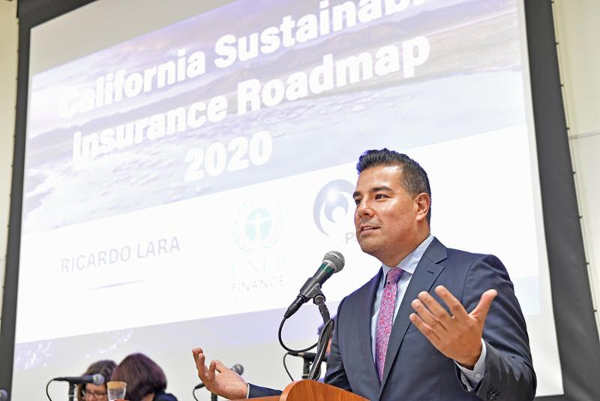
LOS ANGELES – The California Department of Insurance and the United Nations Environment Program have launched a yearlong effort to develop a Sustainable Insurance Roadmap to confront California’s climate risks.
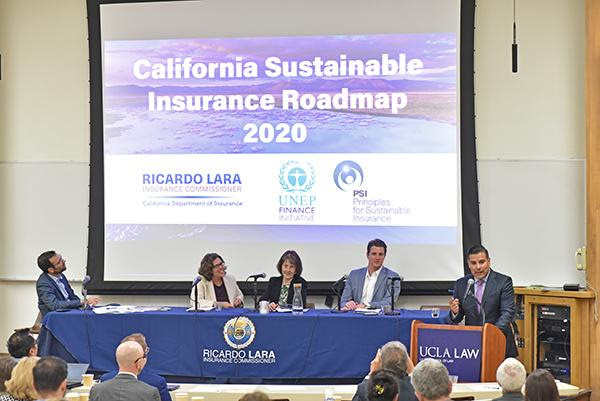
Insurance Commissioner Ricardo Lara and Butch Bacani, who leads U.N. Environment’s Principles for Sustainable Insurance, or PSI – the largest collaboration between the United Nations and the insurance industry – announced the groundbreaking initiative at a roundtable co-hosted with the UCLA School of Law and UC Berkeley School of Law on Tuesday.
This is the first time the United Nations has partnered with an American state to create a sustainable insurance strategy and action plan that would tackle the growing risks of climate change.
Last year, California experienced the deadliest and most destructive wildfires in the state’s history, resulting in more than $12 billion in insured losses, making it the world’s costliest disaster.
“We have a historic opportunity to utilize insurance markets to protect Californians from the threat of climate change, including rising sea levels, extreme heat and wildfires,” said Insurance Commissioner Ricardo Lara. “Working with the United Nations, we can keep California at the forefront of reducing risks while promoting sustainable investments.”
“A sustainable insurance roadmap will enable California to harness risk reduction measures, insurance solutions, and investments by the insurance industry in order to build safer, disaster-resilient communities, and accelerate the transition to a low-carbon, sustainable economy,” said U.N. PSI leader Butch Bacani. “With Commissioner Lara’s vision and leadership, we look forward to working together with insurers and key stakeholders to drive ambitious climate action now, in line with the aims of the Paris Agreement on Climate Change.”
California is the largest insurance market in the U.S., and one of the largest in the world. The California Department of Insurance was one of the first insurance regulatory and supervisory authorities in the world to sign U.N. Environment’s Principles for Sustainable Insurance and commit to tackling global sustainability challenges such as climate change, biodiversity loss and ecosystem degradation, pollution, and social and financial exclusion.
The California Sustainable Insurance Roadmap is envisioned to pave the way for innovative risk management, insurance and investment solutions that reduce climate risks and protect natural ecosystems. For example, new insurance products could be developed to promote cooler streets and renewable energy.
In other countries, insurance solutions for coral reefs and mangroves are emerging as these natural ecosystems have been proven to significantly reduce wave energy and buffer storm surge, reducing flood risk and protecting communities.
In this vein, insurance solutions for California’s protective, life-supporting natural infrastructure – such as wetlands and forests – could reduce climate and disaster risk and present new opportunities.
The latest report of the Intergovernmental Panel on Climate Change highlights the rapid, far-reaching and unprecedented changes needed to limit global warming to 1.5°C. It shows that every extra bit of warming matters, and that warming of 1.5ºC or higher increases the risk associated with long-lasting or irreversible changes, such as the loss of some ecosystems.
Moreover, the latest report of the Intergovernmental Science-Policy Platform on Biodiversity and Ecosystem Services finds that around 1 million animal and plant species are now threatened with extinction, many within decades, more than ever before in human history.
The California Department of Insurance and U.N. Environment’s PSI Initiative will engage insurers and reinsurers, public policy leaders, environmental NGOs, researchers, and risk management experts on this major collaborative effort to make California’s communities and economies resilient, inclusive and sustainable.
- Details
- Written by: Elizabeth Larson
Accompanying the letters are questionnaires to be returned to the CDFA by Aug. 31 in order to verify commodities grown, determine whether annual sales qualify farms for a PSR exemption, and to help prioritize future inspections.
The current stage of inspections to verify PSR compliance has been taking place since April for “large” farms.
“California has many more produce farms than any other state in the nation,” said CDFA Secretary Karen Ross. “Approximately 20,000 farms in the Golden State will now be subject to new food safety regulations under the Produce Safety Rule.”
PSR regulations include ensuring produce is properly handled by workers, that farm equipment is sanitary, that produce is grown with safe soil inputs, and that measures are in place to prevent contamination of produce by wildlife or domesticated animals.
These regulations are similar to food safety plans that many farmers have been implementing for years, and that most grocery stores and restaurants already require. However, the Produce Safety Rule now makes food safety on farms federal law.
To help implement the PSR, CDFA created the Produce Safety Program, or PSP, to educate farmers and then conduct on-farm inspections on behalf of the U.S. Food and Drug Administration.
PSP farmer education resources include a website, a Facebook page and an e-newsletter. Website features include the ability to schedule an On-Farm Readiness Review, and to register for a Produce Safety Rule Grower Training Course.
This course is mandatory for at least one employee of every produce farm covered under the new regulations and is the best way for farmers to learn about required food safety practices.
In the current PSR stage:
• Inspections are under way for “large” produce farms with average annual sales of $500,000 or greater during the previous three-year period.
• “Small” farms with average annual sales of $250,000 to $500,000 during the previous three-year period are now expected to be in PSR compliance, with inspections set to begin in January 2020.
• “Very small” farms with average annual sales of $25,000 to $250,000 during the previous three-year period must be in general compliance by January 2020, with inspections set to begin in January 2021.
Any farm that does not comply with the Produce Safety Rule may face economic, regulatory and legal consequences.
Minor violations will be handled through on-site education, in line with an “Educate Then Regulate” commitment.
However, if there is significant and imminent threat to public health, a PSP inspector will inform the FDA and the California Department of Public Health, which may perform accelerated on-farm follow-up inspections or administrative detention orders up to and including seizure of the product that could cause people to get sick.
Visit www.cdfa.ca.gov/producesafety.
- Details
- Written by: Elizabeth Larson
Sen. Catherine Cortez Masto (D-NV) introduced the companion bill in the Senate.
“Clean energy is our future – a crucial part of deploying green energy that creates jobs, reduces our dependence on foreign energy sources, improves our environment. That’s why I am proud to introduce the Renewable Energy Extension Act, a bill to extend the energy investment tax credit at 30 percent for five years,” said Thompson. “This tax credit is a key part of increasing the use of clean energy technologies and it helps our environment. And we know it works, the ITC produced billions in investment last year alone and I’m proud to introduce this important bill to help green our tax code today.”
“I’m pleased to cosponsor the Renewable Energy Extension Act. This legislation will create jobs, encourage investment in our economy, and it’s good for the environment,” said Cook. “I look forward to working with Congressman Thompson to advance this bipartisan issue.”
“Clean energy presents an enormous opportunity to grow our economy, reduce carbon emissions, and bolster our national security,” said Fitzpatrick. “Entrepreneurship in clean energy must be incentivized for these reasons, and I strongly support enhanced investment in the clean energy sector to promote American prosperity.”
Under current law, several provisions of the ITC begin to phase out at the end of this year and 2019 is the last year that both residential and commercial renewable energy projects can take advantage of the ITC’s full 30 percent value before it steps down to 10 percent in 2022 for commercial and utility projects, as well as residential systems owned by companies.
Without the ITC’s extension, the credit drops to zero for residential installations owned by homeowners in 2022.
The Renewable Energy Extension Act would provide a five-year extension of the current law Section 48 business energy investment tax credit and 25D tax credit for residential energy efficient property. This includes technologies related to solar, fuel cells, geothermal and microturbines.
“Protecting the environment is good for our health and our economy. These tax incentives help us achieve these goals by increasing commercial and residential solar use, reducing carbon emissions, and creating good-paying jobs,” said Sen. Cortez Masto. “My legislation would ensure that Nevada remains a national leader in solar energy and that companies continue to make strong investments in solar energy and innovation for years to come.”
The solar industry alone generated a $17 billion investment in the American economy in 2018 and employs over 240,000 workers nationwide. Because of these credits, solar energy has averaged 50 percent annual growth for a decade.
Thompson represents California’s Fifth Congressional District, which includes all or part of Contra Costa, Lake, Napa, Solano and Sonoma counties