
Business News
WASHINGTON, DC – Agriculture Secretary Sonny Perdue announced that the United State Department of Agriculture continues to invest in rural America with more than $4.8 billion in payments being made, starting this month, to agricultural producers through the Farm Service Agency’s Agriculture Risk Coverage (ARC), Price Loss Coverage (PLC) and Conservation Reserve (CRP) programs.
Approximately $3 billion in payments will be made under the ARC and PLC programs for the 2017 crop year, and approximately $1.8 billion in annual rental payments under CRP for 2018.
“Despite a temporary lapse of Farm Bill authorities, farmers and ranchers can rest assured that USDA continues to work within the letter of the law to deliver much needed farm safety net, conservation, disaster recovery, and trade assistance program payments,” said Perdue.
The ARC and PLC programs were authorized by the 2014 Farm Bill and make up a portion of the agricultural safety net to producers when they experience a substantial drop in revenue or prices for their covered commodities.
“These program payments are mandated by Congress, but the Department has taken measures to ensure we meet our deadlines and get capital in the hands of those folks that need it most. Unfortunately, 2018 has proven to be another tough year for producers across the Nation, making the timeliness even more critical. Our resilient farmers, ranchers, and producers are battling more hurricanes, wildfires, droughts, floods, and even lava flows,” said Perdue.
PLC payments have triggered for 2017 barley, canola, corn, grain sorghum, wheat and other crops. In the next few months payments will be triggered for rice, chickpeas, sunflower seeds, flaxseed, mustard seed, rapeseed, safflower, crambe, and sesame seed.
Producers with bases enrolled in ARC for 2017 crops can visit www.fsa.usda.gov/arc-plc for updated crop yields, prices, revenue and payment rates.
The estimated payments are before application of sequestration and other reductions and limits, including adjusted gross income limits and payment limitations.
Also, this week, USDA will begin issuing 2018 CRP payments to over 362,000 landowners to support voluntary conservation efforts on private lands. “CRP has long been a useful tool for the Department to encourage farmers to take that environmentally-sensitive, more unproductive land, out of production and build-up their natural resource base. These CRP payments are meant to help encourage land stewardship and help support an operation’s bottom line,” said Perdue.
Approximately $3 billion in payments will be made under the ARC and PLC programs for the 2017 crop year, and approximately $1.8 billion in annual rental payments under CRP for 2018.
“Despite a temporary lapse of Farm Bill authorities, farmers and ranchers can rest assured that USDA continues to work within the letter of the law to deliver much needed farm safety net, conservation, disaster recovery, and trade assistance program payments,” said Perdue.
The ARC and PLC programs were authorized by the 2014 Farm Bill and make up a portion of the agricultural safety net to producers when they experience a substantial drop in revenue or prices for their covered commodities.
“These program payments are mandated by Congress, but the Department has taken measures to ensure we meet our deadlines and get capital in the hands of those folks that need it most. Unfortunately, 2018 has proven to be another tough year for producers across the Nation, making the timeliness even more critical. Our resilient farmers, ranchers, and producers are battling more hurricanes, wildfires, droughts, floods, and even lava flows,” said Perdue.
PLC payments have triggered for 2017 barley, canola, corn, grain sorghum, wheat and other crops. In the next few months payments will be triggered for rice, chickpeas, sunflower seeds, flaxseed, mustard seed, rapeseed, safflower, crambe, and sesame seed.
Producers with bases enrolled in ARC for 2017 crops can visit www.fsa.usda.gov/arc-plc for updated crop yields, prices, revenue and payment rates.
The estimated payments are before application of sequestration and other reductions and limits, including adjusted gross income limits and payment limitations.
Also, this week, USDA will begin issuing 2018 CRP payments to over 362,000 landowners to support voluntary conservation efforts on private lands. “CRP has long been a useful tool for the Department to encourage farmers to take that environmentally-sensitive, more unproductive land, out of production and build-up their natural resource base. These CRP payments are meant to help encourage land stewardship and help support an operation’s bottom line,” said Perdue.
- Details
- Written by: United State Department of Agriculture
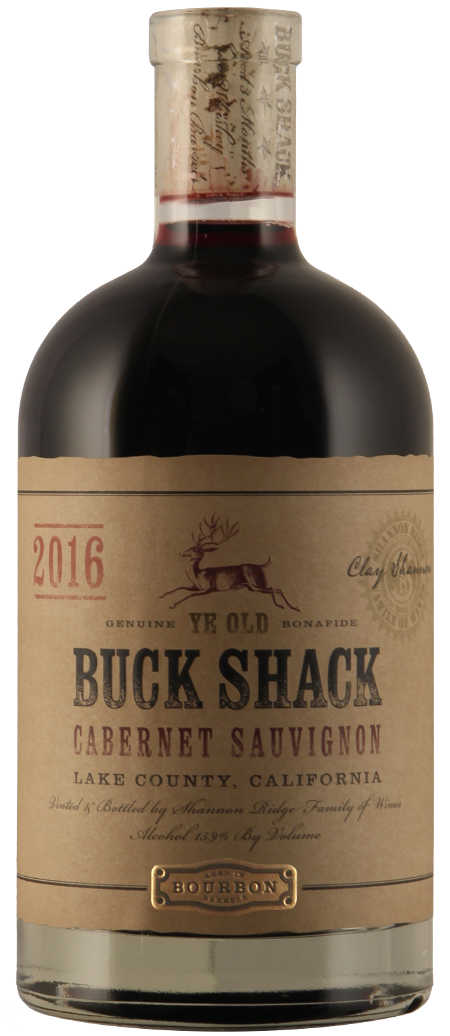
LOWER LAKE, Calif. – Shannon Ridge Family of Wines has announced the release of its 2016 Buck Shack Bourbon Barrel Cabernet Sauvignon.
Grown in Lake County, the 100-percent Cabernet Sauvignon was first aged in traditional French and American oak barrels for 15 months, followed by 3 months in freshly emptied, or “wet” Kentucky Bourbon barrels. The wine was then bottled in a clear bourbon/whiskey bottle and sealed with a custom made cork.
"We thought aging our Cabernet Sauvignon in bourbon barrels was a perfect fit for our Buck Shack brand," said Clay Shannon, owner of Shannon Ridge Family of Wines. "The Buck Shack is a 100-year-old deer-skinning shed, discovered on our property when we were clearing land for a vineyard. We restored it and converted it into a whiskey bar on our property we call Sheep Camp."
Four thousand cases were produced, with a retail price of $24. The wine is currently being rolled out nationwide.
The Shannon Ridge Family of Wines portfolio includes Buck Shack, Cross Springs, Dalliance, High Valley, Playtime, Vigilance, Shannon Ridge and Shannon Reserve.
- Details
- Written by: Shannon Ridge Family of Wines





 How to resolve AdBlock issue?