
Opinion
There are rejected but tame kittens and cats that wind up at the pound. They can make good house pets. Then, there are stray or “community” cats that are actually tame, not feral, and they can make good pets or good barn cats. And, the feral cats can also make good barn cats, or just outdoor cats that keep down the rodents.
In April I went to Animal Control to get a license for Zeus, my Great Dane. I couldn't resist, so I took a peek at the cat room. I wound up leaving with a wonderful 5-month-old Lynx Point Siamese that had no business being at the pound. She had actually been adopted once and then returned to the pound. She is beautiful and sweet, though feisty, and has made a good adjustment to our home and our other dogs and cats. She was and remains healthy. I was sad that I couldn’t save all the kittens there.
I urge people to consider adopting a cat from the pound. It is located in an out-of-the-way location off of Hill Road next to the county jail, which is unfortunate. Animal Care and Control could place a lot more cats if they took them out into the community, like they do elsewhere.
For instance, Rainbow Ag in Ukiah has cages with kittens from the Mendocino pound, and also from private rescue organizations. I once adopted two kittens from there, just because they caught my eye when I was shopping. Perhaps Rainbow Ag and other places in Lake County would be willing to showcase pound kittens and cats.
Concerning feral and stray cats, Lake County clearly needs to organize a TNR (trap, neuter, release) program. There are plenty of people willing to feed feral colonies, and plenty of rats, mice, gophers and voles for them to eat. (Yes, the occasional bird too, but such is life.)
According to veterinarian Richard Bachman, director of Veterinary Services for Contra Costa County, there are numerous successful models of TNR, usually combined with vaccinating for rabies and “tipping” the cats' ear so they can be easily identified as sterile, and studies show a decrease in feral and community cat populations when such models are used.
Besides the love and companionship, many of us cat lovers like having cats around in the country to keep rodents under control. Rodents attract rattlesnakes, so having cats also keeps the rattlers away, and if one shows up, a cat is a good early warning device (you’ll hear the rattlesnake rattle as the cat stalks it), and, more often than not, a cat will kill a rattlesnake before it can strike.
Of course, rats can really wreak havoc and devastate the human population. Rats transmit over 20 diseases to humans, including bubonic plague, a dread disease that thins the rat population when it exceeds the available food supply.
We need to learn from history. In the Middle Ages, cats were commonly blamed for everything, thought to be witches, and millions were murdered. As a result, the rodent population surged out of control. In the 14th century, following widespread superstitious destruction of cats and their near-extinction, rats proliferated and bubonic plague (“Black Death”) decimated the population of Europe, killing more than one-third (possibly even two-thirds) of the people, but generally sparing those households with cats.
We shouldn't return to Ancient Egypt's death penalty for killing a cat, but the Board of Supervisors should take steps to adopt more cats and prohibit the killing of healthy feral cats, and initiate a trap, neuter, release program instead of exterminating the feral cats.
Neuter and feed the stray and feral cats, but let them roam and destroy their share of rats, mice and other rodents. Respect the cats – they're among our best friends.
Ron Green is an attorney who lives in Lower Lake, Calif.
- Details
- Written by: Ron Green
Despite the lack of information, direction and decisions from the state of California regarding education funding, our local school districts are working hard to develop balanced budgets that meet the state-prescribed criteria and time lines.
Local school boards, administration and staff continue to work together to develop “plan for the worst, hope for the best” scenarios to provide the very best education for each and every student in Lake County, while remaining fiscally solvent during these difficult economic times.
A major difficulty expressed by local educators is the lack of timely information which would enable them to make informed decisions regarding education funding and budget development.
Most concerns revolve around three basic issues:
1. Continued decrease of the COLA and ongoing increases in the deficit factor.
2. Increase in the number and amount of deferrals of funding apportionments.
3. Tax extensions … “The big unknown” … yes, no, how much and when?
COLA and the deficit factor
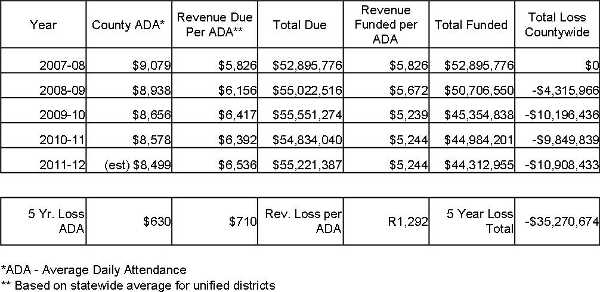
Over the past few years the education dollars have been greatly impacted by lagging cost of living adjustments and an increasing deficit factor (a percentage by which an allocation of funds is reduced until the state’s economy recovers, and then the amount would theoretically be restored).
The cumulative effect of these two factors – along with a decline in student enrollment in Lake County Schools – have resulted in significantly less money per child now than we had five years ago, as reflected in the table in Figure 1. At the same time, health benefits, goods and materials, fuel and food costs continue to climb.
Deferrals
The state continues to increase the amount and number of deferrals. Deferrals don’t necessarily increase or decrease the funding for education. Deferrals simply put off a portion of payment or funds to a later date. This is similar to Wimpey’s deal, “I will gladly pay you next Tuesday for a hamburger today.”
Imagine having an annual salary of $36,000 and budgeting and planning to pay your monthly bills based on $3,000 per month. Then you are told that your monthly paycheck is being held until sometime next year. You are still responsible for your rent/mortgage, utilities, food and other monthly bills.
In an effort to pay your bills, you exhaust your savings to meet your financial obligations. Two months later you are told again that your paycheck is being “deferred” to next year. Now you need to secure a loan to meet your monthly obligations and to pay the interest fees as well.
This is the situation faced by our school districts in Lake County and across the state.
According to the Governor’s proposed “May Revise,” It is anticipated that Lake County schools will have over $14,896,205 in “deferrals” from the 2011-12 school year to the 2012-13 school year.
Recent news releases report that education can expect an additional $3 billion statewide in funding, if the proposed budget is approved.
Unfortunately, this does not mean new dollars for education. If the budget is approved as proposed, it would reduce the impact of deferrals and help hold funding levels close to last year … if, and only if, the tax extensions are agreed to by voters.
Tax extensions
Proposed tax extensions are the “big unknown” for local educators. Tax extensions are a significant piece of the proposed budget.
A balanced state budget depends on resources from existing taxes to be extended through the 2011-12 school year. This requires voter approval and cannot be counted on until the public decides “yes or no.”
If the voters turn down tax extensions, the effect on education funding will be significant, resulting in even greater reductions.
Projections related to an “all cuts budget” may result in an additional $350 per student in further reductions. Reductions of this significance will cause local boards and administrators to grapple with reductions far beyond what has been considered “the worst case scenario.”
Summary
While budget concerns are certainly a huge issue for our local school districts, we continue to maintain our focus on serving and educating our students with dedication and compassion.
We will strive to keep cuts away from the classroom and continue to investigate strategies to be more efficient and cost effective.
We continue to be grateful and appreciative of the tremendous support for education by parents, community members and service groups.
Together we will successfully and creatively provide the best possible education for each and every one of our students in Lake County.
Thank you for your continued support.
Wally Holbrook is superintendent of schools for Lake County, Calif.
- Details
- Written by: Wally Holbrook



 How to resolve AdBlock issue?