 How to resolve AdBlock issue?
Opinion
- Details
- Written by: Sheriff Rodney K. Mitchell
In 29 years of law enforcement I have never seen an incident generate so much discussion, and consequently, so much concern for many citizens. The only problem with the discussion is that much of it has revolved around inaccurate sound-bites that served to evoke an emotional response. Even the most supportive citizen can become concerned when this kind of information is circulated repeatedly without confirmation of – or challenge to – its accuracy.
Of course, this department could do neither before the matter was resolved in the court. Now that the Dinius case has concluded, I want to assure that the public has accurate answers to their questions about this department’s involvement in the investigation.
It is my intention to release this department’s entire case file as a PDF on our Web site for the public’s review. Obviously very few citizens will have the time to read through a voluminous record like this. But those same people may have important questions about their Sheriff’s Department’s role in the investigation and they deserve answers to those questions. It will take a few days to get the PDF created but I will have it posted the moment that it is ready.
On Aug. 18, as closing arguments were being made in the Dinius case, I began coordinating with three people to assist with collecting questions from the public. The reason for using outside parties to collect and sort the questions is to allay concerns that we would choose only the questions to which we prefer to respond. This working group will include:
Elizabeth Larson, Editor and Publisher of www.lakeconews.com : I have asked Elizabeth to chair this committee because she is well known for being an unbiased collector of facts.
Phil Murphy, pear farmer from Kelseyville: I have asked Phil to serve on this committee because he is known as a citizen with a strong will, and a healthy skepticism of many aspects of government – including me and my department.
Helen Whitney, former county supervisor from District 1 and community volunteer: Helen is known as a fair and independent person who truly cares about this county and I wanted to assure that the south county was represented in this working group too.
This committee will review the questions to assure that they are relevant to our department. They will also synthesize multiple questions about the same topic or issue and assure that the questions represent the scope and the breadth of our involvement in this case.
Please send your questions to:
It is my duty to take every step necessary to fulfill our mission – SECURE THE PUBLIC’S TRUST. Transparency is an important part of that process. It is also my obligation to ensure that the members of this department are able to function effectively. They are both community members and service providers who must operate secure in the knowledge that the general public maintains confidence in them.
As a person who has responded to many tragedies, I know the impact that they can have on all parties involved.
Public safety officers often conduct a “debriefing” after a critical incident. This is a process of providing clarity where there are questions and healing where there are wounds. Asking and answering questions is a very important part of that process.
The fatal boat crash was a tragedy for all parties involved and for the many people who know and love them. The aftermath of this particular tragedy has made this a critical incident for the broader community as well.
Through this process we are inviting you to participate in a community wide debriefing of this critical incident and I look forward to the opportunity to answer your questions.
Rodney K. Mitchell is Lake County's sheriff, coroner and Office of Emergency Services director.
- Details
- Written by: Dr. William MacDougall
This also has to be the charge of our community. We need to make sure that we give our children our time, energy and support.
The local service clubs have been very generous to our youth and have made them as a priority. Many adults in our neighborhoods have provided assistance to the our youth through Youth Football, the South Shore Little League, the Konocti Basketball League, Youth Soccer, The Boy Scouts, Girl Scouts, FFA, clogging classes, the skate park and church youth groups through their church – just to name a few.
These are the activities that create wonderful memories and help our children grow. We need to continue these efforts more than ever because “every kid counts.”
The Konocti Unified School District has embarked upon a concept of “neighborhood schools.” These schools are the “hub” of their neighborhoods providing intellectual enrichment and assistance to our kids, as well as, athletics, music, art and family activities.
Our budget is balanced and we have kept our dedicated teachers and support staff. We have the maintained our small class sizes in kindergarten, first, second and third grades. We have preserved our classroom music program in the primary grades and the band and drama programs for seventh and eighth graders.
The After School Opportunity programs will still be available to for students needing academic assistance. We have planned a full intramural athletic program that will involve more students than ever before and include county-wide competitions. We’ve done this because “every kid counts.”
Our children deserve the best experience that our community can provide. We need our parents, grandparents, foster parents and caregivers to make sure that their kid makes it to school daily. This is a key to making sure our kids get what they need.
Good attendance means missing no more than one day per month or being present at least 95 percent of the time. National research proves that less than 95 percent attendance is the break point at which a student starts to fall behind and disparities in learning begin to appear.
If our students don’t have good attendance, they miss out and so do the schools which lose the funding needed to continue the programs. We took the chance, kept the programs and we are counting on our kids coming to school.
We are all connected. If the students don’t come to school, we lose the programs. If we lose the programs, people will be less inclined to move into our community or they will leave to communities that have more to offer. If people leave, our businesses cannot prosper.
We are tied together and we can either do what it takes to create neighborhoods and communities that flourish or we can watch the whole thing slowly fall apart.
I love this community. It has given me the opportunity to serve others and has given me a clear purpose in life. The friends and family I have made here over the past 20 years are the most valued things in my life. This community has taught me that helping others flourish is tremendously important and satisfying.
Let’s join together, volunteer at a school, help a kid, and in turn, help yourself because we know that every kid counts.
Dr. William R. MacDougall, Ed.D., is in his first year as Konocti Unified School District's superintendent. He writes periodic updates with community members to let them know the state of the district.
- Details
- Written by: Gabby Fellows
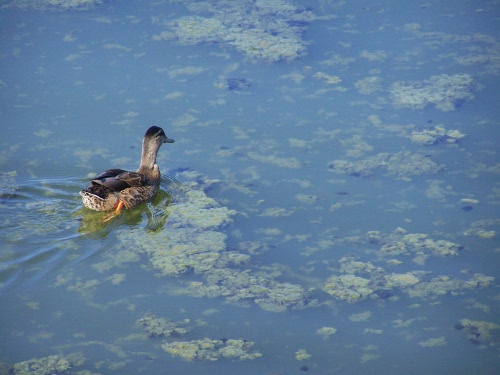
Our lake, formally known as “Clear,” has recently gained “celebrity status” attention from Bay Area reporters inspecting our Cyanobacteria pandemic with their refined scope of discernment.
Local residents rant and rave when corporate media moguls exploit a good story at the cost of tarnishing Lake County’s public relation’s image.
Locals do not like headlines from news stations miles and miles away such as “toxic algae blooms” displayed across their computer or television screens.
When a corporate branded reporter hunts down and seeks out a good lead, they don’t usually consider the issue’s ramifications on the general populous.
They see the story as a great gem they found covered in mud.
Once taken back to the “studio” and polished, it’ll be turned into a diamond that’ll impress their bosses and shareholders and allow them to make their next BMW payment.
Don’t bother complaining about the “out-of-county” reporter’s spin on this local story.
If you have to waste the effort and place blame somewhere, try blaming the people interviewed by these vultures who were the ones that tipped them off to the story in the first place.
Those big city suits preyed on us and used our information, spitting us back out with a smug look on their face, knowing our simple minds wouldn’t realize the mess our need for attention had created until it was too late.
First reported on by the Press Democrat on Aug. 9 as a “Stinky mess along Clear Lake’s south shore,” CBS 5 in San Francisco ran with the story and turned it into a typical corporate media news package on Aug. 12, varnished on the surface by a catchy buzz word such as “toxic” to entice and sell the reader.
What else could we expect from a news outlet controlled indirectly by one of the six corporations that owns the rest of the electronic mediums we flock to in order to find our “news”?
Their motive for writing stories is the same as their bottom line: Profit.
The only people their bosses care about and need to impress are the shareholders.
KPIX is a CBS affiliate owned by Westinghouse Inc.
CBS is a publicly traded stock on the NYSE that is currently being traded at $10.55 a share. Their first quarter profit for 2009 was $3.2 billion.
Jeffrey Schaub, CBS 5 Greenbeat reporter, referred to all Lake County residents at the end of his piece as “those people” when attempting to correct his assessment of the situation.
The other clown-faced anchors merely bobbed their heads and said “those poor resort owners.”
Indeed, we should all be upset and feel sympathy for the lake shore business community, especially on the south end of the lake, that have been affected negatively from this ancient environment condition.
But what about the rest of the population that resides in this county of lake that doesn’t own a business? Doesn’t this issue affect them as well?
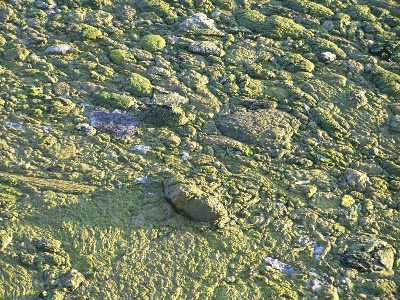
Is the drinking water safe?
The water supply seems to be the most important natural resource that could possibility be impacted by this problem.
Aside from the obvious negative impact to the tourism industry, this problem is making the environment unpleasant to live in for local residents and the water unfit for swimming and other lake related recreational activities.
In a press release published back in June, our government representatives declared the water unsafe to drink. County Health Officer Dr. Karen Tait advised people to stay away from areas with visible algae mats and not drink the water.
However, there was a distinction made between raw water and treated water running out of the pipes.
On face value, the general population that drinks and bathes with this water on a regular basis is supposed to trust our water companies and believe that they are doing the best they can in adhering to state standards.
One would think these companies would want to reassure their customers that their product is safe and healthy for human consumption.
There are three water companies that do business in the Clearlake community: Highlands Water Co., Konocti County Water Co. and Golden State.
None of them wished to speak about the quality of product they were selling to our local constituency.
However one of them, Golden State Water Co., actually scheduled an open house for Tuesday, Aug. 25, to discuss their general operations and “water quality” after being probed on the issue.
What we do know is very little about the treatment process our drinking water undergoes before reaching our lips.
Inside sources at Highlands Water Co., who requested anonymity, attempted to explain the treatment process for the raw water that is pumped out of Clearlake for treatment at their plant.
This source explained that when the pipeline transports the water from Beakbane Island to the Highlands treatment facility, the turbidity level is 11.68 percent.
After being treated, our drinking water’s turbidity level is reduced to 0.07 percent, which is significantly lower than the state’s 0.3 percent standard.
Turbidity merely refers to the clarity and clearness of the water before and after treatment.
There are several steps involved in the entire treatment process such as filtration through clarifiers with ozone, carbon filters and a final chlorine dose.
Potassium permanganate is also added during the process to aid in treating the algal cells present in the raw water.
This inorganic chemical compound can be purchased at pool supply stores and has historically been used to disinfect drinking water and to remove that “rotten egg” smell from well and wastewater.
Since the other two companies declined comment, we can merely assume that the entire treatment process all our drinking water undergoes is affectively “disinfecting” and killing all algal cells in our drinking water.
Although temporary solutions have already been enacted, such as breaking up the mats with various machinery, the county’s Web site details the most important long-term solution that needs to be addressed:
“Working in cooperation with the State Department of Water Resources and the University of California, Lake County officials completed studies that have shown there is an over-abundance of nutrients (food for the algae) within the lake. Because the lake is so large, spraying algae to reduce nuisance conditions is not a practical long-term solution. Reduction of lake nutrient levels is anticipated to reduce the quantities of nuisance, blue-green algae.”
The county recognizes that excessive nutrient levels in the lake are the main contributing factor causing the excessive algal blooms this season and are "anticipating" that in the future they might attempt to reduce nutrient levels.
How this feat will be carried out and what caused these excessive nutrient levels are questions left unanswered.
Two town hall meetings have already taken place down at Clearlake City Hall within the last two months. Economic and environmental concerns arising from the cyanobacteria problem were subjects of concern.
The next public forum addressing the issue will take place Monday, Aug. 31, at 6 p.m. at the Main Street Bar and Grill.
Joyce Overton, Dian Gibson and 15 residents will dine, discuss and conduct the first of hopefully a series of algae volunteer committee meetings aimed at creating an open dialogue about the problem, as well as encouraging possible long-term solutions.
An anonymous poster on this very site named “Ray” responded to an earlier commentary on the issue stating: “This is the greatest lake west of the Mississippi. Like a wife she’s not consistent, but you have to support her.”
Indeed, we must support our lake and her natural beauty for it makes all of us look good to the outside world.
Instead of blaming the out-of-county press for making us look bad, we should concentrate our efforts on fixing the problem and giving our tourists something to brag about.
Gabby Fellows is a freelance journalist from Humboldt County. She can be reached by e-mail at
- Details
- Written by: Steven Hajik
In response to the recent article submitted by the Lake County Public Works Department concerning the quagga and zebra mussels, there were several inaccuracies and expectations that need to be addressed.
Although Tthe California Department of Food and Agriculture (CDFA) assigned these quagga and zebra invasive mussels an “A” rating, however, it doesn’t change the current roles of the CDFA and the Lake County Agricultural Commissioner (LCAC) concerning these pests. The rating simply recognizes that these two mussels are harmful invasive species. The rating is merely a policy statement;, it carries no legal authority to take action. It signifies that an organism is of known economic importance that is not yet known to be established permanently in the state. Because neither species is a direct pest to agriculture, regulatory or other action does not fall under our jurisdictions.
Prohibition of the entry into the state of quagga and zebra mussels is authorized under the California Fish and Game Code and both species are named as prohibited species in its Fish and Game regulations. Accordingly, the California Department of Fish and Game (DFG) Department has been, and continues to be, the lead enforcement agency concerning the quagga and zebra mussels.
The CDFA collaborates with the DFA by enforcing its regulations by inspecting incoming boats at its border protection stations and taking action if either mussel is found to be present still needs to be granted authority by Fish and Game to enforce any regulations beyond the current inspections they perform at the borders. The LCAC would do the same if either mussel was found during its regular inspection activities.
According to Fish and Game regulations, the CDFA will continue to inspect watercraft coming into California at the border stations to prevent infested watercraft from entering the state, and the LCAC will continue to assist Lake County Public Works in issuing boat stickers to resident and non-resident boat owners.
An “A” rating signifies an organism of known economic importance which requires serious enforcement action, but it requires no legal action by state and/or local government to establish a quarantine. Under California regulations, Lake County cannot establish a countywide quarantine regardless of the presence of an “A” rated organism.
Fish and Game DFG will continue to monitor the Quagga and zebra mussel situation s’ progress and will determine, if and when, it would be necessary for a state and/or local action is needed quarantine to be imposed.
Steven Hajik is Lake County agricultural commissioner and sealer of weights and measures.