 How to resolve AdBlock issue?
Education
- Details
- Written by: Editor

LAKEPORT, Calif. – Home-based alternative education programs are excellent options for parents and students seeking customized educational opportunity with many advantages, according to staff at the Lakeport Unified School District (LUSD) Home School Program.
Benefits of a home-based program include the ability to adapt to health or family needs, increased parental involvement, access to college-level classes and a focus on student interests.
“The LUSD Home School Program gives students a competitive academic program with a level of accountability and structured support,” says Rena Roush, home school teacher. “Teachers, parents, tutors, and a diverse home-support team commit an incredible amount of instruction and guidance to ensure the academic success of their students. Students who do well in the LUSD Home School Program are generally academically motivated, good at taking initiative, and have a strong family support system.”
Students and parents are provided with a comprehensive, district-approved curriculum that meets the California State Standards for first through 12th grades.
Learning objectives are consistent with and evaluated in a similar manner as that for other enrolled students.
Families interested in the LUSD Home School Program as an educational option are encouraged to call the Lakeport Alternative Education Center at 707-262-3013.
Alternative school staff will provide a detailed overview of the program and an individualized assessment of student needs and assistance with the enrollment process.
- Details
- Written by: Jesse Harrell

This Sunday, Feb. 10, English teacher Robin Shrive will hosted “The Big Read” down at the Lower Lake Schoolhouse Museum.
Every year they apply for a grant from the National Endowment for the Arts. This year they held a fundraiser at the Lower Lake Schoolhouse Museum showing the film “The Joy Luck Club,” which is also the novel selection for the year.
The actual program month is not until October, but the fundraiser was held to bring everyone together for a lovely evening. Carlé students attended to help out doing community service as well as be audience members. This year there was a Chinese New Year theme to the event.
The main purpose of The Big Read is “to encourage reading of literature through interesting and diverse cultural activities within extensions of the selected novel,” said Shrive.
Shrive thanked The Big Read Committee members for their support and interest in the arts. Shrive is “looking forward to October activities” and mentions, “there will be something for literally everyone.”
Student of the Week this week was Summer Gunn. Summer hasn’t been at Carlé for very long but ever since she’s been here she has done some fine work, most notably as a designer in the media room. Summer recently made our secretary a special plaque for doing so much for our school. Congratulations, Summer.
CHILY winner this week was Charles Trujillo. Charles took the dragon castle incense burner as his prize.
This past week our school had the CAHSEEs for 10th grade students. The English portion took place on Tuesday and the Math portion took place on Wednesday. Best of luck to all of our 10th grade students and we hope to see some great scores out of you all.
On Feb. 7 teacher Alan Siegel spoke at a meeting of the Park Study Club to speak on behalf of Carlé. In addition Siegel will be attending the State Teacher of the Year gala in Sacramento on Feb. 11. Siegel was a member of this year’s Teacher of the Year Selection Committee. Siegel also will run the audio visuals at the event.
Last Wednesday, visitors from West Ed did a walk-through at our school site, observing all classes and programs. In addition, they met separately with a group of students and our teachers.
The visit went very well and Carlé, along with its students and staff, received compliments from both of the lovely women that visited us. Thank you both for your visit, you’re welcome back anytime.
The mouse pad contest in the media room will be ending this week. If any Carlé student would like to get in one last design they would need to have it in by Friday, Feb. 15.
Progress reports for the fourth grading period will also take place on Friday, Feb. 15.
Jesse Harrell is a student at Carlé Continuation High School in Lower Lake, Calif.
- Details
- Written by: Editor
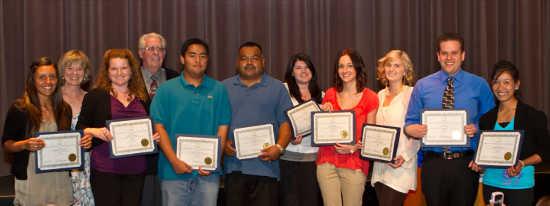
NORTH COAST, Calif. – Mendocino College is currently accepting scholarship applications for the 2013-14 fall and spring semesters until 4 p.m. Friday, March 1.
“Last year the college awarded more than 150 scholarships, totaling over $162,000,” said Lana Eberhard, Mendocino College Foundation scholarship coordinator.
About 54 percent of last year’s applicants received an award and 43 percent of the recipients received $1,000 or more. Some awards are up to $2,500 for the academic year.
“One application is all you have to fill out to be considered for a wide variety of scholarships,” said Eberhard.
Students can qualify and receive more than one award. Some career specific awards include nursing, sciences, culinary arts, performing arts and public service.
High school students, current college students and anyone planning to enroll in the fall 2013 semester are encouraged to apply.
The application must be typed or keyed from the electronic form available on the Mendocino College Web site.
An essay about why financial assistance is needed and two letters of recommendation are required. Graduating high school seniors must submit a copy of their official high school transcripts with their application packets.
“The essay is evaluated on need and the ability to express how the scholarship will help a student attend and stay in college,” says Eberhard. “Tell a compelling story and write about what is important to you.”
She is available in the Mendocino College Foundation office to assist with questions and the application.
In addition she has posted an extensive list of tips on how to write an award winning essay and how to ask for letters of recommendation on the College’s Web site.
“I advise anyone who is thinking about applying to start right now. Applicants need to give themselves time to draft the essay, and also give anyone who is writing a letter of recommendation time to get it done before the March 1 deadline,” said Eberhard.
Scholarships are often awarded based on career or educational goals, grade point average, financial need, service to community groups, participation in clubs, volunteerism and hardships that have been overcome.
To apply for a scholarship, visit the Mendocino College website at www.mendocino.edu then click “students” and then “scholarships.”
Other scholarship opportunities not connected to the college are also listed on the Mendocino College Web site. For more information call Lana Eberhard at 707-467-1018 or
The college invites individuals or organizations interested in contributing to the College’s scholarship fund, the book awards program or in providing a personally sponsored scholarship to contact the Mendocino College Foundation at 707-467-1018.
The Mendocino College scholarship awards ceremonies are held in May and the scholarship money is available in August for the fall semester.
For more information about contributing to the Mendocino College Foundation, call the Foundation Office at 707-467-1018 or email Katie Fairbairn at
- Details
- Written by: Editor
SACRAMENTO – Assemblymember Mariko Yamada (D-Davis) and Assemblymember Susan Eggman (D-Stockton) introduced AB 252 Wednesday to ensure that individuals who are classified as social workers have earned a degree in social work at an accredited college or university.
“Social work is both a calling and a profession,” Yamada said. “The title ‘social worker’ presumes a high standard of education, a solid grounding in professional ethics, and rigorous real-world training. A consumer has the right to assume that a person with the title meets a high standard of competency and integrity, which cannot be guaranteed when services are provided without a social work degree.”
Employers use the title “social worker” inconsistently to describe many types of workers with varying experience and training.
This misrepresentation can be harmful to vulnerable citizens who believe they are receiving care and services delivered by a qualified social worker who can use his or her professional judgment in life-threatening situations, including protecting the elderly from abuse and neglect and intervening in situations posing a serious danger to children.
“The title ‘social worker’ invokes the shared history, training, ethics and practices of a 115-year-old profession,” said Assemblymember Eggman. “We need to ensure that anyone who uses the title meets those well-established standards. This is about truth in advertising.”
AB 252 will require employers to assign the title of “social worker” only to individuals who hold a degree in social work from a school accredited by the Commission on Accreditation of the Council on Social Work Education (CSWE). Individuals will be prohibited from identifying as a social worker without the appropriate educational qualifications.
CSWE accreditation ensures that all who graduate with a social work degree have had coursework grounded in professional ethics, best practices and cultural diversity supplemented by at least 400 hours of supervised field instruction. Additionally, social worker conduct is bound by a Code of Ethics.
Legislation protecting the professional title “social worker” has already been enacted in 37 other states.