How to resolve AdBlock issue?
News
- Details
- Written by: Dennis Fordham
Diversification allows income streams to be created – by selling assets and investing the proceeds for income – in a tax-efficient manner. What remains (at least 10 percent of what was contributed) at the end goes to the charity of choice. Let us examine how this works.
You begin by selecting the type of CRT that works best for you, based on the type of asset you will contribute and your future income needs.
Broadly speaking, there are two types: the annuity trust (CRAT) or the uni-trust (CRUT). They differ in their payout schemes.
The CRAT pays the same amount each year based on a percentage of the CRAT’s “initial value.” CRATs guarantee you the same amount each year. The annuity percentage varies between 5 percent and 50 percent, depending on the CRAT’s term.
A CRUT, however, pays a percentage of the annually “recomputed value” (i.e., the uni-trust percentage times uni-trust new value).
The payout varies each year based on the investment performance of the trust and the cumulative effect of prior years’ withdrawals. The CRUT has two main variations that allow for non-income or low income producing assets to be held without requiring distributions until such year as income is generated.
The CRT is irrevocable – it cannot be amended or revoked (except sometimes under limited circumstances). The CRT document determines (amongst other things) who is the noncharitable beneficiary (usually yourself and your spouse), how long the trust will last (i.e., your lifetimes or for a fixed term up to 20 years), who is trustee (usually yourself) and the charitable remainder beneficiary.
At termination, the charity must receive at least 10 percent of the initial value. A taxpayer identification number is obtained and assets transferred to the trustee. A qualified appraisal may be needed to determine an asset’s value.
In the first year you enjoy an immediate income tax charitable deduction. The amount is the so-called present value of the “remainder interest” left to charity.
For example, if you contribute $500,000 in assets into a CRT that donates 20 percent to charity at the end of a 10-year term then the remainder is the present value today of $100,000 to be received in 10 years time discounted using the applicable federal interest rate. The tax savings today can be used to fund other present investments, including annuities and life insurance.
If you contribute appreciated assets and the CRT sells them then – because the CRT is a tax-exempt charitable trust – the CRT itself is not subject to capital gains taxes. Likewise, if you contribute retirement funds the CRT does not pay ordinary income taxes and can reinvest these funds. Instead, these taxes are postponed over the CRT’s term. That is, as distributions are made to the noncharitable beneficiary (e.g., you) the previously unrecognized income is included in earnings.
The advantages to the taxpayer here are that, first, the CRT gets to reinvest money that otherwise would have been paid out in taxes upon the sale of appreciated assets or the receipt of retirement plan funds; second, the taxpayer gets to include smaller additions to your annual income instead of a big addition that might push you into a higher tax bracket; and, third, some of the income to be included in later years may be offset by other tax losses or taxed in years with less income (e.g., retirement years).
Lastly, CRTs may either be established by you during your life or by your will to take effect after you die for the benefit of your loved ones (e.g., your children).
Editor’s Note: Dennis A. Fordham is an attorney licensed to practice law in California and New York. He earned his BA at Columbia University, his JD at the State University of New York at Buffalo, and his LLM in Taxation at New York University. Dennis concentrates his practice in the areas of estate planning and aspects of elder law. His office is at 55 1st St., Lakeport. He can be reached by e-mail at
- Details
- Written by: Lake County News Reports
Lake County Sheriff's Office volunteers provide the Vacation Check Program.
Subject to accessibility, residents in unincorporated Lake County may request regular checks of their homes for defined and reasonable periods of time while they are away, according to Capt. James Bauman.
While checks may be performed by deputy sheriffs, they are typically conducted by trained sheriff’s volunteers, he said.
Bauman said vacation checks entail a visual check of structures and property, ensuring that vehicles, gates, lighting and the general security of the home is intact and in accordance with the request.
Whenever a vacation check reveals something suspicious or otherwise out of place, volunteers are trained to back out of the immediate area and request a patrol deputy be dispatched to investigate further, according to Bauman.
Bauman said there is no cost associated with requesting a vacation check and the requester need only complete a basic form describing the duration of the checks, description and access to the property, vehicles, alarms, pets, and anyone authorized to be on the property or acting as agent for the owner.
Anyone interested in requesting a vacation check for their home may contact the South County Substation at 707-994-6433, Monday through Friday, from 8 a.m. to noon, or the sheriff’s main office in Lakeport, 707-262-4200, Monday through Friday, 8 a.m. to 5 p.m.
- Details
- Written by: Elizabeth Larson
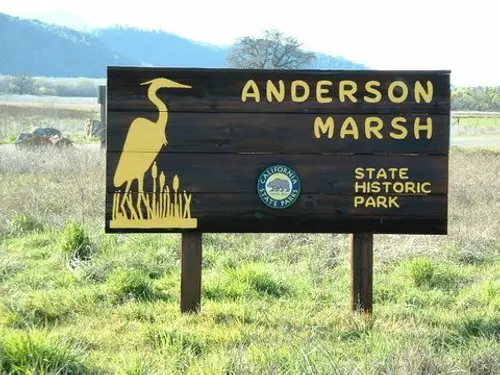
LAKE COUNTY – What's the value of local state parks to the county's economy? Based on a recently released study, the answer is millions of dollars.
As state officials consider a proposal by Gov. Arnold Schwarzenegger to close 220 of the state's 279 state parks – including Lake County's Anderson Marsh – a newly released study gives a look at just how important parks are to the state and local communities.
The California Parks and Recreation Department commissioned the study, which was conducted by California State University, Sacramento's Department of Recreation, Parks and Tourism Administration.
Schwarzenegger is suggesting the park closures – along with thousands of park employee layoffs – in an effort to save an estimated $143 million in state general fund monies.
But the losses incurred by the parks could be much greater than the money the governor is proposing to save.
The study found that 74.9 million people visit California state parks annually, spending an average of $4.32 billion per year in park-related expenditures.
It also reported that park visitors spend an average of $57.63 per person per visit, including $24.63 inside state parks and nearby communities, and $33 in communities more than 25 miles from the park being visited.
Recreation, Parks and Tourism Administration faculty and students surveyed 9,700 visitors at 27 state parks representing the diversity of the parks system’s 279 parks. The survey was taken from fall 2007 to February 2009, according to the report.
Professor David Rolloff of Sacramento State's Recreation, Parks and Tourism Administration told Lake County News that the closest parks to Lake that were in the sample were MacKerricher State Park in Fort Bragg and Mt. Tamalpais near San Francisco.
Of the visitors surveyed, 11.95 percent were non-residents of California, and their average spending per person was $184.91.
Based on the calculated $4.32 billion in park-related visitor expenditures per year, $1.66 billion is generated by non-residents of California, the survey found.
Rolloff said the study as been in the works for a number of years, with data collection beginning in 2007. It's part of a much larger study by the State Parks Department to look at visitors and park usage.
“One of the reasons why we decided to come forth with the data was that it's very relevant right now,” Rolloff said, referring to the proposal to close the parks.
A full report is due out later this summer, said Rolloff.
Rolloff called the spending figure of $57.63 per person per visit “pretty impressive,” especially in light of the tough economy in the last few years.
But that economic downturn has had another effect. “A lot of people are actually staying more local,” and choosing to enjoy nature at nearby state parks, he said. “It seems to be a pattern we're seeing.”
Debra Sommerfield, deputy county administrative officer for Economic Development, said the numbers the study suggests look right, and that she wouldn't be surprised that the numbers are accurate based on her study of tourism trends.
A report issued last year by the California State Parks Foundation found that Anderson Marsh is visited by 43,499 people each year, generating $2,060 in revenue, while Clear Lake State Park has 100,166 visitors annually, with revenue of $332,782.
If the Sacramento State study is accurate, that means that Anderson Marsh and Clear Lake State Park offer $2.5 million and $5.7 million, respectively, in benefit to the local economy.
Anderson Marsh was placed on the closure list this year, which has prompted local officials to write the state to seek alternatives. Last year Anderson Marsh and Clear Lake State Park were both included on a list of 48 state parks that Schwarzenegger had suggested to close to deal with the state budget crisis.
Clear Lake State Park was spared this year, because boating and gas tax revenue – not state general tax revenue – are primary funding sources. County officials have emphasized that keeping Clear Lake State Park open is a priority.
Sandra West, co-owner of Edgewater Resort in Kelseyville, said having Clear Lake State Park close by has benefited her business.
That park, she said, is full every summer with people who enjoy the lake, and it brings a lot of money into the county. West said she's also enjoyed a great relationship with the park and its staff.
She said the fiscal impact of the parks on the state and their surrounding communities is “huge.”
West said she knows that the state is having huge problems, but she would hate to see either of the parks close because of their value to the community.
The California State Parks Foundation is organizing a “Save Our State Parks Weekend” later this month.
They're encouraging people to visit their state parks and show support by wearing green or a green on the weekend of June 20, during which time they also can celebrate the Summer Solstice and Fathers Day. More information on the effort is available at www.calparks.org .
- Details
- Written by: Lake County News Reports
The Rainbow Bridge Festival is set for June 26, 27 and 28 at 10568 Bachelor Valley Road, Upper Lake.
The organizers say the festival is intended to bring people together through a common experience, involving a connection with nature and valuable interaction with community expressed through music, yoga and healthy lifestyle exploration.
There will be workshops and demonstrations on green building, gardening, alternative energy and yoga, with drumming circles and activities for children.
A main component of the festival will be performances by world-class performers, including Pato Banton, the Annie Sampson Band, Elijah Emanuel, Mitchell Holman, Karma, Levi Huffman, Rootstock and Side of Blues.
Speakers will include Jeane Manning, author of several books including “The Coming Energy Revolution” and “Breakthrough Power.” Manning will share information and compelling stories about brave inventors and breakthrough technologies from around the world that are green and sustainable. She makes the case for open sourcing, clean energy inventions such as magnetic motors, zero point energy, water-as-fuel and other new paradigm advances.
Harvey Wasserman, author of “Solartopia, Our Green Powered Earth,” will share his wisdom and vision of making the bridge to a solarized world. Wasserman's widespread appearances throughout the major media and at campuses and citizens gatherings since the 1960s have focused on energy, the environment, the truth about nuclear power, United States history and election protection.
Another speaker will be Anodea Judith, whose books include “Wheels of Life” and “Waking the Global Heart.” Judith holds a doctorate in health and human services, with a specialty in mind-body healing, and a master’s in clinical psychology. Her best-selling books on the chakra system, marrying Eastern and Western disciplines have been considered groundbreaking in the field of transpersonal psychology and used as definitive texts in the U.S. and abroad.
The festival also will pay tribute to the late Marla Ruzicka, a Lake County native and human rights activist who died in Iraq in April of 2005.
Kevin Danaher of Global Exchange, who knew and worked with Ruzicka, will speak about her, and also will present ideas from his book “Building the Green Economy, Success Stories from the Grass Roots.”
For tickets and more information, visit the festival Web site, www.rainbowbridgefest.com .