How to resolve AdBlock issue?
News
- Details
- Written by: Elizabeth Larson
Areas of Cobb have been seeing light to moderate snowfall during the week, with the snow usually melting off fairly quickly, according to Cobb area resident Roger Kinney.
But on Friday the snow was spreading itself around the county.
Areas of the Northshore were coated white during a mid-afternoon snow flurry, with snow continuing into the evening.
In Kelseyville, snow was reported to be falling at about 6 p.m.
Snow shut down the Hopland Grade for about three hours early Friday evening, according to the California Highway Patrol. The roadway was reopened at about 7:15 p.m.
The Lake County Public Works Department reported Friday that chains are currently required on Bartlett Springs Road and on Elk Mountain Road.
CHP reported numerous collisions around the county and the North Coast on Friday due to the winter weather.
No serious injuries were reported in Lake County.
However, a collision involving a single car that went off Highway 128 east of Yorkville in Mendocino County early Friday afternoon claimed the lives of both people in the car, which hit an oak tree, according to a CHP report.
The car was traveling 55 miles per hours in rainy conditions when the car slid off the roadway, according to the CHP. No identifications were offered Friday for the Windsor residents who died in the crash.
E-mail Elizabeth Larson at
{mos_sb_discuss:2}
- Details
- Written by: Lake County News Reports
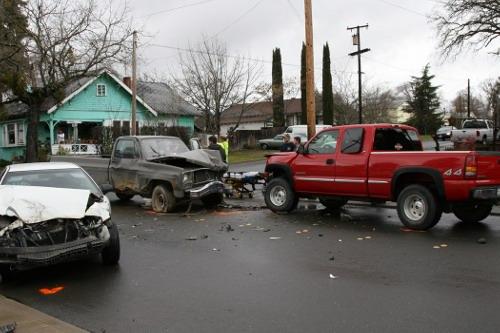
LAKEPORT – A three-vehicle collision in Lakeport late Friday morning sent one person to the hospital and resulted in traffic being diverted around the scene for an hour.
Shortly after 11 a.m. the crash at Forbes and 11th was reported. Within minutes paramedics, police and a handful of Lakeport city employees arrived on scene, the latter group taking up positions around the scene to offer traffic control.
Traffic was closed one block south and one block north of 11th Street, as well as one block east and west at Forbes. A large amount of debris from all three vehicles was scattered across the intersection at 11th and Forbes St.
A white Buick Regal was driving north on Forbes and witnesses said it didn't stop at a stop sign before entering the intersection and colliding with a gray mid-1970s Chevy pickup. The pickup then collided heat-on with a GMC pickup traveling west on 11th.
Both the Buick and the Chevy were heavily damaged.
The driver of the Chevy pickup sustained injuries and was transported to the hospital.
The driver of the Buick was examined at the scene by medical personnel and appeared shaken but not in need of immediate care.
E-mail Harold LaBonte at
{mos_sb_discuss:2}
- Details
- Written by: Lake County News Reports
Beneficiaries of the $700 billion bailout package in the finance and automotive industries have spent a total of $114.2 million on lobbying in the past year and contributions toward the 2008 election, the nonpartisan Center for Responsive Politics has found.
The companies' political activities have, in part, yielded them $295.2 billion from the federal government's Troubled Asset Relief Program (TARP), an extraordinary return of 258,449 percent.
"Even in the best economic times, you won't find an investment with a greater payoff than what these companies have been getting," said Sheila Krumholz, the Center's executive director. "Some of the companies and industries that have received payments may now consider their contributions and lobbying to be the smartest investments they've made in years."
While the Treasury Department, not Congress, doles out TARP funds to specific institutions, congressional lawmakers had to authorize that money in the first place, and lawmakers will determine in the future whether to release more funds to prop up the US economy.
During the bill-writing process, members of Congress were able to specify to some extent where the money should go, and they have lobbied regulators to urge them to inject funds into specific banks and financial institutions, including those in lawmakers' own districts.
"Taxpayers hope their money is being allocated entirely on the merits, but with Congress controlling how much money the Treasury gets to hand out, it will be impossible to completely exclude politics from this process," Krumholz said.
Some of the top recipients of contributions from companies receiving TARP money are the same members of Congress who chair committees charged with regulating the financial sector and overseeing the effectiveness of this unprecedented government program.
They include Sen. Chris Dodd of Connecticut, chairman of the Senate Committee on Banking, Housing and Urban Affairs (he received $854,200 from the companies in the 2008 election cycle, including money to his presidential campaign) and Sen. Max Baucus of Montana, chair of the Senate Finance Committee (he received $279,000).
In total, members of the Senate Committee on Banking, Housing and Urban Affairs, Senate Finance Committee and House Financial Services Committee received $5.2 million from TARP recipients in the 2007-2008 election cycle.
President Barack Obama collected at least $4.3 million from the companies and their employees for his presidential campaign, while Sen. John McCain (R-Arizona), Obama's opponent in the presidential race, received $2.1 million.
The Center for Responsive Politics also provided Lake County News with specific information on the area's legislators, who received much smaller donation amounts.
In the 2008 election cycle, US Sen. Barbara Boxer received $7,300 from the TARP bailout companies. Boxer's counterpart in the Senate, Dianne Feinstein, doesn't appear to have received funds from the companies in the 2008 election cycle, but the center reported that Feinstein didn't do much fundraising for herself in 2008 because her next election isn't until 2012.
Congressman Mike Thompson, who represents several counties including Lake in the US House of Representatives, received $28,500 from the companies and their employees in the 2008 election cycle, according to the center's records.
Most of Thompson's contributions came from PACs, including those for Bank of America, JPMorgan Chase and Co., International Bank of Commerce, Wells Fargo, Citigroup, American Express, Morgan Stanley, FMR Corp. and Goldman Sachs, according to the center's records.
Thompson said his votes were predicated on helping get the country moving forward.
"I voted for the bailout legislation because we had to get our credit markets working again,” he said in an exclusive comment granted to Lake County News.
“I was outraged, like most Americans, at the greed and incompetence at many banking institutions that got us into this mess in the first place,” he said. “Unfortunately, our financial institutions were on the brink of collapse and hard working people in our district and across our country were caught up in a credit crunch that threatened home owners and small businesses. Even the State of California was unable to raise the funds to pay for health and safety programs."
He added, “It was clear to me that we had to act in order to begin to work our way out of this crisis – and we had to act quickly, even if the plan wasn't perfect, so that our entire financial system didn't collapse.
“Voting no on this bill would have been the easy vote, but given the unprecedented economic circumstances I had to make the hard vote in favor of this bill,” Thompson said. “I am glad that the Obama administration has already taken several steps to ensure this money is spent wisely and doesn't end up lining the pockets of bank executives.”
Some, not all, TARP recipients hired lobbyists
Of the more than 300 companies that have been aided by TARP, 25 paid lobbyists a total of $76.7 million to represent them on Capitol Hill in 2008.
Treasury Secretary Tim Geithner said recently that institutions collecting these funds won't be allowed to lobby the federal government going forward.
In the fourth Quarter of 2008, when Congress was crafting bailout legislation, these companies spent $17.8 million on lobbying – less than what they spent in the prior three quarters, probably because they were strapped for cash.
In total, 161 companies approved for TARP money gave $37.5 million to federal candidates, parties and committees in the 2007-2008 election cycle, with 57 percent of that going to Democrats (post-election data is not yet available).
The employees of these companies, rather than their political action committees, gave the bulk of that, at $26.1 million, or 70 percent.
These two groups of donors seem to have differed in their partisan allegiance – individual employees gave 61 percent of their donations to Democrats, while PACs were more evenly divided, giving 51 percent to Republicans.
Some of the companies to give the most in contributions, including Goldman Sachs, Citigroup, JPMorgan and Morgan Stanley, are also among the biggest donors of all time to U.S. politics.
The companies giving the most to fund lawmakers' campaigns and spending the most on lobbying efforts were also those that received the most TARP money to help them stay afloat. This includes General Motors, which spent $15 million between campaign contributions and lobbying expenditures and got $10.4 billion (more than all other companies), Bank of America (and the investment company it bought last year, Merrill Lynch), which spent $14.5 million to play politics and received $45 billion from the bailout bill; and American International Group (AIG), which spent $10.6 million and was paid out $40 billion.
Citigroup was also one of the largest spenders to see a big result: between lobbying expenditures and campaign contributions, the company spent $12.5 million and got $50 billion. For a complete list of TARP recipients that spent money on campaign contributions and lobbying, see the chart below.
"TARP needs to be far more transparent," Krumholz of CRP said. "Hundreds of billions of dollars have already been handed out with little more than a one-line announcement. What qualified these companies for the money they're getting? What disqualified other companies? What contact has there been between members of Congress and the Treasury? What contact have lobbyists had with Congress and Treasury? These are reasonable questions, and taxpayers deserve answers."
The finance, insurance and real estate sector, including all companies and trade groups (not just those that qualified for TARP funds), spent $453.5 million on lobbying in 2008, an 8.7 percent increase from the year before.
In the last quarter of 2008, the sector spent $106.9 million on its influence-peddling efforts. The securities and investment industry spent $20.5 million in the fourth quarter, insurance companies spent $36.7 million and real estate companies spent $16.5 million.
And although this was a decrease from the third for each of these industries, they had plenty of additional support. Trade associations in the finance, insurance and real estate sector spent $123 million on lobbying last year, more than they spent in each of the three years prior.
The Center for Responsive Politics' Web site, www.opensecrets.org, tracks both campaign contributions to federal lawmakers and lobbying expenditures by organization, industry and sector.
CRP calculated the numbers in this report by mashing up these databases with a list of TARP recipients accessed Feb. 2 from www.treasury.gov.
Post-election contribution data is not yet available but should be incorporated into www.opensecrets.org in the coming weeks.
For the table of TARP recipients that spent money on lobbying or were associated with campaign contributions, visit www.opensecrets.org/news/2009/02/tarp-recipients-paid-out-114-m.html.
{mos_sb_discuss:3}
- Details
- Written by: Lake County News Reports
“This blatant and costly scam holds out hope to homeowners that their property taxes will be reduced if they pay hundreds of dollars to a middleman to have their property re-evaluated,” Attorney General Brown said. “In point of fact, homeowners can seek relief directly from their county assessor free of charge. Homeowners should be on high alert.”
Companies are sending deceptive mailers to homeowners offering help in reducing property tax assessments, if the homeowner pays the company hundreds of dollars in fees. The companies use official-sounding names such as “Tax Adjusters,” “Tax Readjustment” or “Tax Review” to make victims believe the company is a government agency.
Local homeowners began receiving the mailers last week, as Lake County News has reported.
Property tax reassessment is a free service provided by county tax assessors, Brown reported. If homeowners believe their property value has declined and they are paying too much in property taxes, the local tax assessor will review the property value for free for a possible downward assessment.
To avoid becoming a victim, homeowners should:
Never pay money for something they did not ask for.
Avoid a middleman – contact the local tax assessor’s office for property value reassessment.
The Lake County Assessor's Office can be reached at 263-2302. County Chief Deputy Assessor Jim Campbell urges county residents to call with questions or to request free reassessment services.
Homeowners who believe they are a victim of this scam should contact the Attorney General’s Office by either calling 1-800-952-5225 or by writing to P.O. Box 944255 Sacramento, CA 94244.
{mos_sb_discuss:2}