How to resolve AdBlock issue?
News
- Details
- Written by: Elizabeth Larson
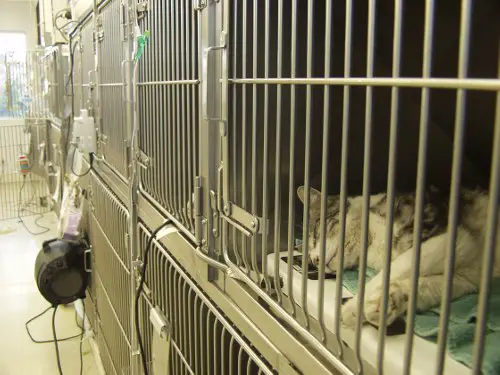
LAKE COUNTY – Taking care of all creatures great and small could become a lot more expensive if the state Legislature approves a proposal by the governor.
In an effort to find additional revenue sources for California, Gov. Arnold Schwarzenegger is proposing to broaden the state's sales tax to include veterinary services.
The plan first arose late last year during special budget sessions, in which state legislators strongly opposed it. Now, Schwarzenegger has included it in his draft state budget for the 2009-10 fiscal year.
Aaron McLear, a spokesman for the governor, told Lake County News that Schwarzenegger released his latest budget – and the seventh proposal of the year – on New Year's Eve.
He said it takes a “balanced approach” of seeking new revenue by adding veterinary care to taxed services.
The American Veterinary Medical Association reports that so far only three states – Hawaii, New Mexico and South Dakota – collect taxes on veterinary medical services, which include routine exams and vaccinations.
The new tax would be a nearly 10-percent additional cost to pet and animal owners, which is raising concerns for animal advocates and others fearing that the number of abandoned and neglected animals – already believed to be growing due to the economic climate – could get much worse.
The exact amount of sales tax added would vary from one area to the next, depending on local sales tax measures. In the unincorporated areas of the county, sales tax currently is 7.25 percent, while in Clearlake and Lakeport – where voter-approved sales tax measures support police and road projects, respectively – sales tax currently is 7.75 percent, according to city and county officials.
"It's obvious that 10 percent onto fees for people that are lower income is going to be devastating for them," said Dr. Debra Sally of Clearlake Veterinary Clinic.
"There's a potential that a lot more animals are going to go without care," Sally added, suggesting many more animals could end up in the pound, which itself is an expense for government.
Jennifer Fearing, chief economist for the Humane Society of the United States, said the organization is referring to the tax proposal as the "Fido fine," although it also will affect large animal and livestock care as well.
“We are absolutely opposed,” she said.
Fearing said animal shelters already are grappling with higher costs and more animals, and making it more expensive to care for animals may just mean more animals in the pound. “This is really just adding insult to injury,” said Fearing, who called the proposal “reckless on the governor's part.”
Because it also will impact livestock, said said it will raise the cost of doing business for farmers and ranchers.
Then there are impacts on government, said Fearing. Because local government agencies aren't immune from paying sales tax, animal shelters that contract for vet services would have to pay the tax along with everyone else.
An example, Fearing said Los Angeles County, which spends $2.5 million a year on contracted services, would have to pay $250,000 in taxes, funds which otherwise would go to animal care.
Fearing said the most absurd and strange aspect of the proposed tax is how it's lumped in with several completely unrelated services.
The budget proposal suggests that, beginning March 1, the sales tax would be extended to appliance and furniture repair, vehicle repair and veterinarian services. Then, on April 1, the sales and use tax rate
would be applied to amusement parks, sporting events and golf.
“Selection of these services was based on ease of implementation as these services are generally provided by entities that already have a relationship with the Board of Equalization,” the budget states.
The new taxes are estimated to generate $272 million in state general fund in 2008-09 and $1.154 billion in 2009-10.
"Ethically I don't see how you can put animals lives in the same category as car repair," Sally said.
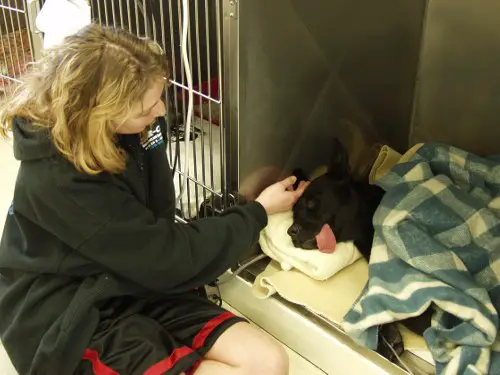
Pet owners could see big rises in costs
Dr. Susan Cannon of Wasson Memorial Veterinary Clinic in Lakeport said the big issue is the prospect of greater expenses for clinics and their patients.
"Obviously, most clinics are not going to afford to be able to absorb those costs," she said.
Cannon said pet owners can expect an increase in fees to compensate for the tax. "A lot of people are having a hard enough time as it is affording vet care," she said, adding that the proposal is "all very vague."
The tax seems very large, said Cannon, and most pet owners don't have insurance or other assistance in paying for care.
"Obviously the state's in trouble and they're trying to come up with as many ways as they can to make money," Cannon said.
On Tuesday, Callie Dailey of Boonville was at Wasson Memorial with her 1-year-old black lab mix, Beau Duke, who she adopted from a Lake County rescue group.
Beau had been hit by a car, and suffered a shattered left hind leg and a hip out of socket, said Dailey.
After being told by other vets that they could only amputate Beau's leg, Dailey connected with Dr. Chris Holmes of Wasson. On Tuesday Holmes operated on Beau in an effort to save his leg.
Dailey said the surgery is expensive enough without having to pay hundreds of dollars more in tax.
She said cost could force heartbreaking choices.
“I'm sure for some people it would mean the difference between saving their dog and having to put it to sleep,” said Dailey.
Vets group speaks out against tax
The California Veterinary Medical Association, which represents 6,000 veterinarians statewide, has come out against the proposal.
The association's president, Dr. William Grant II, told Lake County News that it's hard to say if the tax will become a law.
The association has good support from both Democrats and Republicans who agree it isn't a good tax, Grant said.
Grant said it's not fair to segregate one fraction of the health care profession and target it with this level of taxation. He had no idea why veterinarians were singled out.
"It's already difficult in today's economy for a lot of people to take care of their pets," he said.
Grant said the tax will get passed on from vets to pet owners, and essentially will result in penalizing people for doing the right thing by taking care of their pets.
He also noted that pet owners can be prosecuted for failing to provide veterinarian care. "We just think it's ridiculous."
Grant, who is a small animal vet in Southern California, has told many of his clients about the proposal, and they've responded by calling legislators.
The Humane Society also sent out an e-mail alert to 120,000 California members about a week and a half ago, Fearing said.
Schwarzenegger's office has a constituent affairs line where people can call in to register their opinions about various issues, said McLear.
To call in, dial 916-445-2841; press 5 to leave an opinion – hit 1 to show support for the sales tax and 2 if you oppose it.
As to response on the tax, McLear said "It's higher than most issues right now."
He added, "That changes daily, depending on what the hot issues of the day are."
Schwarzenegger receives a weekly report on constituent feedback on issues, McLear said.
"Obviously we are being heard," Grant said.
The 2009 California Humane Lobby Day, which will take place from 9:30 a.m. to 4 p.m. Thursday, February 12, at the California State Capitol, also will offer animal advocates a chance to speak to elected officials and their staff about important legislation. To RSVP to take part in the event, visit https://community.hsus.org/humane/events/lobbyday_SacramentoCA_Feb12/details.tcl?member_key=ine3wie2z7men7k6&.
E-mail Elizabeth Larson at
{mos_sb_discuss:2}
- Details
- Written by: Elizabeth Larson
THIS STORY HAS BEEN UPDATED.
CLEARLAKE OAKS – A Clearlake Oaks man wanted in connection to a November shooting has been arrested.
Patrick Dewin McDaniel, 44, was booked into the Lake County Jail shortly before 2:30 p.m. Thursday, according to Lake County Jail records. A Friday report said he had been apprehended in Nevada and then, because he is a parolee, was transported to San Quentin before returning to Lake County.
McDaniel and his 37-year-old brother, Cecil, of Clearlake Oaks, are alleged to been involved in a confrontation with Clearlake Oaks residents 42-year-old Patrick O'Conner and his 23-year-old son, James, at a neighbor's residence on the evening of Nov. 26, as Lake County News has reported.
The O'Conners heard Patrick McDaniel yelling at a female neighbor and went next door to intervene. Patrick O'Conner and Patrick McDaniel had had a confrontation earlier in the day, according to investigators.
An argument resulted, with Cecil McDaniel reportedly taking a swing at O’Conner and missing. Then Patrick McDaniel allegedly shot O'Conner in the chest.
The brothers – both of whom are convicted felons – are then alleged to have fled the scene, with deputies searching for them for several hours.
Cecil McDaniel was arrested on Dec. 3, and remains in the Lake County Jail on $500,000 bail for being an accessory to the shooting. He went before Judge Richard Martin on Jan. 21, and is scheduled to return to court on March 9 in Department 3.
Patrick McDaniel is charged with attempted murder, with bail set at $500,000, according to jail records.
McDaniel, who sheriff's officials reported had been paroled from prison not long before O'Conner's shooting, also has a felony bench warrant against him, with an additional $50,000 in bail for that charge.
E-mail Elizabeth Larson at
{mos_sb_discuss:2}
- Details
- Written by: Lake County News Reports
The task force reported that the first warrant was served at 10 a.m. in the 21000 block of Highway 29 in Middletown.
Detectives found an indoor marijuana cultivation in the residence. The plants had been harvested and the marijuana was in the process of drying.
The task force found 48 pounds of processed marijuana and 80 pounds of unprocessed marijuana in the residence, which was prepared to grow more than 500 marijuana plants.
Detectives arrested Moeun Dam, 40, of Middletown for marijuana cultivation. Dam was booked into the Lake County Jail, where he later posted $10,000 bail.
The task force found evidence at the Middletown residence that led them to the Alternative Solutions Collective in the 12000 block of E. Highway 20 in Clearlake Oaks.
Task force detectives obtained another search warrant for the marijuana collective, and with the assistance of the Lake County Sheriff’s Office, the task force served that search warrant at approximately 4 p.m. Wednesday.
Inside the Alternative Solutions Collective, detectives found a honey oil/hash laboratory and evidence that the collective was operating outside of state of California guidelines.
Detectives arrested Daniel Lee Clark, 22, a construction worker from Clearlake Oaks, and Caleb Stuart Hazard, 26, an unemployed Santa Rosa resident, for distribution of marijuana, conspiracy and possession of a clandestine honey oil laboratory.
Bail for Clark and Hazard was set at $40,000 each. Both have since posted bail and been released, according to jail records.
The task force seized 15 pounds of processed marijuana, $2,129 in cash, two pounds of hashish and dozens of food items containing marijuana.
The Lake County Narcotic Task Force is comprised of detectives from the Lakeport Police Department, Clearlake Police Department, the California Highway Patrol, the Lake County Probation Department, the Lake County Sheriff’s Office and the State of California Bureau of Narcotic Enforcement.
If a citizen in Lake County has any information on illegal marijuana grows, or any other narcotic violations, please call the task force at 263-9055.
{mos_sb_discuss:2}
- Details
- Written by: Elizabeth Larson
David Garlow Deason, 69, was found guilty of shooting 48-year-old Marie Claire Parlet to death at their Lower Lake home on Dec. 6, 2004. He also was found guilty of a special allegation of using a firearm in committing the murder.
Marie Parlet's daughter, Charline, and son, Donald, were in the courtroom Tuesday for closing arguments and the jury's verdict.
“It was intense,” said Charline Parlet on Wednesday, adding that she was shocked that he received the first-degree murder verdict again.
She said she called her younger brother, James Clarkson, in Texas to give him the news. “He was very excited.”
Defense attorney Doug Rhoades said Deason didn't take the stand in the trial. “He did not want to confront the charges.”
Rhoades said that Deason felt he could defend himself against the charges based on his level of intoxication at the time of the shootings.
“Mr. Deason had no history of violence prior to this act,” said Rhoades, adding that Deason's only previous criminal record involved some driving under the influence convictions many years earlier.
Rhoades said he had been seeking a voluntary manslaughter charge, and noted that Deason would have pleaded guilty to that if it had been offered.
“How is justice served when a life sentence would be the result regardless of a plea or a conviction?” Rhoades asked.
He added, “I thought it was a waste of resources to put him through this, to put the family through this, when the net result would have been the same.”
Alexandria Firth, 26, sat on Deason's second jury, which began Jan. 6.
She characterized the jury's deliberations as “pretty quick,” estimating that they only took about an hour and a half on Tuesday.
“The only real sticking point was deciding whether or not he premeditated,” Firth said.
She said the jurors went point by point through the jury instructions to look more closely at what constituted first-degree murder, which was their ultimate conclusion.
Jury discounts alcohol as a factor
Deason had been convicted by a jury in February 2006 of first degree murder and personal use of a firearm in an earlier trial for Marie Parlet's killing. Judge Richard Martin subsequently sentenced Deason to a mandatory 50-years-to-life sentence in prison.
However, in December 2007 the First Appellate Court threw out the conviction, saying that the court should have allowed information about Deason's level of intoxication to be admitted.
The District Attorney's Office stated that, in the first trial, the prosecution successfully argued in a pre-trial motion that, since no evidence of the defendant's drinking pattern prior to the shooting was going to be presented by the defense, the defendant's blood alcohol level should be excluded from evidence.
During that hearing, the prosecution contended that since Deason had access to “10 to 15 large 1.75 liter bottles of hard liquor” alcohol for at least 20 minutes, and possibly as long as one hour, after the shots were fired, any drinking Deason did after he fired the shots was irrelevant to his mental state at the time the shots were fired, and the blood alcohol level was misleading.
Judge Martin denied the request of then-defense attorney J. David Markham to present the blood alcohol level evidence. Court records said Markham also had asked to have a toxicologist give testimony on the subject.
“We decided the alcohol wasn't really a factor,” said Firth. “It was clear that he intended to kill her.”
During the trial, Deputy District Attorney John Langan presented evidence by forensic pathologist Dr. Kelly Arthur that Parlet had been shot twice with a .38-caliber pistol.
The first shot struck Parlet in the back and severed her aorta, according to Langan's case. After that first shot, Langan alleged that Parlet raised her arm up in a defensive posture, and then the second shot struck, piercing her left breast and perforating her spleen, with the bullet grazing the underside of her left forearm.
The precise times of the two gunshots was unable to be determined, according to the District Attorney's Office. Deason was taken into custody at 8:01 p.m. the night of the shooting.
The District Attorney's Office alleged that, upon being arrested, Deason stated, “It took you long enough to get here, deputy,” and added, “Yes, I'm the one that did it.”
Deason also told deputies that Parlet had been down for 45 minutes to an hour.
At 9:36 p.m. – two hours after the 911 call was made by a next-door neighbor – a sample of Deason's blood was taken, with his blood alcohol content found to be 0.27. After the blood sample was taken, Deason stated, “I know what I did. I had a reason.”
Firth said the focus for the jury was Deason's actions. “He had to pull the hammer back and pull the trigger, and he had time to think about.”
Seeking closure again
Charline Parlet said she had just started to get closure over her mother's death when Deason's conviction was overturned late in 2007.
“My mom was killed twice to me,” she said, describing her mother as her best friend.
On Jan. 14, while giving testimony in Deason's trial, Charline Parlet had broken down on the stand as she recounted her mother coming to pick her up from a Santa Rosa treatment center on Dec. 6, 2004, the day she died.
Charline Parlet said Deason and her mother had been together for a few years, but she only saw him at their home a few times. The rest of the time she said she saw him at the bar where her mother worked, saying he usually was drunk.
“I do feel for the man,” she said.
Parlet described her mother as a hardworking person who was a member of the PTA and coached baseball. “She was an ultimate person.”
She said her mother always told her to never depend on another person, and “never let a man bring you down, never let a man hurt you.”
That made it all the more shocking that Marie Parlet should die the way she did, her daughter said. “She was just starting to live her life, too.”
Now, with Deason's second conviction, Charline Parlet said she's got to try to get closure all over again, which is a challenge for her and her 10-year-old daughter, who misses her grandma.
Judge Arthur Mann will sentence Deason on Feb. 27.
The District Attorney's Office said Deason faces mandatory sentences of 25 years to life for the first degree murder conviction, plus an additional and consecutive sentence of 25 years to life for the special allegation of personal discharge of the firearm, for a total aggregate sentence of 50 years to life.
E-mail Elizabeth Larson at
{mos_sb_discuss:2}