 How to resolve AdBlock issue?
News
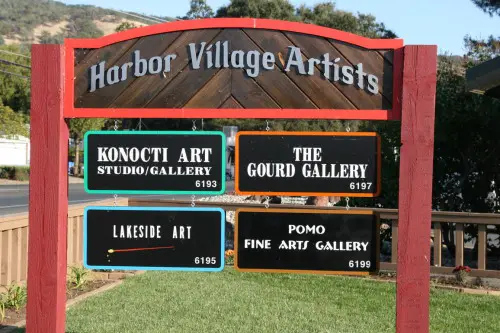
LUCERNE – The new Harbor Village Artists center is a cluster of four charming Alpine-style artist cottages tucked into a park-like setting in the town of Lucerne on the north shore of Clear Lake in Northern California. Each cottage houses a retail art gallery and working art studio featuring works for sale by local and regional artists.
Artist works for sale include original oil, acrylic, and watercolor paintings, Pomo baskets, sculpture, jewelry, original gourd art, gifts and hand-painted tiles.
Gallery shops include The Gourd Gallery, Konocti Art Gallery/Studio, Lakeside Art and Pomo Fine Arts Gallery.
Meet the artists:
Sandie Coelho-Davis
Sandie Coelho-Davis comes from a long line of Lake County pioneer families and, with her husband Jim, moved permanently back to her ancestral roots in 1989.
She was first introduced to gourds about 10 years ago and seriously got involved when a friend started the Bachelor Valley Gourd Club in June 2005. She enjoys the many friendships and creative gourd artists.
Coelho-Davis continues to learn new techniques and understands why the gourd has been in use for centuries. While she uses several gourd art techniques, woodburning has become a favorite.
In July of 2008, she and her gallery partners, Linda Kelly and Marilyn Crayton, opened The Gourd Gallery, the first gallery just for gourds in California. Coelho-Davis sells her work at the gallery and at craft fairs and gourd festivals.
Marilyn Crayton
Marilyn Crayton was born, raised, and employed in San Francisco before retiring to Lake County in 1998.
A guest speaker at a local garden club meeting first introduced her to gourds in 2000. Several years later, she began working with a few gourds that she had previously purchased. While she has never had any formal art classes, Crayton has taken a handful of one-day classes at gourd festivals, and in June 2005 she started a local gourd club that meets monthly.
Today, Crayton grows many of her own gourds on her ranch in Witter Springs. These gourds come in many shapes and sizes. At the end of the growing season, the gourds are picked and set out to dry slowly. When fully dry, the gourds are cleaned and decorated.
Virtually any technique that can be used on wood or leather can be applied to a gourd, including burning, dyeing, carving, staining, painting, sewing, etc. The choices seem to be limitless.
Crayton sells her gourds at local shops, The Gourd Gallery in Lucerne, and at several craft fairs.
Joan Facca
Joan Facca was born and raised in Redwood City and raised her family in Fremont. Facca spent many childhood summers at Clear Lake and moved to Lake County with her husband in 1985. Her love of art began at a very early age.
Mostly self-taught, Joan began painting with oils and moved to pastels, the medium she finds most rewarding. Her pastel landscapes reflect her love and respect for the natural world and the exceptional beauty of Clear Lake.
Ray Farrow
Ray Farrow was born in England and educated in England, Canada, and the United States. He developed his passion for painting after a successful career in the international resort industry.
Farrow is self-taught with the help of workshops, videos, books and through his association with other artists who, like himself, continue to hone their skills by painting daily.
He enjoys exhibiting his work where he learns from the comments and feedback of viewers and other artists. Farrow also is co-owner of Konocti Art Gallery/Studio in the artist colony Harbor Village Artists.
Meredith Gambrel
Meredith Gambrel considers her painting a hobby gone awry. She began painting and drawing at a very young age, studied at various art schools and colleges, and also studied under numerous well-known artists. Gambrel’s love of nature is the theme of most of her paintings.
While she has worked in most media, at the present time, her paintings are rendered in oil. Her love is to create beautiful paintings for all to enjoy.
Carolyn Hawley
Carolyn Hawley, former college music instructor and conductor of the Ukiah Symphony, is by profession a classical musician but has been painting since she moved to Mendocino and Lake counties in 1970. She is self-taught and has shown her work in numerous solo and group art shows,
locally and in the Bay Area.
Hawley has won many ribbons and prizes for her art, which critics have dubbed "magic realism." She paints landscapes, seascapes, skyscapes, people and animals and is inspired to capture the true "essence" of her subjects. She sells her paintings, prints, and gift cards in galleries and also by commission.
Lynn Hughes
Lynn Hughes is a Californian through and through. She was born and raised in San Francisco, and her great-grandparents were Lake County settlers.
Hughes was a stay-at-home mom with three children and returned to finish her college education at the age of 40. After working in San Francisco for 12 years, she retired in 1998 to a 16-acre horse ranch in
Bachelor Valley.
A combination of time and circumstance enabled Hughes to explore a new creative avenue, jewelry making, an adventure that has been filled with supportive friends, inspiring teachers, books and magazines, as well as joyful hours seeking just the right “ingredients” to make something beautiful.
This spring, Hughes was published in a national magazine with another piece of jewelry to be featured in Beadunique in spring 2009. She creates jewelry for pleasure.
While she finds it gratifying to receive compliments about her jewelry, she finds the biggest compliment in having a piece of her jewelry sell.
Linda Kelly
Linda Kelly had always wished to move to Lake County, and 10 years ago that wish came true when she moved from San Jose. She loves Lake County, its beauty and how friendly the people are. Her daughter and son, grandchildren, and even a great-grandchild live in San Jose.
Kelly has always enjoyed crafts and also enjoys gardening. Once, she was given a few gourd plants that she planted and watched as they grew to cover a 30-foot fence with a beautiful vine and about 26 huge gourds. At the time, she had no idea what to do with them, so she stored them in the garage.
Upon moving to Lake County, she met a group of gourd artists who happily took the gourds and created a form of art that, until then, Kelly had never seen.
Then three years ago, Kelly, along with her sister, Sandie Coelho-Davis, and fellow gourd artist Marilyn Crayton formed the Bachelor Valley Gourd Club, which now has grown to 22 members. Together, they recently opened The Gourd Gallery.
Kelly also shows beautiful, artistic gourds at craft fairs and gourd festivals and in local shops.
Barbara LeVasseur
Barbara LeVasseur has been self-employed for 27 years, painting on ceramic tiles with her own glazes for homes and businesses. She has produced custom tile gifts for Williams-Sonoma, Sur la Table and Gardener’s Eden catalogs, as well as custom corporate gift tiles for the Heinz Corp. for the last 11 years. She is the owner of Frozen in Fire Tile.
LeVasseur has studied privately with teachers for graphics, photography and painting over the years and has a fine arts degree from the Rochester Institute of Technology School of Art and Design. Her painting media are oil, gouache and ceramic glaze.
While serving on the Board of Directors of the Lake County Land Trust, LeVasseur began the Art and Nature Show at Rodman Preserve, an annual fundraiser and public outreach event that she has chaired for the last six years. She is a member of Lakeside Art, the Konocti Art Society and the Konocti Plein Air Painters.
Diana Liebe
Diana Liebe is a lifelong artist, winning her first competition at the age of 8. She holds a bachelor’s degree in fine art and education. Her experience in arts and crafts is varied, and she has been working in watercolors and hand-painted clothing for the past 10 years.
Liebe keeps involved with the Lake County communities through several art groups including the Lake County Arts Council, Main Street Gallery, the Konocti Arts Society and the Plein Air Painters. She enjoys meeting new friends and staying active in the community.
Carolyn Morris
Carolyn Morris is a 30-year resident of Lake County. She and her husband are longtime business owners of a local video store and currently live in Buckingham Estates, where she enjoys painting garden scenes. She has two grown children who reside in the Petaluma area.
Morris is a self-taught artist who has painted for many years on the side. Her favorite medium is that of oil painting and her goal is to spend more time painting and make a career out of what she loves. She enjoys painting local scenes and the vast opportunities that life in Lake County has offered for beautiful scenery and festive events to feature in her artwork.
Patricia Oates
Patricia Oates is a native of Marin County, and upon moving to Lake County 25 years ago, found a love of Mt. Konocti, much as she had loved Mt. Tamalpais in Marin.
When Oates started painting in earnest, she painted only Mt. Konocti for several years but has since painted other subjects. She is always trying new ideas, new techniques and new palettes. Her teachers have been Lorraine Brady Hull, Sandra Powell, Pat Hopper and Jack Balance, and she has attended workshops with Hope Stevenson, Armand Cabrera, and Adele Pruitt. Her main interest is, and
probably always will be, the landscape.
Oates and her husband Jarth owned and operated a local dry-cleaning business for 19 years and were active in the Lakeport Regional Chamber of Commerce; she also was on the board of the Lakeport Main Street Association. Since selling the cleaners two years ago, Oates has devoted much of her time to her artwork and art events in the county.
She belongs to the Konocti Plein Air Painters, the Konocti Art Society and the Lake County Arts Council. She is pleased to be a part of Lakeside Art and the Harbor Village Artists.
Richard Seisser
Richard Seisser finds real joy in painting with pastels, saying it has opened a window into another world, so vast, and more beautiful than any world he could imagine. He loves to paint the places he visits in nature with all its beauty and mystery and tries to visualize what is there and capture the unusual on paper.
After graduating from art school in 1955, Seisser spent his early years sketching, drawing with pen and ink, and painting with watercolors and acrylics. He recently began working with pastels and has discovered that his years of sketching and drawing gave him the advantage needed to discover the soft vagueness of pastels, the distinctive line of pastel pencil and the brilliant contrast of rich pastel colors.
Seisser became an avid reader and studied the works of master pastel artist Elizabeth Mowery. He credits patterning much of his style of pastel painting after her work.
He and his wife Mary married in 1961 and set about a life together to raise two daughters. After many years in industry, he retired and came to California determined to become an artist, a good artist. He
says he’s still working at it.
Jackie Smythe
Jackie Smythe has been painting for several years. She has taken classes at Mendocino College. Her art includes painting in oil and watercolor, and drawing in pencil, charcoal, and ink. She enjoys painting still life, peaceful landscapes, portraits and photography.
Ruth Wagner Morgan
Ruth Wagner Morgan was born in Detroit in 1950 and grew up in the suburbs. She studied painting and printmaking at Eastern Michigan University and graduated with a Bachelor of Fine Arts in 1972. She moved to California in 1975, where she worked as a draftsperson in engineering offices and painted whenever she could.
She met and married artist and tile contractor Jackson Morgan in 1988 and lives in Jerusalem Valley with her family and an assortment of tame and wild creatures. She has shown and sold paintings at the Jessel Miller Gallery in Napa for the past 20 years.
Luwana Quitiquit
Luwana Quitiquit has been weaving traditional Pomo baskets for more than 30 years. She became interested in basketweaving as a student at the University of California at Berkeley and traveled many miles to study with renowned Pomo basketweaver Mabel McKay. As a student who also was raising a family, it was difficult for her to find time for weaving, but she was determined to learn.
When Quitiquit retired and finished raising her family, she decided to dedicate her life to teaching basketry. She also has started a native nursery where she cultivates the plants needed for weaving because these materials have become scarce in the region. She also uses only indigenous materials, including handmade dogbane cordage and twine, in place of the usual commercial cotton cord or fish line.
One of Quitquit's goals is to train her students to be instructors so they can then carry on the basketweaving tradition. In fact,she has taught representatives from the seven Lake County Pomo tribes traditional basketweaving techniques. She also now operates a retail gallery studio, called the Pomo Fine Arts Gallery at the Harbor Village Artists center.
Harbor Village Artists is located at 6197 East Highway 20, adjacent to Lucerne Harbor Park, in Lucerne. For information about Harbor Village Artists, call 707-274-2346.
{mos_sb_discuss:2}
- Details
- Written by: Lake County News Reports
LAKEPORT – Two local veterans were honored in a special ceremony Saturday that drew dozens of people from throughout Northern California and the county.
Although the event may have appeared, at first glance, to simply be another veterans' funeral, it had a special significance, since both the men had no relatives and, in the case of one of them, his remains had gone unclaimed and unburied since his death five years ago.
Lawrence John Quinn died Sept. 11 at age 79; Robert Kincaid died on June 10, 2003, at age 76. Both men served in the Navy and died, for the most part, without family or friends to take care of them.
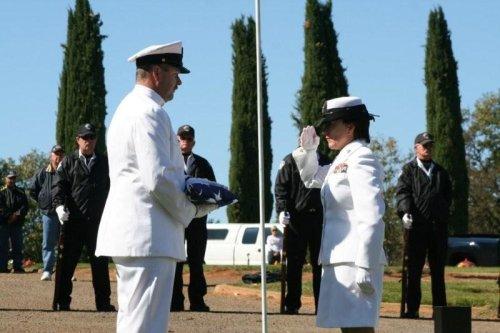
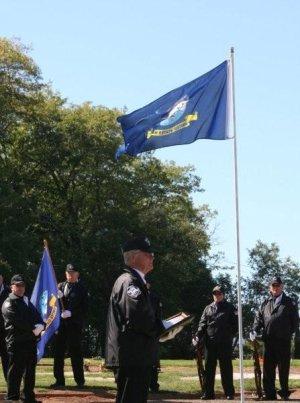
They received a military funeral on Saturday at Veterans Circle, located at Hartley Cemetery.
Approximately 55 motorcycles ridden by members of the Patriot Guard Riders escorted the cremains of the two men to the cemetery.
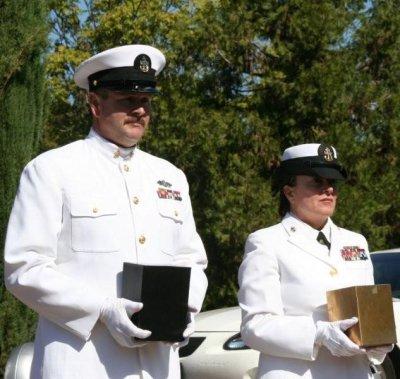
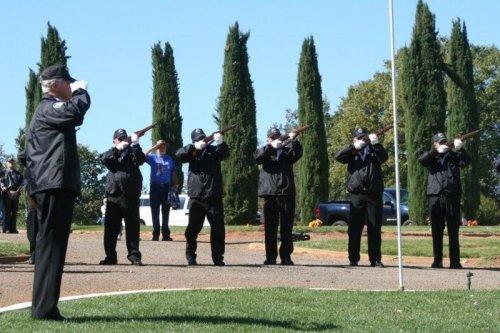
Two Naval officers, dressed in stark white uniforms, carried the small boxes of cremains to the center of Veterans Circle, setting them on two small benches next to U.S. flags folded into careful, star-studded blue triangles. A bagpiper and a bugler played the men to their rest, and the United Veterans Council Military Honors Team fired a salute.
Capt. Herman “Woody” Hughes, a retired US Naval Reserve officer and chaplain for the United Veterans Council, said Quinn and Kincaid died alone and with few friends.
Hughes said it was important to remember them and their sacrifice, and quoted English poet John Dunne's words, “No man is an island, entire of itself, every man is a piece of the continent ... any man's death diminishes me, because I am involved in mankind ...”
As veterans, the two men were part of the World War II and Korean War conflicts, according to their records.
“There are no unimportant jobs in the armed forces,” said Hughes. “There are no unimportant people in the armed forces.”
Dean Gotham, president of the Vietnam Veterans of America Chapter 951, accepted Quinn's flag from the Navy representatives, while Slick Hultquist of Lakeport, a Patriot Guard Rider member who also is involved with the Missing in America Project, accepted Kincaid's flag.
Relatively little is known about Quinn and Kincaid. The United Veterans Council was able to acquire basic information on Kincaid, who was born July 23, 1927, and served as an apprentice seaman in the Navy from 1945 to 1946 during World War II.

Slightly more is known about Quinn, whose discharge records was obtained by the United Veterans Council. Quinn, who was originally from Syracuse, New York, was born Feb. 2, 1929 and died this past Sept. 11.
Record show Quinn served in the Navy from January of 1953 to January of 1956. For his service he earned a Korea Service Ribbon, United Nations Service Ribbon, Navy Occupation Service Medal with a European clasp, China Service Medal, National Defense Service Medal and an American Area Campaign Medal.
He also received a World War II Victory Medal, which was given to any member of the armed forces who was on active or reserve duty from Dec. 7, 1941 to Dec. 31, 1946. Local vets suggested he may have had previous service during World War II that didn't show on the last discharge records.
Both Kincaid and Quinn were discharged honorably, according to military records.
Missing in America Project works on behalf of forgotten veterans
Playing an important part in Saturday's burial was the Missing in America Project (MIAP), a group whose mission is to locate, identify and inter the unclaimed cremated remains of veterans. Lake County News profiled the group in a May 2007 article, Missing in America Project searches for forgotten veterans.
MIAP, which incorporated in February of 2007, has a massive task ahead of it, considering the untold thousands of veterans – some of them having served in wars across a timespan that stretches into the 19th century – believed to be unburied and sitting on storage shelves in mortuaries, hospitals and institutions around the nation.
In many cases, the veterans have no living family or friends, and so they're left in the care of funeral homes. After a waiting period, the funeral homes must then decide what to do with the remains.
Oregon resident Fred “Ducpho” Salanti, executive director of MIAP's veterans recovery program and a Vietnam veteran, attended Saturday's ceremony.
Since May of 2007, when Lake County News first reported the group's efforts, significant progress has been made, said Salanti.
So far, MIAP has succeeded in retrieving and interring the cremains of 346 veterans – including Kincaid – which had been in storage and unclaimed by next of kin, said Salanti.
They've located another 6,300 stored cremains, of which between 10 and 30 percent are expected to be veterans. Salanti said they've also visited 620 funeral homes to inquire about helping inter unclaimed cremains.
Congresswoman Carolyn B. Maloney (D-NY) is drafting a bill that Salanti expects to be introduced in the 111th Congress next year; he said the legislation will assist in setting time limits that cremains can be held before being interred.
“We finally have some national sponsorship,” said Salanti.
Seven states – not including California – are working to have those time limits reduced before turning over information either to the Department of Defense or the MIAP, which can then verify if an individual is a veteran. That will then allow open the way to arranging for interment.
Kincaid is the first Lake County veteran whose cremains were interred through the efforts of MIAP working with local funeral homes. Hultquist is working with mortuaries in Lake and Mendocino counties to continue the process of interring lost vets.
For more information about the MIAP's local or national effort, contact Hultquist at 263-8105, Salanti at
E-mail Elizabeth Larson at
{mos_sb_discuss:2}
- Details
- Written by: Elizabeth Larson

To me, winter is soup time; throughout the entire winter I almost always have a pot on the stove making some kind of soup.
Originally I was going to wait until around late fall/early winter to do a column about lentils and include a recipe for lentil soup. However I’m not going to wait because of a discovery I made recently in an Upper Lake health foods store. Not only do they have some beautiful red lentils but also the hard-to-find French green lentils.
Lentils are very high in protein (26 percent), second only to soybeans, which is one reason why they are so popular with India’s vegetarian population (in India they are called dal or dahl). They also provide 90 percent of the US Recommended Daily Allowance of folic acid, higher than any other food. In addition they are high in iron and carbohydrates.
As I write this I’m thinking, “You always hear that pregnant women should get more folic acid, pregnant women should get more protein, pregnant women should get more iron; maybe we’ve found the perfect food for women who are carrying a child or two,” but then I remember that lentils were also considered an aphrodisiac so maybe lentils would just be a new can of worms. They are also rumored to make children more alert and studious.
Lentils come in many different colors, which makes for some fun choosing. The average mega-mart typically carries an olive drab type (actually called “brown lentils”) which, although nutritious, are the least flavorful and makes an unfortunately-colored olive/gray soup or paste that looks like it should be used to spackle military installations.
Sometimes dried split peas are called lentils and they are used in many dishes with lentils, but they really aren’t lentils and so won’t be part of this discussion.
Lentils also decrease insulin requirements for diabetics (now, check with your doctor before any radical changes in your diet or I’ll just point at you and laugh). Lentils make great soup, a unique side dish and can even be made into bread.
Naturally (no pun intended), I was thrilled when I found the brightly colored pink/orange (actually called “red”) lentils in the health food store in Upper Lake. And the green lentils which actually are green with speckles of black are a treasure to find in the county.
Green lentils don’t break down when cooked so they make a great side dish. They hold their shape and have a unique flavor reminiscent of black pepper. Green lentils are sometimes called Puy lentils since they originate and are revered in the Le Puy en Velay region of France.
The scientific name for lentils is Lens Culinaris, and larger types of lentils belong to the group macrosperma while smaller varieties belong to microsperma. No, that’s not very interesting, but I wanted you to have the information anyway.
Lentils are considered to be one of the oldest cultivated crops with evidence of their domestication going back 10,000 years. Objects like your camera lens and the lens in your eye are actually shaped like lentils and therefore are named after them, not vice versa. They are mentioned frequently in literature throughout history. Even the infamous Greek gastronome Apicius had several recipes for lentils. They were the food of the rich and poor alike.
There are current studies showing that Great Britain experienced a “Mini Ice Age” from the 16th to 19th centuries where the climate was too cold for warm-season loving plants like lentils to grow. These findings are even backed up by insect, fish and many public records of the time.
In Hungary, traditionally a pork and lentil stew is eaten after midnight on Dec. 31 to ensure financial success in the New Year, both pork and lentils being symbols of prosperity.
Lentils are simply planted, grow best in poor soil, are easily harvested and winnowed, and so they have always been a very inexpensive food throughout the ages. Many cultures consider lentils as poverty food although they were buried in tombs with the pharaohs. The Egyptians even used them as packing material before the invention of those pesky Styrofoam peanuts. Over 100 tons of lentils were used to ship an obelisk from Egypt to Vatican City.
Lentils are a legume just like beans, but what really is a legume? A legume is a seed that grows inside a pod. So just count off in your head what’s a legume ... beans, peas, lentils and, yes, even corn. Try calling corn a legume sometime and watch people as they try to figure out if you’re correct or not.
When preparing lentils, always sort through them by hand to look for any rocks or stones. The manufacturer tries to remove all these it possibly can, but the technology and machinery to remove small hard objects out of a pile of small hard objects hasn’t been perfected yet; it’s like finding a needle in a pile of pins.
Green lentils retain their shape after cooking and take about 20 minutes to cook, while other lentils like red lentils dissolve during cooking and take only 15 minutes to cook. If you add anything acidic to the cooking liquid it will slow the cooking down, so you will need to allow some more time.
The French, I can only guess in honor of Esau from the Old Testament selling his birthright for a meal of lentils, named a dish of lentil porridge or stew “Potage Esau.”
Esau’s act has been fodder for biblical scholars for quite some time; after all, what could have been going on in his life to cause him to give away this right for just one meal? Evidently he was starving but why? Or did he really love lentils? The Bible never explains this point.
Lentils also are a traditional Jewish food to be eaten during mourning since they are round and have no mouth (it’s a long story).
I don’t consider recipes as biblical documents that should be copied without reconsiderations; rather I consider them as guidelines for you to start from, then take out what you don’t like and add a little of what you do so feel free to play with this recipe.
Lentil soup
1 ½ cups red lentils
4 cups chicken stock or broth (with an extra cup set aside for later just in case)
1 slice fresh ginger (a disc the size of a quarter)
1 pinch nutmeg
Cayenne pepper powder (I used dash of African bird pepper)
1 sprig thyme
½ medium onion, minced fine
1 clove garlic, minced fine
4-5 threads saffron
1 tablespoon butter
Juice of one lemon
Melt the butter in your favorite soup pot. Add the onions and sweat until tender, then add the garlic and cook for one minute. Add the lentils and continue to cook until you start to see some of them start to turn yellow. Then add the chicken stock and bring to a boil.
Reduce heat and add ginger, thyme, nutmeg, saffron and pepper. Simmer for an hour, stirring occasionally. When the lentils have dissolved, thin the soup with water or stock to the desired consistency and finish with fresh lemon juice to taste.
Ross A. Christensen is an award-winning gardener and gourmet cook. He is the author of "Sushi A to Z, The Ultimate Guide" and is currently working on a new book. He has been a public speaker for many years and enjoys being involved in the community.
{mos_sb_discuss:4}
- Details
- Written by: Lake County News Reports
The incident was unfolding at about 9 p.m. on Highway 20, as a white Ford Focus registered in Eureka was being pursued eastbound by CHP, Ukiah Police and Mendocino Sheriff's deputies.
At least six Lake County Sheriff's deputies and local CHP joined the effort to stop the car, which at one point veered into the oncoming lane and nearly hit another vehicle head-on.
Law enforcement was preparing to place spike strips when the Ford Focus reportedly crashed into a field at Blue Lakes and Scotts Valley roads shortly before 9:30 p.m.
Two suspects were believed to be involved, a male and a female. Officers and deputies were reported to be in a foot chase at Le Trianon Resort.
A sheriff's K-9 was brought in and put to work looking for the suspects shortly after 9:30 p.m. A second K-9 and paramedics originally called to the scene were canceled.
The search for the suspects continued late into the evening, with at least two CHP officers, two Ukiah Police units and several sheriff's deputies looking around the Blue Lakes area.
No arrests were reported by publication time.
E-mail Elizabeth Larson at
{mos_sb_discuss:2}
- Details
- Written by: Elizabeth Larson and Harold LaBonte