 How to resolve AdBlock issue?
News
The event features music from Alhambra Valley Band, Sidesaddle, The Mighty Crows, Pat Ickes & Bound to Ride, Mountain Laurel Band, Public Nuisance, The Mighty Chiplings, Laura and Darin Smith, and others for performances on two stages all day.
Musician workshops will be held throughout the day on such topics as banjo, fiddle and flat-picking techniques for guitar. Attendees are encouraged to bring their instruments for workshops and informal jam session.
The Old Time Bluegrass Festival will feature demonstrations and vendors selling old-time handmade crafts, Art in the Barn, a wine garden featuring Lake County wines, and a beer garden, as well as food prepared by local service clubs and local schools’ culinary programs.
The Old Time Bluegrass Festival will be held from 10 a.m. to 6 p.m. Saturday and from 10 a.m. to 4 p.m. Sunday. Gates open on both dates at 9:30 a.m.
Advance tickets are $15 for Saturday, $10 for Sunday, or $25 for both days. A limited number of advance tickets will be available for purchase at various locations and on the Web site, www.andersonmarsh.org, or call 707-995-2658. Children 12 and under may attend free but must be accompanied by a parent.
{mos_sb_discuss:2}
- Details
- Written by: Lake County News reports
On Aug. 28 the state Assembly approved AB 2747, the Terminal Patients End of Life Information Act,” which Berg's office reported is meant to give patients the right to receive a candid assessment of what to expect when they are dying of a terminal disease.
Berg, D-Eureka, wrote the bill to require health care providers to answer their patients questions, and to tell them about their rights and options when in their final months of life.
“I fully expect we’ll see better pain management, more use of hospice, and fewer people in a panic at the end of life,” Berg said in a statement.
The measure, previously approved by the Senate, passed the Assembly in a 42-33 vote. It now waits to be signed by Gov. Arnold Schwarzenegger, who said last month he won't sign any more bills until the budget is done, although he made an exception for a high-speed rail bill.
A recent nationwide study by cancer doctors found that only one in three terminally ill patients were told about their treatment and pain-management options by their doctors, even when their doctors knew the patients were dying.
Those patients who did receive frank information were less likely to die in intensive care, more likely to receive hospice; and their families were better prepared for their loss than were the families of patients who were uninformed. according to the study.
The California Medical Association and many other health care organizations, as well as senior citizens’ groups, civil liberties advocates and others supported AB 2747.
It has, however, drawn opposition from groups that believe it is a back-door route to the kind of death-with-dignity bill that Berg authored in previous years. The opposing groups include California Disability Alliance, California Family Council, California Nurses for Ethical Standards, Mercy San Juan Medical Center, Sierra Nevada Memorial Hospital, and St. Mary's Medical Center, San Francisco.
“This bill is about information and nothing else,” Berg maintained.
Sen. Sam Aanestad (R-Grass Valley) says he's urging Schwarzenegger to veto the bill.
Aanestad, a licensed oral surgeon and vice-chair of the Senate Health Committee, said he has deep concerns about the effects of AB 2747 on patient care.
“The so-called end of life options act interferes with the medical care of people who just received the worst news of their lives,” Aanestad said in a written statement. “State government has no business intruding upon the doctor-patient relationship at that time, yet that is exactly what this bill does.”
His office reported that AB 2747 is sponsored by an organization called Compassion and Choices, formerly known as the Hemlock Society, which has strongly advocated for physician-assisted suicide legislation in the past. The founder of this group, Derek Humphry, once praised Dr. Jack Kevorkian for assisting in the deaths of 130 people.
Dozens of opponents testified against this measure during a recent marathon hearing of the Senate Health Committee. They included disability rights advocates, nursing organizations, doctors who care for cancer patients, minority rights groups, members of religious communities, hospitals and individuals whose lives and families are affected by this issue.
He said the measure is cloaked as compassion but actually opens the door to further “end of life” intrusions.
Aanestad said that patients facing terminal illness need information based on who they are as individuals, not an intrusion into their relationship with their doctor.
“Patients don’t need their doctors to dispense a laundry list developed by Sacramento politicians,” he said. “It’s downright cruel to take a list of treatments that may not even apply to a patient and have the doctor say, ‘Here, this is what the state of California legislates I must tell you when you find out that you’re dying and you ask me what to do.’”
Will Shuck, Berg's chief of staff, told Lake County News they're still awaiting the outcome.
“Hopefully the governor will give greater weight to the California Medical Association and all the other health organizations in support of the bill than to the opinion of a dental surgeon who may never have to tell a patient that they have a terminal illness,” Shuck said.
{mos_sb_discuss:2}
- Details
- Written by: Lake County News reports
LAKEPORT – A San Francisco man is facing more than four years in state prison after being sentenced for a burglary and assault with a firearm in a 2005 incident in Clearlake Park.
Renato Hughes Jr., 24, was sentenced Monday afternoon by Judge Arthur Mann.
He was convicted last month of burglary and assault with a firearm; at the same time, he was acquitted of two homicide counts he faced under the provocative act, and robbery and attempted murder charges, as Lake County News has reported. A charge of causing great bodily injury resulted in a hung jury.
The prosecution alleged that Hughes and two friends, Christian Foster and Rashad Williams, had broken into the Clearlake Park home of Shannon Edmonds and Lori Tyler in the early morning hours of Dec. 7, 2005, planning to steal Edmonds' medical marijuana.
Tyler's son, Dale Lafferty, then 17, was assaulted with a baseball bat and left with permanent brain injuries.
Mann said that, because of the violence of the burglary, he was sentencing Hughes to the upper term of six years in prison with a one-year enhancement for the burglary, plus another year for the assault charge, which was a mid-term sentence for that crime
In all Hughes received an eight-year prison sentence, according to Mann. With time served and a 15-percent time credit, he should face just over four years in state prison.
Following the hearing, which lasted more than an hour, Hughes' attorneys, Stuart Hanlon and Sara Rief, said they expected Hughes to appeal the conviction and sentence.
Hughes' case has generated significant attention in the nearly three years it's been under way, in part because he was being tried for two homicides he didn't commit.
Edmonds shot Foster and Williams as they ran from his home but has never been charged. Hughes was charged with the murder under the provocative act doctrine, which held him responsible for the deaths because he was alleged to have taken part in a crime with a possible lethal result.
Hanlon had argued that Edmonds was a drug dealer and had killed the men in a drug deal gone wrong.
In making the sentencing decision, Mann considered a 22-page probation report, victim impact statements by Tyler and Lafferty's grandmother, Deborah Besley, and arguments by Hanlon and District Attorney Jon Hopkins.
Reading her statement before the court, Tyler thanked Hopkins for “bringing out the truth” of the case.
She said she didn't have feelings of hatred for Hughes but believed that, if one of the men involved had spoken up, the incident that led to her son's near-fatal beating and the deaths of Foster and Williams could have been avoided.
"Dale was a wonderful young man with a great future and everything going for him," she said.
Today, he has to have 24-hour daycare after suffering eight skull fractures during the incident. Tyler said he had to have surgery to remove part of his brain in order to survive.
"The counselor told me that I have lost my son," she said, adding when she took him home after his hospitalization, it was like bringing home a 170-pound infant.
She and Edmonds are no longer together, and she said she has trouble sleeping at night, sometimes getting up to check the doors and windows.
"You never dream that anything this horrible cold ever happen to you," said Tyler, asking Mann for the strictest sentence.
Reading her statement, Besley said Hughes, Williams and Foster made the decision to take away her grandson's future.
"This is not a crime of race, this is a crime of burglary and assault," she said.
She asked Hughes, "Renato, do you have any idea what you have done to Dale and his family?" Hughes looked up at her from the defense table as she asked the question.
Besley said it costs $48,000 a month to care for Lafferty at a special care home more than 400 miles away.
She, too, asked the court for the maximum sentence. "Why should you get all the opportunities that Dale will never get?" she said to Hughes.
As Besley was speaking, Hughes' sister, sitting in the audience, said, "He didn't do anything," which she repeated as Besley turned to return to her seat.
Hopkins relayed to the court a brief statement from Edmonds, who said he whole life was ruined as a result of the incident, adding it has impacted his 11-year-old daughter.
Edmonds was not present at the sentencing. On Saturday, he was arrested by Clearlake Police on a drunk and disorderly charge, but has since been released from jail, according to jail records.
The families of Foster and Williams are suing Edmonds and Tyler in federal court, a case expected to come to trial next year, as Lake County News has reported.
Prosecution, defense debate sentencing
Hughes himself took the chance to speak to the judge during the hearing, appealing to Mann's sense of fairness.
“I stand by my innocence in this whole ordeal,” said Hughes, who noted he has been incarcerated for 33 months.
If he could give Lafferty back his life and bring back Foster and Williams, Hughes said he would.
He said he looks forwarding to having positive opportunities once he's released, including going to college and becoming “a productive and contributing member of society.”
He said he wouldn't continue to be degraded and humiliated by the accusations against him. “Only God can judge me.”
Hughes said he looks forward to being home with his young daughter.
Hanlon told Mann that he had objections to the probation report, and he also faulted Hopkins for statements he's made about the jury verdict in the media.
He said the fact that Hughes was acquitted of most of the charges keeps getting lost. “Those acquittals define the facts.”
Hanlon said the jury found that Hughes was not responsible for Lafferty's injuries, and asked that the entire probation report be stricken due to its lack of impartiality.
Hopkins asserted that the facts of the case still remain, and then discussed previous convictions on Hughes' record. When the 2005 incident happened, Hughes was on probation for driving under the influence, said Hopkins. Hughes also has a conviction for having marijuana for sale.
The probation officer who prepared the report for the sentencing interviewed Hughes, whose statements differ from those he made on the witness stand during the trial, said Hopkins. The report, he said, quoted Hughes as saying the police planted his blood in Edmonds' house to link him to the scene, “which is patently ridiculous,” said Hopkins.
As Hopkins began to recount testimony Hughes gave in court, Hanlon said he objected to an attempt to retry the case. Mann overruled the objection.
Mann said he didn't consider Hughes' prior record significant. However, Williams and Foster inflicted significant injury during the incident, which Mann said demonstrated planning and professionalism.
Hopkins asserted that the burglary was particularly brutal. “Someone had a shotgun, someone had a hammer, and a melee broke out.”
Hanlon responded that Hughes' level of involvement, which was “some sort of aid and abet” and not the murders or use of the bat, called for no more than a midterm sentence with no enhancements, for a total of four years.
Mann said he gave no weight to the two homicides because the jury found Hughes not guilty and Edmonds was “integrally involved.”
“I do find that there was great violence in this burglary,” said Mann, which led him to conclude it merited the upper term.
After handing Hughes the sentence, Mann explained his right to appeal. The appeal must be filed with the Superior Court within 60 days.
He asked Hughes if he had any questions about the sentence. Hughes only responded, “At least I'm not getting life” – which is what he would have faced had he been convicted of the homicide charges.
Hopkins informed the court that he would not seek to retry Hughes on the single charge of assault causing great bodily injury, which had resulted in a hung jury.
E-mail Elizabeth Larson at
{mos_sb_discuss:2}
- Details
- Written by: Elizabeth Larson
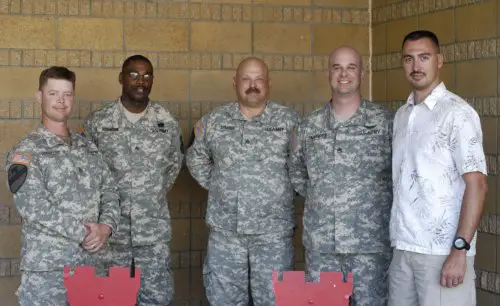
LAKEPORT – A Sunday celebration at Lake County's National Guard Armory officially welcomed home local guardsmen who returned from serving in Iraq this spring.
Staff Sgt. Everette Prescott, 40, of Kelseyville; Sgt. First Class Chad Holland, 36, of Kelseyville; Sgt. Chris Deshiell, 47, of Willits; Staff Sgt. John Snowden, 37, of Lakeport, and Staff Sgts. Russell Wright and Don McPherson returned in May after serving in Iraq in the 649th Engineering Unit from September 2007 to this past May.
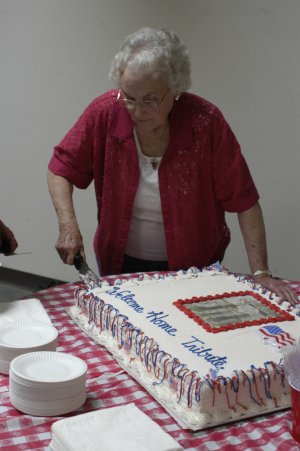
The Lakeport Veterans of Foreign Wars Post 2015 and the Vietnam Veterans of America Chapter 951 put on the event, which welcomed all active members of the military and veterans from Iraq and Afghanistan, as well as veterans of other wars.
The afternoon event included a dinner, live music, awards and raffle prizes, led by VFW Commander Robert Deppe and his wife, Lisa.
Randy Sutton, whose son is on his fourth tour in Iraq, spoke about the importance of service.
VVA President Dean Gotham, after he was done with barbecue duty, added his note of thanks to the returning soldiers, telling them their service was both valued and appreciated.
"Welcome home," he said. "You're among friends."
The returning soldiers are among many local National Guard members who have served in Iraq in recent years, including Cliff Shores and Norman "Joe" Valdez Jr., both of whom are now retired from the service; Specialist Danny Strawn, Sgt. Jacob Taylor, Denny Salisbury and Travis Benson.
Sgt. Albert Manfredini and Sgt. Jody Helms both served in Egypt in 2004 as multinational forces observers with the United Nations, where they acted as "referees" between Egypt and Israel.
The men who returned from the deployment this spring were responsible for convoy security, working around Baghdad, Sadr City and Balad.
They come from a variety of backgrounds. Prescott works for Lake County Special Districts, Holland is a correctional officer with the Lake County Sheriff's Office, Deshiell is employed at Willits Furniture and Snowden is a full-time staffer with the local National Guard armory, where he serves as active guard reservist. Wright and McPherson did not attend the Sunday event.
None of the men had been deployed overseas to Iraq before last year. However, after Sept. 11, 2001, all of them took part in Operation Noble Eagle, said Snowden. Noble Eagle was a domestic security effort that included guarding the Golden Gate Bridge, chemical depots in Utah and other sensitive areas.
This past February, they hit a few improvised explosive devices – IEDs – and came under small arms fire on the east side of Sadr City, where they had just completed building a new combat outpost. Holland, a platoon leader, said they had some minor damage to vehicles but mostly were "ticked off."
Fortunately, none of the men were injured or saw serious fighting in Iraq. All of them, however, report trouble sleeping at night and other issues related to dealing with the stress of being in a combat situation.
Snowden said they ran their missions mostly at night. A strict curfew was in effect, so if they encountered anyone on the roads they had clearance to be aggressive in confronting them.
The men say that the situation in Iraq is not as bad as the media makes it appear. While the emphasis is on fighting and explosions, they said the new bridges and schools being built, along with new roads and water systems, don't get much coverage.
"I think, just generally, it's an unpopular war," Holland said, offering his explanation of its perception.
Although they didn't have the opportunity to meet and talk with civilians on a regular basis, in the encounters they did have they didn't experience hostility from most Iraqi citizens, who they found to be very generous and courteous.
Holland recalled a case where an Iraqi baker came out to speak to the soldiers one day, then returned to give them cake after cake, not asking for any payment, until they had to refuse to accept any more of the cakes he'd piled into their arms.
The men said they made a point of waving to people to try to present a friendly face. They also received a warm reception from school children they met, who they treated with glow-sticks. Some soldiers were known to give the children energy drinks, which the local sheik and the local school teachers didn't welcome.
There is definite hostility from some groups, however, such as the forces of Muslim cleric Moqtada al-Sadr, whose personal army defended Sadr City. US forces often get caught in the crossfire between Shia and Sunni Muslim factions, the guardsmen explained.
There also is the issue of weapons smuggling from nearby Iraq and Syria. Sgt. James Robinson, 37, of Lakeport, a postal worker who served in Iraq from 2004 to 2005 in a Petaluma-based unit before joining the local armory, said he was part of a patrol that looked for weapons coming into the country.
Prescott, who works on the county's sewer system, said Iraq's sewer systems and its entire infrastructure is aging and, in many cases, broken down. When Saddam Hussein's government fell, it left a vacuum regarding the management of those systems, as well as the electrical grid.
The men all noted the emphasis being placed on building clean water systems in the country.
Snowden said they saw definite improvements during their time there. For one, as security increased, people began to start cleaning up their neighborhoods, which had been littered with garbage.
He said they also saw people putting their lives back together. When the men first got to Iraq, a road they commonly traveled along was often deserted, with just a few people seen along it due to fears for safety. As they were preparing to leave, they drove down it one day to find it crowded with people and soccer games, with people waving and smiling at the soldiers as they passed.
Prescott said they saw a large community garden being grown along a security barricade wall, in an area where residents hadn't frequented.
Asked about when the US could begin to pull out, none of them can offer a definitive idea of when it can happen.
Holland suggests much of it depends on the Iraqi army and police forces, both of which are under increasing threats and pressure from insurgents. He noted they are stepping up more, and have taken over Anbar Province.
The Iraqi army also was able to take over Sadr City with no shots being fired, which wouldn't have been the case if US forces had gone in, said Snowden, because of al-Sadr's anti-American stance.
Overall security continues to be an issue, with police in some areas turning blind eyes to roadside bombs planted by insurgents, or being bribed to ignore them, said Prescott.
The soldiers are concerned that if the US leaves too soon, Iran and Syria will seek to fill the void in Iraq.
"I think we're going to maintain a presence there for years to come," said Prescott.
Holland said problems with insurgents and terrorist cells aren't new. He pointed to Germany during World War II, where even after Adolf Hitler committed suicide, his forces tried to fight the Allies. However, historians continue to debate just how severe of a problem the Nazi "werewolf" forces were.
One unit member from Fulton may be facing deployment soon, but no other local members are scheduled to go to Iraq currently. All of the men have a 24-month hold before they could go back, either by order or voluntarily, said Snowden.
They approach their service matter-of-factly. "You joined up, you gotta do your fair share," said Snowden.
Robinson said he's encouraged by the increasing community support for guardsmen, such as the event put on for the men on Sunday. He called local support for soldiers "outstanding."
All of the men say they missed their children most while overseas.
Snowden said his 10-year-old daughter asks a lot of poignant questions – such as what happens when you get blown up – about his time overseas. "I don't answer most of them."
E-mail Elizabeth Larson at
{mos_sb_discuss:2}
- Details
- Written by: Elizabeth Larson