 How to resolve AdBlock issue?
News
- Details
- Written by: Harold LaBonte and Elizabeth Larson

LAKE COUNTY – Efforts to increase the number of local students who will attend four-year colleges are seeing results, say county education officials.
The Lake County Office of Education's College-Going Initiative, now in its fourth year, seeks to give students the knowledge they need about college requirements in order to move them on to higher education, said Jamey Gill, a curriculum and instruction specialist.
It appears to be working based on a few years' worth of data, although the county's college attendance numbers still aren't huge.
Gill said last year 105 local students were accepted to four-year colleges. That number edged up slightly this year to 108. Gill called the numbers “encouraging.”
This year the program has begun tracking community college students making the move to a four-year school this year, said Gill. Five students from Yuba College are going on to new schools, and the Lake County Office of Education is working with Mendocino College to track how many local students are moving to four-year institutions.
Twenty-six local graduates were accepted at University of California institutions, among them Santa Cruz, Berkeley and Davis, said Gill. Popular California State Universities include Sonoma State – one of the schools with the largest Lake County student population – along with Humboldt, Chico and Sacramento.
A few students are even on their way to out-of-state schools, Gill added.
The business of getting to college, said Gill, is much bigger than just having good grades or filling out the application.
A great deal rests on completion rates for “A” through “G” courses, which are completed in high school and make students eligible to attend four-year colleges or universities, she explained.
“We are below the state average, though, and that's what we're really working on,” she said. “We want to get kids eligible.”
Gill said many students don't understand the course requirements until it's too late. “It makes many voices” outside of school counselors – including parents, teachers and others – to get the message across, she added.
Lake County Office of Education Superintendent Dave Geck said the resources that go into the program are a combination of his agency's staff coupled with the staff efforts of higher education partners such as the University of California, San Francisco.
The Office of Education receives money from the University of California to assist in some of the program's projects, said Geck.
The College-Going Initiative includes special grade-level activities to get students to the point of meeting all the criteria for higher education, said Geck.
Those activities include special presentations, college visitations, SAT preparation classes and financial aid workshops, and algebra academies for eighth graders, he said.
The initiative tops off the year with a celebration of students who are making that next big step in their education.
On April 28, the Lake County Office of Education held its third annual dinner and reception for students accepted to four-year institutions.
Eighty-five of the 113 students honored – along more than 100 family members, friends and teachers – attended the evening event, held at Kelseyville High School.
Also there to recognize the students were two dozen top officials from a cross section of Lake County school districts.
Guest speakers included Dr. Blas Guerrero from the University of California Office of the President, Geck and Kathy Kelley from the office of state Sen. Pat Wiggins.
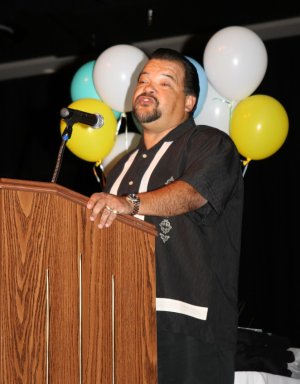
Guerrero offered comparisons of his personal experiences of his growth and education in California to the future opportunities the soon to be graduates may look forward to and advised that they could return to Lake County as “the role models of the next class of graduates.”
Geck said Guerrero has personally helped Lake County's College-Going Initiative in its efforts.
The Kelseyville High School Jazz band provided the evening's music and several Kelseyville high students contributed their time and efforts in the kitchen as well as serving and busing tables during the dinner hour.
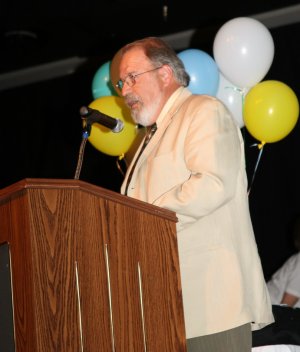
Gill said the students “were really excited” at the event.
“It just pumps the kids up,” she said.
The dinner is meant to encourage the students and make sure they take the next steps to get to college in the fall, said Gill. It's also an opportunity for families to celebrate and be recognized.
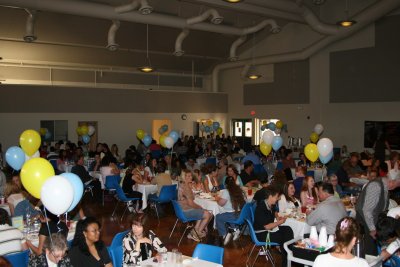
Many of the young people served by the initiative are the first in their family to make it to college, she noted.
Gill said the initiative is trying to keep the upward growth trend for college attendance going. In the coming years she believe some local education programs like algebra academies are going to increase the pool of students eligible to attend college.
Just around the corner is another College-Going Initiative event, Higher Education Week II, scheduled for May 12 and 13. The two days of workshops are aimed at all local students – upper elementary, middle and high school – and their parents, and offer the chance to learn more about several visiting colleges, as well as the college and financial aid application processes.
Lake County students accepted at four-year colleges or universities
Karina Acosta, Saint Mary's College
Jayson Adair, DeVry
Myrna Aleman, CSU Sonoma
Rathid Aliji, UC Riverside
Cecily Anaraki, UC Irvine
Johnathan Bateman, CSU Humboldt
Katrina Beaudin, CSU Sacramento
Cassie Belden, UC Santa Barbara
Nathan Bell, UC Irvine
Amanda Bettencourt, UC Davis
Danielle Bettencourt, Pacific Union College
Cole Bordisso, CSU Sonoma
Casey Bowlin, UC Santa Barbara
Kasey Bresso, University of Wyoming
Bianka Buchanan, CSU Long Beach
Celestine “CeCe” Burgher, CSU Sacramento
Rawley Butler, Silver Lake College (Wisconson)
Annemarie Catrambone, Art Institute of San Francisco
Daniella Cazares, CSU Long Beach
Luis Cazares, CSU Sacramento
Cori Cockerton, CSU Sacramento
Noemi Cocone, Saint Mary's College
Krista Collins, CSU Sonoma
Guy Conger, Whitworth University of Washington
Ashley Crawford, CSU Humboldt
Kristin Currier, CSU Sonoma
Nikeedra Davis, CSU Chico
Katie Davis, CSU Humboldt
Candy Diener, CSU Sonoma
Nicholas Driver, UC Santa Barbara
Chyere Duncan, CSU Sacramento
Antoine Ellis, CSU Sacramento
Zoe Everett, University of Minnesota
Jennifer Frazell, University of Nevada Las Vegas
Daniel Gildea, UC Davis
Tyler Glazier, Brigham Young University, Idaho
Ashlee Graham, UC Santa Cruz
Robin Grayhorse, UC Santa Cruz
Rebecca Grupe, CSU Sacramento
Vanessa Guerrero, CSU Sonoma
Tracy Herrmann, Pillsbury Baptist Bible College
Jameson Holder, Crown College, Minnesota
Tyler Hunt, UC Santa Cruz
Erik Jameson, UC Davis
Trevor Johns, CSU San Diego
Loren Jones, DeVry
Norris Jones III, DeVry
Correy Koshnick, CSU Cal Poly San Luis Obispo
Ashley Lamb, CSU Sonoma
Bobby Latona, CSU Humboldt
Anna Lopez, Southern Oregon University
Benjamin Lopez, CSU Humboldt
Kyle Lowry, DeVry
Beatris Lozano, CSU San Francisco
Kate Lyons, UC Berkeley
Haley Mabery, University of Oregon
Benjamin MacDonald, Whitworth University of Washington, California Baptist University
Armando Martinez, St. Mary's College
Samantha Mattern, CSU Northridge
Maria Mendoza, CSU Sacramento
Jennifer Miller, CSU Chico
Stephanie Mitten, CSU Humboldt
Teina Moore, CSU Chico
Amanda Moore, UC Santa Cruz
Kayla Myrick, UC Davis
Kylynn Nelson, DeVry
Sarah Norris, UC Davis
Tyler O'Brien, Lourdes College
Kersti Olof, CSU Sonoma
Kellen Olson, CSU Chico
Francisco Olvera, DeVry
Victor Padilla, UC Davis
Hina Parmar, CSU San Jose
Aryn Pauly, CSU Cal Poly San Luis Obispo
Cierrra Peel, CSU Long Beach
Valerie Peng-Plevney, CSU Sacramento
Danielle Peterson, SF Academy of Art
Cynthia Pimentel, UC Davis
Joseph Rebolledo, CSU San Diego
Gabriela Reyes, CSU Sonoma
Victor Rico, CSU Sacramento
Darcy Rogers, CSU Humboldt
Chuck Rosencrans, UC Berkeley
Mary Ruffcorn, CSU Humboldt
Geneve Rupert, Schiller University
Joshua Salazar, UC Davis
Juan Salguero, CSU Humboldt
Jesse Salmeron, UC Santa Cruz
Austin Schader, CSU Cal Poly San Luis Obispo
Kelsey Sills, CSU Sacramento
Ashley Smith, Simpson University
Brent Smith, Masters College
Corey Smith, CSU Humboldt
Jodi Snider, Lewis & Clark
Conor Sullivan, CSU Cal Poly San Luis Obispo
Maegan Taylor, CSU San Diego
Noah Thorn, CSU Sacramento
Keith Todd, UC Davis
Nancy Trejo, UC Santa Barbara
Ashley Underwood, CSU Sonoma
Veronica Valadez, CSU Sonoma
Enrique Villanueva, CSU Chico
George Weiss, UC Berkeley
Andy Weiss, CSU San Jose
Nicole Wells, UC San Diego
Eric Wessendorf, UC Santa Cruz
Alexandrea Williams, CSU Sonoma
Beau Woodson, UC Berkeley
Alicyn Yaffee, CSU Sacramento
Megan Young, CSU San Marcos
Jonathon Ziemanski, DeVry
Elise Zolczynski, UC Santa Barbara
E-mail Harold LaBonte at
{mos_sb_discuss:2}
- Details
- Written by: Sophie Annan Jensen
THIS ARTICLE HAS BEEN CORRECTED.
LUCERNE – California Water Service, the drinking water division of the state Department of Public Health, the California Public Utilities Commission (CPUC) and its Division of Ratepayer Advocates were in Lucerne Wednesday evening to update the community on work at the Highway 20 treatment plant – and on paying for it.
The meeting was arranged by the Lucerne Community Water Association (LCWO) and attracted nearly 90 people.
LCWO President Craig Bach presented a petition with 430 signatures to Sean Wilson, a regulatory analyst with the CPUC. He said the petition asks that California Water Service Co. make full financial information on the $7.1 million plant upgrade available to the community.
The plant upgrades were required by the state Department of Public Health, which suggested a moratorium on new connections in 2006. The DPH had told Cal Water in 2002 there were deficiencies in the treatment plant and directed the company to correct them.
Cal Water applied for a 30-year, zero-percent interest loan from the State Revolving Fund for reimbursement of the costs it has incurred in the work. The plant is due to be in operation this September, and the company has announced it will then impose a water bill surcharge of $17.36 monthly to repay the loan.
The upgraded plant, which uses membrane filtration and ultraviolet disinfection, will allow for 10 percent growth in connections to the system; Bruce Burton of the drinking water division said that limit is a state requirement.
Some questioners wanted to know why the cost had grown from $3.6 million since the plant upgrade was first proposed in August 2005.
Cal Water rates manager Tom Smegal and engineer Jeff Yarne said some of the costs included $1.7 million for engineering studies on other properties which proved unsuitable for a treatment plant, and that there have been dramatic increases in in materials and transportation costs. They said costs at other locations would have been much higher.
Frank Parker, a Lucerne resident who worked on a crew that maintained the city of Weed's well and spring-fed water system in the 1960s, criticized the company severely for the overruns on its engineering studies, which were originally estimated at $260,000, and suggested they should have used Cal Water employees rather than consultants to do the work.
Yarne explained that Cal Water staff engineers are not construction engineers and the number of plants the company builds – one every other year – doesn't justify keeping construction engineers on staff.
Responding to 10-year-old Arthur Wilkie's question about what happens to the plant's old materials, Yarne said anything that can be recycled will be, including valuable steel and brass.
One questioner wanted to know how the treatment deals with "mercury in the water." Burton told him in 23 years of working in the district and monitoring testing he has never seen a sample positive for mercury, although it is in the lake sediment.
Much of the last hour of the two-hour meeting was taken up with the question of profits and explanations of the law governing loans from the State Revolving Fund.
Wilson and Danilo Sanchez, manager of the DRA, explained that construction funded by the State Revolving Fund does not become part of the rate base, and cannot create profit for the company if it sells the property. The financing is overseen and tracked by the CPUC, the DRA and a fiscal agent, such as a bank. Surcharges for loan repayment are kept in a balancing account and can be used only to repay the loan, Wilson said.
All Lucerne residents have received rate relief of $17 per month since the company's last rate increase was settled in July 2006, with the intervention of LCWO and its pro bono attorney, Steve Elias of Lakeport. The discount is funded by a one cent surcharge on Cal Water's other customers in California, some 500,000 households.
In addition, low-income Lucerne residents receive a $10 discount on their water use. Sanchez said four or five other California communities receive similar rate relief.
The company had asked for a 246 percent increase and received 121 percent.
E-mail Sophie Annan Jensen at
Editor's Note: The original article incorrectly stated that Frank Parker worked at the city of Weed's water treatment plant. Instead, he was on the city crew which maintained the well and spring-fed water system in the 1960s. Weed does not have a treatment plant, he said.
{mos_sb_discuss:2}
- Details
- Written by: Lake County News reports
The dinner is hosted by Marie Beery, and sponsored by Foods Etc. in Clearlake. The food, wine, and services are donated to support the Land Trust and its projects.
The public is cordially invited to attend the event, which starts at 6 p.m. with a no-host cocktail hour.
Numerous paintings by local nature artists will be on display and for sale. The artwork is donated by the artists to the Land Trust as part of the fundraiser. Several of the paintings will have been given awards stemming from the Land Trust’s Art and Nature event (held on May 3).
The proceeds from this dinner will go to the Land Trust’s many projects, including the Rodman Slough Preserve, the upcoming effort to preserve Mount Konocti, and other plans for preserving and protecting the beautiful habitats of Lake County.
The Rodman Slough Preserve is located on the north end of Clear Lake at the intersection of Westlake Road and the Nice-Lucerne Cutoff.
The Trust spearheaded the preservation of the property and hosts hikes and events there. The property is open for guided nature walks every Saturday morning, weather permitting.
The Land Trust is a private, nonprofit local organization dedicated to land conservation and protecting Lake County’s natural, recreational, historical and scenic resources.
To make reservations, at $60 per person, simply call the Saw Shop Gallery Bistro at 278-0129. Payment is made the night of the dinner, with all proceeds going to the Lake County Land Trust.
For more information about the Lake County Land Trust or the upcoming dinner, go to www.lakecountylandtrust.org or call 995-1398.
{mos_sb_discuss:2}
- Details
- Written by: Elizabeth Larson
Nicolai Chukreeff, 40, was stabbed to death in an incident that took place late Sunday night at the Harbor Lite Resort on Lakeshore Drive, as Lake County News has reported.
On Tuesday Lt. Mike Hermann of the Clearlake Police Department said that investigators were continuing to conduct interviews, but no arrest had yet been made.
Also on Tuesday, Chukreeff's autopsy was to be performed, said Hermann.
Preliminary findings from the autopsy are expected to be issued shortly, Hermann added.
Police are asking anyone with information on the case to call Detective Sgt. Tom Clements at 994-8251.
E-mail Elizabeth Larson at
{mos_sb_discuss:2}




