
News
LAKE COUNTY – If you hear dogs barking on a cold January night, they just might be two hunting dogs alerting their master, Orion, to the presence of a rabbit.
But we’re getting ahead of our story. Let’s start at the beginning.
In January, the winter skies are dominated by what may be the most beautiful of all constellations, Orion the Hunter.
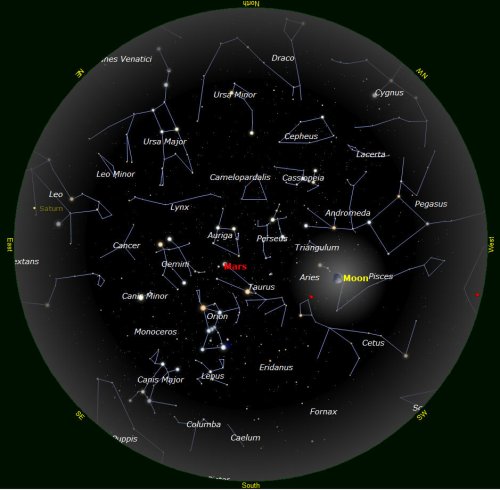
Look at our January star chart – Orion is below Mars, which is now fading from its December brightness as it begins to move away from the earth.
Orion is framed by four bright stars that represent his shoulders and feet. There are three stars in a line in the middle of Orion – they represent his belt.
In Greek mythology, Orion was a great hunter who boasted he would eventually kill all of the wild animals on earth.
This boast angered Gaia, the earth goddess, so she sent a scorpion named Scorpius to kill Orion. Scorpius was successful, stinging Orion on the heel.
To commemorate the Orion versus Scorpius main event, both were placed in the night sky. To prevent them from fighting, Orion was placed in the winter sky, while Scorpius was placed in the summer sky.
Below Orion’s belt is a magnificent object that can be seen through a telescope – it’s called The Great Orion nebula, and it looks like the picture below.

The Orion nebula is a huge cloud of dust and gas. New stars are born here, and we sometimes refer to this object as being a star nursery. Through a telescope of any size it is beautiful to behold.
Every great hunter should have some hunting dogs. Orion is no exception. Look at the star chart and locate Canis Major and Canis Minor. Those names are Latin for “Big Dog” and “Little Dog.” Canis Major has the brightest star in the sky, Sirius.
Sirius is sometimes called the “Dog Star,” for obvious reasons. In addition to being the brightest star, Sirius is also a double star. A tiny star rotates around Sirius like our planets rotate around the sun. This star is called “The Pup.”
The following photograph shows the Dog Star and Pup.

We mentioned the two dogs barking at a rabbit. That would be Lepus the Hare on our star chart. Lepus is a faint constellation originally cataloged by the ancient Greek mathematician-astronomer, Ptolemy.
On our star chart, you will note the bright full moon will light up the night sky on Jan. 15.
Keep that in mind, because in February we’ll talk about the eclipse of the moon that will happen at the end of that month.
For more information about astronomy and local astronomy-related events, visit the Taylor Observatory Web site at www.taylorobservatory.org.
On Jan. 12, starting at 8 p.m., the observatory will be open to the public. The life cycle of stars will be the featured topic.
John Zimmerman has been an amateur astronomer for 50 years. He is a member of the Taylor Observatory staff, where, among his many duties, he helps create planetarium shows.
{mos_sb_discuss:2}
- Details
- Written by: Lake County News Reports
On Friday morning District Attorney Jon Hopkins and San Francisco defense attorney Stuart Hanlon had disparate views of where the trial of 23-year-old San Franciscan Renato Hughes should be moved.
In November Hanlon won a change of venue request for Hughes after months of attempts to do that in appeals to the state's appellate and supreme courts.
Hughes is accused under provocative act theory of the deaths of two friends allegedly taking part with him in December 2005 home robbery.
It wasn't until a jury actually was seated in November that retired Alameda Superior Court Judge William McKinstry decided to grant Hanlon's change of venue request, citing his concern over the number of potential jurors who had been dismissed for various reason.
The Judicial Council of California's Administrative Office of the Courts is responsible for choosing possible venues when a change is granted, which isn't often, as Brad Campbell, the Administrative Office of the Courts' supervising analyst, told Lake County News last month.
A report Campbell submitted to Judge Arthur Mann last month said the office contacted the superior courts of Alameda, Fresno, Los Angeles, San Diego, San Francisco and San Joaquin to look for a suitable new venue.
Campbell wrote in the report that factors considered in looking for a new venue included ethnic diversity, transportation, availability of appropriate court facilities and support staff, and ability to accommodate the media.
Los Angeles and San Diego were available to accommodate Hughes' trial without undue burden, said Campbell. Fresno County indicated it could host the trial after March 1, but it would require a judge and staff.
During the brief hearing Friday morning, which lasted about 20 minutes in Judge Mann's Department 3 courtroom, Mann revealed that on Thursday Contra Costa County was added to the list.
“Contra Costa can now handle this case in late March or early April,” said Mann.
Hughes was present at the hearing, sitting beside Hanlon in a black- and white-striped Lake County Jail uniform.
For Hanlon, who has a teenage son and wants to be able to return home from court every night, Contra Costa was the best choice.
Not so for Hopkins, who argued that Hanlon's “publicity moves” have saturated Bay Area counties, including Contra Costa.
Hopkins cited TV and radio shows, and numerous articles by the area newspapers including the San Francisco Chronicle in his argument. He added that Hanlon has used a group based in Richmond – located in Contra Costa County – to protest the case on the courthouse steps.
Contra Costa, Hopkins stated, “would be a county this case could not go to without a full survey and analysis of how it would affect people.”
Neither was Los Angeles an ideal choice, according to Hopkins, who called it a “logistical nightmare” that would significantly increase costs for the trial, including housing of witnesses.
Of the three, San Diego is the best choice, said Hopkins, thanks to the courthouse's close proximity to the airport, making it easy to transport witnesses in and out.
Responding to Hopkins' concerns about publicity in Contra Costa County, Hanlon said, “He didn't mind all the media when it was in Lake County.”
Contra Costa is close, said Hanlon, and therefore more convenient for everyone involved.
“Either Los Angeles or San Diego is incredibly expensive,” Hanlon said.
Another concern for Hanlon is San Diego's black population, which he said is below the state average – a number that Hanlon did not specify.
Hanlon said he didn't believe a survey would find that Contra Costa County residents knew much about the Hughes case.
Hopkins replied that the court had records of all the Bay Area media coverage. The Lake County publicity for the case, he said, was far less than that witnessed by the Bay Area.
“This issue with the publicity in the Bay Area is widespread,” said Hopkins.
Hopkins said he was disappointed that the Administrative Office of the Courts didn't contact Sacramento County to gauge its superior court's availability. Sacramento, he said, has a “well-balanced diversity,” and hasn't had the Bay Area media to influence it.
He also addressed Hanlon's comments about a certain black population level being a factor for choosing a venue. “Mr. Hanlon seems to think there's some support for his position.”
Only seven California counties exceed the state average for black population figures, said Hopkins.
According to Hopkins, Hanlon took a petition to the state Supreme Court asking them to consider race in addition to other factors in determining a change of venue. “The Supreme Court denied that petition,” he said.
Hopkins asked Mann's court to contact Sacramento County's presiding judge to ask that they consider making their court available for the case.
Both Hopkins and Hanlon indicated their desire to further argue their cases for specific venues.
Mann asked what evidence Hopkins planned to present against moving the trial to Contra Costa. Hopkins indicated he would submit copies of radio and television broadcasts, in addition to copies of stories published by Bay Area publications which Hopkins said were already in the court's possession.
Mann gave Hopkins a Jan. 17 deadline to submit those materials in preparation for the next hearing.
The case will return to Mann's courtroom on Jan. 22, at which time defense and prosecution will present their cases to Mann, who must ultimately decide where Hughes' trial should move.
E-mail Elizabeth Larson at
{mos_sb_discuss:2}
- Details
- Written by: Elizabeth Larson





 How to resolve AdBlock issue?