
News
- Details
- Written by: Elizabeth Larson
CLEARLAKE – A Clearlake handyman accused of a May 4 homicide pleaded not guilty Friday.
Andre Stevens, 42, made an appearance before Judge Steve Hedstrom in Department 4, according to his attorney, Jason Webster. Deputy District Attorney John Langan is prosecuting the case.
Stevens is being charged in connection with the death of John Rayford McCoy Jr., 42, at a Lakeshore Drive apartment complex.
As Lake County News previously reported, Clearlake Police arrested Stevens for McCoy's murder after they reportedly found him with a knife, covered with blood. McCoy is reported to have identified Stevens as his attacker before he died, according to a Clearlake Police report.
Stevens is facing a murder charge, Webster said, as well as a special allegation of using a dangerous weapon – in this case, the knife.
Webster entered a not guilty plea on the murder count with a denial of the special allegation regarding the knife.
Stevens is scheduled for arraignment on June 11 before Judge Arthur Mann in Lakeport, Webster said.
Stevens remains in the Lake County Jail on $1 million bail.
E-mail Elizabeth Larson at
{mos_sb_discuss:2}
- Details
- Written by: Elizabeth Larson
LOWER LAKE – A fire Friday morning reportedly left one person so seriously injured that they had to be transported to a burn unit.
The California Highway Patrol incident logs reported that a propane tank explosion caused a vegetation and structure fire at Brown's Recreation Center on Orchard and Highway 53 in Lower Lake. The fire was reported at 9:56 a.m.
The victim, whose identity and gender wasn't reported by CHP, was transported by officials to Redbud Hospital's emergency room, and then transported via REACH helicopter to a burn center due to the severity of their injuries.
Calls to Lake County Fire Protection District yielded no further information on Friday. Fire officials were out on other calls all day and were unavailable for comment.
E-mail Elizabeth Larson at
{mos_sb_discuss:2}
- Details
- Written by: Elizabeth Larson
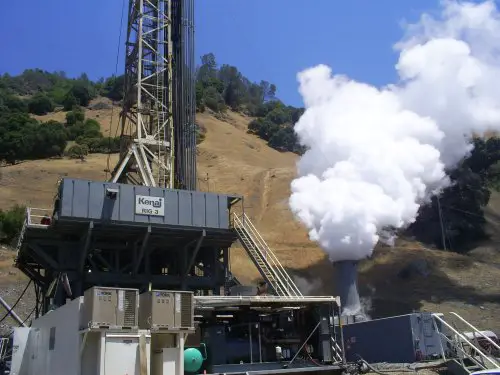
THE GEYSERS – Standing near a geothermal well billowing thousands of pounds of hot steam into the sky, Calpine officials on Thursday launched a multimillion-dollar effort that they say will significantly increase geothermal power production.
Over the next five years, Calpine Corp. will invest $200 million to expand steam production and identify new sources of geothermal power, and replace geothermal turbines with more efficient models, said chief executive officer Robert P. May.
State and local officials took part in Thursday's events at Calpine, which included a visit to The Geysers, in a rugged and remote area straddling Lake and Sonoma counties.
May; Dennis Gilles, senior vice president for geothermal power operations; and other Calpine officials were joined at the event by California Public Utilities Commission Commissioner Timothy Alan Simon.
Calpine was found in 1984, and got its start at The Geysers in 1989. Today, Calpine owns 19 of the 21 geothermal units in the 40-square-mile Geysers steamfield network – the Northern California Power Agency owns the other two plants – and employs 350 people in what is the world's largest geothermal facility, Gilles reported. The company has corporate offices in both San Jose and Houston.
May and Gilles emphasized geothermal power's renewable aspects and its almost constant availability. Twenty-five percent of California's renewable energy is produced at The Geysers.
The Geysers produces 725 kilowatts of power, which is enough energy to supply 725,000 households, May said.
Calpine hopes that its investments in new equipment and finding efficiencies will yield as much as 80 kilowatts more power production, said May. That's how much energy is needed to power another 80,000 households.
Gilles said Calpine sells its power to several companies, including Pacific Gas & Electric and Southern California Edison.
The company began considering the investment plan in earnest early last year, May said, as Calpine worked on its business plan for 2007.
The effort to focus on sustainability is in keeping with Calpine's history, which is founded in clean energy, May said.
Rebuilding the company
It's a significant move for Calpine, which has had hard times following years of strong growth.
In December 2005, the company hired May, whose resume included leadership positions at FedEx and Cablevision, and who had earned a reputation for successfully helping companies in trouble.
A week later, Calpine filed for Chapter 11 bankruptcy.
But the company is looking at the future, not the past, with plans to move ahead based on the strength of its holdings and its employee team.
“Our strategy over the past year has been to really focus the company on our energy assets and our core business,” May said.
That includes Calpine's plans to focus on growing its portfolio and making better use of its current facilities, said May.
In the case of The Geysers, the facility isn't operating now at full capacity. “We have recognized for a long time the opportunity that exists at here at The Geysers,” said Gilles.
Calpine, said Gilles, plans to drill 31 new geothermal wells and redrill 59 more. Some of the wells will go as deep as 11,000 feet.
In addition, the company will install 50,000 feet of new steam and water injection line, and will repower eight older steam turbines to extend their lifetime by 30 years, Gilles said.
In a break with its past, May noted that as Calpine moves forward, “It's unlikely you would see unbounded development,”a trait for which Calpine previously was noted.
They're also considering co-locating other renewable energy production – such as solar – at current facilities, May said.
He added that there's no plan now to “aggressively diversify” the company's portfolio.
Next month, Calpine will file its reorganization plan, which May said he hopes will lead to the company emerging from bankruptcy early next year. He declined to discuss details of the proposed reorganization, saying that it would be “more than premature” to do so.
A green company
The history of The Geysers area discovery and development is colorful, but the color Calpine is emphasizing today is green – for sustainability and environmental-friendly practices.
Officials from the state Department of Conservation's Division of Oil, Gas and Geothermal Resources presented an award to Calpine at Thursday's event for going beyond what's required in compliance with state environmental guidelines.
During a tour of the West Ford Flat facility at The Geysers, Dave Jackson of Calpine explained that the production facility has almost no carbon footprint, with the plants running mostly on geothermal power that they also produce.
Company spokesman Mel Scott added that the facility's byproducts include water and sulfur. The latter, he said, is used for fertilizer on crops.
Gilles explained that the company uses nearly 20 million gallons of treated wastewater each day – 11 million gallons from Santa Rosa and 8 million gallons from Lake County – in its geothermal production.
That wastewater is injected into wells below the steamfields, where heat from the earth's core heats the water's temperature to produce steam, which spins the facility's turbines and creates electricity.
The downside of the process is increased seismicity – in the form of dozens of earthquakes a month in the Cobb and Anderson Springs areas.
US Geological Survey seismologist David Oppenheimer said in a recent interview that those earthquakes are due to the geothermal injection.
Geothermal production, he explained, adds additional stress to the area's geology, triggering the earthquake. “There's no debate about that,” he said.
On its Geysers Web site, Calpine acknowledges that, “The phenomenon of seismicity associated with geothermal power production has been known and acknowledged for decades. With the expanded geothermal development beginning in the in the 1970's, there was a measurable increase in the frequency of "microearthquakes", or earthquakes registering under 3.0 on the Richter scale.”
The Geysers' history
William Bell Elliott, a member of John C. Fremont's survey party stumbled across The Geysers in 1847 while tracking a grizzly bear, according to histories of the area compiled by the state's Department of Conservation and Calpine.
The historical account said Bell thought he was looking at “The Gates of Hades.”
But the bubbling hot springs would lend themselves to the county's first tourism. A hotel and spa would later be located in the steamfields, not far from where Thursday's ribbon-cutting ceremony for Calpine's new effort took place. Visitors would include Ulysses S. Grant and Theodore Roosevelt.
In 1955, the first modern geothermal well was drilled at The Geysers, followed five years later by the first large-scale geothermal plant. In 1989, Calpine produced its first megawatt of power at The Geysers, said May.
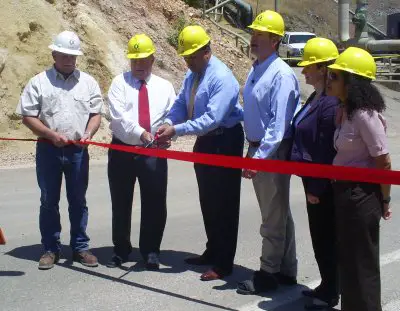
The site of two of the company's first wells now is the location of GDC-31, a more recent well drilled in 2004, which is where the company marked the ribbon-cutting for its new investment effort on Thursday afternoon. GDC-31 is The Geysers' largest-producing well, said Gilles, pumping out 177,000 pounds of steam per hour.
E-mail Elizabeth Larson at
{mos_sb_discuss:2}
- Details
- Written by: Elizabeth Larson
KELSEYVILLE – It's a green light for the Kit's Corner stoplight, with Caltrans officials opening bids for the project this week.
In recent years, community concerns have mounted about Kit's Corner, which is located at the intersection of Highways 281 and 29, and the number of traffic accidents in the area.
That led Kelseyville-area residents, including Supervisor Rob Brown, to lobby Caltrans for a stoplight at the intersection.
Brown said he recently attended the District External Advisory Liaison – or DEAL – meeting in Laytonville, where he met with officials from Caltrans' District 1, which includes Lake County.
At that meeting, Brown reported that Caltrans District 1 Director Charles Fielder said they could break ground on the project by the end of June.
Brown said Fielder has been very helpful in seeing the request through.
Fielder had just joined Caltrans in the fall of 2004, said Brown, when the agency held a meeting at Konocti Harbor with area residents. The meeting, at times heated, revealed a widespread community desire to see a stoplight at the intersection.
At first, Caltrans said the intersection didn't meet the requirements for a stoplight. They did, however, express concerns about road safety near the intersection, and explained that they already had a project in mind to address it.
That $2.3 million sight distance improvement project at Kit's Corner, was completed in December 2005. The project included a 700-yard vertical road realignment, which essentially meant shaving down a hill so drivers could see farther. Caltrans said the project was meant to increase safety and visibility.
By the time that project was under way in the spring of 2005, Brown said he had met with Caltrans officials, who reconsidered the stoplight and decided to pursue it.
As Lake County News previously reported, Caltrans recently estimated the signal project would cost about $500,000, with the county paying only $33,000.
“We got a bargain on that deal,” said Brown.
However, it's possible that the project could cost less.
Caltrans spokesman Phil Frisbie said the project was advertised in April, and the Caltrans Office Engineer opened bids on Wednesday.
Electrical contracting and engineering firm Steiny and Co. of Vallejo was the tentative low bidder, Frisbie said, with a bid of $398,356, about $30,000 lower than the next bid. Frisbie said it will take a few weeks to certify Steiny and Co.'s bid as final.
Once that bid is final, work will likely get started soon, said Frisbie.
“We are expecting construction to start late this summer, and then complete before the onset of winter,” said Frisbie, who said that schedule is “weather permitting.”
E-mail Elizabeth Larson at
{mos_sb_discuss:2}





 How to resolve AdBlock issue?