
News
- Details
- Written by: Editor
The charges were felonies because Moreno had been convicted of at least three previous driving under the influence cases, including one felony for which he was on probation in Sonoma County.
The jury further found that Mr. Moreno willfully refused a blood or breath test.
Moreno crashed his vehicle on Highway 175 near Mathews road on Thanksgiving night, and refused to submit to a blood test even after the California Highway Patrol officer explained to him that he was required by law to submit to the test.
Upon Moreno's refusal to take the test, the CHP officer called for additional officers to meet him at the hospital where a blood sample was obtained without Moreno’s consent.
That test showed that Moreno had a blood alcohol level of 0.14.
This was the first felony DUI jury trial for the Lake County District Attorney’s new DUI Vertical Prosecution Unit.
The unit’s primary focus is the investigation and prosecution of all DUI cases in Lake County. Members of the unit also provide community outreach to raise public awareness on the dangers of driving under the influence.
Funding for this program is provided by a grant from the California Office of Traffic Safety (OTS), through the National Highway Traffic Safety Administration.
“This is the type of case we had in mind when we applied for the grant from OTS, and this is the type of defendant we want to target in order to make the streets of Lake County safe to drive,” Hopkins said. “I want to commend our team, and we plan on them having this same success in the future.”
{mos_sb_discuss:2}
- Details
- Written by: Editor
Citizens of Lucerne recently approached Dills to see if the Coordinated Resource Management and Planning (CRMP) process might work for their watershed, as it has in so many other areas of the county.
This voluntary, grassroots approach to land management and planning originated in the 1950s and is still an effective problem-solving method today.
This system of management has seen successful throughout the entire state, but perhaps nowhere more than Lake County. Many of the sub-watersheds in the Upper Cache Creek Watershed have formed successful groups; if the citizens of Lucerne decide to adopt the process, it would be the tenth such group in the county.
The neighboring Nice Watershed Group was recently nominated for the Stars of Lake County Volunteer Group Award, and has been extremely instrumental in cleaning-up the Nice area.
It also was influential in the passage of the new OHV ordinance. The group's concerns about erosion and subsequent damage to water quality, caused by illegal off-road vehicles, put a spotlight on this serious trespassing issue.
Other groups have also made valuable contributions to their local watersheds.
The Big Valley CRMP, Lower Lake Watershed Council, Middle Creek CRMP and Scotts Creek Watershed Council all participate in annual creek cleanups in their areas. Along with watershed group volunteers, local high school students, 4-H members, Boy Scouts and other concerned community members participate in these events. It's hard work, but very rewarding, and their dedication contributes to the reduction of illegal dumping.
The different groups may focus on different concerns, but the approach is the same. Volunteers work together with the tribal, city, county, state, and federal governments, their neighbors, local businesses and other service organizations to solve local problems at the local level, in a cooperative manner.
The Scotts Creek Watershed Council worked with the West Lake Resource Conservation District, Bureau of Land Management, State Department of Conservation, and private landowners to secure grants to complete a fire break on the ridge line of Cow Mountain. They also held meetings for fire safety education.
The Lower Lake Watershed Council works with award-winning Carle High School students, and has developed a student water quality monitoring team. The group is also in the process of implementing a stream-bank restoration project. The project entails working with local, county, state, and federal agencies, but is accomplished by volunteers at the local level.
The Middle Creek CRMP quite literally dug an abandoned earth moving equipment out of the creek. These dedicated volunteers worked diligently with county officials and local business owners to see this task accomplished.
The group also designed and installed road signs along a dangerous stretch of road for the protection of wildlife and unsuspecting motorists. In addition, they join together with the Scotts Creek Watershed Council to support West Lake RCDs very popular "Kids in the Creek" program.
The Chi Council for the Clear Lake Hitch monitors and collects data on this historic fish. Volunteers all over the county stop at bridges and creekside turnouts to track the Clear Lake Hitch, found only in Lake County.
Volunteers from all of the groups in the Upper Cache Creek Watershed trained and participated in a citizens' water quality monitoring team. This team was given special recognition by the Upper Cache Creek Watershed Alliance at the recent Year in Review; an event that celebrates and highlights the accomplishments of the watershed volunteers throughout the entire county.
The list of contributions that East Lake and West Lake Resource Conservation Districts and their various watershed groups make to the communities in Lake County is long and impressive. Citizens of Lucerne who attend this meeting may choose to adopt the same path to problem-solving success that these other groups have enjoyed.
Voris Brumfield, code enforcement manager for the County of Lake, will also address those in attendance. Brumfield will report actions the county will be taking on Morrison Creek and other areas.
Don't miss this informative meeting at the Lucerne Alpine Senior Center, located at 10th and County Club Drive in Lucerne.
Be sure to mark March 7, 6:30 to 8 p.m. on your calendar, and plan to attend.
Contact Dills at 263-4180 x12 for questions or additional information.
{mos_sb_discuss:2}
- Details
- Written by: Elizabeth Larson
MENDOCINO NATIONAL FOREST – Two men reportedly lost overnight in the Mendocino National Forest were found Monday afternoon.
Lt. Pat McMahon of the Lake County Sheriff's Office reported Monday that the Lake County Search and Rescue Team found 29-year-old Cody Dobbs of Clearlake and Nicholas T. Lolonis, 24, of Upper Lake, who had gotten lost in the forest on Sunday.
At 8:57 a.m. Monday Dobbs' girlfriend, Jenny Sutherland of Upper Lake, had reported that Dobbs and Lolonis had driven to the forest's Bear Creek area on Sunday, looking for a piece of property, McMahon said.
They had last spoken to Sutherland via cell phone at 4 p.m. Sunday, when they reported they had gotten lost but obtained a map for a forest ranger, reported McMahon.
Authorities early on Monday hadn't been able to identify the ranger with whom the men had reportedly been in contact, McMahon added.
Search and Rescue, along with U.S. Forest Service personnel, began searching the area Monday, and were concerned that weather – including possible snowfall – might complicate the search.
However, the men were located early Monday afternoon, McMahon said. No injuries to the men were reported.
E-mail Elizabeth Larson at
{mos_sb_discuss:2}
- Details
- Written by: Elizabeth Larson
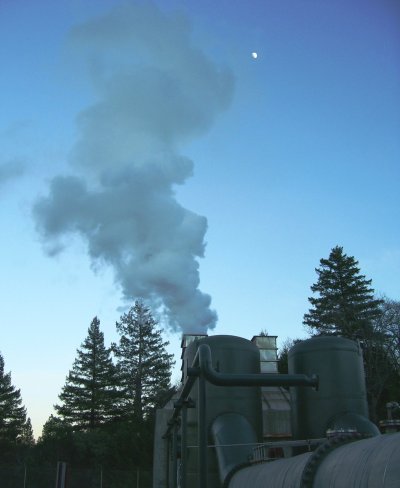
KELSEYVILLE – A long-closed geothermal plant is expected to be online once again in early March.
Santa Monica-based US Renewables Group (USRG) purchased the Bottle Rock Power plant in September 2005, said Lee Bailey, USRG's co-founder and a partner in the firm.
USRG is involved with a number of alternative power operations, said Bailey. Their holdings include biomass, landfill methane, ethanol and biodiesel plants.
Bottle Rock is USRG's only geothermal plant, Bailey said, although the company is proposing to build two to three other such plants in California.
Last June, Riverstone Holdings and The Carlyle Group, in the form of the Carlyle/Riverstone Renewable Energy Infrastructure Fund I, acquired from USRG a "significant stake" in the Bottle Rock plant, according to a company statement.
Riverstone is a New York-based private equity firm that focuses on energy and power.
The Carlyle Group, based in Washington, D.C., is a multinational firm that has major defense and aerospace contracts. Some of those connected with the company over the years have included former President George Bush and Secretary of State James Baker, along with former British Prime Minister John Major. Some critics of the current war in Iraq have accused the company of war profiteering.
The Bottle Rock plant was built and operated by the Department of Water Resources (DWR), said Bailey, who used the power for its own operations.
Gary Snedaker, the Bottle Rock plant's project manager, said DWR closed the plant in 1990 due to a "lack of steam." However, he said, the plant required significant repair, cleaning and new drilling, and DWR wasn't receiving very much compensation for the energy it was producing.
When the plant shut down at noon on Sept. 16, 1990, it was producing 12 megawatts, said Snedaker, although its capacity is 55 megawatts, a level it had operated at when it opened in 1985.
Fifty-five megawatts, he said, can power about 55,000 homes, he said. When the plant comes back online, it will produce 20 megawatts.
"We fully intend on getting the plant past 30 megawatts," said Snedaker.
Bailey said USRG already has an exclusive contract with Pacific Gas & Electric, who will purchase the power the plant generates.
After DWR closed the plant, Bailey said, it changed hands, eventually purchased for $5 million by partners from Little Rock, Ark., and New Orleans.
Those owners, he said, were found to be involved in an illegal pyramid scheme scheme, and were arrested by the Federal Bureau of Investigation. At the same time, he said, the Securities Exchange Commission put the plant into trusteeship.
Bailey said USRG found out about the plant and bid for it through court proceedings.
The purchase was scheduled to close Sept. 1, 2005, but Bailey said the stock certificates and ownership documents were located in New Orleans. In a safe. Underwater.
USRG had to wait until the documents could be retrieved and brought to California, said Bailey; in the mean time, more bidders were trying to come forward.
"It was a colorful transaction," he said.
Plant renovation, said Bailey, began in February 2006. The three-story plant is located on 160 acres that are leased from the Coleman family.
An East Coast native, Snedaker is partner in Integral Energy management, a company partially owned by USRG that has the Bottle Rock plant's operations and maintenance contract. He was sent out to lead the renovation because of his extensive experience with energy production, from coal and gas turbine plants to a Nevada geothermal plant.
Snedaker said when the plant was closed, some of the major equipment was mothballed, and the geothermal wells plugged. For the most part, he said, most of the major pieces of equipment had been left sitting, with little attention.
There's been a lot of work involved in getting the plant back online, said Snedaker.
"It has been a significant overhaul," he said. "We have gone over every system in the plant."

When DWR operated the plant, Snedaker said, they had 10 production wells that produced steam. DWR had plugged those wells, seven of which have been successfully reopened, Snedaker said, and two new ones are now being drilled.
The wells, between 8,000 and 9,000 feet deep, produce water that averages 345 degrees, he said. When the plant reaches the 30 megawatt level, it will produce between 500,000 and 600,000 pounds of steam per hour.
The plant's 19 permanent employees are local, said Snedaker, with a former Calpine employee appointed to the plant manager spot.
There have been a number of regulatory requirements at all different levels of government, including county and state, in order to get the plant back producing geothermal power again, said Snedaker.
Those included public hearings, he said, which had good turnout.
"The residents of this area are very well-informed about geothermal," he said.
The result was intelligent questions. "We were very pleased with the feedback from the community," he said.
That doesn't mean there were no objections or concerns, and Snedaker.
However, he said, community members treated them fairly with their questions. The public hearings were held this past September, he said, and the plant eventually got the approval to move forward.
The company doesn't anticipate concerns with increased seismic activity as a result of geothermal power production, although that concern has been raised in the community in recent years.
Bailey said he doesn't believe there's any evidence to show that steam reinjection increases seismic activity.
However, Calpine has acknowledged that reinjection at the Geysers has increased frequency and magnitude of seismic activity in the area.
The Web site for The Geysers, owned by Calpine, states: “The phenomenon of seismicity associated with geothermal power production has been known and acknowledged for decades. With the expanded geothermal development beginning in the in the 1970's, there was a measurable increase in the frequency of 'microearthquakes,' or earthquakes registering under 3.0 on the Richter scale.”
When it comes to geothermal production, Snedaker said Lake County is a key area.
"This is the largest area of geothermal in the world," he said.
E-mail Elizabeth Larson at
{mos_sb_discuss:2}





 How to resolve AdBlock issue?