 How to resolve AdBlock issue?
Education
- Details
- Written by: Janelle Bird
Open registration for all students will begin April 21 online at https://webadvisor.mendocino.edu or by visiting any one of our four locations.
"In order to better serve the diverse needs of our college community, we have expanded our online offerings and added evening courses this summer," said Dean of Instruction Rebecca Montes. "With staggered scheduling, students can get closer to graduation by completing more than one general education class in the semester.”
Many students are finishing finals and looking forward to summer break, but also recognize it’s a great time to sign up for university transfer courses at Mendocino College, especially for those looking to get a four-year degree and save money.
Mendocino College enrollment fees are just $46 per unit and many of the students who attend Mendocino College qualify for some form of financial aid. Many also meet the guidelines that eliminate unit fees and others receive grants to cover college costs.
Mendocino College course offerings not only meet the needs of university transfer students, but also those interested in pursuing a technical certificate, associate’s degree, professional development and personal enrichment.
In working with academic counselors, students can choose a course schedule that allows them to meet important family or employment commitments without missing the chance to attend college classes.
For more information about upcoming Mendocino College classes, or to make a counseling appointment, please consult the college’s Summer 2018 schedule recently mailed to local households, the Mendocino College Web site at www.Mendocino.edu , or visit or call any of our Mendocino College locations.
For additional assistance, call the counseling office at 707-468-3048.
Janelle Bird is interim director of community relations and communication for Mendocino College.
- Details
- Written by: Editor
All children who are age 5 on or before Dec. 2 can be registered for transitional kindergarten.
Students who are age 5 by Sept. 1 can be registered for kindergarten. Registration packets are available in the school office, 679 Second St.
A parents’ night will take place from 5:30 to 6 p.m. Thursday, April 19, in Room 14. This is a chance to meet teachers, ask questions, and learn about the difference in transitional kindergarten and kindergarten programs.
Kindergarten roundup will take place from 2:30 to 5:30 p.m. Thursday, May 10, in Room 14.
Kindergarten teachers will do a quick assessment and make sure they get children signed up.
School officials said the goal is to get children signed up before the school year is over so they can plan staffing, materials and building needs for the 2018-19 school year.
Appointments for kindergarten roundup are available; call the Upper Lake Elementary office at 707-275-2357.
- Details
- Written by: Editor
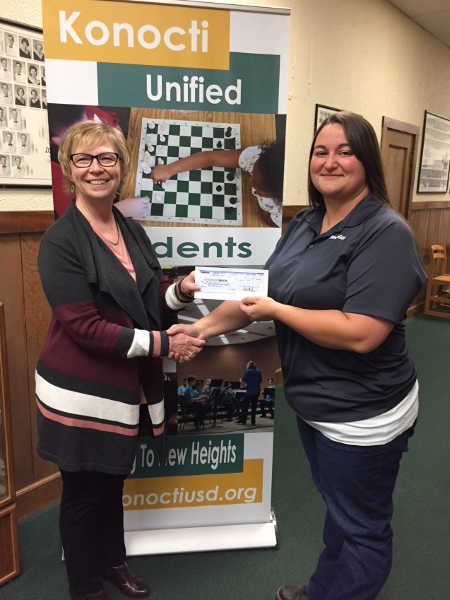
LAKE COUNTY, Calif. – On Tuesday, April 10, AmeriGas presented a check to Konocti Unified School District Superintendent Donna Becnel.
This donation was only possible through the dedicated efforts of AmeriGas customers turning in their receipts to be used as part of the School Days Program.
The program is available for any AmeriGas customer to take part in. All you do is save the second page of the invoice and turn it into the school of your choice, or take it to the local AmeriGas office and indicate which school you wish it to benefit.
Then, all the accumulated invoices are gathered, gallons are totaled up and, once per school year, AmeriGas cuts a check. For every minimum 100-gallon delivery, it would mean a $2 donation from AmeriGas to the school of the customer’s choice.
Becnel was delighted to accept the donation. She said she intends to use the donation for “student funds, particularly for trips.”
That’s the beauty of this type of program; the school has full discretion of what to do with the funds.
If you would like more information or want to know more about the AmeriGas School Days program, please contact the local AmeriGas office at 707-263-5438.
- Details
- Written by: Yuba Community College District
Borrego Solar Systems – a California-based developer, installer, and operations and maintenance provider of commercial solar and energy storage projects – expects to begin construction on the systems when school is out for the summer.
“The board is very pleased to announce the newest Solar projects for the Yuba Community College District, in our continued efforts to generate and store clean renewable energy. I characterize this announcement as a win, win for the District and community,” said Board President Michael Pasquale. “Win one will be a reduction in our carbon footprint. Win two will be lowering our operating costs. The staff and administrators have once again done an outstanding job of looking for innovative solutions that will have a residual and sustainable impact on student success.”
The solar energy installations at the Marysville and Woodland campuses are expected to provide enough energy to meet approximately 85 percent and 100 percent of each campus’ remaining energy needs, respectively.
YCCD estimates it will save approximately $77,000 and $87,000 in energy costs from the solar and the energy storage projects annually.
Purchased with Clean Renewable Energy Bonds, the solar energy systems will generate clean power for the District for at least the next 25 years.
“The YCCD Governing Board and leadership is committed to reducing our carbon footprint for our students and community. This is the environmentally responsible action to take and it will result in substantial cost savings that will lower our operating costs,” said Dr. Douglas Houston, Chancellor. “Additionally, the District’s use of Clean Renewable Energy Bonds to finance this project allows the District to apply Measure J General Obligation Bond funds to other important and needed facilities projects that directly impact student success.”
The installation is expected to offset around 2,000 metric tons of carbon dioxide annually, which is the equivalent of taking nearly 450 cars off the road for a year or the amount of carbon sequestered by about 2,450 acres of U.S. forests in one year.
The energy generated will be net-metered, meaning that any of the solar energy not consumed by the campus will be fed onto the local electricity grid and credited back to Yuba CCD.