
News
For the first time, astronomers have obtained visual evidence that a star met its end by detonating twice.
By studying the centuries-old remains of supernova SNR 0509-67.5 with the European Southern Observatory’s Very Large Telescope, they have found patterns that confirm its star suffered a pair of explosive blasts.
This discovery shows some of the most important explosions in the Universe in a new light.
Most supernovae are the explosive deaths of massive stars, but one important variety comes from an unassuming source. White dwarfs, the small, inactive cores left over after stars like our Sun burn out their nuclear fuel, can produce what astronomers call a Type Ia supernova.
"The explosions of white dwarfs play a crucial role in astronomy,” said Priyam Das, a PhD student at the University of New South Wales Canberra, Australia, who led the study on SNR 0509-67.5 published in Nature Astronomy.
Much of our knowledge of how the Universe expands rests on Type Ia supernovae, and they are also the primary source of iron on our planet, including the iron in our blood. “Yet, despite their importance, the long-standing puzzle of the exact mechanism triggering their explosion remains unsolved," he adds.
All models that explain Type Ia supernovae begin with a white dwarf in a pair of stars. If it orbits close enough to the other star in this pair, the dwarf can steal material from its partner. In the most established theory behind Type Ia supernovae, the white dwarf accumulates matter from its companion until it reaches a critical mass, at which point it undergoes a single explosion.
However, recent studies have hinted that at least some Type Ia supernovae could be better explained by a double explosion triggered before the star reached this critical mass.
Now, astronomers have captured a new image that proves their hunch was right: at least some Type Ia supernovae explode through a ‘double-detonation’ mechanism instead. In this alternative model, the white dwarf forms a blanket of stolen helium around itself, which can become unstable and ignite.
This first explosion generates a shockwave that travels around the white dwarf and inwards, triggering a second detonation in the core of the star — ultimately creating the supernova.
Until now, there had been no clear, visual evidence of a white dwarf undergoing a double detonation. Recently, astronomers have predicted that this process would create a distinctive pattern or fingerprint in the supernova’s still-glowing remains, visible long after the initial explosion. Research suggests that remnants of such a supernova would contain two separate shells of calcium.
Astronomers have now found this fingerprint in a supernova’s remains. Ivo Seitenzahl, who led the observations and was at Germany’s Heidelberg Institute for Theoretical Studies when the study was conducted, says these results show “a clear indication that white dwarfs can explode well before they reach the famous Chandrasekhar mass limit, and that the ‘double-detonation’ mechanism does indeed occur in nature.”
The team were able to detect these calcium layers (in blue in the image) in the supernova remnant SNR 0509-67.5 by observing it with the Multi Unit Spectroscopic Explorer, or MUSE, on the European Southern Observatory’s Very Large Telescope. This provides strong evidence that a Type Ia supernova can occur before its parent white dwarf reaches a critical mass.
Type Ia supernovae are key to our understanding of the Universe. They behave in very consistent ways, and their predictable brightness — no matter how far away they are — helps astronomers to measure distances in space.
Using them as a cosmic measuring tape, astronomers discovered the accelerating expansion of the Universe, a discovery that won the Physics Nobel Prize in 2011. Studying how they explode helps us to understand why they have such a predictable brightness.
Das also has another motivation to study these explosions. “This tangible evidence of a double-detonation not only contributes towards solving a long-standing mystery, but also offers a visual spectacle,” he says, describing the “beautifully layered structure” that a supernova creates. For him, “revealing the inner workings of such a spectacular cosmic explosion is incredibly rewarding.”
- Details
- Written by: European Southern Observatory
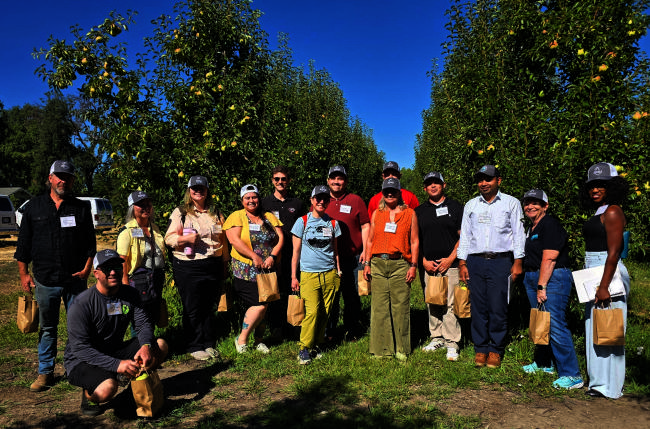
LAKE COUNTY, Calif. — On Aug. 15, 14 community leaders participating in this year’s AgVenture class dug into the pear industry with special presentations, a visit to Panella Orchards during harvest, and a tour of Scully Packing Company in Finley.
The “Next Generation” is the theme for farming families in this year’s program. Diane Henderson, who is the fourth-generation of her family to farm pears in Kelseyville, ran through the history of her family’s orchard with its 134-year-old trees.
She turned over the podium to her nephew Greg Panella, a fourth generation farmer himself, whose family is the current steward of the former Henderson Ranch, now known as Panella Orchards.
Panella took the class to one of his orchards that was being skillfully picked by workers and forklifted by his 12-year-old daughter, Audrey, for transport to the packing shed.
At Scully Packing Co., founders Phil and Toni Scully, sons Pat and Andy, both co-owners and company managers, and granddaughter Hanna, the newest addition to their sales team, welcomed the group for an in-depth tour of their shed in full operation.
For most in the group, it was their first time seeing the start to end cycle of the pears from packing to palletizing and into the cold storage before being shipped to stores and markets across North America.
Each family member spoke, highlighting their specialty within the company, covering history of the pear industry to date, current marketing conditions and challenges, and labor, including the shed’s innovative program that allows them to hire 16- to 18-year-old high school students.
Deputy Lake County Agricultural Commissioner Sam Upton began the afternoon presentations highlighting his office’s regulatory functions and ways they partner with and help farmers.
Pear and wine grape farmer Myron Holdenried (fifth generation farmer), and his grandson, Carson Holdenried (seventh generation farmer), gave an historical overview of how agriculture developed in Lake County and how programs like 4-H and FFA enhance youth learning and prepare them for working in agriculture.
He added his personal insights into ranching with family seven days a week.
Broc Zoller, PhD, aka The Pear Doctor, highlighted his agricultural research and integrated pest management (IPM) in pears. Son Zach Zoller also spoke on solar farms and aiming towards becoming a full-time farmer.
Recurring themes with the next generation were sustainability, food safety, worker safety, regulatory issues, and the difficulty of farming pears.
Class members appreciated getting a full scope of the pear market and the many impacts on it, from the pests in the field to the vagaries of market forces influencing wholesale prices which in turn affect what the farmer receives at the end of harvest. The shed tour and the many intricacies of managing it was a highlight.
Class participant Margaux Kambara summed up the day with, “I liked getting the big picture of why pears are so unique, and I can see that the families involved make it special.”
Launched in 2010, AgVenture is an innovative educational program presented by the Lake County Chapter of California Women for Agriculture. It is for non-farming community members and others who wish to understand the vital contributions of agriculture to Lake County’s quality of life and economy. The program’s steering committee includes Katy Evans, Rebecca Harper, Colleen Rentsch, Toni Scully, Bonnie Sears, Katherine VanDerWall, and Sharron Zoller.
AgVenture is made possible with funding from individual donors and program sponsors like Bella Vista Farming Company, who provides van transport for program tours.
The next AgVenture seminar will be in September focusing on Lake County’s wine grape industry.
- Details
- Written by: LAKE COUNTY NEWS REPORTS





 How to resolve AdBlock issue?