 How to resolve AdBlock issue?
Education
- Details
- Written by: Editor
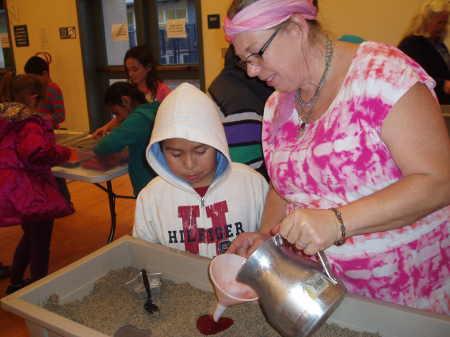
CLEARLAKE, Calif. – Students in the after school programs at Pomo and Burns Valley Schools were delighted in early December when Stephanie Figueroa, a local artist, came to their sites to teach them how to make sand candles.
This activity was a collaboration between Figueroa and the Children’s Museum of Art and Science (CMAS).
Figueroa donated her time and equipment and CMAS paid for the materials the students used.
The cafeterias were buzzing with excitement and the wonderfully aromatic scent of the wax.
Students decorated bags at one table so they could safely carry the candles home once completed.
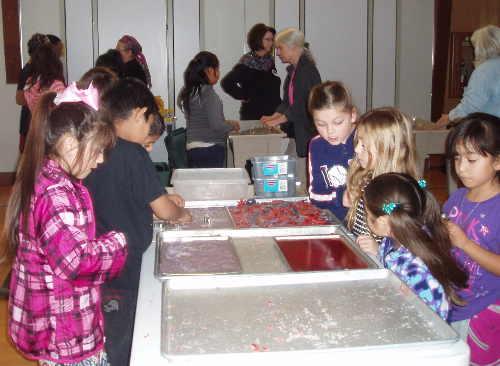
Twelve students at a time could work at the three sand tables, choosing the shape of the candle and the color of the wax.
Students carefully prepared the holes in the sand to make their candle shape. When the student was happy with their design, an adult poured the hot wax for them.
When the candles had mostly cooled and hardened they were moved to another table and a wick was added.
Students were very surprised and proud of how well the candles turned out. A total of 135 students from both schools participated.
Figueroa participates in birthday parties, craft fairs and other private events. If you are interested in her services, Figueroa’s business, “Candle Play,” can be reached through Facebook ( https://www.facebook/candleplay ) or by phone at 707-994-1098.
This year CMAS is very interested in partnering with local artists to bring art experiences to after school programs in Clearlake.
An anonymous donor has started a fund to provide money to purchase art materials that would be needed.
Activities could be a craft project, a drawing lesson or anything that would appeal to students in grades first through eighth.
Call Carolynn Jarrett at 707-994-2878 if you would like to be a presenter or a donor.
- Details
- Written by: Editor
LAKE COUNTY, Calif. – A donation to Imagination Library recently was made in honor of a local book lover and businesswoman.
Steven and Peggy Buchholz made the donation in memory of Lynn Fegan, who owned Catfish Books.
Fegan, of Kelseyville, died Nov. 1 at the age of 70.
One of Fegan's final wishes was for people to support the Imagination Library.
It only takes $25 per year to give a child a book each month for one year and the Lake County Literacy Task Force wants to make sure all of the children in Lake County have this opportunity.
This gift of literacy writes a lasting page in the book of literacy for each recipient.
The Imagination Library is a program, originally created by Dolly Parton, which sends books to the homes of registered children between the ages of 0 to 4.
These books arrive for the low price of postage – $25 per year.
The Imagination Library, coordinated by the Lake County Literacy Task Force, is seeking support to continue adding pages to the future of literacy in Lake County.
Children are eligible and need sponsorships to continue to receive books until their fifth birthday.
Gather up friends, neighbors, and coworkers and help to write a page in Lake County’s Book of Literacy.
Gift cards commemorating your donation “in honor” of a special person and a tax deductible donation receipt will be mailed to all donors.
Send donations to the Lake County Office of Education at 1152 S. Main St., Lakeport CA 95453,. attention Imagination Library.
Call or email Stephanie Wayment for more information,
- Details
- Written by: Editor
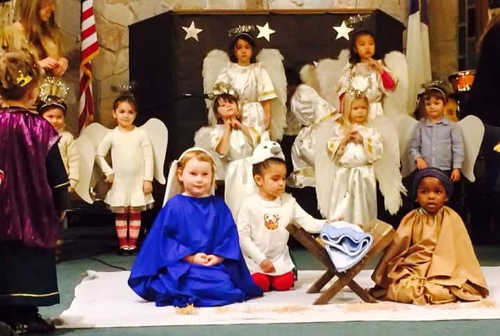
LAKEPORT, Calif. – Lakeport Christian Center Preschool held its annual Christmas program on Thursday, Dec. 18, to a packed house.
The children performed a live nativity scene with accompanying narration singing and dancing.
The program was entitled “The Best Gift.”
Words and music were written by Mary Rice Hopkins.
The songs included “Best Gift,” “Joseph and Mary Blues,” “Away in a Manger,” “Follow that Star,” “Go Tell It on the Mountain” and “Jingle Bells.”
The live nativity scene was played by the following: Joseph, David Wageni; Mary, Gemma Lewis; kings, Bryson Gaynor, Gael Moreno and Churro Ceja-Avila; shepherd, Colin Ingram; star, Jasmine Grider; sheep, Mason Carter; donkey, Knox Hensler; camel, Hollace Stencil; dove, Ximena Venegas.
The angel choir included Elyse Haley, Izzy Ceja-Avila, Alora Nieto, Annica Warren and Aliereya Scudder.
The messenger angels were portrayed by Erick Alvarez, Hayton Chen, Lennon Llorin, Wyatt Marshall, Evan Moretz, Serenity Hermo, Gabriella Keyes, Jason Patrick, Haylee Perry and Kiera Mick.
LCC Preschool would like to thank Doris Perry who made and donated all the beautiful costumes as well as Preschool Director Julie Landrum; teachers Michele Walker, Amber Greenwood and Monica Grider; and aide Sarah Landrum.
The preschool wishes everyone a blessed Christmas and a prosperous and healthy 2015.
- Details
- Written by: Editor
NEW YORK, NY – the application deadline for the 2015-2016 Kennedy-Lugar Youth Exchange and Study (YES) Abroad scholarship program is Jan. 7, 2015.
The program provides full scholarships to American high school students to experience overseas communities and cultures, preparing students to collaborate on today’s global challenges such as human rights, community development, workforce development, climate change, and global health.
Sponsored by the U.S. Department of State’s Bureau of Educational and Cultural Affairs, the YES Abroad program enables students to study for one academic year in countries that may include Bosnia and Herzegovina, Ghana, South Africa, India, Indonesia, Macedonia, Malaysia, Morocco, Oman, Philippines, Thailand, and Turkey.
The merit-based scholarship covers domestic and international travel; applicable visa fees; medical benefits; room and board; tuition at the local high school; orientations; and fees for educational and cultural activities.
Participants in the program fully immerse themselves into the culture of their host family while attending local high school.
Erica, a current scholarship recipient from Wisconsin, who was named the October 2014 American Abroad of the Month by the State Department, said: “My time in South Africa has given me a chance to learn from daily life in my host school, while focusing my attention outward to my host family and community. Every day I am both a student and teacher to my peers, and I have learned so much not just about what it means to be Zulu, Xhosa, or Afrikaans, but also what it means to be an American. I have found that it is in the informal conversations between classes and sport where I have learned and shared the most.”
A 2012 participant, Hannah, who studied in Malaysia for one year, stated that “the YES Abroad program opened my eyes. I learned about a new culture and shared my own. I now have two homes, two families and countless friends from around the world.”
Interested students should visit www.yes-abroad.org to learn more the program and to apply.
Contact the YES Abroad program at