
News
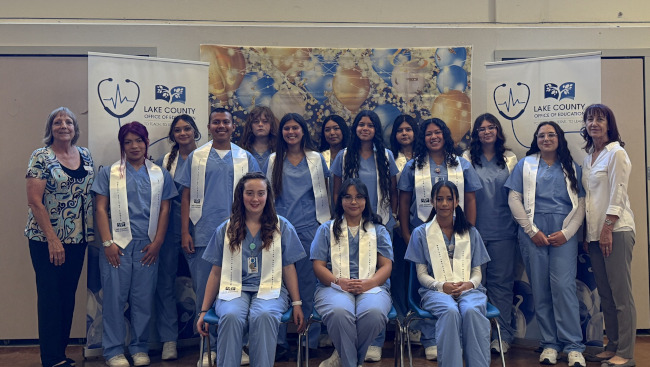
LAKEPORT, Calif. – Recently, the Lake County Office of Education, or LCOE, successfully graduated its first Youth Summer Certified Nursing Assistant Cohort — but where are they today?
LCOE is proud to share the continued success of students who participated in its first Youth Program.
The program’s first cohort included high school students from across Lake County.
“Lake County students are the future leaders of our county, state and county. This program gives students the opportunity to explore a career in the medical field and develop real-world skills before they graduate,” said Lake County Superintendent of Schools Brock Falkenberg. “By preparing them for the workforce while they’re still in high school, we’re helping students take confident steps toward their future.”
Three months after completion, many of the program’s alumni have gone on to pursue college degrees in nursing or health-related fields, while others have entered the local workforce serving residents across Lake County’s skilled nursing facilities.
Nine of the 14 youth work or are onboarding at local care homes, including Meadowood Nursing Center, Rocky Point Care Center and Lakeport Post Acute.
Students are earning between $22 and $25 per hour, gaining valuable real-world experience in patient care while continuing their education. Other participants are still in high school and already working part time in skilled nursing facilities.
“Balancing academics, part-time work, and patient care responsibilities is no small feat, and these students continue to demonstrate remarkable commitment, maturity, and compassion,” said Christian Villalobos, LCOE’s grant coordinator for career and college readiness.
Several other participants are full-time college students in nursing pathways. Alumni like Maliyna Aguilar (Chico State University) and Ire Rivera (Pacific Union College) have transitioned seamlessly into higher education, applying their CNA training toward future medical programs.
“The LCOE Youth Summer CNA program has helped me in my educational journey at PUC by providing me with so much more confidence in my nursing skills and abilities than many of my classmates possess,” said Ire Rivera, now pursuing pre-nursing at Pacific Union College. “Attending clinicals feels easier for me because of the hands-on experience I gained at Rocky Point Care Center. Ultimately, my experience in the Youth Summer CNA program has greatly impacted my educational journey.”
For those already working in the field, the program has been equally transformative.
“Working at a local skilled nursing facility is a beautiful experience and a feeling of accomplishment knowing that I’m making a difference in residents’ lives,” said Nataly Torres, a senior at Lower Lake High School. “I enjoy creating bonds with my residents and knowing they feel supported and cared for correctly.”
The LCOE Youth Summer CNA Program was made possible through collaboration with local skilled nursing facilities and Lake County high schools, with funding support from Empowered Aging and the Healthcare Career Pathway program.
“From my time as a Paramedic through teaching Health Careers classes to my current role, it has always been my hope to offer an opportunity like this to high school students. Being a part of this high school CNA program was an incredible experience. Our teachers and support staff did a wonderful job preparing these young students for success as CNAs and have prepared them for success in their future medical careers as well. I had the opportunity to observe the students both in the classroom and at the clinical site. Their dedication to learning and their professionalism while caregiving was always apparent and shows what Lake County students are capable of doing. We are excited to be able to offer this program again in the summer of 2026, and hope to be able to continue to offer it in the future,” said Matt Russell, director of Adult Education & Career & College Readiness.
The Lake County Office of Education is currently in the process of recruiting its second cohort. To learn more about our Medical Training Programs, visit lakecoe.org/MTP.
- Details
- Written by: LAKE COUNTY NEWS REPORTS
Following a series of winter storms and multiple years of improved hydrologic conditions, California’s ongoing efforts to recover from the multiyear drought that began in 2021 are showing significant progress.
Current conditions are notably better across much of the state, and the work to restore long-term water security continues, officials reported.
Reservoir storage has improved substantially, with Lake Oroville — the largest reservoir in the State Water Project — rising 137 feet since Dec. 20 and capturing over 300,000 acre-feet of water.
“California's water strategy is working. We're not just managing for today's conditions – we're building a system that can handle whatever our changing climate throws at us. That means capturing rainwater when storms hit, storing it for dry seasons, and protecting communities from floods. This is how California, a state of nearly 40 million people, leads,” said Gov. Gavin Newsom.
Snowpack is near to above seasonal averages in many regions, and groundwater conditions continue to benefit from multiple years of precipitation.
Several state and national indicators, including the U.S. Drought Monitor, show eased drought conditions across California – a reflection of both favorable weather and sustained investments in smarter, more resilient water management.
Managing for climate extremes
While statewide indicators show improvement, some areas remain drier than average, underscoring the need for continued conservation and forward-looking water management.
Recovery from multiyear droughts can be a multiyear process, and increasing climate instability means that periods of intense precipitation can quickly give way to renewed dry periods.
Tools like California Water Watch provide a detailed, real-time picture of precipitation, snowpack and reservoir storage, helping water managers make informed, day-to-day decisions based on local and regional conditions.
As the 2026 water year begins with above-average conditions to date, state agencies continue to capture stormwater when possible, protect communities from flooding, and store water for dry periods ahead — strengthening California’s ability to manage extremes and ensuring the state is better prepared for whatever comes next.
Building water storage for a more resilient California
Along the Sacramento River Basin, the Big Notch fish passage project is now in action to both modernize and improve California’s water system while also protecting juvenile endangered winter-run Chinook salmon. The Big Notch is a key State Water Project infrastructure investment, improving conditions for migratory fish while supporting the water supply depended upon by tens of millions of Californians. It’s part of the State Water Project’s ongoing efforts to balance water supply and environmental protection.
In August, California committed an additional $219 million to the Sites Reservoir project. Sites Reservoir is a key component of Gov. Newsom’s water strategy – capturing water from the Sacramento River during wet seasons and storing it for use during drier seasons. These efforts will hold up to 1.5 million acre-feet of water, which is enough to supply over 4.5 million homes for a year. The project will help California maintain a resilient water supply in the face of climate change, weather extremes, and water scarcity.
In addition to surface water storage, the Newsom administration is working to improve California’s underground water storage through groundwater recharge efforts.
Over the course of 2024, the state received average precipitation, helping sustain recharge efforts after the exceptionally wet 2023. These last three years (2023, 2024, and 2025) have seen continued increases in groundwater storage.
Water Year 2024 increased by 2.2 million acre-feet reported across 98 basins – a direct result of state and local actions to capture and store more water underground.
“These investments ensure that when water does arrive, we can store it, use it wisely, and build long-term resilience for the entire state,” the Governor’s Office said in its statement on water conditions.
- Details
- Written by: LAKE COUNTY NEWS REPORTS





 How to resolve AdBlock issue?