How to resolve AdBlock issue?
Education
- Details
- Written by: Kasandra Colwell

It is the start of the second grading period here at Carlé and the Carlé Chronicle wants to tell everyone to keep up all the good work!
We have some interesting topics to report including the Mountain Vista Middle School garden project, new ways to get physical education credits at Carlé, the Big Read, Student of the week and projects student council is working on.
Recently Ms. Seely from Mountain Vista Middle School approached Carlé to do some business. Mountain Vista has made a big school garden and they wanted some nice signs with the garden’s rules on it.
Alyssa Peterson once had Ms. Seely as a teacher and is very fond of her, so she made a couple beautiful handmade signs. She won two T-shirts from the business for her hard work, one of her signs was laminated, the other pressed onto a metal plaque. About five other students submitted designs for the garden contest as well.
Carlé is trying to organize different ways to get physical education credit. Vice Principal Mr. Wickersham has decided to open up the basketball courts at lunch for credit.
As has been mentioned in previous articles, paintball club is another way to get credit. Student Jonathan Lansdowne came up with the idea to organize softball games to be held after school, which also gives physical education credit to those who attend.
The Big Read is back! The Big Read is a grant-funded program sponsored by the National Endowment for the Arts.
Ms. Shrive runs the Lake County Big Read. She brought the Big Read to Lake County with the help of Wally Holbrook, the county superintendent of schools.
Lake County is one of 77 selected organizations to receive a Big Read grant this year. The purpose of the Big Read is to promote literacy and bring communities together through literature.
The Harbor On Main will have a discussion group about The Joy Luck Club by Amy Tan, which is the featured novel. Former Carlé student Nura Brown will be leading the discussion group as she is now an employee at The Harbor.
For more information about the Big Read, see Ms. Shrive at Carlé High School.
Congratulations to Lukas Carlson, who won student of the week this week! Keep up the good work!
While on the topic of congratulations, Lucas Stickel presented the first portfolio of the year! It was a great representation of who he is and serves as a great example for portfolios to come.
Student government is trying to brainstorm different ways to raise funds for the school.
One idea that was brought up at a recent meeting was that we should make a prom donation box to be set up at back to school night. Another topic brought up was a treat for the students, lunchtime music. Student government decided it was only fair to play music if there were songs everybody likes in the play list.
The next step is to gather favorite songs from students around the school, similar to the method we used to gather songs for prom last year.
Kasandra Colwell is a student at Carlé Continuation High School in Lower Lake, Calif.
- Details
- Written by: Editor
The Council of Graduate Schools (CGS) reported a 1.8 percent increase in first-time enrollment between fall 2011 and fall 2012.
More than 461,000 students enrolled for the first time in graduate certificate, education specialist, master’s, or doctoral programs for the fall 2012, according to institutions responding to the CGS/GRE Survey of Graduate Enrollment and Degrees, an annual survey that has been conducted since 1986.
Despite the gains in first-time enrollment, total graduate enrollment fell 2.3 percent following a 0.8 percent decline in the previous year. Total graduate enrollment was nearly 1.74 million students in fall 2012.
Institutions responding to the survey received nearly 1.98 million applications for admission to fall 2012 graduate programs. Applications rose 3.9 percent between fall 2011 and fall 2012.
The overall acceptance rate was slightly lower than the previous year, with 39.5 percent of applications resulting in offers of admission for fall 2012.
As CGS also reported last year, the fact that first-time enrollment trends have not matched the growth in applications may be a sign that many qualified students who wish to attend graduate school are faced with obstacles to enrolling.
First-time graduate enrollment of temporary residents increased 8 percent between fall 2011 and fall 2012, according to survey respondents, up slightly from the 7.8 percent increase in fall 2011.
In contrast, the growth in first-time graduate enrollment for U.S. citizens and permanent residents between fall 2011 and fall 2012 was essentially stagnant at 0.6 percent.
In fall 2012, more than one-half (54.7 percent) of all temporary resident graduate students were enrolled in engineering, mathematics and computer sciences, physical and earth sciences, or biological and agricultural sciences. Only 17.3 percent of U.S. citizens/permanent residents were enrolled in these fields.
CGS President Debra W. Stewart viewed the data for first-time graduate enrollment with cautious optimism. “It’s certainly good news that the number of new students enrolling in U.S. graduate programs is trending upward. However the trend must accelerate if we are to gain ground against previous losses.”
Stewart added that this is particularly the case for domestic students. “An increase of less than one percent in first-time enrollment for domestic students is worrisome given that the U.S. economy will have an increasing need for highly-skilled talent in order to thrive. Our country must do more to address the economic factors, like student debt, that discourage many students from enrolling in U.S. graduate programs.”
One piece of encouraging news contained in the report is that first-time enrollment for underrepresented minorities has increased.
Among survey respondents, first-time graduate enrollment rose 7.4 percent for Hispanic/Latinos, 5.7 percent for American Indians/Alaska Natives, and 4.6 percent for Blacks/African Americans between fall 2011 and fall 2012.
Other report findings include:
Trends by field
-
The largest one-year changes in graduate applications between fall 2011 and fall 2012 occurred in mathematics and computer sciences (11.1 percent), health sciences (9.6 percent), and engineering (9.3 percent).
-
Applications to graduate programs in business rose 0.7 percent between fall 2011 and fall 2012, much slower than the 4.3 percent growth in the previous year.
-
First-time enrollment in education programs grew 2.5 percent for fall 2012, compared to a sharp drop of 8.8 percent in fall 2011.
-
The largest fields by total enrollment were education and business, respectively accounting for 20 percent and 16 percent of total graduate enrollment at responding institutions in fall 2012.
Trends by degree level
-
About 74 percent of all graduate students in fall 2012 were enrolled in programs leading to a master’s degree or a graduate certificate, according to survey respondents.
-
Responding institutions awarded approximately 67,200 doctoral degrees, 540,000 master’s degrees, and 31,900 graduate certificates in 2011-12.
-
Between fall 2011 and fall 2012, first-time enrollment increased by 5.0 percent at the doctoral level and 1.2 percent at the master’s level.
Student demographics
-
About 58 percent of all first-time graduate students in fall 2012 were women, according to survey respondents.
-
According to survey respondents, women earned nearly two-thirds of the graduate certificates, 60 percent of the master’s degrees, and 52 percent of the doctorates. Academic year 2011-12 marked the fourth straight year women earned a majority of doctoral degrees.
-
Over the 2011-2012 period, first-time enrollment for Whites fell by 0.9 percent.
- Details
- Written by: Timothy Mcguire
Happy sixth week of school, Carlé! This week puts us one-sixth of the way through the school year!
I would like to thank all the teachers for the good work that they do. I would like to give a huge thank you to Barbara Dye for making Carlé High School the best school in the county. She received a plaque designed and produced by Summer Gunn.
Sabrina Farnan and Marla Mitchell made a plaque for Pamela Bordisso, thanking her for coming and speaking with students about the opportunities they have for going to college locally at Yuba.
Ms. Bordisso has given generously of her time over the last many years. She looks out for all students at Yuba and we are pleased to have her come visit and share with us.
Sept. 5 was the second meeting of Interact Club meeting.
The club motto is “Service Above Self.” The club has been at Carlé for about five or six years.
The first project is helping to renovate the safe house. A free T- shirt is given to members every time they attend the meetings.
The purpose of this club is to help make the community and the world better places. The club is free to join. If you decide to be a part of the club, you get to meet new business owners and important people in the community.
Also, the annual community Christmas dinner is at Burns Valley Elementary School on Dec. 2. The annual seafood boil is the last Saturday in February. You can apply for a $500 scholarship.
The best thing about the club is that you can choose what you want to do around your community. The club is looking for more members, so please sign up. The club is looking for more ideas on how to help the safe house.
The club made a $25,000 pledge to build the new emergency room at St. Helena Hospital in Clearlake. The Rotary Club meets every Tuesday and the Interact club meets every Thursday.
Student of the week last week was Jasmine McGee. Jasmine is a great student with a great attitude. Last week’s CHILY winner was Fred Miller who chose a football.
Student council: People elected for student council in Alan’s advisory were Chris Stutz and Jonathan Lansdown, the alternate is Deandre Morris. People elected in Angie’s advisory were Cody Perdock and Dane Pearson. Alternate was Kevin Fisher. People elected in Maes’ class were Jacob Davis and Marla Mitchell. People elected in Shrive’s advisory were Esparanza Roberts and Amaree Whiley.
Student government: The student government helps shape activities. The purpose of student government is for students to inform their advisory classes about upcoming events, and for students to decide what they want to do, such as prom or a barbecue. President is Marla Mitchell. Vice President is Esparanz Roberts. Secretary is Nathan Frigge. Teacher’s assistant is Melyssa Moreno.
Also known as Student Council, the students will meet every Tuesday at lunch. The student council advisor is Ms. Shrive.
Timothy Mcguire is a student at Carlé Continuation High School in Lower Lake, Calif.
- Details
- Written by: John Jensen
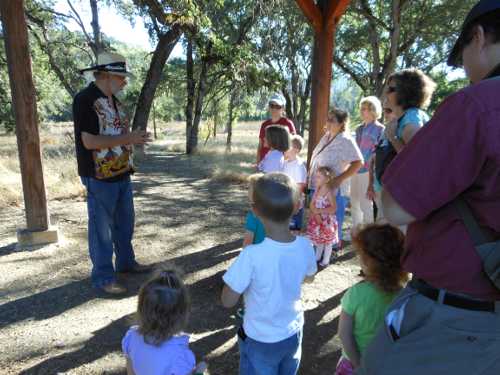
LAKE COUNTY, Calif. – Dr. John Parker led a group of 15 children and adults on an archaeological adventure at the Rodman Preserve on Aug. 17 as part of this summer’s children’s nature education programs presented by the Lake County Land Trust.
Dr. Parker started out with suggesting students would be taking a “trip in time,” and when they walked out from under the gazebo at the beginning of the Rodman Preserve trailhead, they would be stepping back in history by 1,000 years.
“What did people eat 1,000 years ago?” he asked, and “How did they gather and prepare their food.”
With that Dr. Parker then revealed to the group how California’s American Indians gathered and prepared food, using everything from spears, baskets and small clay balls that were used to fling at wild fowl, to stone mortars and pestles that were used to grind acorns into acorn mush.
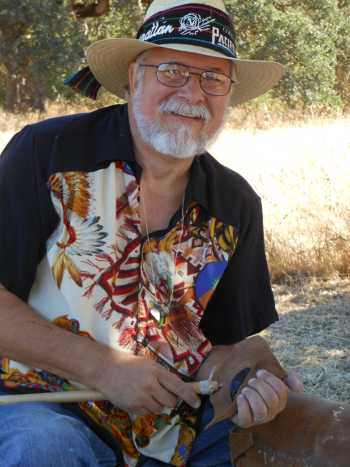
Dr. Parker showed numerous artifacts to the group that were used by native peoples and led a walk to the water’s edge to discuss techniques American Indians used for fishing and creating reed (tule) boats on Clear Lake.
After returning to the nature center children or their parents had fun fashioning their own necklaces out of clam shells and acorn caps using bead drills provided by Dr. Parker. He also demonstrated the ancient art of flint knapping, showing how early people created the arrows and spear heads used in their everyday lives.
The Lake County Land Trust is a nonprofit local organization that owns and operates the Rodman Preserve on Westlake Road between Lakeport and Upper Lake.
The Land Trust presents children’s nature education programs through the summer, with the last program to be presented on Saturday, Sept. 21, starting at 9 a.m. at the Nature Center.
The focus of this last program of the summer will be wetlands and the creatures that live near them and in them.
The programs are led by Elaine Mansell, a nature education specialist.
For more information about the Land Trust, go to www.lakecountylandtrust.org .