 How to resolve AdBlock issue?
Health
- Details
- Written by: Editor

MENDOCINO COUNTY, Calif. – Aaron Poole has accepted the position of Mendocino regional controller for Howard Memorial Hospital (HMH) and Ukiah Valley Medical Center (UVMC), according to Brandon Parker, vice president of finance for both HMH and UVMC.
“I am excited to welcome Aaron to the finance teams of both HMH and UVMC,” said Parker. “He is a continuous student, enjoys learning and brings a varied skill set to this position. I’m confident that Aaron’s collaborative work style will be well received at both campuses.”
Poole received his BBA from Walla Walla University and is currently pursuing his MBA. He is a CPA with previous health care experience in the Adventist Health system, including planning and implementation of a new budget management reporting software.
He and his wife, Karen, love sports, the great outdoors, and are both avid tennis fans.
Poole will work predominantly from the HMH campus, helping to fill the void left by Julie Vichi, and will provide accounting oversight for HMH and UVMC.
Howard Memorial Hospital and Ukiah Valley Medical Center are part of the Northern California Network, a network that also includes St. Helena Hospital Napa Valley, St. Helena Hospital Clear Lake and St. Helena Center for Behavioral Health. All are part of Adventist Health, a faith-based, not-for-profit integrated health care delivery system serving communities in California, Hawaii, Oregon and Washington.
- Details
- Written by: Editor
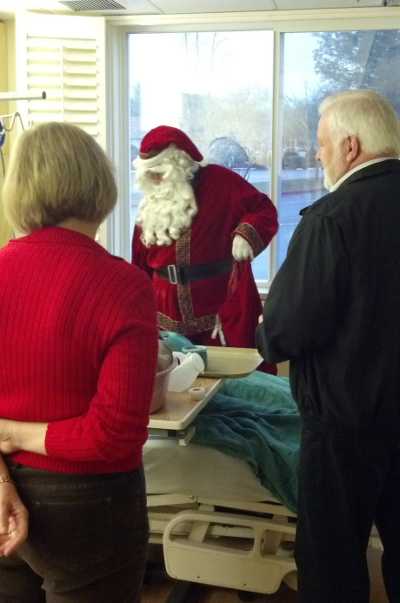
LAKEPORT, Calif. – Patients staying at Sutter Lakeside Hospital over the holidays received a surprise visit from Santa on Christmas Day.
The jolly old elf gave each patient a Sutter Lakeside blanket as a gift as he spread holiday cheer throughout the hospital halls.
John Gorbenko, director of Emergency Services, along with infection control coordinator Kathleen Dinges and hospital Chief Administrative Officer Siri Nelson, accompanied Santa on his rounds.
“This is a holiday tradition for us,” Nelson said. “Santa is a nice addition this year.”
“The patients just light up when they see Santa,” Kathleen Dinges said. “No matter how old they are, seeing Santa is still a treat.”
- Details
- Written by: Editor
Working-age adults with disabilities account for a disproportionately high amount of annual emergency department visitors, reports a comparison study from National Institutes of Health researchers.
As emergency department care may not be the best to address non-urgent concerns and is higher in cost, finding a way to decrease these visits is of interest to many stakeholders.
One of the first detailed looks at this population’s heightened use of urgent care, the NIH study published online in Health Services Research on Dec. 26, analyzed pooled data from the Medical Expenditure Panel Survey External Web Site Policy.
Researchers found access to regular medical care, health profile complexity and disability status contributed to people with disabilities’ use of the emergency department.
To address this disparity, the authors recommend enhanced communication between emergency department and primary care physicians, and tailored prevention and primary care programs.
“We want to understand what takes people to the emergency department to learn if their care could be better managed in other ways,” said Elizabeth Rasch, Ph.D., chief of the Epidemiology and Biostatistics Section in the NIH Clinical Center’s Rehabilitation Medicine Department. “While many of those visits may be necessary, it is likely that some could be avoided through better information sharing among all of the health care providers who see a particular individual.”
The study found that despite representing 17 percent of the working age U.S. population, adults with disabilities accounted for 39.2 percent of total emergency room visits.
Those with a severely limiting disability visited an urgent care department more often than their peers and were more likely to visit the department more than four times per year.
Emergency visits were also associated with poor access to primary medical care, which was more prevalent among adults with disabilities.
Rasch and her coauthors identified three nationally representative comparison groups – those without any self-reported mental or physical limitations, those with a limitation but who did not need daily living assistance, and those who did need assistance with daily living.
Researchers evaluated access to medical care through self-reported survey answers to questions about attainment and delay of primary care services and prescription medications. The number of emergency department visits was also self-reported.
The authors – from the NIH Clinical Center and Brandeis University, Waltham, Mass. – made recommendations for provider and policymaker actions to offset some of the need for emergency care by individuals with disabilities.
Prevention and chronic condition management programs tailored for the functional limitations and service needs of people with disabilities may help avoid a crisis situation that would call for an urgent care visit, the report noted.
The authors also endorsed wider adoption of coordinated care systems for the disabled that provide case management, integration of psychosocial care and 24/7 access to medical assistance, among other services.
When a patient is admitted to the emergency department, sharing detailed medical information between emergency room and primary care staff could prevent repeat visits. Such coordination is particularly important for disabled patients as they may have limitations that interfere with medical self-advocacy and complex conditions that demand care from various providers.
“When a person has an emergency department visit, their primary care providers often don’t know or don’t get the results of that visit, and vice versa. The emergency department often doesn’t know about the complex medical history people bring with them,” Rasch said. “That’s where things tend to break down.”
- Details
- Written by: Editor
A new way to use MRI scans may help determine whether dementia is Alzheimer’s disease or another type of dementia, according to new research published in the December 26, 2012, online issue of Neurology, the medical journal of the American Academy of Neurology.
Alzheimer’s disease and frontotemporal lobar degeneration (FTLD) often have similar symptoms, even though the underlying disease process is much different.
“Diagnosis can be challenging,” said study author Corey McMillan, PhD, of the Perelman School of Medicine and Frontotemporal Degeneration Center at the University of Pennsylvania and a member of the American Academy of Neurology.
“If the clinical symptoms and routine brain MR are equal, an expensive positron emission tomography (PET) scan might be needed,” said McMillan. “Or, a lumbar puncture, which involves inserting a needle into the spine, would be needed to help make the diagnosis. Analysis of the cerebrospinal fluid gives us reliable diagnostic information, but this is not something patients look forward to and is also expensive. Using this new MRI method is less expensive and definitely less invasive.”
The study involved 185 people who had been diagnosed with a neurodegenerative disease consistent with Alzheimer’s disease or FTLD and had a lumbar puncture and a high resolution MRI.
Of the 185, the diagnosis was confirmed in 32 people either by autopsy or by determining that they had a genetic mutation associated with one of the diseases.
Researchers used the MRIs to predict the ratio of two biomarkers for the diseases in the cerebrospinal fluid, the proteins tau and beta-amyloid.
The MRI prediction method was 75 percent accurate at identifying the correct diagnosis in those with pathology-confirmed diagnoses and those with biomarker levels obtained by lumbar punctures, which shows similar accuracy of the MRI and lumbar puncture methods.
“Developing a new method for diagnosis is important because potential treatments target the underlying abnormal proteins, so we need to know which disease to treat,” McMillan said. “This could be used as a screening method and any borderline cases could follow up with the lumbar puncture or PET scan. This method would also be helpful in clinical trials where it may be important to monitor these biomarkers repeatedly over time to determine whether a treatment was working, and it would be much less invasive than repeated lumbar punctures.”