 How to resolve AdBlock issue?
Health
- Details
- Written by: Editor
The decision by several states not to expand Medicaid health insurance for the poor may create unintended cuts for hospitals that provide uncompensated care, according to a study by John Graves, Ph.D., a Vanderbilt policy expert in the Department of Preventive Medicine.
Graves used financial data from U.S. hospitals and insurance data in each state to predict cuts in Medicare and Medicaid disproportionate share (DSH) funds paid to the nearly three-fourths of U.S. hospitals that serve low-income patients.
The results, published in the Dec. 20 issue of the New England Journal of Medicine, put numbers behind the impact of funding changes and predict what the difference would be if Medicaid is, or is not, expanded in each state.
“Expanded insurance through the exchanges alone will trigger lower DSH payments to hospitals,” Graves said. “The problem comes in states where much of the uncompensated care provided will remain the same if Medicaid is not expanded, yet DSH cuts will still occur. Hospitals will need to recoup these DSH losses either by providing less uncompensated care, or by shifting the costs onto everyone else.”
As planned under the Affordable Care Act (ACA), Medicare DSH cuts will begin with a 75 percent across-the-board reduction in 2014 as new insurance exchanges come on line across the country.
To reduce the impact of the cuts, the government has devised a calculation to add some DSH funds back, based on the proportion of citizens who are uninsured in each state.
But because of the Supreme Court determination that states could not be compelled to expand Medicaid, who becomes covered in each state will vary widely.
Graves found that some states that do not expand Medicaid will be offering coverage to a greater number of people in their insurance exchanges, while continuing to leave most low-income, uninsured people without coverage.
DSH cuts will still move forward in those states, placing a burden on hospitals that provide the most uncompensated care.
On the flip side, Graves found states that are planning to expand Medicaid coverage could end up covering as much as 60 percent of their uninsured citizens, significantly increasing the amount of hospital care covered by public and private insurers and offsetting the reduction in DSH funds.
Graves said of the top five states his calculations show will experience the most unintended DSH reductions, three – Texas, Louisiana and Florida – have already announced they will not expand Medicaid.
The federal government has set no time limit on states opting in or out of Medicaid expansions, but DSH cuts are currently set to begin in 2014.
- Details
- Written by: Editor
Visceral, or deep belly, obesity is a risk factor for bone loss and decreased bone strength in men, according to a new study presented at the recent annual meeting of the Radiological Society of North America (RSNA).
“It is important for men to be aware that excess belly fat is not only a risk factor for heart disease and diabetes, it is also a risk factor for bone loss,” said Miriam Bredella, M.D., radiologist at Massachusetts General Hospital and associate professor of radiology at Harvard Medical School in Boston.
According to the National Center for Health Statistics, more than 37 million American men over age 20 are obese.
Obesity is associated with many health problems, including cardiovascular diseases, diabetes, high cholesterol, asthma, sleep apnea and joint diseases.
Yet despite all the health issues, it was commonly accepted that men with increased body weight were at lower risk for bone loss.
“Most studies on osteoporosis have focused on women. Men were thought to be relatively protected against bone loss, especially obese men,” Dr. Bredella said.
But not all body fat is the same. Subcutaneous fat lies just below the skin, and visceral or intra-abdominal fat is located deep under the muscle tissue in the abdominal cavity.
Genetics, diet and exercise are all contributors to the level of visceral fat that is stored in the body. Excess visceral fat is considered particularly dangerous, because in previous studies it has been associated with increased risk for heart disease.
After the Osteoporotic Fractures in Men Study – a multi-center observational study designed to determine risk factors for osteoporosis – indicated that male obesity was associated with fracture risk, the researchers wanted to quantify belly fat and study its impact on bone strength.
Dr. Bredella and her team evaluated 35 obese men with a mean age of 34 and a mean body mass index (BMI) of 36.5.
The men underwent CT of the abdomen and thigh to assess fat and muscle mass, as well as very high resolution CT of the forearm and a technique called finite element analysis (FEA), in order to assess bone strength and predict fracture risk.
“FEA is a technique that is frequently used in mechanical engineering to determine the strength of materials for the design of bridges or airplanes, among other things,” Dr. Bredella said. “FEA can determine where a structure will bend or break and the amount of force necessary to make the material break. We can now use FEA to determine the strength or force necessary to make a bone break.”
In the study, the FEA analysis showed that men with higher visceral and total abdominal fat had lower failure load and stiffness, two measures of bone strength, compared to those with less visceral and abdominal fat.
There was no association found between age or total BMI and bone mechanical properties.
“We were not surprised by our results that abdominal and visceral fat are detrimental to bone strength in obese men,” Dr. Bredella said. “We were, however, surprised that obese men with a lot of visceral fat had significantly decreased bone strength compared to obese men with low visceral fat but similar BMI.”
The results also showed that muscle mass was positively associated with bone strength.
- Details
- Written by: Editor
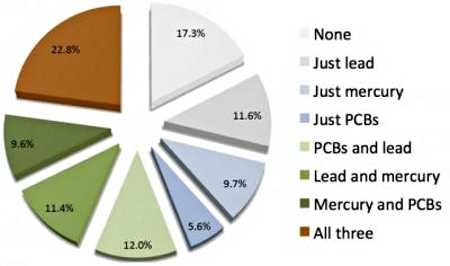
Nearly 23 percent of American women of childbearing age met or exceeded the median blood levels for all three environmental chemical pollutants – lead, mercury, and PCBs – tracked in an analysis of data on thousands of women by Brown University researchers.
All but 17.3 percent of the women aged 16 to 49 were at or above the median blood level for one or more of these chemicals, which are passed to fetuses through the placenta and to babies through breast milk.
The study, published in advance online Nov. 15 in the journal Environmental Research, identified several risk factors associated with a higher likelihood of a median-or-higher “body burden” for two or more of these chemicals.
The three pollutants are of greatest interest because they are pervasive and persistent in the environment and can harm fetal and infant brain development, albeit in different ways, said study lead author Dr. Marcella Thompson.
But scientists don’t yet know much about whether co-exposure to these three chemicals is more harmful than exposure to each chemical alone. Most researchers study the health effects of exposure to an individual chemical, not two or three together.
“Our research documents the prevalence of women who are exposed to all three of these chemicals,” said Thompson, who began the analysis as a doctoral student at the University of Rhode Island College of Nursing and has continued the research as a postdoctoral research associate for Brown University’s Superfund Research Program with co-author Kim Boekelheide, professor of pathology and laboratory medicine. “It points out clearly the need to look at health outcomes for multiple environmental chemical co-exposures.”
Most of the childbearing-age women – 55.8 percent – exceeded the median for two or more of the three pollutants.
Risks of exposure
Data were collected between 1999 and 2004 from 3,173 women aged 16 to 49 who participated in the Centers for Disease Control and Prevention National Health and Nutrition Examination Survey (NHANES).
The survey was designed to represent the national population of 134.5 million women of childbearing age.
Because the original study also elicited a wide variety of information on health behaviors, socioeconomic and demographic characteristics, Thompson and Boekelheide were able to identify specific risk factors associated with increased odds of having higher blood levels of lead, mercury, and PCBs.
They found several statistically significant risk factors. The most prominent among them was age. As women grew older, their risk of exceeding the median blood level in two or more of these pollutants grew exponentially to the point where women aged 30 to 39 had 12 times greater risk and women aged 40 to 49 had a risk 30 times greater than those women aged 16 to 19.
Thompson said women aged 40 to 49 would be at greatest risk not only because these chemicals accumulate in the body over time, but also because these women were born in the 1950s and 1960s before most environmental protection laws were enacted.
Fish and heavy alcohol consumption also raised the risk of having higher blood levels. Women who ate fish more than once a week during the prior 30 days had 4.5 times the risk of exceeding the median in two or more of these pollutants. Women who drank heavily had a milder but still substantially elevated risk.
Fish, especially top predators like swordfish and albacore tuna, are known to accumulate high levels of mercury and PCBs, Thompson said.
However, there is no known reason why they found a statistically higher association between heavy drinking and a higher body burden of pollutants.
One risk factor significantly reduced a woman’s risk of having elevated blood levels of the pollutants, but it was not good news: breastfeeding.
Women who had breastfed at least one child for at least a month sometime in their lives had about half the risk of exceeding the median blood level for two or more pollutants. In other words, Thompson said, women pass the pollutants that have accumulated in their bodies to their nursing infants.
Although the study did not measure whether women with higher levels of co-exposure or their children suffered ill health effects, Thompson said, the data still suggest that women should learn about their risks of co-exposure to these chemicals well before they become pregnant.
A woman who plans to become pregnant in her 30s or 40s, for example, will have a high relative risk of having higher blood levels of lead, PCBs, and mercury.
“We carry a history of our environmental exposures throughout our lives,” Thompson said.
- Details
- Written by: Editor
Better targeted treatments for 20 per cent of renal failure patients are on the horizon following a key discovery about the role of white blood cells in kidney inflammation.
In a new study published in Nature Medicine, researchers from Monash University tracked the movements of white blood cells, or leukocytes, leading to a new understanding of their behaviour in both healthy and diseased kidneys.
Leukocytes play important protective roles in the body’s immune system, but in some cases they cause damaging inflammation.
Glomerulonephritis is an inflammatory disease of the kidney that can lead to the need for transplantation or regular dialysis. More than 20 percent of end-stage renal failure cases result from glomerulonephritis.
Lead researcher, Associate Professor Michael Hickey of the University’s Centre for Inflammatory Diseases in the Department of Medicine said the team used advanced microscopy techniques to visualise the movements of leukocytes through the kidney.
“In order to manipulate a system, you must understand it. Now, we have a really clear understanding of the disease process and the molecules involved in the key steps,” Associate Professor Hickey said.
“Contrary to conventional medical and scientific opinion, we found that leukocytes are constantly circulating through and patrolling the blood vessels within healthy kidneys,” Hickey said. “It was previously believed that they only arrived in the kidney during the development of disease. That’s not the case. However, during disease they linger in the kidney during the course of their normal journey, become agitated and cause inflammation and kidney damage.”
End-stage renal failure leads to significant health and personal impacts, including ongoing visits to a dialysis unit several times a week, or a significant wait for a donor.
Renal Physician and co-investigator Professor Richard Kitching said therapies to effectively target glomerulonephritis were needed before end-stage was reached.
“The treatments we have can be fairly effective, but they are non-specific and they often have unacceptable side effects,” Professor Kitching said.
“Currently, we have to suppress the immune system to combat the inflammation and this immunosuppression leaves the body more prone to infections. Additionally, some of the drugs have metabolic side effects, such as weight gain and bone thinning.
“Now we have a better understanding of how the disease develops, we can identify targets for more specific drugs, with fewer side-effects.”
The Australia and New Zealand Dialysis and Transplant Registry reported that 19,000 Australians had end-stage kidney failure at the end of 2010.