 How to resolve AdBlock issue?
Recreation
- Details
- Written by: Editor
The California Department of Fish and Wildlife (CDFW) reminds 2013-14 full season spiny lobster report card holders to return their cards by April 30 as required by law.
Cardholders should review their cards carefully and check that the information recorded is complete and accurate.
Information collected from the cards provides CDFW with data necessary to monitor and manage California’s spiny lobster fishery.
Please note: Any 2013-14 full season spiny lobster report card holder who fails to return their card by April 30 will be charged a non-return fee of $20 upon issuance of a spiny lobster report card in the subsequent fishing season, or they may choose to skip one fishing season to be able to purchase a lobster card the following season at no extra cost.
Past lobster report card return rates have been too low to accurately estimate catch for the fishery but the Automated License Data System (ALDS) has greatly increased CDFW’s ability to remind card purchasers of the need to return report cards.
ALDS was used to mail reminder notices to all cardholders last year to return their report cards through the mail or submit their harvest data online.
If you receive a reminder notice but have already submitted your card or reported online, CDFW thanks you.
The cards need to be returned even if no lobsters were taken or no attempts were made to take lobsters. Spiny lobster report card data can be submitted online at www.dfg.ca.gov/licensing/harvestreporting .
Report cards also can be submitted by mail to:
CDFW – Lobster Report Card
3883 Ruffin Rd.
San Diego, CA 92123
Additional information and a list of frequently asked questions about this program can be found on CDFW’s Ocean Sport Fishing webpage, www.dfg.ca.gov/marine/invertebrate/lobster.asp .
- Details
- Written by: Carrie Wilson
Turkey hunting with pellet rifles?
Question: While watching some videos on YouTube about turkey hunting with a pellet rifle, I noticed a guy from Northern California stating he was using a nitro piston Remington air rifle which is not constant air or CO2 powered as your regulations state they must be. I believe people are thinking that any pellet rifle that is .177 caliber or larger is all right to use.
This guy has videos of multiple hunts in which he is using illegal equipment, thus couldn’t he be considered “poaching” or at least taking game with illegal equipment?
It’s sad to see people that are not completely understanding of the rules and regulations, but it also angers me to see people shoot these birds with equipment they should not be using. (Rob G., Folsom)
Answer: Thank you for taking the time to contact us about this and the use of the pellet rifle.
According to California Department of Fish and Wildlife (CDFW) Chief Mike Carion, this topic was recently discussed among our law enforcement leaders, and the group’s consensus is that the regulation allows for “compressed air or gas.”
Therefore, since the nitrogen-filled chamber is a compressed gas, it would meet the criteria of the regulations and therefore is not illegal.
This is another example of the regulations not being able to keep up with the advances in technology. We appreciate you bringing this to our attention and we will work to correct the writing of the language of these regulations.
Filleting halibut aboard my boat?
Question: If I catch a California halibut and want to fillet it aboard my boat and keep it as fresh as possible, what do I have to do?
Someone told me that as long as I leave all of the skin still attached on one side, that would be legal. Is this correct? (Robert L., Long Beach)
Answer: Yes.
For California halibut taken from or possessed aboard a vessel south of Point Arena (Mendocino County), fillets must be a minimum of 16 and three-quarter inches in length and shall bear the entire skin intact. A fillet from a California halibut (flesh from one entire side of the fish with the entire skin intact) may not be cut-in-half fillets.
However, a fillet may be cut lengthwise in a straight line along the midline of the fillet where the fillet was attached to the vertebra (backbone) of the fish only if the two pieces of a fillet remain joined along their midline for a length of at least two inches at one end of the fillet (California Code of Regulations Title 14, section 27.65(b)(6)).
How old to hunt in California?
Question: How old do you have to be to hunt in California?
I know you have to be 12 to hunt big game, but are there any age limits to anything else? How old do you have to be to take the hunter safety class? (Zac S.)
Answer: A person must be 12 years old to apply for a big game tag. There is no specified minimum age to hunt other game, but hunters must be accepted into and successfully complete the prescribed hunter education course.
It's up to the hunter education instructors as to what minimum age child they are willing to test, but most recommend 10 years old.
The main thing is the child must be mature enough to successfully complete the hunter education course requirements and examination.
Bear spray
Question: What are the laws in regards to bear spray in the state of California?
I moved from Alaska where it was almost necessary to carry bear spray as your first line of defense in order to eliminate the threat rather than resorting to a firearm. Can you please clarify what the law is here in California?
I understand personal self-defense against humans is legal as long as its 2.5 ounces or less. But as far as bear spray I just don't know the answer. I am concerned because I still have a can I brought from Alaska with me and would like to know if I am breaking any laws? (Paul P.)
Answer: Nothing in the Fish and Game Code or Title 14 regulations limit the amount of bear spray that may be possessed in California. However, depending upon the ingredients in the spray, there are likely Penal Code or Health and Safety Code provisions that apply.
The use of bear spray is not allowed within National Parks found within California but is allowed in some parks in other states.
CDFW recommends checking with the local sheriff’s office in the area you plan on carrying the bear spray.
Carrie Wilson is a marine environmental scientist with the California Department of Fish and Wildlife. While she cannot personally answer everyone’s questions, she will select a few to answer each week in this column. Please contact her at
- Details
- Written by: Editor
The California Department of Fish and Wildlife (CDFW) and U.S. Fish and Wildlife Service (USFWS) along with partners have successfully completed the capture of 36 tule elk from the San Luis National Wildlife Refuge in the San Joaquin Valley, relocating them throughout the state.
The collaborative effort included the Rocky Mountain Elk Foundation as well as volunteers from federal and state agencies who provided time, expertise and other needed resources to help this capture go smoothly.
“Seventy years ago, tule elk were on the brink of extinction and down to just a handful of animals,” said Senior Environmental Scientist Joe Hobbs. “Through CDFW’s wildlife management protocols and collaborative efforts with other wildlife organizations, we now have healthy and thriving herds across the state. It’s one the greatest wildlife success stories of our time.”
Tule elk are one of three sub-species of elk and are found only in California. Bulls (males) can weigh up to a thousand pounds and cows (females) can weigh up to 450 pounds. Capturing and transporting tule elk is a huge endeavor but the effort is critical for their long-term survival.
“Tule elk are one of California’s unique wildlife treasures,” said Kim Forrest, Refuge Manager at the San Luis NWR Complex. “We are pleased to partner with CDFW in relocating a portion of the San Luis herd so that other herds throughout the state can prosper.”
Since 1975, CDFW personnel have safely captured and relocated more than 1,500 tule elk using a variety of capture techniques, including chemical immobilization, trapping, baiting and physical restraint methods. As a result, California’s tule elk population has increased from three herds totaling 500 elk in the 1970s, to 22 herds with approximately 4,200 elk today.
A total of 15 bulls, 16 cows and five calves were captured using helicopters with net guns at the San Luis National Wildlife Refuge and released at the Carrizo Plains Ecological Reserve in San Luis Obispo County, Wind Wolves Preserve in Kern County and the San Antonio Valley Ecological Reserve in Santa Clara County. Hair, measurements, blood and other samples were taken to evaluate the health of the herd. Fourteen cows were also radio-collared to track their movements once they’ve been released.
Tule elk are native to California, live in open country and prefer grassland and marsh habitats. In their historic range, the elk once occupied much of the Central Valley until habitat loss and commercial harvest to feed the Gold Rush nearly drove them to extinction in the late 1800s.
The San Luis National Wildlife Refuge in Los Banos is open year-round and has an easy access auto tour route for unique elk viewing opportunities. Tule elk can also be viewed at CDFW’s Grizzly Island Wildlife Area, the Tupman Tule Elk State Preserve, and Point Reyes National Seashore.
- Details
- Written by: Editor
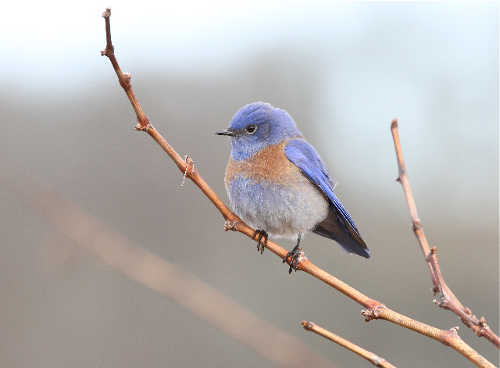
BOGGS MOUNTAIN, Calif. – The Friends of Boggs Mountain group is offering a bird hike for beginning birders on Saturday, April 5, at 8:30 a.m.
Identifying birds in the forest can be more challenging than backyard birding, but the rewards are great.
They will be looking and listening for a variety of birds from the violet-green Swallows and Western Bluebirds that are checking out the next boxes to the always popular raucous acorn and pileated woodpeckers that are always a fun to hear and see.
A second bird hike geared for intermediate-level birders is scheduled for Saturday, April 12.
If you haven’t already discovered the joy of birding, now is a good time to start, so come and enjoy a hike, get some exercise and delight in the Boggs birdlife.
The hike led by Peg Landini and Darlene Hecomovich will be a moderately-paced two-mile hike and should take approximately two hours.
Wear sturdy shoes, dress appropriately for weather conditions, and bring your binoculars, water and enthusiasm.
Meet at the parking lot kiosk promptly at 8:30 a.m.
The forest entrance is located off Highway 175 just a mile and a half north of Cobb Village. Turn at the blue State Fire Station/Boggs Mountain Forest sign.
For further information phone Darlene at 707-928-5591 or email at