 How to resolve AdBlock issue?
Recreation
- Details
- Written by: Carrie Wilson
Question: I have a question about feeding raccoons. My good-intentioned neighbor puts large pans of dog food out every night for the raccoons. We live in a very close community and the raccoons keep me awake at night with sounds of their fighting over food. They also venture onto my patio to cause more commotion and damage. I've tried everything to discourage their visits – ammonia-soaked rags, cayenne pepper, lights, etc. Nothing works.
I've tried to talk to my neighbor, telling her it's not good for wildlife to be fed by an unnatural food source, but she turns a deaf ear. Are there laws against feeding wildlife? Is there any other advice you can give me? (Anonymous)
Answer: While feeding wildlife makes those people doing so feel good, in the long run it is often to the detriment of the animal recipients. Although many animals will eat offered food, temporarily satisfying their hunger, in reality, many human foods lack the protein and nutritional components animals need for good health.
So, although your neighbor may be well-intentioned, she’s actually hurting the wildlife and her neighbors by encouraging wild animals to get too comfortable around humans.
When animals concentrate around food, they are more likely to spread diseases to each other and to domestic pets.
When wild animals lose their natural fear of humans, they can become very aggressive. Coyotes, in particular, are well-known for eating small pets because they do not differentiate between the food you leave for them and other prey items, like dogs and cats.
People often think they are just feeding cute, furry critters. But if they were to put a surveillance camera out, they would likely be surprised to find out what’s actually eating the food at night. They would probably be appalled to discover animals fighting over the food, and that they’re actually keeping the neighborhood rats fat and happy.
By feeding wildlife, your neighbor may be disrupting the animals’ normal behavior patterns in violation of California Code of Regulations (CCR) Title 14, section 251.1.
There may also be a local ordinance that bans feeding of some wild animals. Los Angeles County, for example, has an ordinance that prohibits feeding of “non-domesticated mammalian predators, including but not limited to, coyotes, raccoons, foxes and opossums.”
Feeding raccoons also presents a real human health risk. Raccoons are frequent carriers of a potentially fatal human pathogen, raccoon roundworm, Baylisascaris procyonis. This roundworm is transmitted through contact with the feces of raccoons and has caused fatalities in humans, including toddlers who will put raccoon feces in their mouths.
For more information visit www.cdph.ca.gov/healthinfo/discond/Documents/RaccoonRoundworms.pdf .
Using trout for bait?
Question: Can you please clarify whether trout can be used in California waters as bait? (Andrew G.)
Answer: Trout may not be used for bait. Statewide bait-fish regulations for all inland fishing districts begin with, "Except as provided below, live or dead fin fish shall not be used or possessed for use as bait . . ." (CCR Title 14, sections 4.00-4.30.)
Therefore, if the species is not specifically authorized in that section, it may not be used for bait. Even though trout are not specifically prohibited from being use as bait in the law, neither are they specifically authorized, and are therefore included in the general prohibition against using (any) live or dead finfish.
In addition, there are only two districts (Valley and South Central) where any species of finfish that is lawfully taken may be used for bait. However, trout and salmon are specifically excluded (CCR Title 14, section 4.20(d)). This is the provision that authorizes the use of bluegill for taking striped bass in the Delta.
How often to check hoop nets?
Question: When fishing my hoop nets in the river or ocean, how often do I need to check them?
Answer: Hoop nets are required to be checked at intervals not to exceed two hours (CCR Title 14, section 29.80). The owner of the hoop net or the person who placed the hoop net into the water must raise the hoop net to the surface and inspect the contents of the hoop net at intervals not to exceed two hours (CCR Title14, section 29.80(b)). Any hoop net abandoned or left unchecked for more than two hours may be considered abandoned and may be seized by any person authorized to enforce these regulations.
Picking up antler sheds
Question: Is it illegal in California to pick up antlers found in the wild? I see it is legal in every other state pretty much as long as you are not harassing the wildlife or trespassing. I have no intention of selling them or using them in a harmful way. I just want a little decoration around the house. (Kristian D.)
Answer: Yes, it is legal to collect antlers that have been naturally shed or dropped by deer or elk in California.
Carrie Wilson is a marine environmental scientist with the California Department of Fish and Wildlife. While she cannot personally answer everyone’s questions, she will select a few to answer each week in this column. Please contact her at
- Details
- Written by: Editor
LOWER LAKE, Calif. – The finals in Konocti Basketball League’s Lake County All-Stars Tournament will be held on Saturday, March 9.
The tournament will take place from 8 a.m. to 9 p.m. at the main gym at Lower Lake High School, 9430 Lake St.
The finals begin at 5 p.m.
Fifth and sixth graders from around the lake will be taking part.
Entry fees are $5 for adults, $3 for students and free for under age 4.
During the finals halftime there will be shoot-out competitions for free-throws, three-point shots, and half-court shots.
Prizes will be awarded to the winners of the competition.
Also, there will be a special raffle held for a miniature scoreboard complete with MP3 player and microphone. Raffle tickets will be $5 each.
Food and beverage will be available for purchase throughout the tournament.
All proceeds will go directly to KBL to support the continuation of their enormous efforts in our community.
Bring the family, bring a friend and come on down and watch Lake County's youth play their best.
- Details
- Written by: Editor

LAKEPORT, Calif. – The high school swim season opened on Thursday, Feb. 28, as Clear Lake/Kelseyville dueled Analy at the Westshore pool in Lakeport.
Top-ranked Analy dominated the meet, as expected.
“Facing Analy is always a humbling experience,” said Clear Lake/Kelseyville Coach Agustin Merodio. “They have such a strong program and all we can do is focus on doing our best. Our boys actually did well, considering who they were up against.”
Freshman Owen Lawler led the boys’ varsity placing first in the 100 breaststroke with a personal best time of 1:16.85.
He was also on the winning 200 yard medley relay team, accompanied by senior Pedro Hernandez, junior Andres Tejeda and senior Evan Thompson.
“Keep your eye on Owen. He’s going to have a great season this year,” said Merodio.
Other notable boys capturing second place finishes included junior Nathan Powers, who narrowly missed first place by less than a second in the 50 freestyle; junior Connor Disney, who came on strong at the finish in the 100 freestyle; senior Evan Thompson (100 butterfly), and freshman Kyle Nakken, (200 freestyle).
“Kyle did amazingly well,” said Merodio. “This was his very first meet, going against some very tough competition, and in his first event he takes second. Nice job.”
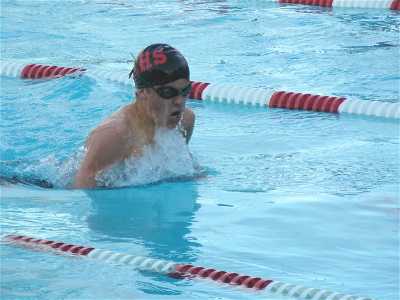
Second place scores were also achieved in the 200 freestyle relay by Disney, Powers, Thompson, and senior Aaron Copsey; as well as the 400 freestyle relay by Hernandez, Tejeda, Thompson and Lawler.
In girls’ varsity, third place times were posted by sophomore Liz Fricker (50 freestyle); senior Shao-Jia Chang (100 butterfly); and junior Allison Hanson (500 freestyle).
Last year, the future of the combined Clear Lake/Kelseyville team was in serious doubt at the end of the season due to high propane costs and other expenses.
Thanks to enormous community support in all the team’s fundraising efforts, including the fireworks booth, bingo night, ATV raffle, pancake breakfast, among others, as well as donations from the CLHS Sports Foundation and numerous local merchants, the team not only survived but grew considerably in size.
This investment in local youth is deeply appreciated by the team.
- Details
- Written by: Editor
LOWER LAKE, Calif. – The Anderson Marsh Interpretive Association (AMIA) holds monthly guided nature walks on the second Saturday of each month.
The next walk will be held this Saturday, March 9, followed by a tour of the historic ranch house museum.
Meet in front of the ranch house at 8:15 a.m. for time to experience the early morning wildlife to be found in the ranch house and barn complex yard. The walk begins at 8:30 a.m.
Join park docents Henry Bornstein and Gae Henry as they lead a leisurely walk along the ADA-compliant Cache Creek Nature Trail and Boardwalk.
Discover what the changing seasons are bringing to the park. The tour of the ranch house will begin immediately after the walk. If rain cancels the walk, the house tour will begin at 8:30 a.m.
Bring your binoculars – the trees are still mostly bare, so it is a good time of the year to view the birds that are attracted to the Park because of the abundance of food and shelter.
Anderson Marsh State Historic Park is located on Highway 53, between Lower Lake and Clearlake.
For more information about the walks, email
For information about how you can help support AMIA’s campaign to keep the park open to the public and available for events such as our monthly nature walks and tours, visit www.andersonmarsh.org or contact them at the telephone number or email address above.