 How to resolve AdBlock issue?
Recreation
- Details
- Written by: Editor
The California Department of Fish and Game (DFG) closed the 2012 black bear hunting season on Tuesday, Dec. 18.
Under regulations adopted by the Fish and Game Commission, the black bear season must be closed when DFG verifies 1,700 bears are taken by hunters or on the last Sunday in December, whichever occurs first.
As of Tuesday, the DFG has determined the 1,700 limit has been met. Tags yet to be received by DFG will put the total harvest at slightly more than 1,700 bears.
DFG is mailing notices to all bear tag holders, informing them that the season is closed. DFG wardens, biologists and customer service staff will also inform hunters they encounter that the season is closed. Statewide media sources and the California Fish and Game Commission will also be notified.
All bear tags, including unsuccessful tags, must be returned to the DFG Wildlife Branch, P.O. Box 944209, Sacramento, CA 94299-0002, by Feb.1, 2013.
Tags also can be reported online by logging into the Automated Data Licensing System. More details can be found at http://dfg.ca.gov/licensing/harvestreporting/ .
Hunters must present their bears to a DFG employee for tag validation immediately after taking the bear.
Furthermore, successful hunters must present the skull to a DFG employee within 10 days of taking the bear to collect biological samples.
Teeth and hair samples are extracted from the bears to determine the age of the bear and provide DNA information that will give DFG biologists an indication about the overall health of the state's bear population.
- Details
- Written by: Editor
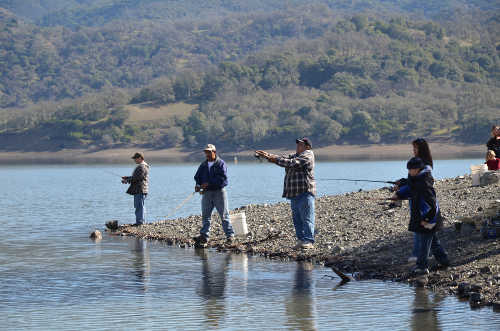
NORTHERN CALIFORNIA – The Department of Fish and Game (DFG) is planting more than 30,000 pounds of rainbow trout – some as large as one pound each – in Bay Area lakes during the month of December.
“We want to create opportunities for families to spend quality time together through the time-honored tradition of fishing,” said DFG acting Regional Manager Scott Wilson. “Fishing, like many other outdoor pursuits, helps keep people connected to their natural environment.”
Anglers are encouraged to submit photos of their catch to the DFG Facebook page with the name, age and location of the catch.
A fishing license is required of all anglers age 16 or older and all fishing regulations apply. Some lakes may require a daily fishing permit.
The enhanced stocking is coordinated through DFG’s Fishing in the City Program. Since 1993, Fishing in the City has enhanced fishing near areas where people live and work.
This is accomplished though enhanced stocking, habitat improvement and learn-to-fish clinics.
Fishing in the City is funded through the Sportfish Restoration Fund, an excise tax on the sale of fishing tackle and motor boat fuel.
The following lakes will be stocked as a part of this special program. Listings include County, lake and number of pounds planted.
Alameda County
Horseshoe Lake (Quarry L.), 1,050 pounds
Lake Elizabeth 500 pounds
Lakeshore Park, 800 pounds
Contra Costa County
Heather Farms Pond, 500 pounds
Hidden Valley Pond, 800 pounds
Lafayette Reservoir, 1,750 pounds
Temescal Lake, 1,300 pounds
Marin County
Bon Tempe, 4,375 pounds
Lagunitas, 500 pounds
San Francisco County
Merced Lake North, 1,750 pounds
Santa Clara County
Campbell Perc Ponds, 1,500 pounds
Cunningham Lake, 1,050 pounds
Sandy Wool Reservoir, 1,000 pounds
Spring Valley Pond, 250 pounds
Solano County
Lake Chabot, 2,250 pounds
Sonoma County
Ralphine Lake, 2,750 pounds
- Details
- Written by: Carrie Wilson
Question: I was informed that a downed crippled bird that was not recovered, even though a true effort was made to find the downed bird, still counts toward your bag limit. Where is this stated in the regulations? (Aaron W.)
Answer: It is not in regulation. It is an ethical hunter issue. Ethical hunters will make every attempt to find a downed bird. Even if that bird is never located but the hunter knows it was hit, the ethical hunter will still count it towards their bag limit. Ethical hunters do what is right even when they think no one’s looking.
Fishing and retrieving lobster hoop nets
Question: I understand that each person that drops a hoop net must be the same person that retrieves it. How is this going to be monitored? If we have four people in the boat and 10 nets, are we supposed to somehow mark each net to distinguish whose is whose? (Bill J.)
Answer: The law states that the owner of the hoop net or the person who placed the hoop net into the water shall raise the hoop net to the surface and inspect the contents of the hoop net at intervals not to exceed two hours.
According to Department of Fish and Game (DFG) Lt. Eric Kord, the intent of this law is to require a minimum checking interval of every two hours at least by whoever placed the net in the water and not to cite somebody for pulling up their buddy's net.
Wardens understand if you are working together as a team, but any net placed into the water is your responsibility to raise and inspect every two hours. Depending on someone else to do that for you may result in you receiving a citation if they fail to comply with this requirement.
Filleting salmon on board
Question: Can a private fisherman filet a fresh-caught salmon on the Sacramento River while retaining the carcass? I ask because I am of the opinion the salmon is not a size or weight limit fish. Does this change the answer? (Leslie G.)
Answer: You are correct that there is no minimum size or weight for salmon caught in the Sacramento River as there is in the Klamath River and ocean. This means Fish and Game Code, section 5508, does not prohibit anglers from filleting salmon caught from the Sacramento River.
However, Fish and Game Code, section 5509 provides it is unlawful to possess on any boat or to bring ashore any fish in such a condition that the species cannot be determined.
Since there are multiple species and runs of salmonids in the Sacramento River, and it is difficult to determine which is which based only on fillets, anglers shouldn’t filet salmon until they are ashore.
Anglers taking salmon from the shore are not affected by this prohibition and not restricted from filleting their catch. Retention of the carcass is not required.
What to do with old abalone shells?
Question: I know that abalone shells may not be sold, but what about shells found on private residential property?
In this case, abalone shells had been used for landscape decoration and were removed in a clean up of that property. Can they be sold or given away?
What about buying abalone shells from retail shops such as those located on Fisherman’s Wharf in San Francisco or other retail tourist destinations where they display these shells for sale?
If someone does buy a shell from one these tourist shops, would the purchaser be violating any DFG regulation for that purchase and possession? Does the Lacey Act of 1900 apply?
What do private citizens do if in fact they encounter abalone shells that have been used for landscape decoration and are in the ground and have been for some years? What about unsuspecting people who obtain shells at a retail tourist shop? How do they ensure they do not inadvertently run afoul of any DFG regulation? (Dr. Thomas G.P. Luparello, D.C. (Ret.))
Answer: California fish and game laws that protect abalone apply to all parts of the fish, including the shell. Under these laws, shells of sport-caught abalone may not be sold.
However, there are many abalone fisheries throughout the world, there was a commercial abalone fishery in California until 1993 and abalone are lawfully produced and sold by aquaculture facilities. The prohibition on selling sport-caught abalone shells does not apply to the shells of these abalone.
Additional information regarding this valuable and vulnerable resource is available online at www.dfg.ca.gov/marine/invertebrate/abalone.asp .
Carrie Wilson is a marine biologist with the California Department of Fish and Game. While she cannot personally answer everyone’s questions, she will select a few to answer each week. Please contact her at
- Details
- Written by: Editor
HIDDEN VALLEY LAKE, Calif. – The HVL Men’s Niners Golf Club held its last tournament of 2012 on Thursday, Dec. 6.
Thirty men participated in a two-man team (or 3 X 3 X 3) competition.
The results were:
- A Flight: The teams of Randy Brown/Bill Brewster, Mike Casolo/Dave Mann, Fred Figg/Jeff Markham, and Al Burrows/Phil Tyler all tied for top honors at net 31.
- B Flight: The father/son team of Jim Hodges/Jay Hodges took first with 27. Bob Schossler/Paul Peterson was second with 29 and Mike Riley/Byron Hoss was third, 30.
Closest to the par 3 pins were Stan Kalata and Byron Hoss.
The only chip-in of the day was scored by Hal Weber.
Opening day for the 2013 season will be March 7.