 How to resolve AdBlock issue?
Recreation
- Details
- Written by: Editor
The Aces were edged out by Upper Lake 28-27 at Haverty Field in Clearlake.
Perhaps a new rivalry was created during the second game when previously winless Kelseyville beat the previously undefeated Robinson Warriors in their first head-to-head match up in league history with a score of 33-26.
The Mobb Squad had a bye this weekend, but are “anxious” to get back into the action next week, roughly paraphrasing their team captain.
The standings as of week four are as follows.
Robinson Warriors
Record: 3-1
Win percent: .750
Home: 2-1
Away: 1-0
PF: 130
PA: 121
Streak: Lost one
Upper Lake
Record: 2-1
Win percent: .667
Home: 1-1
Away: 1-0
PF: 86
PA: 59
Streak: Won one
Devil's Aces
Record: 1-2
Win percent: .333
Home: 0-1
Away: 1-1
PF: 116
PA: 72
Streak: Lost one
Mobb Squad
Record: 1-2
Win percent: .333
Home: 1-0
Away: 0-2
PF: 74
PA: 84
Streak: Won one
Kelseyville
Record: 1-2
Win percent: .333
Home: 0-1
Away: 1-1
PF: 49
PA: 119
Streak: Won one
Anyone interested in helping with the chain crew for the rest of the season should call Bob Hopkins, 707-994-4720, or Vinny Lamb, 707-295-0223. There will be some modest compensation involved.
Visit the league's Web site at www.HTOsports.com/?GDFFL1 for more information.
- Details
- Written by: Editor
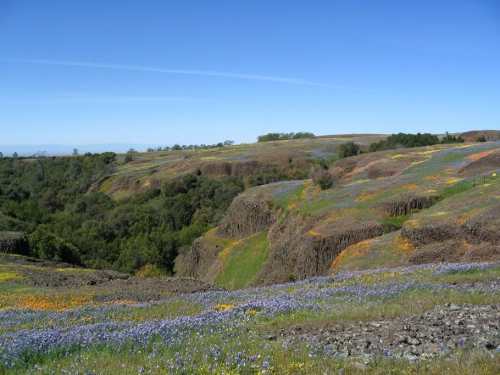
OROVILLE, Calif. – Join Department of Fish and Game (DFG) naturalists for a tour of North Table Mountain Ecological Reserve near Oroville this spring. Tour leaders and local field experts will point out and discuss the area’s unique geology, beautiful vistas, spectacular wildflower blooms, rare vernal pools and more.
North Table Mountain Ecological Reserve is open year-round from dawn to dusk.
Hiking and bird watching are popular activities but the wildflower viewing can be stunning.
Wildflower season generally begins in late February through March, with peak blooms in April. However, the season and intensity of wildflower booms can vary highly from year to year.
Two tours will be offered every Saturday in March and April, one at 10 a.m. and 1 p.m. Each tour is limited to 25 participants.
Advance registration is required on the DFG Web site at www.dfg.ca.gov/lands/er/region2/northtable.html.
These tours were extremely popular in 2011, so early registration is recommended. Additional information and photos can also be found on the website.
These two-hour tours cover up to two miles and involve moderate hiking over fields of uneven and rocky terrain, without established trails. Some small stream crossings and hill climbing may be required.
Hikers should wear sturdy, closed-toed shoes and bring their own water and snacks, as neither are available onsite. Dogs are not allowed on these tours. Before you visit please review the “Special Restrictions” listed on the Web site.
The tours are free, but registrants are encouraged to make a donation online to the California Wildlife Foundation to support this program.
If you are unable to register online or need more information, call DFG Interpretive Services at 916-358-2869.
- Details
- Written by: Editor
The hikes take place from 10 a.m. to 3 p.m. on Saturdays.
Enjoy the scenery of Cache Creek canyon where eagles, tule elk, osprey and other wildlife may be seen.
The first mile consists of a 600-foot climb. All participants should wear sturdy hiking boots and dress for cold weather.
Bring water, lunch and binoculars.
Reservations are required. Call the BLM at 707-468-4000 .
For more information about the Cache Creek Natural Area visit www.blm.gov/ca/st/en/fo/ukiah/cachecreek.html.
- Details
- Written by: Editor
Anglers are requested to review their cards carefully and complete the information as accurately as possible. Information collected from report cards provides DFG with data necessary to monitor and manage California’s steelhead fisheries.
The Steelhead Fishing Report and Restoration Card is a fishing report as well as a catch report. Steelhead anglers record where and when they fished, even if no fish were caught on a given trip.
Anglers are encouraged to submit steelhead report card data online at www.dfg.ca.gov/steelheadcard, but report cards can still be submitted by mail. Information must be submitted regardless of whether or not the angler fished for steelhead.
Those who did not fish for steelhead in 2011 are asked to select the “did not fish” option online or write “did not fish” on the card.
Additional information and a list of frequently asked questions about the program can be found on DFG’s Steelhead Fishing Report and Restoration Card Program Web page, www.dfg.ca.gov/steelheadcard.
Also on the Web page is “A Report to the Legislature (July 2007)” that includes an overview of steelhead biology and statewide status, projects funded with steelhead angler dollars, angling data, and monthly angling effort and monthly catch for a majority of California’s streams.
Anglers may download a copy or they can request one be mailed to them when they return their Steelhead Fishing Report and Restoration Card.
Anglers who wish to return their Steelhead Fishing Report and Restoration Cards by mail should send them to: DFG – Steelhead Fishing Report Card, P.O. Box 944209, Sacramento, CA 94244-2090.