
Recreation
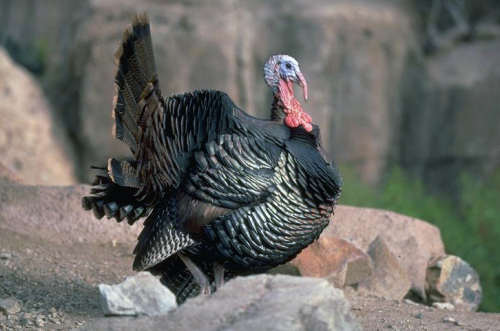
Question: I'm new to hunting and would like to try to bag a turkey this fall. Most of the information I've read about turkey hunting seems to be specific to the spring season. Are there different techniques or approaches I should use for a fall hunt? (Emmy)
Answer: Congratulations on obtaining your license! There has been a fall wild turkey hunting season in California since 1968. The fall turkey hunt is for either sex, and hunting techniques are indeed quite different from a spring gobbler hunt.
One of the more successful techniques is to locate and break up a fall brood flock, position yourself where they were, and call them back. Locating a brood flock often requires a great deal of time, but local hunters and California Department of Fish and Wildlife (CDFW) personnel can assist you with information on flock locations.
Large brood flocks, which are made up of hens and their young of the year, leave signs similar to those of spring turkeys, but on a larger scale. Look for tracks, droppings and the telltale feeding areas with oak leaves scratched in lines. Fall brood flocks are quite vocal, so listen for turkey talk as you scout for the flock.
Once a flock is located, a good break-up of the flock is mandatory for a successful hunt with this technique. Many hunters rush the flock, shouting and waving their arms to startle the flock into scattering (remember, do not run with a loaded gun in your hands!).
In many turkey ranges in California, the rocky terrain makes it dangerous to run at the flocks. A well-trained dog can be used to break up the flock, but must be hidden in a blind during the hunt or removed from the hunt area. After you have broken up the flock, locate a calling site near the point of the break up. Wait about one-half hour or until you hear birds calling before you start to call them.
The most frequently used call in the fall is the "kee kee run" or lost bird call. It is a high pitched "kee kee kee" in a series, usually followed by a yelp or two. Another call to try is a hen assembly call. This is the call of an adult hen gathering her flock. It is a long series of yelps rising slightly in volume and pitch and then declining in volume and pitch.
Hens will often use a series of 15 to 20 yelps for a gathering call. YouTube videos are a great way to familiarize yourself with the different calls. Research and practice will definitely improve your chances of a successful hunt!
Why don't we plant non-native sport fish?
Question: Why doesn't California plant Walleye and Lake Perch in Southern California? The lakes are deep enough, and these fish are tasty. I'm from Michigan and I've been here two years. We're missing out! (Floyd)
Answer: Currently only Salmonids (that is, trout and salmon) are raised and released by CDFW. In fact, increasingly it is primarily native trout and salmon that are raised in our hatchery system - species that have been in California for hundreds of thousands of years.
However, in addition to native salmonids, CDFW also raises and plants non-native brown trout, brook trout and Kokanee Salmon. Introducing non-native species to most ecosystems, though, almost always has unintended consequences that disrupt the balance of nature.
California has more native trout and salmon species than any other state. These fish are fun to catch, excellent to eat, and support ecosystems and tribal, recreational and commercial fisheries. In the past, the state of California did raise and release non-native sportfish (catfish and striped bass) for recreational angling, and currently there are several introduced fisheries in the state (for example, large and small mouth bass, crappie, blue gill, catfish and striped bass).
There are sport fisheries for these introduced species that are self-sustaining, so we don't need to stock them.
Walleye were planted in California waters between 1959-1963. But the anticipated angler benefits did not develop, so the program was abandoned.
Thus, while it's unlikely that Walleye will ever be stocked in California waters again, the Sacramento Perch (California's only native sunfish) is an excellent sportfish and CDFW fisheries managers are open to seeing more of them in the wild, both for conservation and recreational fishery purposes.
While we don't have the Sacramento Perch in our hatcheries at this moment, it is an idea of interest and certainly not out of the realm of possibility for the future!
If you have a question for the California Department of Fish and Wildlife, email
- Details
- Written by: California Department of Fish and Wildlife
The California Department of Fish and Wildlife's Shared Habitat Alliance for Recreational Enhancement, or SHARE, program will provide public access for hunting on three new properties in Plumas, Tehama and Tulare counties this winter.
For the first time, SHARE will offer waterfowl hunts in Sierra Valley, Plumas County. The Feather River Land Trust is opening 500 acres of the Sierra Valley Preserve to 10 SHARE hunters during five hunts from November through January. CDFW will randomly draw one permit (good for two hunters) for each hunt period.
SHARE is also offering four turkey and six quail hunts at River Ridge Ranch in Tulare County. The 722-acre ranch is located in the Sierra Nevada foothills and includes oak woodland and the Tule River. Camping and cabins are available on the property through Hipcamp. CDFW will randomly draw one permit (good for two hunters) for each hunt period.
Lastly SHARE will offer two fully guided wild pig hunts at Dye Creek Preserve in February and March 2019. Dye Creek Preserve is 37,540 acres of blue oak woodland, volcanic buttes and rolling fields located in Tehama County. Western Wildlife Adventures will provide guide services, two nights of lodging, food and transportation for each hunt. CDFW will randomly draw one permit (good for two hunters) for each hunt period.
Hunters with a valid California hunting license may apply for these hunts through the Automated License Data System (ALDS). An $11.62 non-refundable application fee will be charged for each hunt choice. Application deadlines are 17 days before each hunt.
To apply for these hunts, please visit www.ca.wildlifelicense.com/internetsales, log in to your account and select Purchase Licenses. Then select 2018 - Hunting, 2018 - SHARE Hunts Multi Choice Application, then choose specific hunt periods.
These opportunities are made possible by the SHARE Program, which offers private landowners liability protection and compensation for providing public access to or through their land for wildlife-dependent recreational activities.
The goal of the SHARE Program is to provide additional hunting, fishing and other recreational access on private lands in California.
For more information about SHARE opportunities, please visit www.wildlife.ca.gov/hunting/share.
For the first time, SHARE will offer waterfowl hunts in Sierra Valley, Plumas County. The Feather River Land Trust is opening 500 acres of the Sierra Valley Preserve to 10 SHARE hunters during five hunts from November through January. CDFW will randomly draw one permit (good for two hunters) for each hunt period.
SHARE is also offering four turkey and six quail hunts at River Ridge Ranch in Tulare County. The 722-acre ranch is located in the Sierra Nevada foothills and includes oak woodland and the Tule River. Camping and cabins are available on the property through Hipcamp. CDFW will randomly draw one permit (good for two hunters) for each hunt period.
Lastly SHARE will offer two fully guided wild pig hunts at Dye Creek Preserve in February and March 2019. Dye Creek Preserve is 37,540 acres of blue oak woodland, volcanic buttes and rolling fields located in Tehama County. Western Wildlife Adventures will provide guide services, two nights of lodging, food and transportation for each hunt. CDFW will randomly draw one permit (good for two hunters) for each hunt period.
Hunters with a valid California hunting license may apply for these hunts through the Automated License Data System (ALDS). An $11.62 non-refundable application fee will be charged for each hunt choice. Application deadlines are 17 days before each hunt.
To apply for these hunts, please visit www.ca.wildlifelicense.com/internetsales, log in to your account and select Purchase Licenses. Then select 2018 - Hunting, 2018 - SHARE Hunts Multi Choice Application, then choose specific hunt periods.
These opportunities are made possible by the SHARE Program, which offers private landowners liability protection and compensation for providing public access to or through their land for wildlife-dependent recreational activities.
The goal of the SHARE Program is to provide additional hunting, fishing and other recreational access on private lands in California.
For more information about SHARE opportunities, please visit www.wildlife.ca.gov/hunting/share.
- Details
- Written by: California Department of Fish and Wildlife





 How to resolve AdBlock issue?