 How to resolve AdBlock issue?
Recreation
- Details
- Written by: Rick Pyorre
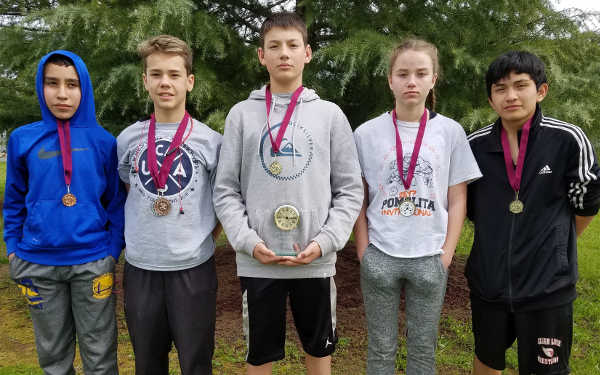
REDWOOD VALLEY, Calif. – On Saturday, March 24, Terrace Middle School Vikings sent six wrestlers to compete in the weekend’s Eagle Peak Middle School Wrestling Tournament.
The Vikings finished with three gold medals, one silver, two bronze medals and a sportsmanship award in memory of Eagle Peak Wrestler Kai Shepherd, who perished in the Redwood Valley fire.
In the girls varsity division, Ashley Pyorre (103 lbs.) went 2-0 with two pins to win her gold medal.
In the boys varsity division, Hayden Fowler (110 lbs.) went 2-1 to win a silver medal. His only loss was against the tournament’s most outstanding lightweight wrestler.
Liam Davis (130 lbs.) injured his elbow and was pulled from the tournament, but was still able to secure a bronze medal.
In the boys JV division, Hernan Romero (116 lbs.) was 3-0 with two pins to win his gold medal.
Elijah Alvarez (124 lbs.) went 2-0 with one pin to win a gold medal and was also awarded the tournament’s Kai Shepherd Memorial Sportsmanship Award as voted on by all the participating teams’ coaches.
Luis Aguilar (93 lbs.) wrestled some tough matches and was awarded a bronze medal.
- Details
- Written by: Tami Cramer
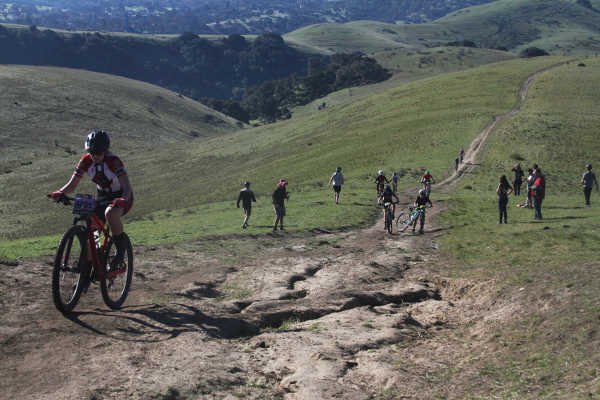
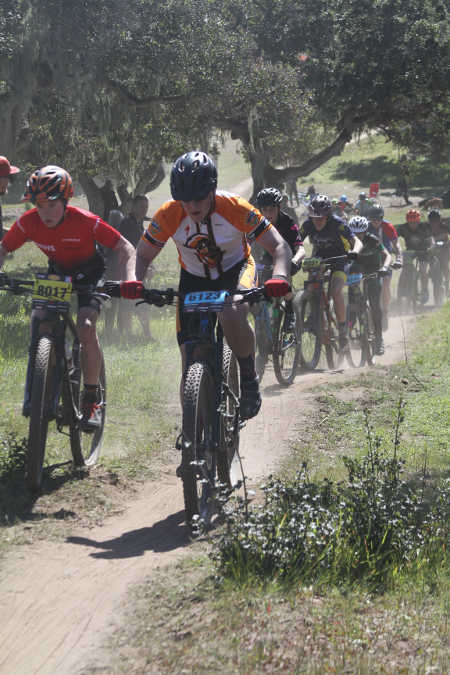
MONTEREY, Calif. – After six years of steady growth in numbers, the Clear Lake and Kelseyville Mountain Bike Teams have “slimmed” down this year, but their grit and determination is bigger than ever.
The season opener on Feb. 25 marked the first of three races in a row in the Monterey area.
A favorite among riders, race No. 1 took place at Fort Ord National Monument, just east of the town of Seaside.
The course provided lots of twisty turns and short climbs on fast-draining sandy soil with a punchy climb just before the finish.
The weather couldn’t have been better as the riders raced two to four laps of between 12 and 24 miles; each lap was five and a half miles with 450 feet of climbing.
At the end of the afternoon, two Clear Lake High School riders, both sophomores, stood atop the podium: Miranda Cramer placed second out of 17 riders in her class while Bron Falkenberg placed fourth out of a huge field of 61.
Falkenberg really stepped up his game after last season, training in the off-season by road biking all summer and fall to prepare.
Other finishers of the day included sophomore boys Nicholas Holmes (CLHS), 19th; Jacob Stahr (CLHS), 23rd; Ryan Rigby (KHS), 29th; and Garrett Smith (CLHS), 37th.
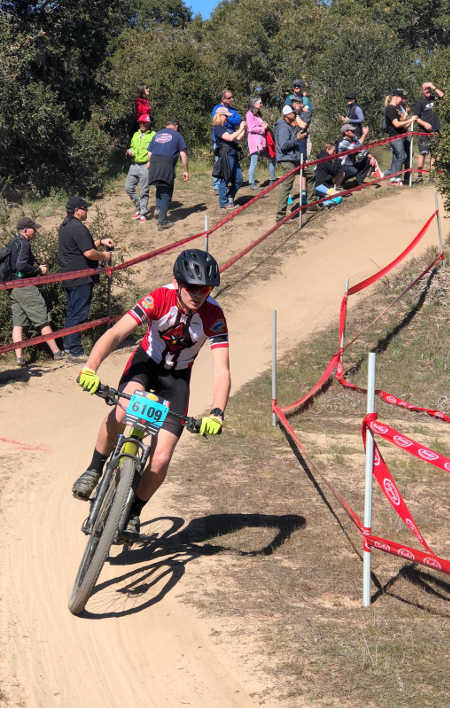
The goal of a new rider is often just to get their feet wet and finish the first race and freshman riders Michael Salata (KHS) and Ethan Bonson (KHS) did just that.
“It felt amazing to finish even though I didn’t do as good as I wanted to. I learned not to push it too hard at the start and get there early to get a good spot at the start,” said Salata.
With race No. 1 done, new goals were made and sights set for the next race held at Laguna Seca Raceway just outside of Monterey.
A 6-mile course with nearly 800 feet of climbing – riders compete two to five laps – Laguna Seca is known for its fast descents, long climbs, gale force winds and infamous “hurl hill.” Luckily, the winds never materialized and the weather was clear and sunny.
Both Cramer and Falkenberg repeated their performances by walking atop the podium once again in second and fourth places, respectively, in their categories.
Cramer held on the wheel of the rider in first place for most of the first lap, but after each of them washed out in turns, first place was able to pull ahead and Miranda just couldn’t catch her.
Cramer’s plan for race No. 3 was to “pace myself so I can sprint at the end and hopefully take the lead.”
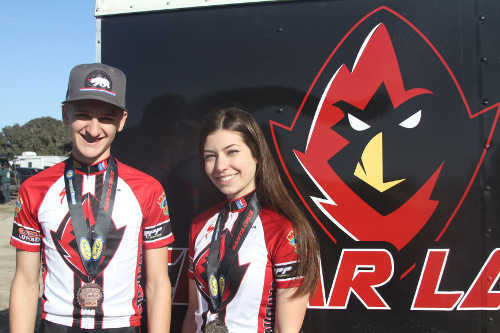
“Laguna Seca was fast paced and fun,” said Falkenberg. “My game plan for is to shoot for second in the next race.”
Other finishers included Rainey Vanoven (CLHS JV girl) finishing mid-pack, 15th of 33, and sophomore boys Jacob Stahr (CLHS), 22; Nicholas Holmes (CLHS), 23; and Garrett Smith (CLHS).
Ryan Rigby (KHS), had a rough go with two flat tires in the first lap and was unable to finish the race.
“That’s racing,” said Coach Tami Cramer. “Sometimes things are out of your control and just don’t go your way. I look forward to upcoming battles at the next race.”
Upcoming races include Granite Bay (Folsom Lake) on April 14 and Six Sigma in Lower Lake on May 5. For full info/locations and the NorCal High School Cycling League, go to http://norcalmtb.org .
For more about the local high school mountain bike teams, check out their Facebook page at Lake County High School Mountain Bike Teams, on Instagram check out #lakecountymtb for info and pictures.
Tami Cramer is coach of the Clear Lake and Kelseyville Mountain Bike Teams.
- Details
- Written by: California Department of Fish and Wildlife
Question: Are you allowed to keep black bass that are of legal size? The regulations are confusing as to if you are allowed to keep them or not. (Jake)
Answer: California Code of Regulations Title 14, section 5.00 describes the black bass regulations for various bodies of water throughout California.
In California, the term "black bass" is used to define four commonly caught members of the sunfish family of the same genus: smallmouth bass, largemouth bass, spotted bass and Alabama bass. A fifth member of the black bass group, the redeye bass, is rare.
Black bass are clearly the most popular of warm water fish and there are many anglers who fish in tournaments with prize money offered for the biggest total catch or individual "big fish."
All licensed black bass tournaments require catch and release fishing, so this is understandably confusing to those who may want to catch and keep black bass.
Black bass are considered very good table fare! Although there are many exceptions, the general rule for black bass is a 12-inch size limit and five fish bag limit in combination of species. It is very important to look up the body of water you plan to fish and verify the specific black bass rules that apply there.
Also please note, black bass cannot be transported live from the waters where taken. Many people try to keep them in a livewell to raise them at home - that is not legal.
Hunting small game and big game at the same time
Question: Would it be legal to carry a shotgun for small game and a rifle for deer at the same time? (SJ)
Answer: Generally, carrying multiple firearms while hunting is not prohibited by the Fish and Game Code or regulations adopted to implement those laws.
Such activity is common, in fact – especially with turkey hunters who are simultaneously keeping an eye out for wild pigs.
Hunts that occur in certain areas with restrictions, such as wildlife areas, refuges and areas with county firearms closures, constitute an exception to this general rule.
And of course, hunts which specifically prohibit shotguns and rifles, such as muzzleloader and archery-only seasons and zones, are exceptions as well.
Be cautious so you don't end up carrying lead ammunition in an area where it is prohibited.
For the authorized methods of take for various categories of game and nongame birds/mammals, please check the hunting regulations (CCR Title 14, sections 311, 353, 465, 475 and 507 (for waterfowl)).
Razor clams and domoic acid testing
Question: My friend and I are enthusiastic razor clam harvesters in Del Norte. For the last two years, however, we have been unable to take part in this popular fishery because of high domoic acid levels in the clams. We noticed that the last published domoic acid tests were from Nov. 13, 2016.
We were wondering if testing of domoic acid levels has continued over the last year but has not been published on the CDFW health advisory website. Does CDFW need volunteers to collect clams for testing? If so, how would we go about doing this? (Jolyon)
Answer: Razor clams are known for bioaccumulating domoic acid, which basically means they concentrate the toxin and are slow to excrete it. Unfortunately, concentrations of domoic acid continue to remain high in samples and it does not look likely the fishery will open soon.
The California Department of Public Health's Marine Biotoxin Monitoring Program coordinates all bivalve shellfish and phytoplankton monitoring in the state for public health protection.
For razor clam sampling, they work with individual volunteers, the Tolowa Dee-ni' Nation and CDFW staff from the Eureka office.
If you are interested in volunteering for the program you can contact CDPH Senior Environmental Scientist Vanessa Zubkousky-White, who coordinates the bivalve shellfish and phytoplankton sampling effort. She can be reached at 510-412-4635, or
If you have a question for the California Department of Fish and Wildlife, email
- Details
- Written by: Mendocino National Forest
The recreation area is in Tehama County in Red Bluff.
The purpose of the proposed action is to facilitate the community’s use of the RBRA. The proposed action is the issuance of short-term special use permits for three events in May: Sober Grad Fun Run (May 5, 2018) using facility trails, Society for Creative Anachronism Inc. (May 11 to 13, 2018) at Camp Discovery Group Campground and Wood Flock (May 25 to 28, 2018) at Camp Discovery Group Campground.
Event activities would be confined to the facility and within the area of existing disturbances; no new disturbances are authorized.
Comments will be accepted for seven calendar days following posting of the scoping letter on the forest’s project Web page at https://www.fs.usda.gov/projects/mendocino/landmanagement/projects.
Please provide comments by mail, fax, email, or in person to the responsible official, Dionne Uzes, Acting District Ranger, c/o Linda Serret, district NEPA planner, at 825 N. Humboldt Ave., Willows, CA 95988; fax: (530) 934-1212; email: