 How to resolve AdBlock issue?
Recreation
- Details
- Written by: CARRIE WILSON
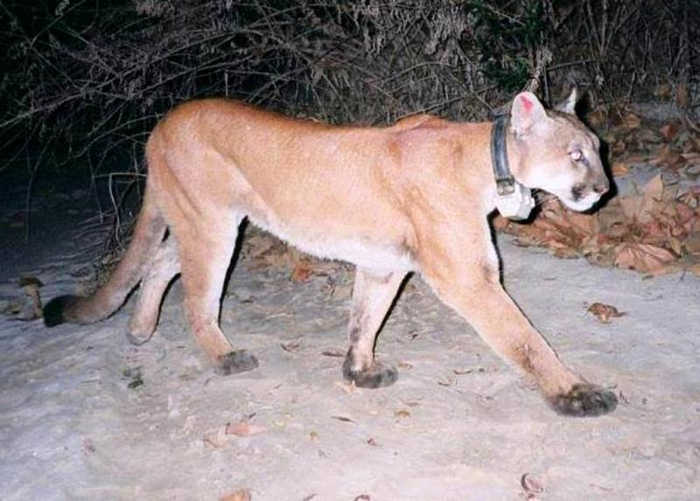
Purpose and frequencies of wildlife tracking collars?
Question: My daughter and I have a huge interest in our local wildlife. We live in the foothills of the Santa Monica Mountains.
I have been interested in radio and emergency communications since my childhood. I was hoping you could educate us regarding what tracking collars are being used around my house and what frequencies the collars are using to transmit over. (Anthony D.)
Answer: Thank you for your interest in California's wildlife. When wildlife researchers affix radio collars to a wild animal, their primary purpose is to understand the animal's movements in a natural setting.
Animals may alter their behavior in response to people intentionally approaching them. If this happens to an animal that has a tracking collar, the results of the study can be altered, resulting in inappropriate conclusions.
This is called introducing "bias" into the data, which is something that scientists always try to minimize.
Therefore, as a matter of maintaining scientific integrity as well as ensuring the safety of the study animals and people (imagine approaching an injured mountain lion), we do not disclose the frequency of the tracking collars we deploy on animals.
Squid jigs
Question: I have a question regarding the regulations for market/jumbo squid. Section 29.70 in the Ocean Regulations simply states that "squid may be taken with hand-held dip nets."
However, I have seen many guys using squid jigs of all types to catch squid. The jigs have no hooks but are a circular nest of pins around a lure body that lightly snag the squid when they attack the jig. This seems like a common method of take but I don't see it listed in the regs.
Is using a squid jig legal to catch squid south of Pt. Conception? (Mark N.)
Answer: Squid fishing regulations can be found in the general mollusks section of the regulations book beginning on page 36.
Here it says, "Except as otherwise provided in this article, saltwater mollusks, including octopus, may be taken only on hook and line or with the hands" (California Code of Regulations Title 14, section 29.10).
Therefore, since squid may be taken with hook and line, the squid jig may be used as a type of hooking device. Squid jigs are legal for catching squid throughout California.
Hearing conditions vs. rifle silencers?
Question: I have substantial hearing loss and my doctor recommends surgery to correct my problem.
The issue is that my hearing would be very sensitive to noise, and shooting a rifle could actually damage it greatly. I don't want to have to give up hunting though, so is there an exception for the hearing impaired where I could use a silencer on my rifle? (Carlos M.)
Answer: No. Section 33410 of the California Penal Code regulates the possession and use of silencers, also known as suppressors, with very specific exemptions for the military and law enforcement personnel. Penalties for mere possession in California are quite severe.
California Penal Code section 33410 states that any person, firm or corporation who within this state possesses a silencer is guilty of a felony and upon conviction thereof shall be punished by imprisonment pursuant to subdivision (h) of section 1170 or by a fine not to exceed $10,000, or by both that fine and imprisonment.
There are no exceptions for hunting or for people suffering from hearing impairment. We recommend that you use hearing protection – which is legal and prudent.
Measuring striped bass?
Question: The other day I caught a striped bass that was between 17 and 18 inches. When I opened the tail it measured 17 inches, but when I barely squeezed the tail, it measured 18 inches. What's the proper way to measure striped bass? (Tou T.)
Answer: Legal-sized striped bass must measure at least 18 inches total length. Total length is defined in the regulations as "the longest straight-line measurement from the tip of the head to the end of the longest lobe of the tail" and specifies that the tip of the head "shall be the most anterior point on the fish with the mouth closed and the fish lying flat on its side" (CCR Title 14, section 1.62).
The best way to measure fish to get the longest total length is to lay the fish down flat on a flat surface, pinch the mouth shut and measure to the longest point of the caudal (tail).
Carrie Wilson is a marine environmental scientist with the California Department of Fish and Wildlife. While she cannot personally answer everyone's questions, she will select a few to answer each week in this column. Please contact her at
- Details
- Written by: Editor
The jump from 19th place in 2008 can be credited in large part to the state’s new Bicycle and Pedestrian Plan and additional funding for active transportation projects.
“This survey has provided an opportunity for Caltrans to measure our advances and gauge our goals for improvement, and these rankings show that we’ve come a long way as a state,” said Caltrans Director Malcolm Dougherty. “We will continue our efforts to ensure California’s transportation system is safe, convenient and accessible for all users, while also making sure all Californians have more livable and economically vibrant communities.”
The continued rise in California’s rankings can be credited to a multi-tiered effort by Caltrans to increase options and safety for bicyclists as part of its approach to a multimodal transportation system.
The report card notes that California has a state Department of Transportation that is increasingly committed to ensuring the safety and comfort of people who bike and is on the verge of establishing new standards and practices that will be a model for other states.
California’s adoption of its first-ever State Bicycle and Pedestrian Plan is part of that multi-tiered effort and was a significant contributing factor to the state’s jump in scoring.
The plan has allowed California to lay out a blueprint to fully integrate bicycling and walking into the fabric of the California transportation system.
It is also Caltrans’ roadmap to achieve the department’s ambitious goals to double walking and triple bicycling trips by 2020, and reduce bicycle and pedestrian fatalities by ten percent each year.
California has also increased the funding for its Active Transportation Program from $130 million to $230 million per year. California’s Active Transportation Program, or ATP, is the largest of its type in the nation and will continue to fund much of the state’s walking and bicycle projects.
The bicycle and pedestrian projects funded by the ATP not only encourage increased use of active modes of transportation, they also support sustainable communities and healthier, low-carbon travel choices.
The Sustainable Transportation Planning Grant program’s funding also increased from $10 million to $35 million. These grants support cities, counties, agencies and transit operators in their efforts to integrate transit, bicycling and walking into their local transportation plans.
Past grants have included planning for bicycle and pedestrian paths and for connectivity of multimodal options such as light rail and bus service to biking or walking.
California’s report card can be found at http://bikeleague.org/sites/default/files/BFS2017_ReportCard_California.pdf.
For more information about the Bike Friendly State Program and the League of American Bicyclists, visit http://bikeleague.org/states.
- Details
- Written by: Editor
The two-hour walk will begin at 8:30 a.m. at the visitor center parking lot and will be a slow walk along Cole Creek, Kelsey Creek and Kelsey Creek Slough.
The walk will cover about one mile of paved road and established trails.
Participants should wear sturdy shoes and bring binoculars and water.
Clear Lake State Park is located at 5300 Soda Bay Road in Kelseyville. Entry into the park is free for those participating in the walk.
Anyone having special needs should contact the Clear Lake State Park Sector office Tuesday through Thursday between 8 a.m. and 5 p.m. at 707-279-2267.
Help support the Clear Lake State Park Interpretive Association in its effort to bring educational and interpretive programs to the state park by becoming a member of the association.
Go to www.clearlakestatepark.org for further information.
- Details
- Written by: Editor
Boat Owners Association of The United States, or BoatUS, the nation’s largest advocacy, services and safety group for recreational boaters, estimates that more than 63,000 recreational boats were damaged or destroyed as a result of both Hurricane Harvey and Hurricane Irma, with a combined dollar damage estimate of $655 million (boats only).
These numbers are strikingly close to 2012’s Hurricane Sandy, which remains the single-largest industry loss with more than 65,000 boats damaged and more than $650 million in estimated losses.
Breaking down the 2017 season storms, Hurricane Irma damaged or destroyed 50,000 vessels with approximately $500 million in recreational boat damage.
About 13,500 boats were damaged or lost costing $155 million in boat damage as the result of Hurricane Harvey.
“These two storms were as different as night and day,” said BoatUS Marine Insurance Program Vice President of Claims Rick Wilson. “The boats that were hit the hardest by Harvey were located on a relatively small slice of Texas coast, while we saw damage to recreational vessels from Irma in every corner of Florida.” The BoatUS Catastrophe Team recently completed two months of field operations arranging for repairs, salvage or wreck removals for BoatUS Marine Insurance program members and GEICO Marine Insurance customers.
“While Hurricane Irma’s losses are significant, it could have been much worse,” added Wilson. “Irma ultimately traveled up Florida’s West Coast and not the East, which was initially forecast. And while locations in the right front quadrant of the storm such as Big Pine Key and Marathon were hit hard with a Category 4 storm, Irma lost strength as it approached the mainland and swept up Florida. As the storm passed east of Tampa Bay, waters receded and came back gradually, also lessening surge damage.”