 How to resolve AdBlock issue?
Recreation
- Details
- Written by: Editor
NORTH COAST, Calif. – California’s popular red abalone sport fishery season will open April 1 in most waters north of San Francisco Bay.
However, parts of Fort Ross State Historical Park remain closed to the take of abalone.
A map of the closed area can be found online at http://nrm.dfg.ca.gov/FileHandler.ashx?DocumentID=42101&inline=true .
Fishing for abalone is allowed from 8 a.m to one half hour after sunset. People may travel to fishing locations before 8 a.m. but may not actively search for or take any abalone before that time.
The annual limit is 18, but only a total of nine can be taken from Sonoma and Marin counties.
A complete list of abalone fishing regulations is available in the 2016 Ocean Sport Fishing Regulations booklet, which is available wherever fishing licenses are sold or at www.wildlife.ca.gov/fishing/ocean/regulations/sport-fishing .
Abalone licenses and report cards may be purchased online at www.wildlife.ca.gov/licensing/fishing .
Abalone report cards are required to be reported online at www.wildlife.ca.gov/licensing/fishing#758846-harvest-reporting or returned to the California Department of Fish and Wildlife’s Fort Bragg office, 32330 North Harbor Dr., Fort Bragg, CA 95437-5554.
The return deadline is Jan. 31, 2017 but cards can be submitted early. Abalone report cards must be returned even if no abalone were taken or no attempt was made to take abalone.
Abalone cling to rocks, from wave-swept intertidal ledges to deep ocean reefs, where they feed on kelp and other algae. It can take 12 years or more for abalone on the north coast to grow to legal size for harvest.
Similar to rockfish, abalone are a long-lived species but have generally low rates of reproduction. The fishery is managed conservatively to ensure a healthy fishery for generations to come.
In recent years, the red abalone fishery has come under some stress due to unfavorable ocean conditions. In 2011, a red tide caused a die-off of abalone and other invertebrates primarily in Sonoma County.
Abalone feed on kelp but the warm water conditions the past two years have greatly reduced kelp growth which has resulted in noticeably leaner abalone.
Great increases in purple urchin populations have reduced the amount of food and habitat available for abalone and could slow the recovery of kelp beds.
Abalone divers can help state biologists assess the ever-changing conditions that influence the abalone fishery.
This year, a program will be established to allow divers to report observations that may help ongoing management. CDFW plans to kick off the new observer program later this spring.
Currently, the only ongoing abalone fishery in California is in the northern region of the state, which has remained productive for nearly 60 years.
In 2014, the most recent year numbers for which are available, the catch estimated from returned abalone report cards and telephone surveys was 148,000 abalone.
The average catch over the past five years has been about 210,000 abalone annually.
- Details
- Written by: Editor
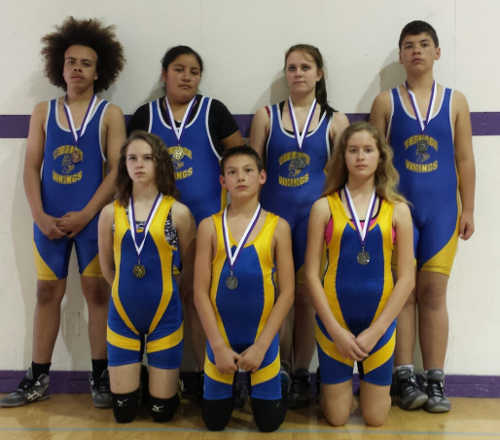
FORT BRAGG, Calif. – On Saturday, March 26, some of the Terrace Middle School Viking wrestlers wanted one more tournament, so just before hunting eggs, they went hunting medals.
The Vikings entered 10 wrestlers into the Del Fiorentino Open Invitational – four boys and six girls – and won seven total medals, including two golds, four silvers and one bronze.
Ashley Vasquez (194 pounds) went 4-0 with three pins and Mavis Pyorre (100 pounds) was 3-0 with three pins to win their gold medals.
Sterling Wong was 3-1 (wrestling up at heavyweight) with three pins; Alyssa Gray (wrestling up at Girls 194 pounds) went 3-1 with two pins; Carlie Green (125 pounds) went 3-1 with two pins; and Elijah Alvarez (85 pounds) went 2-1, to win their silver medals.
Donald Mingo (wrestling up at 150 pounds) went 1-2 with one pin to win his bronze medal.
Jesse Lewis (wrestling up at 140 pounds) and Delia Shirley with one pin (wrestling up at Girls 194 pounds) each went 1-3 and just missed out on medals, with some exciting close matches.
Bryanna Johnson (100 pounds) also wrestled some hard-fought matches for the Vikings.
While most will be enjoying a restful spring break, Mavis Pyorre will have one more week of practice and one more tournament left on her schedule, the California Girls Middle School State Wrestling Championships on April 2 in Albany. Then she is off to softball and track.

- Details
- Written by: Editor
HIDDEN VALLEY LAKE, Calif. – The Hidden Valley Lake Ladies 40-9ers Golf Club held a nine-hole game of “Eenie Meenie” on Thursday, March 24.
The results are as follows:
– First flight: First place, Barbara Harris, net 18; second place, Nancy Erickson, net 20.
– Flight two: First place, Gwen DeRosa, net 18.5; second place (tie), Mariana Bendinelli and Sharon Compatore, net 20.5.
– Third place: First place, Floydean Greenlow, net 18; second place, Linda Millard, net 20.
- Details
- Written by: Editor
NORTHERN CALIFORNIA – A temporary emergency regulation closing all fishing within 5.5 miles of spawning habitat on the Upper Sacramento River begins on April 1, and will remain in effect through July 31.
Enhanced protective measures are also proposed in the ocean sport and commercial salmon fisheries regulations for the 2016 season.
The temporary emergency regulation closes all fishing on the 5.5 mile stretch of the Sacramento River from the Highway 44 bridge where it crosses the Sacramento River upstream to Keswick Dam.
The area is currently closed to salmon fishing but was open to trout fishing.
The temporary closure will protect critical spawning habitat and eliminate any incidental stress or hooking mortality of winter-run chinook salmon by anglers.
California Department of Fish and Wildlife (CDFW) scientists believe the additional protection provided in the emergency river closure and potential ocean fishing restrictions will help avoid a third year of substantial winter-run chinook salmon loss.
Historically, winter-run Chinook spawned in the upper reaches of Sacramento River tributaries, including the McCloud, Pit and Little Sacramento rivers.
Shasta and Keswick dams now block access to the historic spawning areas. Winter-run chinook, however, were able to take advantage of cool summer water releases downstream of Keswick Dam.
In the 1940s and 1950s, the population recovered, but beginning in 1970, the population experienced a dramatic decline, to a low of approximately 200 spawners by the early 1990s.
The run was classified as endangered under the state Endangered Species Act in 1989, and as endangered under the federal Endangered Species Act in 1994.
The Fish and Game Commission adopted CDFW’s proposal for the 2016 temporary closure at its regularly scheduled February meeting.