 How to resolve AdBlock issue?
Regional
- Details
- Written by: Caltrans
The Berry Summit Vista Point along Route 299 is renowned for breathtaking views and starry nighttime skies, but it has long lacked key services for travelers.
The project will add toilet facilities, solar-powered electric vehicle charging stations, a picnic area featuring local drought-resistant vegetation, night-sky-friendly solar lighting, informational kiosks, and decorative garbage cans.
Expected to be completed by early summer, the $759,00 effort was made possible by Governor Gavin Newsom’s Clean California Initiative — a sweeping, $1.2 billion, multiyear clean-up effort led by Caltrans to remove trash, create thousands of jobs, and join with communities throughout the state to reclaim, transform and beautify public spaces.
These enhancements to the popular scenic overlook destination will improve safety, increase convenience, and make for a more enjoyable recreational experience for travelers from across the state.
"A major element of Clean California is to inspire local pride and stewardship,” said Caltrans Director Tony Taveras. “This project reflects that spirit through the involvement of many exceptional local development partners, including local tribes, Humboldt County, the Humboldt County Association of Governments, CHP-Humboldt, and CAL-ORE Life Flight.”
Yolanda Latham of the Whil'kut tribe added, "This project will surely help those traveling through our region and ancestral territory, and I hope that many families will feel a bit safer when traveling with the elderly and little ones."
Humboldt County Supervisor Steve Madrone added, “The efforts by Caltrans and the Clean California team have been commendable. The project at Berry Summit Vista Point was developed by reaching out to tribes and the community to make meaningful improvements.”
Clean California has funded 319 projects statewide to revitalize and beautify underserved communities, some of which are already complete and now sources of community pride. Projects are improving public spaces, tribal lands, parks, neighborhoods, transit centers, walking paths, streets, roadsides, recreation fields, community gathering spots, and places of cultural importance or historical interest in underserved communities.
Since launching Clean California in July 2021, Caltrans has removed nearly 2.3 million cubic yards of litter from state highways – or enough to fill about 700 Olympic-size swimming pools.
The program has also created more than 15,000 jobs that have helped Californians overcome barriers to employment and drawn more than 10,000 volunteers to events ranging from community cleanups to large debris collections for appliances, tires, and mattresses.
For further information, visit https://cleanca.com/.
- Details
- Written by: Lake County News reports

NORTH COAST, Calif. — The Mendocino County Sheriff’s Office has arrested a Covelo man for the killing of the mother of his child.
Johnathan Lee Draughan, 43, was arrested for the early Wednesday morning kiling of 35-year-old Brandy Kay Mathieson, also of Covelo, according to a report from Lt. Andrew Porter.
At 5:29 a.m. Wednesday, the Mendocino County Sheriff's Office received a 911 call from Mathieson, who reported that she was a victim of domestic violence at the hands of her boyfriend, Johnathan Lee Draughan.
Mathieson reported that Draughan was in the house and he was armed with a firearm. While on the phone, gunshots were heard by the dispatcher and Mathieson was no longer speaking with dispatch, Porter said.
A short time later, Porter said Draughan spoke on the phone with the dispatcher and advised he had shot his girlfriend and he would await the arrival of deputies.
Deputies, who were responding from Willits, arrived and took Draughan into custody without incident, Porter said.
Mathieson was located inside the residence and life saving measures were attempted by the deputies and then continued by local fire resources. Porter said Mathieson showed no signs of life and was declared deceased at the scene.
Mathieson’s and Draughan's 2-year-old child was present and was transported to an out-of-county hospital for injuries unrelated to the shooting incident, Porter said.
Porter said Mendocino County Sheriff's Office detectives responded and took over the investigation. Criminalists from the California Department of Justice labs in both Eureka and Santa Rosa responded to assist in processing the crime scene for evidence.
Draughan was subsequently transported and booked into the Mendocino County Jail on a charge of homicide, Porter said. He is being held without bail, according to jail records.
Any persons with information related to this homicide are encouraged to contact the Mendocino County Sheriff's Office by calling Dispatch at 707-463-4086, or through the tip line at 707-234-2100.
- Details
- Written by: Elizabeth Larson
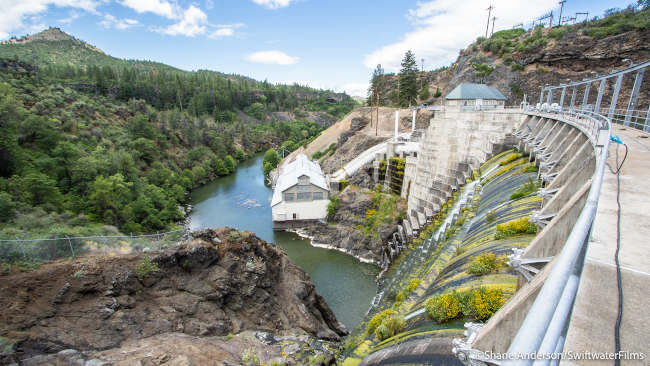
HORNBROOK, Calif. — Following Friday’s successful test blast, the Klamath River Renewal Corp. reported it will proceed with the removal of the Copco No. 1 Dam, the second dam to be removed as a part of the Klamath dam removal project.
The Copco No. 1 Dam, constructed in 1918 for the sole purpose of hydroelectric power generation, has blocked fish passage for over 100 years and is expected to be fully removed by the end of August 2024.
“We are excited to get to work,” said Mark Bransom, CEO of the Renewal Corp. “With the initial phase of drawdown complete, the dam is fully exposed and can safely be disassembled.”
Copco No. 2, a diversion dam that was located just downstream of Copco No. 1, was removed last year.
The remaining three dams, Copco No. 1, Iron Gate, and JC Boyle created reservoirs that needed to be drawn down before removal could begin.
The initial phase of drawdown concluded last month, and shortly thereafter FERC approved an advancement in the schedule, allowing for the removal of Copco No. 1 ahead of the other remaining dams.
Iron Gate and JC Boyle, which are clay core earthen dams, will remain at their full height until the spring runoff period has concluded and the Klamath River has returned to baseline flows. Work on their deconstruction will likely begin sometime in May, depending on precipitation.
Deconstruction of the Copco No.1 Dam, which will be performed through a repetitive cycle of drilling, blasting and chipping, can begin before the spring runoff period has concluded because it is a concrete arch dam.
Officials said that, should the Klamath River experience a significant flow event this spring, water could safely pass over the partially removed concrete dam and the dam would remain securely in place.
The Copco No. 1 Dam removal plan was specifically designed to allow for this safe flow passing, should it occur.
\The removal of Copco No. 1, Iron Gate, and JC Boyle Dams is expected to be complete sometime this fall, in time for the Fall run of Chinook salmon.
The restoration of the former reservoir footprints is currently underway and will continue for several years until vegetation is successfully established and water clarity has returned to baseline conditions.
- Details
- Written by: California Department of Alcoholic Beverage Control
Shoulder tap operations focus on adults who purchase alcohol for people under the age of 21. The statewide effort’s goal is to raise awareness about the dangers of underage drinking and the potential legal repercussions on those who supply minors with alcohol.
“Each year, hundreds of officers from partner agencies across California join with our agents to draw awareness to the fact that it’s illegal to purchase alcohol for minors,” said ABC Director Joseph McCullough. “These operations will continue throughout the year to enhance public safety.”
During a shoulder tap operation, minors supervised by law enforcement stand outside stores that sell alcohol and ask customers to make a purchase for them. The minor says they are underage and cannot purchase the alcohol. Adults who agree may be arrested and cited for furnishing alcohol to a minor.
The purpose of the operation is to keep alcohol out of the hands of underage individuals. According to the National Highway Traffic Safety Administration, car crashes are the leading cause of death for teens. Of those crashes, 27% of drivers between the ages of 15 and 20 had a blood alcohol content of .01 or higher.
The operation resulted in citations for 159 individuals who allegedly furnished alcoholic beverages to minors. At least 16 other individuals were cited for driving under the influence, parole violations, or other infractions.
The operation demonstrates the serious consequences for adults that buy alcohol for minors. The penalty for furnishing alcohol to a minor is a minimum $1,000 fine and 24 hours of community service.
The local operations were funded by ABC’s Alcohol Policing Partnership program and the California Office of Traffic Safety through NHTSA.