 How to resolve AdBlock issue?
Regional
- Details
- Written by: California Transportation Commission
Senate Bill (SB) 1, the Road Repair and Accountability Act of 2017, accounts for more than two-thirds of this critical investment — $328 million.
“This substantial investment will help improve transportation for all Californians now and in the future,” said Caltrans Director Toks Omishakin. “This includes moving toward a more climate-friendly, safe, and equitable state transportation system.”
Projects approved include:
Approximately $796,000 toward pavement, guardrail, lighting, and other upgrades on Route 299 from the 101 junction to east of Blue Lake Boulevard in Humboldt County.
Approximately $853,000 toward pavement, guardrail, and other upgrades on Route 299 from Blue Lake to east of the Burney Vista Point in Humboldt County.
Approximately $841,000 toward pavement, guardrail, and signage upgrades on U.S. 101 near Willits in Mendocino County.
Approximately $776,000 toward culvert upgrades on U.S. 101 near Laytonville, Leggett, and Piercy in Mendocino County.
SB 1 provides $5 billion in transportation funding annually split between the state and local agencies. Road projects progress through construction phases more quickly based on the availability of SB 1 funds, including projects that are partially funded by SB 1.
For more information about other transportation projects funded by SB 1, visit www.RebuildingCA.ca.gov.
- Details
- Written by: California Department of Fish and Wildlife

NORTHERN CALIFORNIA — A Tehama County man has pleaded guilty to deer poaching charges stemming from an August 2020 poaching investigation.
Kaden Pearce, 23, of Red Bluff, killed a large buck in a local walnut orchard where he did not have legal permission to hunt. He then falsified the location information when he reported the deer harvest on his deer tag as required by hunting regulations.
A local wildlife officer received a tip from an anonymous source about a possible deer poaching incident involving Pearce.
The investigation revealed Pearce had illegally trespassed onto the private property to take the buck on Aug. 16, 2020, and an interview with the manager of that property revealed he had previously warned Pearce not to hunt there.
Upon further investigation, wildlife officers concluded Pearce had falsely reported the harvest location.
On Oct. 27, 2021, Pearce pleaded guilty in Tehama County Superior Court to hunter trespass and falsifying a state document.
As a result of his guilty plea, he was ordered to pay $1,580 in fines and penalties, forfeit the antlers from the buck and complete 40 hours of community service. He was also placed on 12 months’ probation with his hunting privileges suspended for the duration of his probation.
The vast majority of California’s hunters are law abiding citizens who adhere to ethical hunting practices.
If you witness a poaching or polluting incident or any fish and wildlife violation, or have information about such a violation, immediately dial the toll free CalTIP number 1 888 334-CALTIP (888 334-2258), 24 hours a day, seven days a week.
Or you may submit anonymous tips to CDFW using tip411, an internet based tool from www.CitizenObserver.com that enables the public to text message an anonymous tip to wildlife officers and lets the officers respond back creating an anonymous two-way conversation. Anyone with a cell phone may send an anonymous tip to CDFW by texting “CALTIP,” followed by a space and the message, to 847411 (tip411).
- Details
- Written by: Caltrans
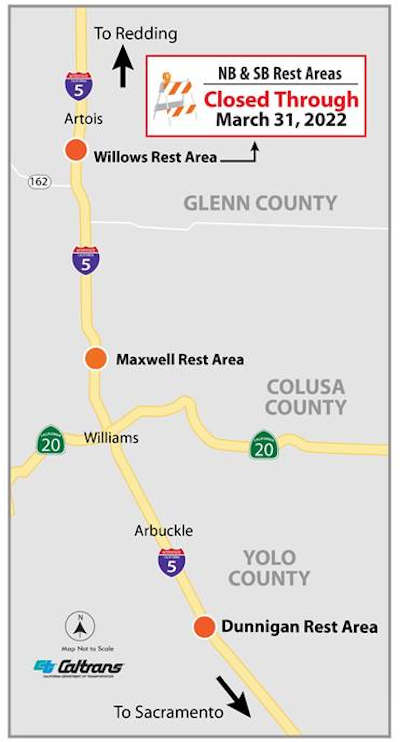
The Willows rest areas have been closed since January for construction and were originally expected to reopen by Dec. 31. However, a time extension is required because of supply chain delays for materials needed to complete improvements to the facilities.
During the closure, northbound I-5 motorists will be directed to use the Red Bluff SRRA in Tehama County, about 42 miles north of Willows; please note the northbound Corning rest area is closed for maintenance work.
Southbound motorists will be directed to the Maxwell SRRA in Colusa County, about 34 miles south of the Willows SRRA.
Caltrans is investing more than $6.9 million to update the wastewater, water, and lighting systems at the Willows rest areas. TSI Engineering Inc. of North Highlands, Sacramento County, is the contractor for the project.
Weather or unexpected events may delay or prolong the work. Caltrans advises motorists to “Be Work Zone Alert.”
The department will issue construction updates on Twitter @CaltransDist3 and on Facebook at CaltransDistrict3.
For real-time traffic, click on Caltrans’ QuickMap http://quickmap.dot.ca.gov/ or download the QuickMap app from the App Store or Google Play.
- Details
- Written by: County of Mendocino
This action follows the extensive work of the board-appointed, citizen-based Advisory Redistricting Commission, or ARC.
The ARC, with assistance from county staff from the executive office, county counsel and GIS, assisted the board in the redistricting process by facilitating community outreach, identifying communities of interest from public input and drafting maps in accordance with the required criteria outlined in the California FAIR MAPS Act, California Elections Code section 21500.
At the Dec. 7 regular meeting, the Board of Supervisors will consider introduction and adoption of an ordinance to repeal and replace Mendocino County Code section 2.08, and attach the Final Map and description of the boundaries of the five supervisorial districts.
Meetings are live streamed and available for viewing online one the Mendocino County YouTube page, at https://www.youtube.com/MendocinoCountyVideo or by toll-free, telephonic live stream at 888-544-8306.
The public may participate digitally in meetings in lieu of personal attendance. Comment may be made in any of the following ways: via written comment to
Information regarding telecomment participation can be found here.
For more information, contact the County Executive Office at 707-463-4441 or