How to resolve AdBlock issue?
 News

CDFW wolf collaring January 2025 photo by Malia Byrtus/California Wolf Project.
NORTHERN CALIFORNIA — The California Department of Fish and Wildlife reported Tuesday that three new wolf packs have been confirmed in the state.
These new wolf families are the Ishi pack in eastern Tehama County, the Tunnison pack in central Lassen County and the Ashpan pack in eastern Shasta County.
This brings California’s total current known number of packs to 10.
“How wonderful to witness another year of continued growth in California’s recovering wolf population,” said Amaroq Weiss, a senior wolf advocate at the Center for Biological Diversity. “It’s inspiring to watch this renaissance and we should do everything we can to ensure California’s wolves have every chance to thrive.”
Confirmation of these new packs shows the ongoing progress in wolf reestablishment and recovery across the West Coast.
The first packs were confirmed in 2008 in Washington and Oregon and in 2015 in California. By the end of 2024 there were 75 individual wolf pack territories across the three states.
A new time-lapsetime-lapse map prepared by the Center depicts the renaissance of wolves across the West Coast region from 2008 to 2024. The map also confirms that wolves here are still in the early stages of recovery since there’s abundant identified suitable wolf habitat that has not yet been occupied. Confirmation of the Ishi, Tunnison and Ashpan packs brings the tally to at least 78 wolf family territories on the West Coast.
California’s other seven packs consist of the Whaleback pack in Siskiyou County; the Lassen pack ranging across parts of Lassen and Plumas counties; the Diamond pack straddling portions of Plumas and Lassen counties; the Beyem Seyo pack which inhabits Sierra County; the Ice Cave pack whose territory touches portions of Lassen, Plumas, Shasta and Tehama counties; the Harvey pack ranging in parts of Lassen and Shasta counties; and the Yowlumni pack in Tulare County.
There are additionally two known small groups of two to three wolves each in northern California, one in southern Modoc County and the other in southern Plumas County, which do not yet qualify as packs. The latest wolf map posted by the department shows where each pack and each small group of wolves are ranging.
The department’s quarterly report provided information on California’s wolves from the start of 2025 up to the end of March. The report mentioned that a dispersing wolf was detected on a camera trap in central Kern County. It also reported that the deaths of two wolves from the Yowlumni pack in Tulare County were discovered this quarter and are under investigation.
“It’s been a bumpy road lately for California wolves as some northern counties have enacted emergency resolutions based on misunderstanding and misinformation,” said Weiss. “Decades of research shows that conflicts between livestock, wolves and people are rare and preventable. These magnificent animals have immense value because they help keep nature wild and healthy, and that ultimately benefits humans as well.”
Background
The first wolf in nearly a century to make California part of his range was OR-7, a radio-collared wolf from Oregon that entered California in late 2011. OR-7 traveled across seven northeastern counties in California before returning to southwestern Oregon, where he found a mate and settled down, forming the Rogue pack.
Several of OR-7’s offspring have since come to California and established packs. Those include the original breeding male of the Lassen pack and the breeding female of the Yowlumni pack residing in Tulare County. The Shasta pack, California’s first confirmed wolf pack in nearly 100 years, was discovered in 2015 but disappeared a few months later.
The gray wolf (Canis lupus) is native to California but was driven to extinction in the state by the mid-1920s. After OR-7 left Oregon for California, the Center and allies successfully petitioned the state to fully protect wolves under California’s endangered species act. Wolves are also federally protected in California under the federal Endangered Species Act. It is illegal to intentionally kill any wolves in the state except in defense of human life.
- Details
- Written by: LAKE COUNTY NEWS REPORTS

X-ray: NASA/CXC/ICRAR, Curtin Univ./Z. Wang et al.; Infrared: NASA/JPL/CalTech/IPAC; Radio: SARAO/MeerKAT; Image processing: NASA/CXC/SAO/N. Wolk.
Scientists have discovered a star behaving like no other seen before, giving fresh clues about the origin of a new class of mysterious objects.
As described in our press release, a team of astronomers combined data from NASA’s Chandra X-ray Observatory and the SKA [Square Kilometer Array] Pathfinder (ASKAP) radio telescope on Wajarri Country in Australia to study the antics of the discovered object, known as ASKAP J1832−0911 (ASKAP J1832 for short).
ASKAP J1832 belongs to a class of objects called “long period radio transients” discovered in 2022 that vary in radio wave intensity in a regular way over tens of minutes. This is thousands of times longer than the length of the repeated variations seen in pulsars, which are rapidly spinning neutron stars that have repeated variations multiple times a second. ASKAP J1832 cycles in radio wave intensity every 44 minutes, placing it into this category of long period radio transients.
Using Chandra, the team discovered that ASKAP J1832 is also regularly varying in X-rays every 44 minutes. This is the first time that such an X-ray signal has been found in a long period radio transient.
In this composite image, X-rays from Chandra (blue) have been combined with infrared data from NASA’s Spitzer Space Telescope (cyan, light blue, teal and orange), and radio from LOFAR (red). An inset shows a more detailed view of the immediate area around this unusual object in X-ray and radio light.
Using Chandra and the SKA Pathfinder, a team of astronomers found that ASKAP J1832 also dropped off in X-rays and radio waves dramatically over the course of six months. This combination of the 44-minute cycle in X-rays and radio waves in addition to the months-long changes is unlike anything astronomers have seen in the Milky Way galaxy.
The research team argues that ASKAP J1832 is unlikely to be a pulsar or a neutron star pulling material from a companion star because its properties do not match the typical intensities of radio and X-ray signals of those objects. Some of ASKAP J1832’s properties could be explained by a neutron star with an extremely strong magnetic field, called a magnetar, with an age of more than half a million years.
However, other features of ASKAP J1832 — such as its bright and variable radio emission — are difficult to explain for such a relatively old magnetar.
On the sky, ASKAP J1832 appears to lie within a supernova remnant, the remains of an exploded star, which often contain a neutron star formed by the supernova. However, the research team determined that the proximity is probably a coincidence and two are not associated with each other, encouraging them to consider the possibility that ASKAP J1832 does not contain a neutron star.
They concluded that an isolated white dwarf does not explain the data but that a white dwarf star with a companion star might. However, it would require the strongest magnetic field ever known for a white dwarf in our galaxy.
A paper by Ziteng Wang (Curtin University in Australia) and collaborators describing these results appears in the journal Nature. Another team led by Di Li from Tsinghua University in China independently discovered this source using the DAocheng Radio Telescope and submitted their paper to the arXiv on the same day as the team led by Dr Wang. They did not report the X-ray behavior described here.
NASA’s Marshall Space Flight Center in Huntsville, Alabama, manages the Chandra program. The Smithsonian Astrophysical Observatory’s Chandra X-ray Center controls science operations from Cambridge, Massachusetts, and flight operations from Burlington, Massachusetts.
Learn more about the Chandra X-ray Observatory and its mission here: https://www.nasa.gov/chandra and https://chandra.si.edu.

A close-up image of ASKAP J1832 in X-ray and radio light. X-ray: NASA/CXC/ICRAR, Curtin Univ./Z. Wang et al.; Radio: SARAO/MeerKAT; Image processing: NASA/CXC/SAO/N. Wolk.
Visual description
This release features two composite images of a mysterious object, possibly an unusual neutron star or white dwarf, residing near the edge of a supernova remnant. The object, known as ASKAP J1832, has been intriguing astronomers from the Chandra X-ray Observatory and Square Kilometre Array Pathfinder radio telescope with its antics and bizarre behavior.
Astronomers have discovered that ASKAP J1832 cycles in radio wave intensity every 44 minutes. This is thousands of times longer than pulsars, which are rapidly spinning neutron stars that have repeated variations multiple times a second. Using Chandra, the team discovered that the object is also regularly varying in X-rays every 44 minutes. This is the first time such an X-ray signal has been found in a long period radio transient like ASKAP J1832.
In the primary composite image of this release, the curious object is shown in the context of the supernova remnant and nearby gas clouds. Radio data is red and and X-ray sources seen with Chandra are in dark blue. The supernova remnant is the large, wispy, red oval ring occupying the lower right of the image. The curious object sits inside this ring, to our right of center; a tiny purple speck in a sea of colorful specks. The gas cloud shows infrared data from NASA’s Spitzer Space Telescope and resembles a mottled green, teal blue, and golden orange cloud occupying our upper left half of the square image.
The second, close-up image shows a view of the immediate area around ASKAP J1832. In this composite image, infrared data from Spitzer has been removed, eliminating the mottled cloud and most of the colorful background specks. Here, near the inside edge of the hazy red ring, the curious object resembles a bright white dot with a hot pink outer edge, set against the blackness of space. Upon close inspection, the hot pink outer edge is revealed to have three faint spikes emanating from the surface.
The primary and close-up images are presented both unadorned, and with labels, including fine white circles identifying ASKAP J1832.

A close-up image of ASKAP J1832 in X-ray and radio light. X-ray: NASA/CXC/ICRAR, Curtin Univ./Z. Wang et al.; Radio: SARAO/MeerKAT; Image processing: NASA/CXC/SAO/N. Wolk.
- Details
- Written by: NATIONAL AERONAUTICS AND SPACE ADMINISTRATION
CLEARLAKE, Calif. — A special meeting called Thursday to consider the Clearlake city manager’s job performance saw community members lauding him for his work and urging the new council to work with him for the benefit of the city.
Dozens of Clearlake residents, community leaders and supporters from around Lake County filled the chambers on Thursday evening to offer their support for City Manager Alan Flora in an effort to convince the council to keep him as city manager.
In addition to 38 people who gave public input, there also were eight letters, seven of them in support, submitted to the council, said Mayor Russell Cremer.
The vast majority of speakers praised Flora for his hard work, vision and dedication to the city, and for efforts to raise employee morale, help businesses, promote transparency and keep an open door policy.
The main two voices who spoke directly against him were connected with Highlands Mutual Water District, which has been involved in litigation with the city since early last year.
The end result of the evening was that, after an hour and a half of hearing from the public, the council went into closed session, with City Attorney Dean Pucci emerging a short time later to inform City Clerk Melissa Swanson that, while they intended to continue to meet into the evening, there would be no action to report out of closed session.
Shortly after 7 p.m., Councilmember Tara Downey emerged alone from the city offices.
Record of service with the city
Flora, who has a background that includes experience in planning and finance, worked for the county of Lake as a deputy administrative officer as part of the staff of longtime County Administrative Officer Kelly Cox before serving in Mendocino County as its assistant chief executive officer beginning in late 2014.
Then-Clearlake City Manager Greg Folsom hired Flora in 2018 as the city’s finance manager and later named him assistant city manager.
In March 2019, after Folsom left to take the city manager’s job for Suisun City, the council appointed Flora as the new city manager for an initial three-year term, with the option to continue for additional terms.
Since that time, Flora — at the council’s direction — has led efforts to lay the groundwork for a new commercial development on Highway 53 as well as created plans for the new Burns Valley sports complex, conducted millions of dollars worth of road repaving projects, improved city parks, bulked up code enforcement work throughout the city, brought in tens of millions of dollars in grant funding for city improvements, worked closely with Tribal Health to bring a new clinic to the city, established a new recreation division, worked to help businesses — large and small — open in the city, had the city become a Blue Zones approved workplace as part of increasing employee health and quality of life, partnered with Adventist Health on a plan for a $50 million new clinic facility and worked with Konocti Unified to create a child care program for staff, to name some of his notable work.
During that time, the city has been sued by the Koi Nation over projects and developments, such as the 18th Avenue extension and the sports complex, due to disagreements about the extent of tribal consultation required for those projects under the California Environmental Quality Act. So far, the city has won the lawsuits at the local level, while the 18th Avenue project decision has been overturned by an appellate court. No appellate decision has so far been reached on the sports complex.
What appears to have led to the threat to Flora’s tenure began with the city’s clash with the Highlands Mutual Water District over capacity issues and shareholder elections.
It led to the largest field of council candidates — eight — in decades, several of which were reported to be supported by Highlands Mutual.
In November, Tara Downey, Jessica Hooten and Mary Wilson were elected over incumbents David Claffey, Joyce Overton and Russell Perdock. The three were sworn in on Dec. 5.
Perdock, who spoke during the Thursday night meeting, pointed out that the issues with the water district grew out of the council directing Flora to work with them because the city had received information about issues with the district that were critical and not safe.
When the city tried to engage with the district, Perdock said they were shut out, referring to Flora — present on behalf of the city as a shareholder — being escorted out of a meeting and having the door locked behind him in March of 2024.
Perdock also said the water district told its staff to campaign for the council challengers.
Since the start of the year, the council has held several closed session discussions regarding the ongoing litigation with both the Koi and Highlands Water.
On March 20, they met in closed session to discuss both cases, and at that time also held a confidential performance evaluation on Flora, who until last year was being reviewed twice annually, based on a review of council agendas. His 2024 evaluations took place in April and September.
On April 7, the council held another closed session to discuss the Koi and Highlands cases, and on May 1, a performance evaluation for Flora was again a closed session agenda item.
When the council met on May 15, a closed session once again was scheduled to consider the Highlands lawsuit and Flora’s performance evaluation.
On Wednesday, the city issued the agenda for a special meeting to discuss Flora’s performance evaluation.
Retired District 2 Supervisor Jeff Smith, who also previously served on the Clearlake City Council, said he found that agenda concerning due to it being set up for a day other than Thursday — the usual meeting day — with the lone agenda item being Flora’s evaluation.
Smith said the matter ended up being the main topic of discussion at the Thursday morning Judges Breakfast in Clearlake, with a number of the meeting’s participants turning up for the special meeting that afternoon.
Performance evaluations are performed in closed session, but under the Brown Act, the public may comment on all agenda items — even confidential ones — ahead of a governing body going into closed session.
Even so, Supervisor Bruno Sabatier, one of the evening’s speakers, received applause after telling the council he was embarrassed for them and how the situation was being handled.
“Leadership should be very lonely,” he said, and decisions like those surrounding job performance should be made in private, not in public as they were doing.
“I’m hurt by that,” he said, urging them to put themselves in Flora’s place.
He said they shouldn’t make decisions based on how they feel but about what’s best in five to 10 years. “This is doing nothing today, this hurts me to see this,” he said. “I feel there is a sanctity that has been broken here.”
Sabatier also urged the council to learn how to become a team so they can work for the city, ending with telling them to “do better.”
It’s unclear whether or not the three new council members could force Flora out at this point.
His most recent amended contract approved on April 18, 2024, is for a two-year period.
Notably, it includes a clause that requires that to terminate him without cause it would require a 4/5ths vote of the council for a period of one year after the election of a new council member.
The contract says that after March 18, 2025, the amount of severance pay and benefits Flora is entitled to is 12 months. His base pay in the contract is $16,342.05 per month, or $196,104.60. The contract also called for him to receive cost-of-living increases and a 3% pay increase in July 2024. He is due to receive another 3% in two months contingent on a positive evaluation from a majority of the City Council members.
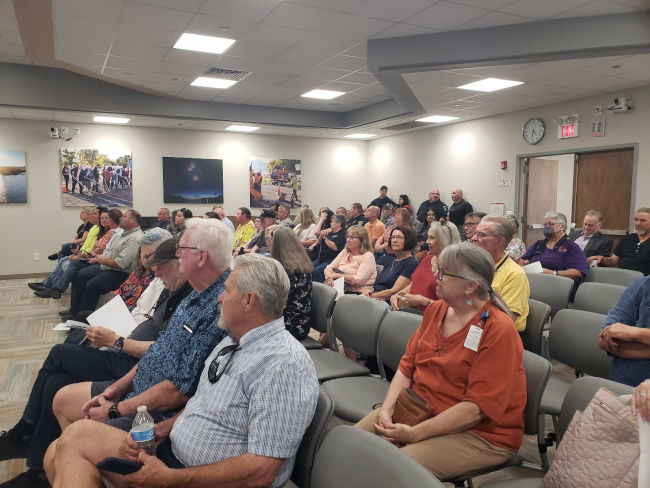
Dozens of community members filled the Clearlake City Council chambers on Thursday, May 29, 2025, for a special meeting in which the city manager’s performance evaluation was to be discussed. Photo by Elizabeth Larson/Lake County News.
Support from across community
The council on Thursday heard from a wide variety of people from all walks of life and professions who supported Flora for reasons that included integrity, values, hard work and dedication.
There was not unanimous support amongst the speakers.
Alice Reece said she and Flora have had misunderstandings and didn’t always agree, and while a lot of good things have happened since he started with the city, she said the council needs to rein him in. However she conceded, “Overall it would be very difficult for our city to start over with a new manager.”
Brett Freeman, a Highlands Water supporter who ran as part of the field of council candidates in November but fell short of winning a seat, accused Flora of losing “tons of money” due to the Highlands Water and Koi Nation lawsuits. “You guys need to reel him in.”
Michael Graves, a water treatment worker with Highlands Mutual, faulted Flora for his recommendation in a code enforcement abatement case a month ago, adding he felt the council election results showed a bigger majority of people than were in the room opposed him.
The rest of the comments offered were in praise of Flora.
On the health care side, former Adventist Health Clear Lake CEO Kendall Fults said the community showing up was giving the council a message. “We’re behind Alan Flora in a deep and personal way.”
A letter from Chuck Kassis, the hospital’s current administrator, spoke about Flora promoting optimism for the city and the $50 million clinic that will anchor the Highway 53 commercial development.
Doug Harris, a member of the Yuba Community College District Board, spoke about Flora’s support of Woodland Community College’s Clearlake campus and how, after 30 years of promises, Flora helped get a new entrance sign for the college.
While Flora was lauded for his vision and planning, Barbara Christwitz of Citizens Caring for Clearlake, a group that has worked with the city to clean up illegal dumping, spoke of him responding to basic requests, such as when he showed up with a scoop shovel after their group told the city they needed one.
Numerous staffers praised him for his success in raising morale and succeeding in retention.
Longtime employees like Clearlake Police Lt. Martin Snyder said that since Flora’s arrival, he’s seen the city’s progress speed up thanks to Flora changing the energy of local government. He has inspired and energized staff, and his commitment to high performance culture has empowered employees to take pride in their roles, Snyder said.
Other staffers, including Code Enforcement Supervisor Lee Lambert, Lt. Ryan Peterson, Sgt. Elvis Cook, Public Works Director Adeline Leyba, grants manager Bambi Cline and Sgt. Michael Perrault paid tribute to his work ethic and his personal touch, his transparency and work to engage the community, and his work to turn around the community, making it safer and more welcoming.
Peterson said Flora’s pace, tenacity and ambitious timelines can be difficult to keep up with but he said they don’t amount to a flaw, but a call to action. “I believe our city’s on a better path because of Mr. Flora’s leadership.”
Cook noted, “Leaders like Alan are rare,” with vision and integrity the city needs. He encouraged the three new council members to give Flora direction, not replace him.
Lakeport businessman Mark Lipps warned the council would cause the city to move backwards if they let Flora go. “Don’t let perfect get in the way of great.”
Conrad Colbrandt, general manager of the Redbud Health Care District, said Flora has at least three fire incidents under his belt and has worked with local, state and federal disaster management. “That’s experience that you can’t hire into Lake County.”
Colbrandt also called out “the elephant in the room” — that Flora’s actions have been directed by the City Council, with Flora carrying out those directives whether he wanted to or not. “I don’t think people can blame Alan for following orders that were given to him by the previous council.”
Dr. Marc Cooper, who has long experience in education leadership and is a board member for Adventist Health along with Flora, referred to the $50 million clinic project and reminded the council that Adventist is the largest employer in Clearlake. “I hope the City Council is not myopic.”
Chris Inglis, a city planning commissioner with a background in economics and public finance, warned that discontinuity in leadership is harmful, can hurt the city’s credit rating and borrowing power, and set the city back.
In a Charlie Brown voice, he asked, “Good grief, what are you guys doing?”
Likewise, his commission colleague Fawn Williams and former commissioner Terry Stewart testified to the progress and improvements they’ve seen in the city, where they’ve lived for decades.
“Our streets are safer. Our parks are safer,” said Williams.
If they made the decision for Flora to leave, “Who are we going to get that loves this community as much as he does?” she asked
“Since Alan has taken the helm at city hall, it’s been a huge improvement,” said Stewart.
Ernesto Padilla, CEO of the Lake County Tribal Health Consortium, told the council that as they were working to establish their Southshore Clinic, they ran into water problems and other challenges which Flora helped them address. He credited Flora with bringing the project to the city.
Retired Supervisor Jeff Smith said the city over the past 10 years has advanced “leaps and bounds” beyond where it’s ever been. “It’s been a dream come true for the city of Clearlake,” he said, crediting Flora and the council.
“This is the best we have ever done and I’ve watched it from the beginning,” he said, adding that to make a change at this point “is beyond ridiculous.”
On the education front, Zabdy Neria, a Konocti Unified School District trustee and Rotarian, spoke of Flora’s collaboration with the district to create the child care program — a small solution that she said has had a massive ripple effect across the district. She called Flora an “exemplary public servant.”
Lake County Superintendent of Schools Brock Falkenberg said that, over the past eight years, the city has become one of the strongest partners the Lake County Office of Education has, and he emphasized that a board or council’s most important relationship is with their administrator or manager.
“You have a big job ahead of you, not just tonight but in general,” Falkenberg told the council.
Businessmen Ray Silva, Tim Biasotti, Carlos Ramos and John Alvarez all offered their support because of the improvements they’ve seen being made under Flora’s leadership.
“I’m a bit shocked this meeting’s happening,” said Biasotti, explaining that he’s now proud of being from Clearlake. Ramos said he’s also seen community pride and progress.
Alvarez shared how Flora was supportive and helped him address obstacles to starting a new business. “Alan has sat down with me multiple times.”
In his 50 years in the city, “By far and away, the most positive progress that we’ve seen has been in the last 5 to 10 years,” Silva said.
Former Mayor Denise Loustalot, a city business owner, said Flora’s foresight and knowledge, with the direction of the right council, will take Clearlake where the community wants to go. If they’re not willing to do what’s best for the community she questioned, “Why are you up there?”
Some of the night’s most poignant comments came from Kelly Cox, Lake County’s retired county administrative officer, who held that job for three decades.
In that time he said there were many city administrators, and said that without a doubt the best decision the council made was hiring Flora, who he said is extremely talented and ethical.
Cox said the city had past controversies and challenges. “Sometimes I think of those times as Clearlake’s lost years.”
Now, however, Cox said the city is poised to make advances, and with Flora he said the sky will be the limit to what they can accomplish because, under Flora, the city has set a new bar for leadership.
A comment submitted through Zoom came from Andrew White, the city’s former police chief who now serves as the city of Martinez’s police chief.
City Clerk Melissa Swanson read the comment from White, who called Flora a visionary who has poured everything he had into making the city better and stronger.
Flora hasn’t just seen Clearlake for what it is, but what it can be, said White.
Visionary leaders take bold steps, and White explained that the city manager doesn’t take action in a vacuum. That position is often the most visible figure and carries public weight of decision. “It’s a tough position.”
Flora’s success at bringing tens of millions of dollars into the city didn’t happen by accident, but was the result of skill, persistence and belief in the city’s potential, White said.
White said the shift in the council presents an opportunity for everyone to come together around a shared vision, with the city’s longterm success depending on a united council to chart a clear course forward.
On a personal level, White credited Flora with helping him be a successful police chief.
“Alan Flora is proud of Clearlake and he has helped all of us believe in a better future for it,” White said.
Editor’s note: Mayor Cremer clarified that of the eight letters submitted, seven were supportive. The article has been updated to reflect that.
Email Elizabeth Larson at
- Details
- Written by: Elizabeth Larson
CLEARLAKE, Calif. — A residential fire that occurred on 12th Street in Clearlake on Wednesday night killed one person and destroyed a home.
The Lake County Sheriff’s Office identified the deceased as Gene Dean Nelson, 52, of Clearlake. The cause of death is pending autopsy.
This is the first fire-related death reported in Lake County in 2025, according to spokesperson Lauren Berlinn of the sheriff’s office.
In 2024, there were two such deaths, Berlinn said.
At 9:59 p.m. on Wednesday, the first fire units were dispatched upon emergency call. They arrived at 10:05 p.m. and found a “fully involved structure fire,” according to a Facebook post of the Lake County Fire Protection District, or LCFPD.
The first crews “saw the building was almost entirely consumed by flames,” LCFPD Fire Marshal Autumn Lancaster told Lake County News. “It was what we'd call ‘fully involved’ — that fire’s on each side of the building.”
The LCFPD reported that it responded to the fire with a type 1 engine, two medic units out of Station 70, along with a tactical water tender out of Station 65 in Lower Lake.
Cal Fire, Northshore Fire Protection District and South Lake County Fire Protection District responded with additional resources upon mutual aid requests.
In total, seven engines, one water tender and two medic units, were on the scene. So were LCFPD Fire Chief Willie Sapeta, Battalion Chief Marc Hill and a Cal Fire chief, according to Lancaster.
The fire was fully contained at 11:16 p.m., the district said.
During the course of the incident, a second structure was reported to have become involved in the fire. But Lancaster confirmed that the fire burned “only the one structure on the property. It did not extend to neighboring structures.”
Lancaster said she did not yet have information on possible vehicle or smoke damage to nearby properties.
“Mop-up was complete. Crews got off the fire around 2 a.m. this morning and got some rehab,’” Lancaster said on Thursday in a call, explaining that the firefighters had to refill equipment and get some sleep, “because they still have to run 911 calls for the rest of their shift.”
LCFPD confirmed the fatality Thursday morning and said the deceased’s family had been notified.
The fire is currently under active investigation by LCFPD and Clearlake Police Department.
Clearlake Police Chief Timothy Hobbs explained that LCFPD will determine the cause of the fire and where it started, while police will investigate if a crime such as arson occurred.
Email staff reporter Lingzi Chen at
- Details
- Written by: LINGZI CHEN
CLEARLAKE, Calif. — The Clearlake Police Department is asking for the community’s help in locating a missing man.
Dillon Smithson, 28, was last seen in the area of Walmart in Clearlake.
He is described as a white male adult, 6 feet tall and 120 pounds, with dirty blonde hair and blue eyes.
When he was last seen, he was wearing black shirt and blue jeans.
If you have any information regarding his whereabouts please contact the Clearlake Police Department at 707-994-8251, Extension for dispatch.
- Details
- Written by: Elizabeth Larson
As schools let out for summer break, speed limits around school zones are relaxed, and young drivers enjoy increased freedom a troubling trend emerges: a rise in traffic accidents.
The time period spanning from Memorial Day to Labor Day is known as the “100 Deadliest Days,” due to an increase in traffic accidents.
Nationwide, 13,135 people were killed in a crash involving a teen driver between 2019 and 2023. More than one third of those deaths occurred during the 100 Deadliest Days, according to a AAA review of crash data from the National Highway Traffic Safety Administration, or NHTSA.
In California, an average of 61 people die each year in accidents involving a teen driver during this period, compared to an average of 137 deaths over the remaining 265 days.
Of the 2,897 people killed in teen-driver involved crashes in 2023, the latest year of complete nationwide data, a third (860) occurred during the 100 Deadliest Days.
“Summer months are particularly dangerous as more young drivers hit the road during school breaks with many logging more unsupervised driving time than usual,” said Doug Johnson, spokesperson, AAA Mountain West Group. “We encourage families to set clear expectations for driving privileges.”
Parents should model safe driving behavior. Lead by example and talk to teens about the importance of buckling up, obeying speed limits, and putting phones away.
Summer is a great time for young drivers to enroll in a comprehensive driver education course to learn the rules of the road. AAA offers a variety of resources to help keep teen drivers safe on the road.
Use smartphone “Do Not Disturb” features. New research from the AAA Foundation for Traffic Safety highlights the life-saving potential of smartphone-blocking technology. Parents should encourage teens to use “Do Not Disturb” features on their phones to silence distractions while driving.
- Details
- Written by: LAKE COUNTY NEWS REPORTS
CLEARLAKE, Calif. — The Clearlake City Council has voted unanimously to advance a state-mandated fire hazard zone map that significantly expands the city’s highest hazard acreage.
The map, approved in its initial hearing on May 15, will return for a second hearing — also the final one — at the next council meeting on June 5.
If adopted then, the map will take effect 30 days later on July 6 for Clearlake, according to City Manager Alan Flora.
City officials say they have no authority to change or reject the map.
In 2024, Cal Fire adopted the fire hazard severity zone map under the “state responsibility area,” which classified 366,812 acres in Lake County as the highest severity, despite local opposition.
Flora noted that those acreages were “largely outside of city jurisdictions.”
This new map released in February, however, designated “local responsibility areas,” or LRA — areas managed by city and county governments — into “very high,” “high” and “moderate” fire hazard severity zones.
The new map marks the first update to the LRA designations since 2011 and adds 14,000 acres in Lake County to the “very high” zone — an 878% expansion in acreage classified as the most hazardous.
In Clearlake, the “very high” acreage increases from 1,583 to 4,054 acres, by 156%.
During the meeting, several council members and Flora expressed frustration at the map’s rigid, state-mandated rating, which can’t be lowered even with local mitigation work.
Despite the reluctance expressed throughout, the council voted unanimously to move forward with adoption.
A recurring theme at the meeting was the lack of genuine local discretion. By state law, cities and counties “must” adopt the map as it is.
“None of the designations can be decreased,” Flora said of the state law that only permits increasing the severity rating.
The map, once adopted, will introduce stricter building codes to the higher severity zones, including requirements for property development standards, road width and water supply, according to Flora. The city will also implement new defensible space regulations and mandatory fire hazard zone disclosure in real estate.
“And this is going to impact insurance rates for folks in the zone,” he added.
Flora said property owners may request a free inspection from the local fire marshal and learn what needs to be done to meet the zone requirements and get a certification that can be forwarded to the insurance company.
“But it’s going to be a real challenge in these ‘very high’ zones in particular,” he added.
Additionally, Flora said that “split zoned parcels” — where a property straddles more than one severity zone — are required to adopt the higher severity zone classification for the entire parcel.
Based on that rule, staff generated a modified version of the map using the GIS mapping system to only reflect the higher designation for parcels that have crossed multiple severity zones, for better clarity, Flora said.
It is also the version that the council voted to adopt.
Concerns of the public and the next step
All members of the public who spoke up or sent a letter in during public comment expressed frustration or opposition to the map, among them, District 2 Supervisor Bruno Sabatier and former City Council member Joyce Overton.
Plants in the yard or plants in a pot — “you can’t have any of that stuff,” Overton said of the strict standards on the higher severity zones, referring to her previous conversations with state officials.
Mayor Russ Cremer pointed out that what Overton described reflects the state’s new “Zone Zero” policy — a statewide regulation requiring all structures in “very high” fire hazard zones to maintain an “ember-resistant zone” within the immediate 5-feet of structures.
“How many people are going to really live in a community that has none of that?” Overton continued. “I don't think any of us want that — we like our roses or our plants or our vegetables. I mean, think about it. You can't really grow your vegetables in your own yard and be a fire safe property.”
Supervisor Sabatier raised doubts on the 50-year projection model the map is based on and the setbacks on development.
“I think their methodology is not realistic. I think they are making things that much more difficult for us,” he said. “Development will become close, if not completely impossible.”
“I think if we all approve and adopt these quietly, we're not doing it correctly,” Sabatier said. “You don’t have a choice; you have to adopt this. But you do have a choice whether or not you send a message back to the state saying, ‘this is not correct the way you’re doing this.’”
“It seems to me that we don't have a whole lot of choice — either we make it more stringent, which we really don't want to do,” said Vice Mayor Dirk Slooten during the council’s discussion. He backed Sabatier’s proposal to urge their state representative to explore “other possibilities to help with still getting some housing built in some of the more stringent zones.”
“It's very frustrating for all of us. We can't do anything about it, but we basically need to pass it,” said Mayor Cremer, who also said he supported sending a letter to let the state know “how much hardship this is going to put on all of us.”
The remaining three council members — Tara Downey, Jessica Hooten and Mary Wilson — did not comment.
Still, the council voted unanimously to move the ordinance forward.
At the end of the meeting, Cremer reiterated that he wanted a letter drafted for discussion at the second hearing.
The city of Clearlake is the first among three local governments to hold a public hearing on adopting the map.
The Board of Supervisors will consider the map on June 3 at 11:15 a.m., according to County Community Development Director Mireya Turner.
Lakeport City Council will hold a public hearing in one of their June meetings too, City Manager Kevin Ingram said.
All jurisdictions are required to adopt the map by ordinance by July 1.
When a mandate meets a vote
A mandatory adoption is inherently in tension, if not outright contradiction, with a decision made by majority vote.
“They gave us a fake decision," Sabatier said during public comment.
In a February Lakeport City Council meeting, Lakeport Fire Chief Patrick Reitz said, “They give us a public hearing process that's lip service only.”
Even with a unanimous Clearlake City Council vote, one question lingers: If the map adoption is required by state law, is a vote by elected officials a meaningful or even necessary part of the process? Does the option to vote “no” actually, legally exist?
And what would happen if three or more council members or county supervisors vote against adoption?
“It is my belief that up to two council members could vote against it as long as it passed,” Flora said in an email to Lake County News. “I am not clear that there are any penalties for not adopting the maps, although I am sure some repercussions would be forthcoming if a jurisdiction refused to do so.”
Flora provided a similar example about the state’s regional housing needs allocation program, where “some jurisdictions decided to ignore the mandate.”
The program began in 1969, but penalties for noncompliance were only introduced recently, which included “no access to funding, financial penalties, other measures crafted by the Attorney General's Office of Housing Accountability,” Flora wrote. “It's hard to envision where it may go.”
“When the map comes before the board, I see no other step to take than to approve the maps as provided by the state,” said Supervisor Sabatier in an email.
Local jurisdictions can technically vote against the map, but such noncompliance could create problems and obstacles for future development projects, according to him.
“If a project was appealed, it's possible that the lack of compliance of our maps could be used to argue against approved projects that go through the process,” he said.
No matter if local jurisdictions adopt it, the state’s map designation always takes precedence when in conflict, said Sabatier, who called such conflict “not needed.”
“It is best for us to approve what the state has handed us, even if we don't like it as it is a document that the state controls, not us,” he said. “Yes we can vote against approving the maps, but it doesn't help anyone for us to do so.”
Email staff reporter Lingzi Chen at
- Details
- Written by: LINGZI CHEN