
 How to resolve AdBlock issue?
 News

LAKE COUNTY, Calif. — For the first time, Lake County has its own entry in the worldwide “City Nature Challenge” — a four-day event which encourages “citizen scientists” to use their phones or cameras to submit observations of all forms of life to further develop the inaturalist.org catalog of the world's life forms.
Between Friday April 25 and Monday April 28, observations submitted to inaturalist.org will be logged into Lake County's project as part of this competition.
Anyone can participate with the inaturalist app or at the inaturalist.org web site.
People can observe on their own, or can take part in two special events, called "bioblitzes" where a group explores an area with some guidance.
The events take place at 9 a.m. Sunday, April 27, at the Lake County Land Trust's Rodman Preserve at 6350 Westlake Road, Lakeport; and Monday, April 28, at 9 a.m. at the McLaughlin Preserve, 26775 Morgan Valley Road, east of Lower Lake.
In 2016, organizers from the Los Angeles Museum of Natural History and the California Academy of Sciences started the City Nature Challenge with the metropolitan areas of San Francisco bay and Los Angeles engaging in a friendly competition to document as many forms of life as their citizen scientists could.
By 2024, the annual event had grown to include 690 competing geographic areas, with over two million observations of over 65,000 species and over 83,000 participants.
The Lake County Project and more information is at https://www.inaturalist.org/projects/city-nature-challenge-2025-lake-county-california.
- Details
- Written by: Ed Oswalt
LAKE COUNTY, Calif. — Lake County Animal Care and Control has more new dogs waiting for their homes this week.
The dogs available for adoption this week include mixes of Australian shepherd, border collie, bull mastiff, Catahoula leopard dog, cattle dog, Chihuahua, French bulldog, German shepherd, husky, Labrador Retriever, pit bull terrier, poodle, Rottweiler and Siberian husky.
Dogs that are adopted from Lake County Animal Care and Control are either neutered or spayed, microchipped and, if old enough, given a rabies shot and county license before being released to their new owner. License fees do not apply to residents of the cities of Lakeport or Clearlake.
Those dogs and the others shown on this page at the Lake County Animal Care and Control shelter have been cleared for adoption.
Call Lake County Animal Care and Control at 707-263-0278 or visit the shelter online for information on visiting or adopting.
The shelter is located at 4949 Helbush in Lakeport.
Email Elizabeth Larson atThis email address is being protected from spambots. You need JavaScript enabled to view it. . Follow her on Twitter, @ERLarson, and on Bluesky, @erlarson.bsky.social. Find Lake County News on the following platforms: Facebook, @LakeCoNews; X, @LakeCoNews; Threads, @lakeconews, and on Bluesky, @lakeconews.bsky.social.




The dogs available for adoption this week include mixes of Australian shepherd, border collie, bull mastiff, Catahoula leopard dog, cattle dog, Chihuahua, French bulldog, German shepherd, husky, Labrador Retriever, pit bull terrier, poodle, Rottweiler and Siberian husky.
Dogs that are adopted from Lake County Animal Care and Control are either neutered or spayed, microchipped and, if old enough, given a rabies shot and county license before being released to their new owner. License fees do not apply to residents of the cities of Lakeport or Clearlake.
Those dogs and the others shown on this page at the Lake County Animal Care and Control shelter have been cleared for adoption.
Call Lake County Animal Care and Control at 707-263-0278 or visit the shelter online for information on visiting or adopting.
The shelter is located at 4949 Helbush in Lakeport.
Email Elizabeth Larson at
Oliver
Rocco
Alma
Hariett
Mila
Charles
Toby
Timmy
Mister
Koda
O'Reiley
Billy
Wheezy
Dottie
Ritz
Mr. Pibb
Chuck
Lady
Hershey
Alex
Willa
Pinto
Kennel#27(BusterBrown)
Marcel
Argo
Sadie
Finn
Rome
Kennel#4
Kennel#22
Kennel#12(Mom)
Kennel#13a
Kennel#13b
Banjo
- Details
- Written by: Elizabeth Larson
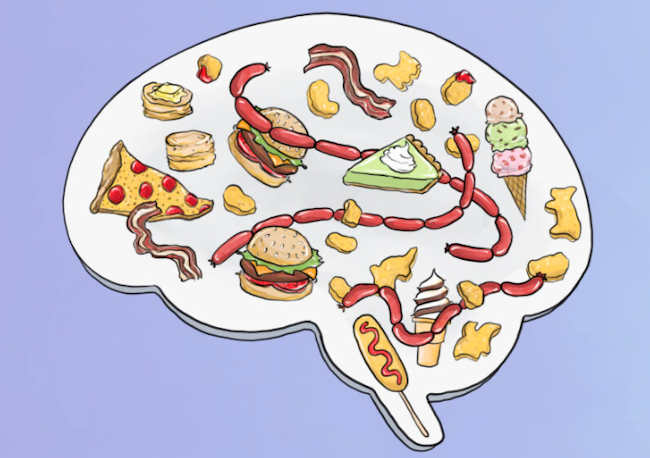
The pleasure we get from eating junk food — the dopamine rush from crunching down on salty, greasy French fries and a luscious burger — is often blamed as the cause of overeating and rising obesity rates in our society.
But a new study by scientists at the University of California, Berkeley, suggests that pleasure in eating, even eating junk food, is key for maintaining a healthy weight in a society that abounds with cheap, high-fat food.
Paradoxically, anecdotal evidence suggests that people with obesity may take less pleasure in eating than those of normal weight. Brain scans of obese individuals show reduced activity in pleasure-related brain regions when presented with food, a pattern also observed in animal studies.
Now, UC Berkeley researchers have identified a possible underlying cause of this phenomenon — a decline in neurotensin, a brain peptide that interacts with the dopamine network — and a potential strategy to restore pleasure in eating in a way that helps reduce overall consumption.
The study reveals an unsuspected brain mechanism that explains why a chronic high-fat diet can reduce the desire for high-fat, sugary foods, even when these foods remain easily accessible. The researchers propose that this lack of desire in obese individuals is due to a loss of pleasure in eating caused by long-term consumption of high-calorie foods. Losing this pleasure may actually contribute to the progression of obesity.
“A natural inclination toward junk food is not inherently bad — but losing it could further exacerbate obesity,” said Stephan Lammel, a UC Berkeley professor in the Department of Neuroscience and a member of the Helen Wills Neuroscience Institute.
The researchers found that this effect is driven by a reduction in neurotensin in a specific brain region that connects to the dopamine network. Importantly, they demonstrate that restoring neurotensin levels — either through dietary changes or genetic manipulations that enhance neurotensin production — can reinstate the pleasure in eating and promote weight loss.
“A high-fat diet changes the brain, leading to lower neurotensin levels, which in turn alters how we eat and respond to these foods,” Lammel said. “We found a way to restore the desire for high-calorie foods, which may actually help with weight management.”
While findings in mice don’t always translate directly to humans, this discovery could open new avenues for addressing obesity by restoring food-related pleasure and breaking unhealthy eating patterns.
“Imagine eating an amazing dessert at a great restaurant in Paris — you experience a burst of dopamine and happiness,” said Neta Gazit Shimoni, a UC Berkeley postdoctoral fellow. “We found that this same feeling occurs in mice on a normal diet, but is missing in those on a high-fat diet. They may keep eating out of habit or boredom, rather than genuine enjoyment.”
Gazit Shimoni and former UC Berkeley graduate student Amanda Tose are co-first authors, and Lammel is senior author of the study, which will be published March 26 in the journal Nature.
Solving a long-standing puzzle in obesity research
For decades, doctors and researchers have struggled to understand and treat obesity, as countless fad diets and eating regimens have failed to produce long-term results. The recent success of GLP-1 agonists like Ozempic, which curb appetite by increasing feelings of fullness, stands out among many failed approaches.
Lammel studies brain circuits, particularly the dopamine network, which plays a crucial role in reward and motivation. Dopamine is often associated with pleasure, reinforcing our desire to seek rewarding experiences, such as consuming high-calorie foods.
While raising mice on a high-fat diet, Gazit Shimoni noticed a striking paradox: While in their home cages, these mice strongly preferred high-fat chow, which contained 60 percent fat, over normal chow with only 4 percent fat, leading them to gain excessive weight.
However, when they were taken out of their home cages and given free access to high-calorie treats such as butter, peanut butter, jelly or chocolate, they showed much less desire to indulge than normal-diet mice, which immediately ate everything they were offered.
“If you give a normal, regular-diet mouse the chance, they will immediately eat these foods,” Gazit Shimoni said. “We only see this paradoxical attenuation of feeding motivation happening in mice on a high-fat diet.”
She discovered that this effect had been reported in past studies, but no one had followed up to find out why, and how the effect connects to the obesity phenotype observed in these mice.
Restoring neurotensin reverses obesity-related brain changes
To investigate this phenomenon, Lammel and his team used optogenetics, a technique that allows scientists to control brain circuits with light. They found that in normal-diet mice, stimulating a brain circuit that connects to the dopamine network increased their desire to eat high-calorie foods, but in obese mice, the same stimulation had no effect, suggesting that something must have changed.
The reason, they discovered, was that neurotensin was reduced so much in obese mice that it prevented dopamine from triggering the usual pleasure response to high-calorie foods.
“Neurotensin is this missing link,” Lammel said. “Normally, it enhances dopamine activity to drive reward and motivation. But in high-fat diet mice, neurotensin is downregulated, and they lose the strong desire to consume high-calorie foods — even when easily available.”
The researchers then tested ways to restore neurotensin levels. When obese mice were switched back to a normal diet for two weeks, their neurotensin levels returned to normal, dopamine function was restored, and they regained interest in high-calorie foods.
When neurotensin levels were artificially restored using a genetic approach, the mice not only lost weight, but also showed reduced anxiety and improved mobility. Their feeding behavior also normalized, with increased motivation for high-calorie foods and a simultaneous reduction of their total food consumption in their home cages.
“Bringing back neurotensin seems to be very, very critical for preventing the loss of desire to consume high-calorie foods,” Lammel said. “It doesn’t make you immune to getting obese again, but it would help to control eating behavior, to bring it back to normal.”
Toward more precise treatments for obesity
Although directly administering neurotensin could theoretically restore feeding motivation in obese individuals, neurotensin acts on many brain areas, raising the risk of unwanted side effects. To overcome this, the researchers used gene sequencing, a technique that allowed them to identify specific genes and molecular pathways that regulate neurotensin function in obese mice.
This discovery provides crucial molecular targets for future obesity treatments, paving the way for more precise therapies that could selectively enhance neurotensin function without broad systemic effects.
“We now have the full genetic profile of these neurons and how they change with high-fat diets,” Lammel said. “The next step is to explore pathways upstream and downstream of neurotensin to find precise therapeutic targets.”
Lammel and Gazit Shimoni plan to expand their research to explore neurotensin’s role beyond obesity, investigating its involvement in diabetes and eating disorders.
“The bigger question is whether these systems interact across different conditions,” Gazit Shimoni said. “How does starvation affect dopamine circuits? What happens in eating disorders? These are the questions we’re looking at next.”
Other co-authors are Charlotte Seng, Tamás Lukacsovich and Csaba Földy of the University of Zurich in Switzerland; Yihan Jin and Lin Tian of UC Davis; Hongbin Yang of Zhejiang University in Hangzhou, China; Jeroen Verharen, Christine Liu, Michael Tanios, Eric Hu, Jonathan Read and Lilly Tang of UC Berkeley; and Byung Kook Lim of UC San Diego.
The work was supported by the McKnight Foundation, One Mind Foundation, Weill Neurohub, Rita Allen Foundation, Wayne and Gladys Valley Foundation and National Institutes of Health (R01DA042889, U01NS120820, U01NS113295, R01NS121231, R01DA049787). Shimoni was supported by a Young Investigator Award from the National Alliance for Research on Schizophrenia and Depression.
Robert Sanders writes for the UC Berkeley News Center.
- Details
- Written by: Robert Sanders

The asteroid 2024 YR4 made headlines in February with the news that it had a chance of hitting Earth on Dec. 22, 2032, as determined by an analysis from NASA’s Center for Near Earth Object Studies, or CNEOS, at the agency’s Jet Propulsion Laboratory in Southern California.
The probability of collision peaked at over 3% on Feb. 18 — the highest ever recorded for an object of its size. This sparked concerns about the damage the asteroid might do should it hit Earth.
New data collected in the following days lowered the probability to well under 1%, and 2024 YR4 is no longer considered a potential Earth impactor. However, the event underscored the importance of surveying asteroid populations to reveal possible threats to Earth.
Sharing scientific data widely allows scientists to determine the risk posed by the near-Earth asteroid population and increases the chances of identifying future asteroid impact hazards in NASA science data.
“The planetary defense community realizes the value of making data products available to everyone,” said James “Gerbs” Bauer, the principal investigator for NASA’s Planetary Data System Small Bodies Node at the University of Maryland in College Park, Maryland.

How scientists spot asteroids that could hit Earth
Professional scientists and citizen scientists worldwide play a role in tracking asteroids. The Minor Planet Center, which is housed at the Smithsonian Astrophysical Observatory in Cambridge, Massachusetts, collects and verifies vast numbers of asteroid and comet position observations submitted from around the globe.
NASA’s Small Bodies Node distributes the data from the Minor Planet Center for anyone who wants to access and use it.
A near-Earth object, or NEO, is an asteroid or comet whose orbit brings it within 120 million miles of the Sun, which means it can circulate through Earth’s orbital neighborhood. If a newly discovered object looks like it might be an NEO, information about the object appears on the Minor Planet Center’s NEO Confirmation Page.
Members of the planetary science community, whether or not they are professional scientists, are encouraged to follow up on these objects to discover where they're heading.
When an asteroid’s trajectory looks concerning, CNEOS alerts NASA’s Planetary Defense Coordination Office at NASA Headquarters in Washington, which manages NASA’s ongoing effort to protect Earth from dangerous asteroids.
NASA’s Planetary Defense Coordination Office also coordinates the International Asteroid Warning Network, or IAWN, which is the worldwide collaboration of asteroid observers and modelers.
Orbit analysis centers such as CNEOS perform finer calculations to nail down the probability of an asteroid colliding with Earth. The open nature of the data allows the community to collaborate and compare, ensuring the most accurate determinations possible.
How NASA discovered risks of Asteroid 2024 YR4
The asteroid 2024 YR4 was initially discovered by the NASA-funded ATLAS (Asteroid Terrestrial-impact Last Alert System) survey, which aims to discover potentially hazardous asteroids. Scientists studied additional data about the asteroid from different observatories funded by NASA and from other telescopes across the IAWN.
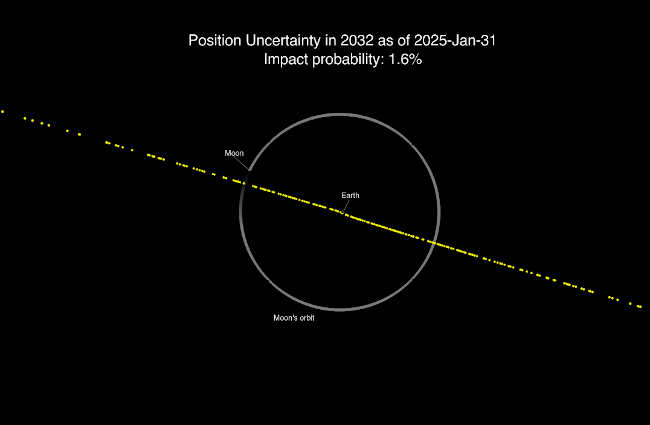
At first, 2024 YR4 had a broad uncertainty in its future trajectory that passed over Earth. As the planetary defense community collected more observations, the range of possibilities for the asteroid’s future position on Dec. 22, 2032 clustered over Earth, raising the apparent chances of collision. However, with the addition of even more data points, the cluster of possibilities eventually moved off Earth.
This visualization from the NASA JPL Center for Near-Earth Object Studies shows the evolution of the risk corridor for asteroid 2024 YR4, using data from observations made up to Feb. 23, 2025. Each yellow dot represents the asteroid’s possible location on Dec. 22, 2032. As the range of possible locations narrowed, the dots at first converged on Earth, before skewing away harmlessly.
Having multiple streams of data available for analysis helps scientists quickly learn more about NEOs. This sometimes involves using data from observatories that are mainly used for astrophysics or heliophysics surveys, rather than for tracking asteroids.
“The planetary defense community both benefits from and is beneficial to the larger planetary and astronomy related ecosystem,” said Bauer, who is also a research professor in the Department of Astronomy at the University of Maryland. “Much of the NEO survey data can also be used for searching astrophysical transients like supernova events. Likewise, astrophysical sky surveys produce data of interest to the planetary defense community.”

How does NASA stop asteroids from hitting Earth?
In 2022, NASA’s DART (Double Asteroid Redirection Test) mission successfully impacted with the asteroid Dimorphos, shortening the time it takes to orbit around its companion asteroid Didymos by 33 minutes. Didymos had no chance of hitting Earth, but the DART mission’s success means that NASA has a tested technique to consider when addressing a future asteroid potential impact threat.
To increase the chances of discovering asteroid threats to Earth well in advance, NASA is working on a new space-based observatory, NEO Surveyor, which will be the first spacecraft specifically designed to look for asteroids and comets that pose a hazard to Earth. The mission is expected to launch in the fall of 2027, and the data it collects will be available to everyone through NASA archives.
“Many of the NEOs that pose a risk to Earth remain to be found,” Bauer said. “An asteroid impact has a very low likelihood at any given time, but consequences could be high, and open science is an important component to being vigilant.”
For more information about NASA's approach to sharing science data, visit https://science.nasa.gov/open-science.
Lauren Leese is web content strategist for the Office of the Chief Science Data Officer.
- Details
- Written by: Lauren Leese

LAKE COUNTY, Calif. — Lake County’s superintendent of schools is raising concerns about a federal education memorandum issued earlier this month that’s aimed at rolling back efforts to encourage and embrace diversity.
On April 3, the U.S. Department of Education issued a four-page memorandum to public school superintendents across the nation, reaffirming that federal funding for school districts is contingent upon compliance with Title VI of the Civil Rights Act of 1964, said Superintendent Brock Falkenberg.
Title VI prohibits discrimination based on race, color, or national origin under any program or activity receiving federal financial assistance.
“Expressed in the form of a positive mindset this is about supporting all students,” said Falkenberg.
“In Lake County, the value of supporting all students is embedded in everything we do. This value is not adopted because federal law demands it, but because it reflects who we are as a Lake County community and what we, the community, believe. Our commitment to nondiscrimination would remain unchanged even in the absence of Title VI,” Falkenberg said.
Falkenberg said that, what is more concerning in the memo is the ambiguous assertion that diversity, equity and inclusion, or DEI, programs may be at odds with federal law.
“The document provides no definition of DEI, no examples of what is considered noncompliant, and no clear guidance for public schools. This vague language, combined with what appears to be an emerging pattern of ambiguous communication from federal agencies, including a similar ‘Dear Colleague’ letter issued on Feb. 14, suggests a shift toward threats and posturing rather than clear policy and guidance,” Falkenberg said.
“This is deeply problematic,” he said.
“DEI is not a slogan or a box to check in Lake County. It is a reflection of our community and a core aspect of our mission to serve every child. Diversity is not optional in Lake County, it is our lived reality. Our families represent a wide range of racial, cultural, religious, linguistic, and socioeconomic backgrounds. Our students include English language learners, children with disabilities, LGBTQ+ youth, and students from every political and social walk of life. You cannot ban or regulate diversity. It exists, and we choose to honor and leverage it,” Falkenberg explained.
“Equity, meanwhile, is how we ensure that every student has what they need to learn and succeed. It’s not about favoritism or unfair advantage, it’s about fairness,” said Falkenberg.
“Equity means providing a wheelchair for a student with mobility issues, lunch for students facing food insecurity, or flexible academic programs for students dealing with a health crisis or family emergency. Equity is meeting students where they are, giving them the tools and support they need, and holding high expectations for all,” he said.
Inclusion, Falkenberg explained, “is simply the practice of making sure every student, every family, and every staff member feels valued, respected, and welcome in our schools. That includes opportunities to engage in clubs, community events, cultural celebrations, and educational programs that reflect our shared values and diverse experiences.”
Across Lake County, over $17.1 million of annual school districts’ budgets comes from federal grants, most notably Title I, which supports students in low-income communities, and Individuals with Disabilities Act, or IDEA, which Falkenberg said provides partial funding for special education services.
“This funding is critical to serving our students and should never be used as leverage to pressure school districts into abandoning the values of the communities they serve or compromising their commitment to children,” Falkenberg said.
The Pledge of Allegiance, Falkenberg points out, ends with the statement, “With liberty and justice for all.”
“Our movement forward as a county is dependent on all students and children thriving, Falkenberg said. “Something is fundamentally wrong when school leaders are asked to choose between critical federal support and doing what is right for students.”
Falkenberg added, “In Lake County, we will continue to stand for all children without exception. We will not allow vague threats or rhetoric to derail the progress we have made. We will not retreat from our responsibility to prepare every child, regardless of background, to thrive, while they contribute meaningfully to society, the workforce, and our democracy.”
- Details
- Written by: LAKE COUNTY NEWS REPORTS
LUCERNE, Calif. — The Central Region Town Hall will next meet on Monday, April 14.
The meeting will begin at 6 p.m. at the Lucerne Alpine Senior Center, 3985 Country Club Drive.
Virtual participation is available via Zoom at https://app.zoom.us/wc.
To join by phone dial 1 669 900 9128. The Zoom Webinar ID is 825 9780 9680; the passcode is 778050.
The full agenda can be seen here.
Agenda items include:
• Discussion and possible action including acceptance of an update from Public Services Director Lars Ewing and the Department of Water Resources regarding Alpine Park cleanup, swim area cleanup and tule/brush cleanup.
• A presentation from Senior Transportation Planner John Speka regarding the Lake Area Planning Council's update of the Regional Transportation Plan.
• A presentation from Public Works Director Glen March regarding transportation concerns and future projects.
• An update from Caltrans regarding potential projects.
• An update regarding a potential joint municipal advisory committee meeting.
• Flood control mitigation for Victoria Creek.
An update from Supervisor EJ Crandell.
The Central Region Town Hall Board includes Chair Becky Schwenger, Vice Chair Austin Pratt, Recorder Atlas Pearson, and members Jon Karlsson and Jacob Blue.
The meeting will begin at 6 p.m. at the Lucerne Alpine Senior Center, 3985 Country Club Drive.
Virtual participation is available via Zoom at https://app.zoom.us/wc.
To join by phone dial 1 669 900 9128. The Zoom Webinar ID is 825 9780 9680; the passcode is 778050.
The full agenda can be seen here.
Agenda items include:
• Discussion and possible action including acceptance of an update from Public Services Director Lars Ewing and the Department of Water Resources regarding Alpine Park cleanup, swim area cleanup and tule/brush cleanup.
• A presentation from Senior Transportation Planner John Speka regarding the Lake Area Planning Council's update of the Regional Transportation Plan.
• A presentation from Public Works Director Glen March regarding transportation concerns and future projects.
• An update from Caltrans regarding potential projects.
• An update regarding a potential joint municipal advisory committee meeting.
• Flood control mitigation for Victoria Creek.
An update from Supervisor EJ Crandell.
The Central Region Town Hall Board includes Chair Becky Schwenger, Vice Chair Austin Pratt, Recorder Atlas Pearson, and members Jon Karlsson and Jacob Blue.
- Details
- Written by: Elizabeth Larson

CLEARLAKE, Calif. — Clearlake Animal Control has many dogs waiting for a new start with adoptive families.
The shelter has 55 adoptable dogs listed on its website.
This week’s dogs include “Levi,” a 10-month-old male mixed breed dog with a brown brindle coat.
Shelter staff said Levi — who is still a puppy — would love another furry friend to play with in his new home. He’s energetic, loves walks and cuddling.
The shelter is located at 6820 Old Highway 53. It’s open from 9 a.m. to 6 p.m. Tuesday through Saturday.
For more information, call the shelter at 707-762-6227, email
This week’s adoptable dogs are featured below.
Email Elizabeth Larson at
- Details
- Written by: Elizabeth Larson




