Astrainedpharmacists who advocate for and take care of patients in community settings, we’ve witnessed this decline firsthand. The loss of local pharmacies threatens individual and community access to medications, pharmacist expertise and essential public health resources.
The changing role of pharmacies
Community pharmacies – which include independently owned, corporate-chain and other retail pharmacies in neighborhood settings – have changed a lot over the past decades. What once were simple medication pickup points have evolved into hubs for health and wellness. Beyond dispensing prescriptions, pharmacists today provide vaccinations, testing and treatment for infectious diseases, access to hormonal birth control and other clinical services they’re empowered to provide by federal and state laws.
Given their importance, then, why have so many community pharmacies been closing?
There are many reasons, but the most important is reduced reimbursement for prescription drugs. Most community pharmacies operate under a business model centered on dispensing medications that relies on insurer reimbursements and cash payments from patients. Minor revenue comes from front-end sales of over-the-counter products and other items.
And it’s not just mom-and-pop operations feeling the pinch. Over the past four years, the three largest pharmacy chains have announced plans to close hundreds of stores nationwide. CVS kicked off the trend in 2021 by announcing plans to close 900 pharmacy locations. In late 2023, Rite Aid said that thousands of its stores would be at risk for closure due to bankruptcy. And late in 2024, Walgreens announced its plans to close 1,200 stores over the next three years.
So if your neighborhood pharmacy closes, what should you do?
While convenience and location matter, you might want to consider other factors that can help you meet your health care needs. For example, some pharmacies have staff who speak your native language, independent pharmacy business owners may be active in your community, and many locations offer over-the-counter products like hormonal contraception, the overdose-reversal drug naloxone and hearing aids.
You may also consider locations – especially corporate-owned pharmacies – that also offer urgent care or primary care services. In addition, most pharmacies offer vaccinations, and some offer test-and-treat services for infectious diseases, diabetes education and help with quitting smoking.
What to ask if your pharmacy closes
If your preferred pharmacy closes and you need to find another one, keep the following questions in mind:
• What will happen to your old prescriptions? When a pharmacy closes, another pharmacy may buy its prescriptions. Ask your pharmacist if your prescriptions will be automatically transferred to a nearby pharmacy, and when this will occur.
• What’s the staffing situation like at other pharmacies? This is an important factor in choosing a new pharmacy. What are the wait times? Can the team accommodate special situations like emergency refills or early refills before vacations? Does the pharmacist have a relationship with your primary care physician and your other prescribers?
• Which pharmacies accept your insurance? A simple call to your insurer can help you understand where your prescriptions are covered at the lowest cost. And if you take a medication that’s not covered by insurance, or if you’re uninsured, you should ask if the pharmacy can help you by offering member pricing or manufacturer coupons and discounts.
• What are your accessibility needs? Pharmacies often offer services to make your care more accessible and convenient. These may include medication packaging services, drive-thru windows and home delivery. And if you’re considering switching to a mail-order pharmacy, you should ask if it has a pharmacist to answer questions by phone or during telehealth visits.
Remember that it’s best to have all your prescriptions filled at the same pharmacy chain or location so that your pharmacist can perform a safety check with your complete medication list. Drug interactions can be dangerous.
Community pharmacies have been staples of neighborhoods for more than a century. Unfortunately, current trends in pharmacy closures pose real threats to public health. We hope lawmakers address the underlying systemic issues so more Americans don’t lose access to their medications, health services and pharmacists.
From left, Capt. Bret Butler and Det. Michael Nakahara. Courtesy photos. On Monday, Rep. Mike Thompson (CA-04) announced Lake County Sheriff’s Det. Michael Nakahara and Fire Capt. Bret Butler as the 2025 Lake County Public Safety Heroes.
Every year, Thompson honors first responders who have gone above and beyond the call of duty in our community.
“Our first responders go above and beyond to protect and serve the communities they call home. I am proud to recognize many of the public safety heroes in our district who go the extra mile to keep us safe,” said Thompson. “Detective Michael Nakahara displayed great courage, especially during a recent homicide investigation involving the first known death from fentanyl in the county of Lake. I am also proud to recognize Fire Captain Bret Butler for his leadership in his firehouse and as a Federal Excess Equipment Program Coordinator with CalFire. Detective Nakahara and Fire Captain Butler are both exemplary public servants who are well deserving of this recognition.”
Congressman Mike Thompson with 2025 Lake County Public Safety Hero Det. Michael Nakahara of the Lake County Sheriff’s Office on Monday, Feb. 17, 2025, in Vallejo, California. Photo courtesy of Congressman Thompson’s office. Det. Michael Nakahara
Det. Michael Nakahara graduated from the San Joaquin Delta College POST Academy in 2021 and joined the Lake County Sheriff’s Office later that year.
In 2024 he was promoted to the Major Crimes Unit, where he was assigned an investigation regarding the tragic death of a 17-year-old from fentanyl.
Despite this being his first major case, Nakahara worked tirelessly to gather evidence and conduct interviews. His work led to the arrest and charging of a suspect who is now set to face trial next month.
Det. Nakahara is also known for his contributions to our community outside of the sheriff’s office, notably as an assistant coach for the Youth Varsity Kelseyville Chiefs.
“His tenacity, dedication, and resolve make our community safer,” Thompson said in his announcement.
Congressman Mike Thompson with 2025 Lake County Public Safety Hero Capt. Bret Butler of the Lake Pillsbury Fire Protection District on Monday, Feb. 17, 2025, in Vallejo, California. Photo courtesy of Congressman Thompson’s office. Capt. Bret Butler
Capt. Bret Butler began his career as a firefighter before rising to the rank of captain. He is locally recognized for his involvement in the Rice Fork community and thought of by many as the unofficial “mayor.”
Most notably, Capt. Butler is the leader of the Lake Pillsbury Fire Protection District. He is responsible for many important local projects, including procuring and installing mile marker signs along popular rural roads, facilitating engines and ambulance donations, and personally installing a solar system on Fire Station 2.
“We thank Captain Butler for his leadership, selflessness and love of our community,” Thompson’s announcement said.
Thompson’s office said, “Det. Nakahara and Capt. Bret Butler’s actions are the epitome of what it means to be public servants. They, along with many other public safety officers and first responders, keep our communities and citizens safe. Congressman Thompson is honored to recognize them”
The full list of 2025 Public Safety Heroes for the Fourth Congressional district includes:
• Det. Michael Nakahara, Law Enforcement Public Safety Hero, Lake County; • Capt. Bret Butler, Fire/EMS Public Safety Hero, Lake County; • Sgt. Erik Olson, Law Enforcement Public Safety Hero, Napa County; • Station Lead Roger Lutz, Fire/EMS Public Safety Hero, Napa County; • Officer Matthew Bowen, Law Enforcement Public Safety Hero, Solano County; • EMT Michael Robinson, Fire/EMS Public Safety Hero, Solano County; • Officer Murph, Canine Public Safety Hero, Solano County; • Detective Kelsea Nelson, Law Enforcement Public Safety Hero, Sonoma County; • inRESPONSE Program, Fire/EMS Public Safety Hero, Sonoma County; • Deputy Reiko Matsumura, Law Enforcement Public Safety Hero, Yolo County; • Battalion Chief Emily Lo, Fire/EMS Public Safety Hero, Yolo County.
Thompson represents California’s 4th Congressional District, which includes all or part of Lake, Napa, Solano, Sonoma and Yolo counties.
LAKE COUNTY, Calif. — Community members are invited to come and take the plunge for a good cause later this month.
The Lake County Special Olympics 2025 Polar Plunge will be held on Saturday, Feb. 22, at the Buckingham Homeowners Association clubhouse.
The event begins at 10 a.m. with the check in, continues through the plunge and ends with lunch in the clubhouse.
The annual event is a crucial fundraiser for Special Olympics, providing funding to support athletes with uniforms, equipment and transportation as they compete year-round in a variety of sports.
This year, the funding goal is $20,000. As of Tuesday, 46 people in six teams have registered, with an estimated $13,725 raised.
“For every $500 that is donated, the life of an athlete is enriched. So far 27 Special Olympics athletes have been positively impacted by your support,” Special Olympics reported.
Every Plunger must raise a minimum of $125 and will receive a Polar Plunge T-shirt and post Plunge festivities. Participants are invited to raise additional funds and earn incentive rewards. Costumes are encouraged.
Insurance Commissioner Ricardo Lara, along with several legislators, is advancing a comprehensive legislative package aimed at protecting wildfire survivors and improving preparedness for future disasters.
Lara’s office said this package focuses on three key goals: Consumer protection, climate resiliency, and market strength.
Among the 10 proposals sponsored by the commissioner are a new statewide grant program to assist with wildfire hardening, protections for businesses against insurance non-renewals, initiatives to combat deceptive disaster advertising, and measures to maximize insurance claim payouts by limiting the fees that public adjusters can charge.
“As we face increasingly catastrophic disasters, our responsibility is to assist people in their recovery while also ensuring we are better prepared for the next event,” said Commissioner Lara. “Now is the time for transformational action. I will not shy away from this moment and will continue to advocate for consumer protection and the restoration of our state’s insurance market. Bold actions will yield bold results.”
“Countless families, businesses, and communities in Los Angeles have suffered a devastating loss due to the fires,” said Assemblymember Lisa Calderon, chair of the Assembly Insurance Committee. “Under the leadership of Speaker Rivas and with support from Insurance Commissioner Lara, my colleagues and I are fighting to ensure homeowners can access the resources they need to prepare for and recover from wildfires.”
“Strengthening how we build and harden our homes can save lives, safeguard property, and help rein in the skyrocketing insurance costs burdening families across the state,” said Sen. Susan Rubio, chair of the Senate Insurance Committee. “That’s why we’re committed to taking bold, proactive action, not just protecting those in high-risk areas but every Californian. The steps we’re taking now will fortify our neighborhoods year-round and help all hardworking Californians keep their families safe now and for future generations.”
“Just like residential homeowners, holders of commercial insurance policies need and deserve reliable insurance during a disaster like the wildfires we’ve just experienced,” said Sen. Sasha Renée Pérez. “My legislation will expand the one-year moratorium to prevent cancelations or notices of nonrenewal on small businesses and nonprofit organizations. I appreciate the State Insurance Commissioner’s actions to protect Californians during these devastating Los Angeles County wildfires.”
“This legislative package is an important step to incentivize homeowners to harden and protect their homes from wildfires, while helping consumers save money on insurance bills,” said Assemblymember Damon Connolly. “With the current state of our insurance market, it is critical that we continue to support homeowners across California who are proactively protecting their homes and making community level wildfire mitigation efforts by making sure that they are being offered as much relief as possible.”
“Wildfire victims have been through so much, and deserve all the support we can offer. Guaranteeing coverage of their possessions offers an important step towards closure, and extending deadlines to provide proof of loss allows them ample time to sufficiently regroup and sort through the many logistics of recovery,” said Sen. Ben Allen. “Californians who have lost all that they call home should not be subject to the pain compounded by insufficient coverage or missed deadlines. Additionally, the Eliminate ‘The List’ Act modernizes our data collection protocols to provide us with better climate insight that will guide us to a more insurable future.”
“The advertising of disaster recovery related services to the victims of natural disasters needs to be open and transparent,” said Assemblymember Heath Flora. “Private companies are certainly allowed to offer services to victims, but they should not be allowed to disguise those for-profit services as a form of government or non-profit relief aid.”
"Public adjusters should help wildfire survivors rebuild, not wreck their recovery. Some public adjustors will charge excessive fees or take a portion of homeowners’ insurance payouts through unfair practices. I’m proud to partner with Commissioner Lara on AB 597 to ensure wildfire survivors get every dollar they deserve to rebuild their lives," said Assemblymember John Harabedian.
“Wildfires and other natural disasters continue to devastate communities across California, leaving families struggling to recover,” said Assemblymember Mike A. Gipson. “AB 232 empowers homeowners by providing them with a tax-exempt savings account to proactively prepare for emergencies. By allowing individuals to set aside funds for natural disasters, we are ensuring that Californians have the financial tools necessary to protect their homes and rebuild their lives when disaster strikes. I am proud to co-author this critical legislation with Assemblymember Calderon and stand with Commissioner Lara in advancing policies that enhance resilience and consumer protection."
“When disaster strikes, Californians should be able to count on their insurance coverage to pay out claims,” said Assemblymember David Alvarez. “It is clear that the FAIR Plan needs more legs to stand on, and AB 226 is an urgent step among many we must take, to stabilize California’s insurance market and prevent additional assessments that will hurt California homeowners.”
“This first-in-the-nation public wildfire catastrophe model will be transparent, science-driven, and work for everyone—homeowners, communities, emergency responders, and local governments. By investing in a university-led research center, this bill ensures a model that not only improves wildfire preparedness and planning but also gives homeowners and communities a clearer picture of wildfire risk and whether they’re getting a fair deal on insurance,” said Sen. Dave Cortese.
“Time and time again, fires have destroyed our communities throughout California including my own. As we begin to recover from this historic disaster, it’s important now more than ever that we find a way to make communities fire-safe and stabilize the insurance market. We cannot do this home-by-home. That’s why the Commission takes a community scale approach to hardening, to ensure that local governments and communities that take fire code compliance seriously, and invest in hardening, have that work recognized by insurers. If we don’t, it won’t just be more houses that burn, but costs for everyone will go up,” said Sen. Henry Stern.
Commissioner Lara’s 10 sponsored bill proposals include:
The California Safe Homes Act (authored by Assembly Member Lisa Calderon) This legislation aims to create safer homes and communities by providing state-tax-free funds to help residents purchase fire-rated roofs and develop non-ignition zones around their properties, along with other crucial mitigation measures. These initiatives seek to safeguard lives and homes while enhancing eligibility for insurance discounts under Commissioner Lara’s existing Safer from Wildfires regulation. The act would establish a grant program at the Department of Insurance, utilizing existing funds without incurring additional costs to taxpayers—similar to current programs in other states that address windstorm threats. Additionally, the grants would be federal-tax-free if Congress passes the bipartisan “Disaster Resiliency and Coverage Act,” which has received support from the Commissioner, many members of California’s congressional delegation, and numerous representatives from states facing the severe impacts of climate change.
The Business Insurance Protection Act (jointly authored by Senators Sasha Renée Pérez and Susan Rubio) The Wildfire Safety and Recovery Act of 2018 (SB 824, authored by then-Senator Lara) has protected millions of homeowners by prohibiting non-renewals of residential property insurance for one year. This proposal aims to extend this essential protection by broadening the insurance moratorium to include commercial policies, covering businesses, homeowners' associations (HOAs), condominiums, affordable housing units, and non-profits.
The Insurance Payment Protection Act (AB 597, authored by Assembly Member John Harabedian) ensures that wildfire survivors receive the maximum funds from their insurance claims is crucial for their recovery. To help policyholders obtain the full amount they are owed, AB 597 establishes a 15% cap on fees for adjuster-contracted work and prohibits any additional awards outside the contract. Currently, there is no limit on the fees that public adjusters can charge, which may include claims funds received before a consumer-adjuster contract is finalized — ultimately reducing the funds available for consumers to rebuild their homes and lives.
Eliminate “The List” Act (authored by Senator Ben Allen) This bill requires insurance companies to pay wildfire survivors 100 percent of their contents coverage without needing a detailed inventory list. It also grants consumers additional time—at least 180 days—to provide proof of loss to their insurance company following a declared state of emergency. Furthermore, the proposal aims to establish specific data collection authority to assist the Department in understanding long-term trends in risk management tools, technical data, and the integration of information related to climate-intensified risks that can significantly affect insurance availability.
The California Community Fire Hardening Commission Act (jointly authored by Senators Susan Rubio, Dave Cortese, and Henry Stern) proposes the creation of an independent statewide commission within the Department of Insurance. This commission is designed to develop a more effective inspection system that enables individuals to receive insurance discounts for home hardening, thereby improving wildfire safety for entire communities. Chaired by the Insurance Commissioner, the commission will review lessons learned from recent wildfires and offer recommendations to enhance and expedite home and community hardening efforts throughout the state, among other responsibilities
The Deceptive Disaster Relief Advertising Act (AB 637, authored by Assembly Member Heath Flora) After major disasters, consumers are frequently bombarded with misleading advertisements that claim to provide legal or recovery services, often posing as official government or non-profit guidance. To enhance transparency and safeguard consumers from being misled during these difficult times, AB 637 requires that advertisements on social media, traditional broadcast media, and digital streaming platforms clearly display the statement: “This is a solicitation for business. Not affiliated with any government entity or non-profit.
The California Wildfire Public Model Act (authored by Senator Dave Cortese) Establishes the nation's first public catastrophic model for wildfires, offering a crucial tool to assist wildfire planning and enhance transparency.
The Insurance and Wildfire Safety Act (AB 1, authored by Assembly Member Damon Connolly) AB 1 builds on Commissioner Lara’s groundbreaking Safer from Wildfires regulation. The legislation requires future insurance commissioners to assess the need for updates to the regulation based on new fire science and public input.
The FAIR Plan Stability Act (AB 226, jointly authored by Assembly Members Lisa Calderon and David Alvarez) AB 226 aims to strengthen consumer safeguards by allowing the FAIR Plan to access catastrophic bonds through the California Infrastructure and Economic Development Bank. This provision would add an extra layer of financial support for the state’s insurer of last resort, enabling it to continue paying consumer claims promptly in the event of a worst-case disaster.
The Savings Accounts for Mitigation and Catastrophes Act (AB 232, jointly authored by Assembly Members Lisa Calderon and Mike Gipson) AB 232 creates a tax-exempt savings account for consumers. This account allows them to set aside funds specifically for home hardening and insurance deductibles in the event of a disaster.
Bills without numbers have not been formally introduced but will be by Feb. 21.
Firefighters, along with organizations representing businesses, non-profits, wildfire survivors, and other consumers, are uniting in support of this legislative package, which supporters said will enhance the implementation of the Sustainable Insurance Strategy this year and beyond.
“We appreciate Insurance Commissioner Lara and Legislative Leaders for providing substantive measures to address our current insurance crisis and its impact on California’s housing crisis,” said Dan Dunmoyer, president and CEO of the California Building Industry Association. “Homebuilders, homebuyers, and renters must be able to secure insurance, including Californians who live in condominiums, apartments, and affordable housing. All consumers will benefit greatly from more stability in the insurance market and a stable FAIR Plan. This is why CBIA is sponsoring AB 226 (Calderon and Alvarez), which gives the FAIR Plan new tools to better manage costs related to paying policyholder claims after disasters.”
"Our communities demand action on the insurance crisis, and this bill package is a critical step forward," said Jeff Griffiths, California State Association of Counties president and Inyo County supervisor. "Counties appreciate Commissioner Ricardo Lara for leading this effort and encourage continued progress by streamlining recovery efforts, such as expanding the Executive Orders issued for the 2025 Los Angeles County Wildfires to all counties facing disaster.”
“The California Fire Chiefs Association strongly supports legislation that prioritizes home hardening and the implementation of Zone Zero within our communities. Regulations that promote adaptive strategies and provide resources to assist homeowners in fortifying their properties are essential components of wildfire resilience. Forward-thinking legislation that embraces innovation and prioritizes proactive wildfire mitigation measures will play a critical role in safeguarding lives, property, infrastructure and environment,” said Chief Brian Fennessy, president, California Fire Chiefs Association.
“The California Association of REALTORS has supported the Department of Insurance's Sustainable Insurance Strategy, which aims to remove barriers to insurance access, particularly for those in higher risk areas. CAR is encouraged that this comprehensive legislative package will continue to build on that strategy and provide enhanced consumer protection for homeowners who have been victims of wildfires,” said Heather Ozur, CAR president.
National Institutes of Health indirect costs, which are under the knife, go toward managing laboratories and facilities. Fei Yang/Moment via Getty Images
Proposed cuts to the federal agencies that fund scientific research could undercut America’s global competitiveness, with negative impacts on the economy and the ability to attract and train the next generation of researchers.
I’m an astronomer, and I have been a senior administrator at the University of Arizona’s College of Science. Because of these roles, I’m invested in the future of scientific research in the United States. I’m worried funding cuts could mean a decline in the amount and quality of research published – and that some potential discoveries won’t get made.
The endless frontier
A substantial part of U.S. prosperity after World War II was due to the country’s investment in science and technology.
In this report, Bush argued that scientific research was essential to the country’s economic well-being and security. His advocacy led to the founding of the National Science Foundation and science policy as we know it today. He argued that a centralized approach to science funding would efficiently distribute resources to scientists doing research at universities.
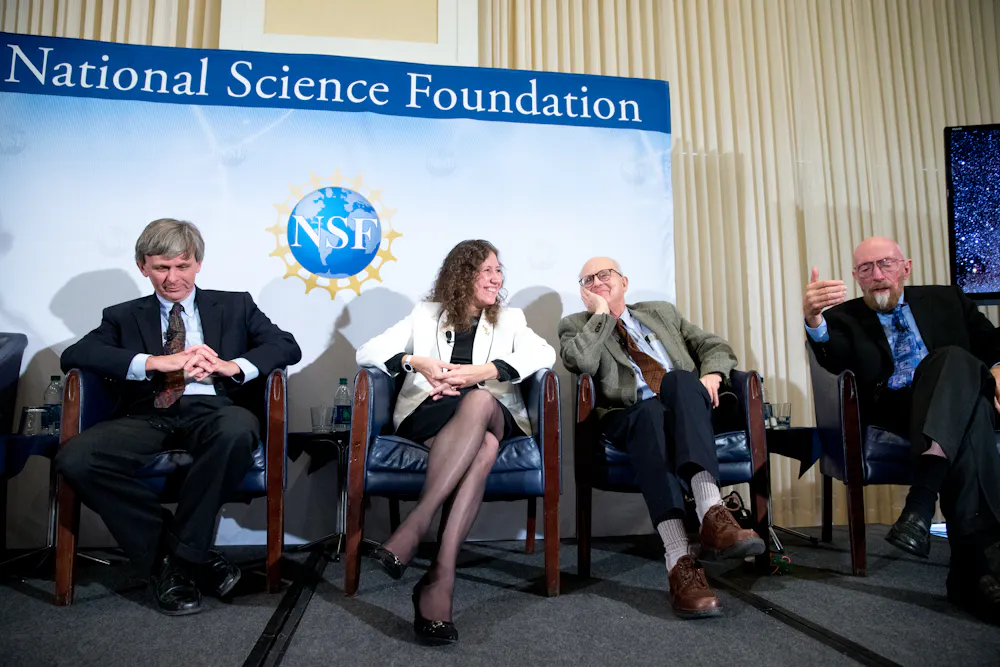
The National Science Foundation awards funding to many research projects and early career scientists. Pictured are astronomers from the LIGO collaboration, which won a Nobel Prize.AP Photo/Andrew Harnik
Since 1945, advances in science and technology have driven 85% of American economic growth. Science and innovation are the engines of prosperity, where research generates new technologies, innovations and solutions that improve the quality of life and drive economic development.
This causal relationship, where scientific research leads to innovations and inventions that promote economic growth, is true around the world.
The importance of basic research
Investment in research and development has tripled since 1990, but that growth has been funded by the business sector for applied research, while federal investment in basic research has stagnated. The distinction matters, because basic research, which is purely exploratory research, has enormous downstream benefits.
Quantum computing is a prime example. Quantum computing originated 40 years ago, based on the fundamental physics of quantum mechanics. It has matured only in the past few years to the point where quantum computers can solve some problems faster than classical computers.
Basic research into quantum physics has allowed quantum computing to develop and advance.AP Photo/Ross D. Franklin
Worldwide, basic research pays for itself and has more impact on economic growth than applied research. This is because basic research expands the shared knowledge base that innovators can draw on.
For example, a biotech advocacy firm calculated that every dollar of funding to the National Institutes of Health generates US$2.46 in economic activity, which is why a recent cut of $9 billion to its funding is so disturbing.
The American public also values science. In an era of declining trust in public institutions, more than 3 in 4 Americans say research investment is creating employment opportunities, and a similar percentage are confident that scientists act in the public’s best interests.
Science superpower slipping
By some metrics, American science is preeminent. Researchers working in America have won over 40% of the science Nobel Prizes – three times more than people from any other country. American research universities are magnets for scientific talent, and the United States spends more on research and development than any other country.
But there is intense competition to be a science superpower, and several metrics suggest the United States is slipping. Research and development spending as a percentage of GDP has fallen from a high of 1.9% in 1964 to 0.7% in 2021. Worldwide, the United States ranked 12th for this metric in 2021, behind South Korea and European countries.
Metrics for research quality tell a similar story. In 2020, China overtook the United States in having the largest share of the top 1% most-cited papers.
China also leads the world in the number of patents, and it has been outspending the U.S. on research in the past few decades. Switzerland and Sweden eclipse the United States in terms of science and technology innovation. This definition of innovation goes beyond research in labs and the number of scientific papers published to include improvements to outcomes in the form of new goods or new services.
Among American educators and workers in technical fields, 3 in 4 think the United States has already lost the competition for global leadership.
Threats to science funding
Against this backdrop, threats made in the beginning of President Donald Trump’s second term to science funding are ominous.
Trump’s first wave of executive orders caused chaos at science agencies as they struggled to interpret the directives. Much of the anxiety involved excising language and programs relating to diversity, equity and inclusion, or DEI.
The new administration has proposed deeper cuts. The National Science Foundation has been told to prepare for the loss of half of its staff and two-thirds of its funding. Other federal science agencies are facing similar threats of layoffs and funding cuts.
The impact
Congress already failed to deliver on its 2022 commitment to increase research funding, and federal funding for science agencies is at a 25-year low.
As the president’s proposals reach Congress for approval or negotiation, they will test the traditionally bipartisan support science has held. If Congress cuts budgets further, I believe the impact on job creation, the training of young scientists and the health of the economy will be substantial.
Deep cuts to agencies that account for a small fraction – just over 1% – of federal spending will not put a dent in the soaring budget deficit, but they could irreparably harm one of the nation’s most valuable enterprises.
The forecasts can seem effortless, but behind the scenes, a vast network of satellites, airplanes, radar, computer models and weather analysts are providing access to the latest data – and warnings when necessary. This data comes from analysts at the National Oceanic and Atmospheric Administration, known as NOAA, and its National Weather Service.
Atmospheric scientists Christine Wiedinmyer and Kari Bowen, who is a former National Weather Service forecaster, explained NOAA’s central role in most U.S. weather forecasts.
When people see a weather report on TV, what went on at NOAA to make that forecast possible?
All of that information goes into the agency’s computers, which process the data to begin defining what’s going on in different parts of the atmosphere.
NOAA forecasters use computer models that simulate physics and the behavior of the atmosphere, along with their own experience and local knowledge, to start to paint a picture of the weather – what’s coming in a few minutes or hours or days. They also use that data to project seasonal conditions out over weeks or months.
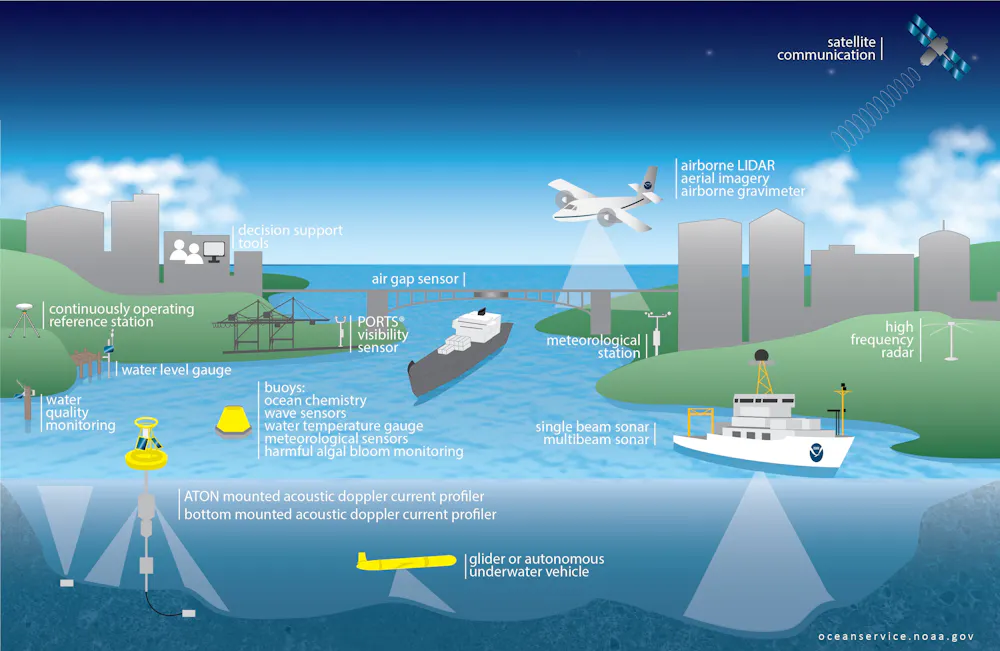
NOAA’s data comes from many sources to provide a more complete picture of developing climate and weather conditions. Communities and economies rely on that constantly updated information.NOAA
When severe weather is on the way, the agency issues the official alerts you’ll see in the news and on your phone.
All of this analysis happens before the information reaches private weather apps and TV stations.
No matter who you are, you can freely access that data and the analyses. In fact, a large number of private companies use NOAA data to create fancy maps and other weather products that they sell.
It would be extremely difficult to do all of that without NOAA.
The agency operates a fleet of 18 satellites that are packed with instruments dedicated to observing weather phenomena essential to predicting the weather, from how hot the land surface is to the water content of the atmosphere. Some are geostationary satellites which sit high above different parts of the U.S. measuring weather conditions 24/7. Others orbit the planet. Many of these are operated as part of partnerships with NASA or the Air Force.
Some private companies are starting to invest in satellites, but it would take an enormous amount of money to replicate the range of instrumentation and coverage that NOAA has in place. Satellites only last so long and take time to build, so NOAA is continually planning for the future, and using its technical expertise to develop new instruments and computer algorithms to interpret the data.
NOAA’s low earth orbiting satellites circle the planet from pole to pole and across the equator 14 times a day to provide a full picture of the year twice a day. The agency also has geostationary satellites that provide continuous coverage over the U.S.NOAA
Maritime buoys are another measuring system that would be difficult to replicate. Over 1,300 buoys across oceans around the world measure water temperature, wind and wave height – all of which are essential for coastal warnings, as well as long-term forecasts.
Weather observation has been around a long time. President Ulysses S. Grant created the first national weather service in the War Department in 1870. It became a civilian service in 1880 under the Department of Agriculture and is now in the Commerce Department. The information its scientists and technologists produce is essential for safety and also benefits people and industries in a lot of ways.
Could a private company create forecasts on its own without NOAA data?
It would be difficult for one company to provide comprehensive weather data in a reliable way that is also accessible to the entire public.
Some companies might be able to launch their own satellite, but one satellite only gives you part of the picture. NOAA’s weather observation network has been around for a long time and collects data from points all over the U.S. and the oceans. Without that robust data, computer models and the broad network of forecasters and developers, forecasting also becomes less reliable.
Analyzing that data is also complex. You’re not going to be able to take satellite data, run a model on a standard laptop and suddenly have a forecast.
And there’s a question of whether a private company would want to take on the legal risk of being responsible for the nation’s forecasts and severe weather warnings.
Neil Jacobs, nominated to oversee NOAA, explains why the agency is essential for accurate national weather forecasting, and why private companies might not want to take on the legal risk on their own.
NOAA is taxpayer-funded, so it is a public good – its services provide safety and security for everyone, not just those who can pay for it.
If weather data was only available at a price, one town might be able to afford the weather information necessary to protect its residents, while a smaller town or a rural area across the state might not. If you’re in a tornado-prone area or coastal zone, that information can be the difference between life or death.
Is climate data and research into the changing climate important for forecasts?
The Earth’s systems – its land, water and the atmosphere – are changing, and we have to be able to assess how those changes will impact weather tomorrow, in two weeks and far into the future.
Rising global temperatures affect weather patterns. Dryness can fuel wildfires. Forecasts have to take the changing climate into account to be accurate, no matter who is creating the forecast.
Drought is an example. The dryness of the Earth controls how much water gets exchanged with the atmosphere to form clouds and rainfall. To have an accurate weather prediction, we need to know how dry things are at the surface and how that has changed over time. That requires long-term climate information.
NOAA doesn’t do all of this by itself – who else is involved?
NOAA partners with private sector, academia, nonprofits and many others around the world to ensure that everyone has the best information to produce the most robust weather forecasts. Private weather companies and media also play important roles in getting those forecasts and alerts out more widely to the public.
A lot of businesses rely on accuracy from NOAA’s weather data and forecasts: aviation, energy companies, insurance, even modern tractors’ precision farming equipment. The agency’s long-range forecasts are essential for managing state reservoirs to ensure enough water is saved and to avoid flooding.
The government agency can be held accountable in a way private businesses are not because it answers to Congress. So, the data is trustworthy, accessible and developed with the goal to protect public safety and property for everyone. Could the same be said if only for-profit companies were producing that data?
When a hurricane or tornado starts to form, your local weather forecasters can quickly pull up maps tracking its movement and showing where it’s headed. But have you ever wondered where they get all that information?
Details
Written by: Christine Wiedinmyer, University of Colorado Boulder and Kari Bowen, University of Colorado Boulder
UPPER LAKE, Calif. — The Western Region Town Hall will meet this week to discuss a biochar project which community members are appealing.
The meeting will take place from 5:30 to 7 p.m. Wednesday, Feb. 19, in the Habematolel tribal room, 9460 Main St. in Upper Lake.
The meeting also will be available on Zoom. The link is here; the webinar ID is 833 1071 8838, passcode is 222669.
On the agenda is a discussion of a biochar project proposed by Scotts Valley Energy on county-owned property that the Lake County Planning Commission approved late last year. Community members have joined together and are appealing the project to the Board of Supervisors.
In other business, Angela DePalma-Dow of Lake County Water Resources will discuss with the group the Clover Creek diversion channel.
There also will be subcommittee reports on Upper Lake traffic safety, Pyle Road and the Upper Lake levees.
Email Elizabeth Larson at This email address is being protected from spambots. You need JavaScript enabled to view it.. Follow her on Twitter, @ERLarson, and on Bluesky, @erlarson.bsky.social. Find Lake County News on the following platforms: Facebook, @LakeCoNews; X, @LakeCoNews; Threads, @lakeconews, and on Bluesky, @lakeconews.bsky.social.

 How to resolve AdBlock issue?