
 How to resolve AdBlock issue?
 News
LAKE COUNTY, Calif. — The Lake County Sheriff’s Office has identified the Clearlake Oaks woman killed in a Christmas Eve crash with a semi truck.
Frances Cline Novak, 76, died in the wreck, said sheriff’s spokesperson Lauren Berlinn.
The California Highway Patrol’s Clear Lake Area office said Novak was traveling on state Route 53, south of state Route 20 near Clearlake Oaks in a a 2000 Lexus RX3 when she made a U-turn from the southbound shoulder ahead of a 2015 Peterbilt truck tractor driven by Javier Gomez Jimenez, 57, of Williams.
As a result, Novak’s Lexus was hit broadside by the semi truck, and she died of her injuries at the scene, the CHP said. Gomez Jimenez was not injured.
The crash remains under investigation.
Email Elizabeth Larson atThis email address is being protected from spambots. You need JavaScript enabled to view it. . Follow her on Twitter, @ERLarson, and on Bluesky, @erlarson.bsky.social. Find Lake County News on the following platforms: Facebook, @LakeCoNews; X, @LakeCoNews; Threads, @lakeconews, and on Bluesky, @lakeconews.bsky.social.
Frances Cline Novak, 76, died in the wreck, said sheriff’s spokesperson Lauren Berlinn.
The California Highway Patrol’s Clear Lake Area office said Novak was traveling on state Route 53, south of state Route 20 near Clearlake Oaks in a a 2000 Lexus RX3 when she made a U-turn from the southbound shoulder ahead of a 2015 Peterbilt truck tractor driven by Javier Gomez Jimenez, 57, of Williams.
As a result, Novak’s Lexus was hit broadside by the semi truck, and she died of her injuries at the scene, the CHP said. Gomez Jimenez was not injured.
The crash remains under investigation.
Email Elizabeth Larson at
- Details
- Written by: Elizabeth Larson
On Thursday, California’s Employment Development Department announced a major boost in Paid Family Leave and disability benefits for workers — up to 90% of pay for workers earning less than $63,000 per year, and 70% for higher income workers.
“Expanded Paid Family Leave benefits are about making it easier for Californians to care for themselves, bond with a new child, and care for their families without worrying about how they’ll pay the bills,” said Governor Gavin Newsom. “This is another example of California leading the way in supporting workers, creating a more affordable California, and building more opportunity for all.”
“This benefit boost makes it more affordable to take time off work and care for an ill family member, bond with a child, or recover from illness or injury,” said EDD Director Nancy Farias. “These investments strengthen California’s workforce and improve the lives of millions of Californians.”
California’s benefit boost will help workers take time off work for pregnancy, childbirth, or recovery from illness or injury.
It will also help people care for seriously ill family members, bond with new children, or support family during military deployment abroad.
The new law that increases these benefits, Senate Bill 951 (SB 951), went into effect Jan. 1, 2025, and is not retroactive — meaning claims from 2024 continue payment at 2024 rates (which paid 60 to 70% of weekly wages).
Information about this transition period is posted on the 2025 Benefit Payment FAQs webpage.
Paid Family Leave and Disability Insurance are insurance plans that cover more than 18 million California workers. Workers pay into these insurance plans through payroll contributions and then draw benefits when needed. Eligible workers receiving disability can get up to 52 weeks of benefits and workers taking Paid Family Leave are eligible for up to 8 weeks of benefits, plus 4 weeks before birth for expecting mothers. On average, workers last year received over $870 per week in Paid Family Leave and over $780 per week for disability.
"SB 951 will ensure every California worker can afford to care for their family and themselves during life’s most important moments," said Sen. Maria Elena Durazo, author of SB 951. "I applaud Governor Newsom for signing my bill into law, which will allow middle and low paid workers to receive up to 90 percent of their wages when out on leave. This change will benefit millions of workers who have contributed to the program during their careers. This bill, which I was proud to introduce, is part of the historic work California is doing to expand equitable access to paid leave."
"SB 951 will make a huge difference to California parents and caregivers who will now be able to afford to take the time to bond with their children, care for their family members, or to heal from their own serious health condition,” said Jenya Cassidy, director of the California Work & Family Coalition. "I'm really proud to have been part of the huge effort that made this possible. Now we need to spread the word to make sure everyone knows about it!"
"We are thrilled to see SB 951 go into effect," said Sharon Terman, director of the Work & Family Program at Legal Aid at Work. "By raising benefit rates to 90 percent for low-paid workers, this landmark law makes Paid Family Leave and State Disability Insurance accessible to Californians with low incomes who previously could not afford to take a massive pay cut when dealing with a family medical crisis or welcoming a new child. Thanks to SB 951, millions more workers will be able to afford to take the leave they need to take care of themselves and their families, without having to risk their economic stability."
For more information and updates visit EDD’s State Disability Insurance webpage.
“Expanded Paid Family Leave benefits are about making it easier for Californians to care for themselves, bond with a new child, and care for their families without worrying about how they’ll pay the bills,” said Governor Gavin Newsom. “This is another example of California leading the way in supporting workers, creating a more affordable California, and building more opportunity for all.”
“This benefit boost makes it more affordable to take time off work and care for an ill family member, bond with a child, or recover from illness or injury,” said EDD Director Nancy Farias. “These investments strengthen California’s workforce and improve the lives of millions of Californians.”
California’s benefit boost will help workers take time off work for pregnancy, childbirth, or recovery from illness or injury.
It will also help people care for seriously ill family members, bond with new children, or support family during military deployment abroad.
The new law that increases these benefits, Senate Bill 951 (SB 951), went into effect Jan. 1, 2025, and is not retroactive — meaning claims from 2024 continue payment at 2024 rates (which paid 60 to 70% of weekly wages).
Information about this transition period is posted on the 2025 Benefit Payment FAQs webpage.
Paid Family Leave and Disability Insurance are insurance plans that cover more than 18 million California workers. Workers pay into these insurance plans through payroll contributions and then draw benefits when needed. Eligible workers receiving disability can get up to 52 weeks of benefits and workers taking Paid Family Leave are eligible for up to 8 weeks of benefits, plus 4 weeks before birth for expecting mothers. On average, workers last year received over $870 per week in Paid Family Leave and over $780 per week for disability.
"SB 951 will ensure every California worker can afford to care for their family and themselves during life’s most important moments," said Sen. Maria Elena Durazo, author of SB 951. "I applaud Governor Newsom for signing my bill into law, which will allow middle and low paid workers to receive up to 90 percent of their wages when out on leave. This change will benefit millions of workers who have contributed to the program during their careers. This bill, which I was proud to introduce, is part of the historic work California is doing to expand equitable access to paid leave."
"SB 951 will make a huge difference to California parents and caregivers who will now be able to afford to take the time to bond with their children, care for their family members, or to heal from their own serious health condition,” said Jenya Cassidy, director of the California Work & Family Coalition. "I'm really proud to have been part of the huge effort that made this possible. Now we need to spread the word to make sure everyone knows about it!"
"We are thrilled to see SB 951 go into effect," said Sharon Terman, director of the Work & Family Program at Legal Aid at Work. "By raising benefit rates to 90 percent for low-paid workers, this landmark law makes Paid Family Leave and State Disability Insurance accessible to Californians with low incomes who previously could not afford to take a massive pay cut when dealing with a family medical crisis or welcoming a new child. Thanks to SB 951, millions more workers will be able to afford to take the leave they need to take care of themselves and their families, without having to risk their economic stability."
For more information and updates visit EDD’s State Disability Insurance webpage.
- Details
- Written by: LAKE COUNTY NEWS REPORTS

The shelter has 44 adoptable dogs listed on its website.
This week’s dogs include “Sahara,” a female Doberman pinscher mix with a short black and tan coat.
The shelter is located at 6820 Old Highway 53. It’s open from 9 a.m. to 6 p.m. Tuesday through Saturday.
For more information, call the shelter at 707-762-6227, email
This week’s adoptable dogs are featured below.
Email Elizabeth Larson at
- Details
- Written by: Elizabeth Larson
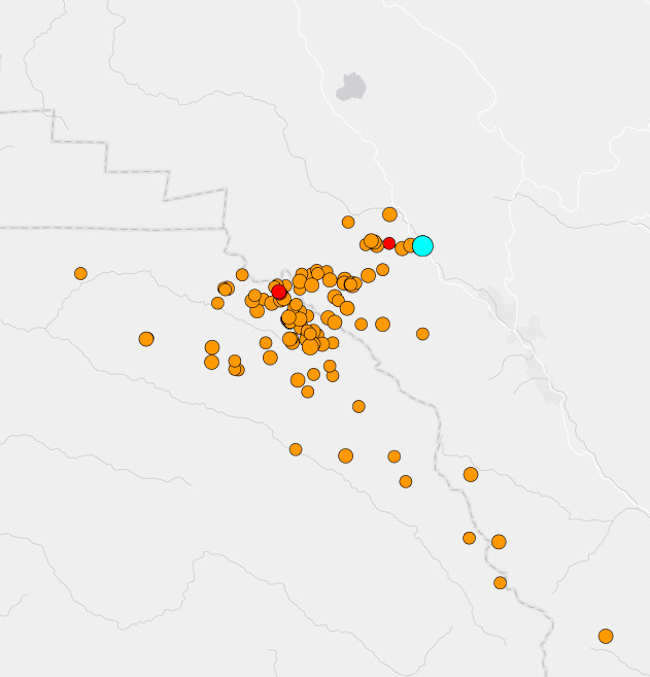
LAKE COUNTY, Calif. — A moderate earthquake that occurred on New Year’s evening shook residents across Lake County and triggered dozens of smaller quakes in the hours afterward.
The United States Geological Survey said the 4.7-magnitude quake occurred at 6:34 p.m. Wednesday.
USGS mapping showed that it occurred two and a half miles north northwest of Cobb, along Bottle Rock Road, at a depth of six tenths of a mile.
During the rest of the evening, more than 30 smaller quakes occurred within Lake County and another 50 in neighboring Sonoma County, according to USGS records.
Across Lake County, residents reported feeling the powerful main quake, which they variously described as intense and rolling, with items falling off walls and shelves, and furniture moving.
There were also those who said it was the strongest quake they’ve felt in Lake County.
Longtime Kelseyville resident Ellen Karnowski was among that latter group.
Karnowski said her daughter, who lives in the Kelseyville Riviera, felt her couch shake but the quake was even stronger in the main part of Kelseyville.
“This was the strongest we have felt since living here since 1987. Our cabinets and walls were shaking and I was about to drop and roll as we are recommended to do but was so disoriented I couldn't really move,” Karnowski said.
Over 1,500 people filed shake reports with the USGS from around Lake County and the Bay Area, and around Northern California and even Nevada.
Reports from Lake County classified the quake as “moderate,” but the strongest rating for the quake came from Sacramento, which rated the quake’s strength as “strong.”
The last major shaker to be felt around the region and beyond occurred on the morning of Dec. 5, when a 7.0-magnitude quake offshore of Humboldt County, as Lake County News has reported.
Email Elizabeth Larson at
- Details
- Written by: Elizabeth Larson
LAKE COUNTY, Calif. — Students of all ages interested in degrees, certificates or just expanding their knowledge on a subject are urged to enroll for the spring semester at Woodland Community College’s Lake County Campus.
The spring semester begins Jan. 13.
Campus Dean Kori Ebenhack said students can enroll until the first week of the term.
On Jan. 11, the campus will host its “Super Saturday” enrollment event.
From 10 a.m. to 2 p.m. that day, prospective students can visit the campus at 15880 Dam Road Extension in Clearlake and get help with the registration process.
Ebenhack said their welding program is nearly full for the spring semester.
They still have spaces in workforce programs like culinary, early childhood education and wastewater treatment, Ebenhack said.
She also noted that many transfer courses are still open as well.
To view the spring course schedule, visit https://wcc.yccd.edu/lake/, click on “Course schedule” and then click on the green button that says “Global course search via self-service.”
From there, choose Lake County as the location, “catalog listing” as the results view, Spring 2025 for the term, and Monday through Friday for days of the week before hitting the blue search button.
That will bring up the available course selections for the spring semester.
For more information, call the Lake County Campus at 707-995-7900.
Email Elizabeth Larson atThis email address is being protected from spambots. You need JavaScript enabled to view it. . Follow her on Twitter, @ERLarson, and on Bluesky, @erlarson.bsky.social. Find Lake County News on the following platforms: Facebook, @LakeCoNews; X, @LakeCoNews; Threads, @lakeconews, and on Bluesky, @lakeconews.bsky.social.
The spring semester begins Jan. 13.
Campus Dean Kori Ebenhack said students can enroll until the first week of the term.
On Jan. 11, the campus will host its “Super Saturday” enrollment event.
From 10 a.m. to 2 p.m. that day, prospective students can visit the campus at 15880 Dam Road Extension in Clearlake and get help with the registration process.
Ebenhack said their welding program is nearly full for the spring semester.
They still have spaces in workforce programs like culinary, early childhood education and wastewater treatment, Ebenhack said.
She also noted that many transfer courses are still open as well.
To view the spring course schedule, visit https://wcc.yccd.edu/lake/, click on “Course schedule” and then click on the green button that says “Global course search via self-service.”
From there, choose Lake County as the location, “catalog listing” as the results view, Spring 2025 for the term, and Monday through Friday for days of the week before hitting the blue search button.
That will bring up the available course selections for the spring semester.
For more information, call the Lake County Campus at 707-995-7900.
Email Elizabeth Larson at
- Details
- Written by: Elizabeth Larson
New laws taking effect in 2025 are intended to help fight property and retail crime by providing new tools to crack down on retail theft, smash-and-grab robberies, and more.
The new set of laws have been signed by Gov. Gavin Newsom.
“California's new laws tackle today's biggest emerging challenges head-on,” said Newsome. “Through partnership with the Legislature, we’re strengthening public safety, building more housing, and providing more resources for our communities. These practical reforms protect what matters most while creating more opportunities for all Californians.”
Cracking down on retail theft and property crime
Among the most significant changes coming in 2025 is California's landmark package to combat property and retail crime, which Newsom’s office called the most substantial legislation of its kind in modern state history.
This bipartisan set of laws, announced in August, provides robust new tools to crack down on retail theft, smash-and-grab robberies, property crime, and auto burglaries while holding criminals accountable.
Aggregation
AB 2943 by Assemblymember Rick Chavez Zbur (D-Los Angeles) allows aggregation of the value of property stolen from different victims or in different counties in order to reach the felony grand theft threshold of $950.
SB 905 by Sen. Scott Wiener (D-San Francisco) allows aggregation of the value of property stolen from vehicles over multiple acts, in order to charge a person with automotive property theft for resale.
Shoplifting and petty theft
AB 2943. Allows an officer with probable cause to arrest a person for shoplifting, even if the act did not take place in the officer’s presence.
AB 2943. Doubles permissible probation period for shoplifting and for petty theft from one year to two years. Allows defendants under 25 to be referred to rehabilitative programs.
AB 3209 by Assemblymember Marc Berman (D-Palo Alto) allows a court to issue a “retail theft restraining order” prohibiting a person convicted of organized retail theft, shoplifting, theft, vandalism, or assault of a retail employee from entering the establishment, or other locations of the same establishment, for up to two years.
Retail and cargo theft
AB 2943. Creates a new crime punishable by up to three years in jail, for possessing more than $950 of stolen goods with intent to sell, exchange, or return the goods. Facilitates prosecution by eliminating the need for DAs to prove that a defendant knew the goods were stolen.
AB 1802 by Assemblymember Reginald Byron Jones-Sawyer (D-Los Angeles) eliminates the sunset date for the crime of organized retail theft and the sunset date for the highly-successful regional property crimes task force.
AB 2943. Extends, until Jan. 1, 2031, a law that prevents suspects of organized retail theft from being released with just a signed promise to appear in court.
SB 1416 by Sen. Josh Newman (D-Grand Terrace) mandates sentencing enhancements for large-scale resale of property.
AB 1972 by Assemblymember Juan Alanis (R-Modesto) adds cargo theft to the list of property crimes that regional property crimes task forces may address.
Increased penalties for smash and grabs
SB 1242 by Sen. Dave Min (now Member-elect of the U.S. House of Representatives) mandates higher penalties for thieves who set fires to facilitate organized retail theft.
AB 1960 by Speaker Robert Rivas (D-Salinas) establishes mandatory sentencing enhancements for taking, damaging, or destroying property over $50K during the commission of a felony.
Vehicle theft and online sales
SB 905 by Sen. Scott Wiener (D-San Francisco). Removes the locked door loophole for automotive property thefts.
SB 1144 by Sen. Nancy Skinner (D-Alameda) requires online platforms to collect information about all “high-volume third-party sellers," in order to combat fencing of stolen goods.
Government response
AB 1779 by Assemblymember Jacqui Irwin (D-Thousand Oaks) permits the consolidation of theft charges and associated offenses occurring in different counties into a single criminal case.
AB 2943. Protects retailers from being cited or fined for repeatedly reporting retail theft.
Newsom’s office said these changes give law enforcement and prosecutors new tools to tackle organized theft and protect local businesses.
Now police can better stop repeat offenders, while prosecutors have more power to hold thieves accountable — especially when dealing with organized retail crime rings that operate across city and county lines.
The laws also create tougher consequences for smash-and-grab robberies that damage stores, stricter oversight of online marketplaces where stolen goods are sold, and stronger protections against car break-ins.
By closing old loopholes and maintaining successful enforcement programs, these reforms help ensure safer neighborhoods and more secure businesses.
The new set of laws have been signed by Gov. Gavin Newsom.
“California's new laws tackle today's biggest emerging challenges head-on,” said Newsome. “Through partnership with the Legislature, we’re strengthening public safety, building more housing, and providing more resources for our communities. These practical reforms protect what matters most while creating more opportunities for all Californians.”
Cracking down on retail theft and property crime
Among the most significant changes coming in 2025 is California's landmark package to combat property and retail crime, which Newsom’s office called the most substantial legislation of its kind in modern state history.
This bipartisan set of laws, announced in August, provides robust new tools to crack down on retail theft, smash-and-grab robberies, property crime, and auto burglaries while holding criminals accountable.
Aggregation
AB 2943 by Assemblymember Rick Chavez Zbur (D-Los Angeles) allows aggregation of the value of property stolen from different victims or in different counties in order to reach the felony grand theft threshold of $950.
SB 905 by Sen. Scott Wiener (D-San Francisco) allows aggregation of the value of property stolen from vehicles over multiple acts, in order to charge a person with automotive property theft for resale.
Shoplifting and petty theft
AB 2943. Allows an officer with probable cause to arrest a person for shoplifting, even if the act did not take place in the officer’s presence.
AB 2943. Doubles permissible probation period for shoplifting and for petty theft from one year to two years. Allows defendants under 25 to be referred to rehabilitative programs.
AB 3209 by Assemblymember Marc Berman (D-Palo Alto) allows a court to issue a “retail theft restraining order” prohibiting a person convicted of organized retail theft, shoplifting, theft, vandalism, or assault of a retail employee from entering the establishment, or other locations of the same establishment, for up to two years.
Retail and cargo theft
AB 2943. Creates a new crime punishable by up to three years in jail, for possessing more than $950 of stolen goods with intent to sell, exchange, or return the goods. Facilitates prosecution by eliminating the need for DAs to prove that a defendant knew the goods were stolen.
AB 1802 by Assemblymember Reginald Byron Jones-Sawyer (D-Los Angeles) eliminates the sunset date for the crime of organized retail theft and the sunset date for the highly-successful regional property crimes task force.
AB 2943. Extends, until Jan. 1, 2031, a law that prevents suspects of organized retail theft from being released with just a signed promise to appear in court.
SB 1416 by Sen. Josh Newman (D-Grand Terrace) mandates sentencing enhancements for large-scale resale of property.
AB 1972 by Assemblymember Juan Alanis (R-Modesto) adds cargo theft to the list of property crimes that regional property crimes task forces may address.
Increased penalties for smash and grabs
SB 1242 by Sen. Dave Min (now Member-elect of the U.S. House of Representatives) mandates higher penalties for thieves who set fires to facilitate organized retail theft.
AB 1960 by Speaker Robert Rivas (D-Salinas) establishes mandatory sentencing enhancements for taking, damaging, or destroying property over $50K during the commission of a felony.
Vehicle theft and online sales
SB 905 by Sen. Scott Wiener (D-San Francisco). Removes the locked door loophole for automotive property thefts.
SB 1144 by Sen. Nancy Skinner (D-Alameda) requires online platforms to collect information about all “high-volume third-party sellers," in order to combat fencing of stolen goods.
Government response
AB 1779 by Assemblymember Jacqui Irwin (D-Thousand Oaks) permits the consolidation of theft charges and associated offenses occurring in different counties into a single criminal case.
AB 2943. Protects retailers from being cited or fined for repeatedly reporting retail theft.
Newsom’s office said these changes give law enforcement and prosecutors new tools to tackle organized theft and protect local businesses.
Now police can better stop repeat offenders, while prosecutors have more power to hold thieves accountable — especially when dealing with organized retail crime rings that operate across city and county lines.
The laws also create tougher consequences for smash-and-grab robberies that damage stores, stricter oversight of online marketplaces where stolen goods are sold, and stronger protections against car break-ins.
By closing old loopholes and maintaining successful enforcement programs, these reforms help ensure safer neighborhoods and more secure businesses.
- Details
- Written by: LAKE COUNTY NEWS REPORTS
The California Racial and Identity Profiling Advisory Board this week announced the release of its annual report on police stops across California.
The report analyzes 4.7 million vehicle and pedestrian stops conducted in 2023 by 539 law enforcement agencies in California under the Racial and Identity Profiling Act, or RIPA.
Overall, the report shows disparities consistent with those observed in prior years’ data with respect to perceived race, age and disability status.
The report finds, for example, that the disparity between the proportion of stops and the proportion of residential population was greatest for individuals perceived to be Black, who were stopped 126% more frequently than expected, followed by individuals perceived to be Latino, who were stopped 44% more frequently than expected.
In addition to providing an in-depth look into policing in 2023, the report contains a wide array of best practice recommendations related to policing, with a particular focus this year on the policing of youth and its impacts.
"Like those before it, the 2025 RIPA report provides actionable information to address bias in policing. This year’s report is particularly important with its focus on young Californians. The racial disparities of policing stops, searches and use of force of youth is alarming,” said Andrea Guerrero, co-chair of the RIPA Board and Executive Director of Alliance San Diego. “Young Californians who are driving, biking, and walking and perceived to be Black or Brown are regularly stopped, asked to consent to a search, handcuffed, sat on the curb, put in a police car, and questioned for information that is recorded on a field interview card before being released. This is California’s version of stop and frisk that causes immeasurable harm to the community and erodes trust in law enforcement from a young age. In this report, the board makes a number of recommendations that we encourage policy makers, law enforcement agencies and community advocates to consider to eliminate bias in policing and enhance public safety."
“The annual collection of RIPA stop data is one part of our broader effort to increase public safety for all Californians. Through the analysis of stop data and recommendations for thoughtful reforms, we’re continuing to strengthen trust between local law enforcement and the communities they serve,” said Attorney General Rob Bonta. “This year’s report takes a close look at the policing of youth and the lasting impact interactions with police can have at a young age. I’m grateful to the RIPA Board and staff at the California Department of Justice for continuing to shine a light on disparities in police stops at every age and provide recommendations for targeted data-driven reforms.”
The information collected under RIPA includes data on peace officers’ perceptions of the demographics of stopped individuals, such as race or ethnicity, gender identity, sexual orientation, age and disability.
The board uses several well-established methodologies to analyze the data and determine whether disparities can be found across demographic groups and whether bias exists.
Some of the key findings from the Board’s report related to youth include:
• Actions taken: Overall, Native American, Black, Latino, and Multiracial individuals had more actions taken per average stop than other racial and ethnic groups. For youth ages 1-17, officers reported the highest average of actions taken during a stop for Black youth. And for those perceived to be 18-24, officers reported the highest average number of actions taken for Black and Latino youth. Youth perceived to be 12-14 were more likely to be searched, handcuffed, and detained during a stop than any other age group, while youth perceived to be 15-17 were the most likely to be ordered to exit a vehicle during a stop.
Search rates: Native American and Black individuals were searched at higher rates than those who are White, and officers were less likely to discover contraband or evidence during searches of those individuals than they were during searches of individuals perceived to be White. Officers reported the highest rates of searches in stops involving Black, Native American, Multiracial, and Latino youth across all age categories for youth ages 12–24.
Use of force: For youth ages 12–24, officers were more likely to use force in stops of youth perceived to be Black and Native American compared to other racial and ethnic groups. Black and Native American youth also had the highest rates of handcuffing and the highest rates of a firearm pointed at them during a stop. Youth with a perceived disability were more likely to be handcuffed as part of a stop than youth without a perceived disability.
Results of stop: Officers were also more likely to report no action taken for stops of individuals perceived as Native American and Black. Individuals perceived as transgender were arrested at approximately double the rate of those perceived as cisgender or gender nonconforming.
The board’s report also contains a wide array of policy recommendations related to policing, with a particular focus on the impact of police interactions with youth, civilian complaint processes, accountability, officer decertification, and training, on racial and identity profiling.
Through this data analysis and these recommendations, the board said it reaffirms its commitment to improving public safety and achieving the legal mandate to eliminate the racial and identity profiling of all Californians.
For more on RIPA, members of the public are encouraged to visit OpenJustice, a data-driven initiative that works to increase access to data and support the development of public policy.
A copy of the report is available here. More information about the Board is available here.
Learn more about the 2025 RIPA Report: On Tuesday, Jan. 21, at 11 a.m., the California Department of Justice’s Office of Community Awareness, Response, and Engagement, or CARE, will host a community briefing to discuss the RIPA Board’s report. Register for this free webinar at the link here.
The report analyzes 4.7 million vehicle and pedestrian stops conducted in 2023 by 539 law enforcement agencies in California under the Racial and Identity Profiling Act, or RIPA.
Overall, the report shows disparities consistent with those observed in prior years’ data with respect to perceived race, age and disability status.
The report finds, for example, that the disparity between the proportion of stops and the proportion of residential population was greatest for individuals perceived to be Black, who were stopped 126% more frequently than expected, followed by individuals perceived to be Latino, who were stopped 44% more frequently than expected.
In addition to providing an in-depth look into policing in 2023, the report contains a wide array of best practice recommendations related to policing, with a particular focus this year on the policing of youth and its impacts.
"Like those before it, the 2025 RIPA report provides actionable information to address bias in policing. This year’s report is particularly important with its focus on young Californians. The racial disparities of policing stops, searches and use of force of youth is alarming,” said Andrea Guerrero, co-chair of the RIPA Board and Executive Director of Alliance San Diego. “Young Californians who are driving, biking, and walking and perceived to be Black or Brown are regularly stopped, asked to consent to a search, handcuffed, sat on the curb, put in a police car, and questioned for information that is recorded on a field interview card before being released. This is California’s version of stop and frisk that causes immeasurable harm to the community and erodes trust in law enforcement from a young age. In this report, the board makes a number of recommendations that we encourage policy makers, law enforcement agencies and community advocates to consider to eliminate bias in policing and enhance public safety."
“The annual collection of RIPA stop data is one part of our broader effort to increase public safety for all Californians. Through the analysis of stop data and recommendations for thoughtful reforms, we’re continuing to strengthen trust between local law enforcement and the communities they serve,” said Attorney General Rob Bonta. “This year’s report takes a close look at the policing of youth and the lasting impact interactions with police can have at a young age. I’m grateful to the RIPA Board and staff at the California Department of Justice for continuing to shine a light on disparities in police stops at every age and provide recommendations for targeted data-driven reforms.”
The information collected under RIPA includes data on peace officers’ perceptions of the demographics of stopped individuals, such as race or ethnicity, gender identity, sexual orientation, age and disability.
The board uses several well-established methodologies to analyze the data and determine whether disparities can be found across demographic groups and whether bias exists.
Some of the key findings from the Board’s report related to youth include:
• Actions taken: Overall, Native American, Black, Latino, and Multiracial individuals had more actions taken per average stop than other racial and ethnic groups. For youth ages 1-17, officers reported the highest average of actions taken during a stop for Black youth. And for those perceived to be 18-24, officers reported the highest average number of actions taken for Black and Latino youth. Youth perceived to be 12-14 were more likely to be searched, handcuffed, and detained during a stop than any other age group, while youth perceived to be 15-17 were the most likely to be ordered to exit a vehicle during a stop.
Search rates: Native American and Black individuals were searched at higher rates than those who are White, and officers were less likely to discover contraband or evidence during searches of those individuals than they were during searches of individuals perceived to be White. Officers reported the highest rates of searches in stops involving Black, Native American, Multiracial, and Latino youth across all age categories for youth ages 12–24.
Use of force: For youth ages 12–24, officers were more likely to use force in stops of youth perceived to be Black and Native American compared to other racial and ethnic groups. Black and Native American youth also had the highest rates of handcuffing and the highest rates of a firearm pointed at them during a stop. Youth with a perceived disability were more likely to be handcuffed as part of a stop than youth without a perceived disability.
Results of stop: Officers were also more likely to report no action taken for stops of individuals perceived as Native American and Black. Individuals perceived as transgender were arrested at approximately double the rate of those perceived as cisgender or gender nonconforming.
The board’s report also contains a wide array of policy recommendations related to policing, with a particular focus on the impact of police interactions with youth, civilian complaint processes, accountability, officer decertification, and training, on racial and identity profiling.
Through this data analysis and these recommendations, the board said it reaffirms its commitment to improving public safety and achieving the legal mandate to eliminate the racial and identity profiling of all Californians.
For more on RIPA, members of the public are encouraged to visit OpenJustice, a data-driven initiative that works to increase access to data and support the development of public policy.
A copy of the report is available here. More information about the Board is available here.
Learn more about the 2025 RIPA Report: On Tuesday, Jan. 21, at 11 a.m., the California Department of Justice’s Office of Community Awareness, Response, and Engagement, or CARE, will host a community briefing to discuss the RIPA Board’s report. Register for this free webinar at the link here.
- Details
- Written by: LAKE COUNTY NEWS REPORTS




