 How to resolve AdBlock issue?
News
- Details
- Written by: Elizabeth Larson
The council will meet at 6 p.m. Thursday, Feb. 20, in the council chambers at Clearlake City Hall, 14050 Olympic Drive.
The agenda can be found here.
The meeting will be broadcast live on the city's YouTube channel or the Lake County PEGTV YouTube Channel.
Community members also can participate via Zoom. The webinar ID is 862 3977 6660, the pass code is 268411. One tap mobile is available at +16694449171,,86239776660#, or join by phone at 669-444-9171 or 253-205-0468.
At the start of the meeting the council will meet one of February’s adoptable dogs from the city shelter, host the swearing in of new and promoted police department employees, receive the Clearlake Police Department Annual Report and offer a presentation to departing Recreation and Events Coordinator II Tina Viramontes.
On the agenda is a hearing to consider a resolution of necessity to acquire a property at 12105 San Joaquin Ave. through eminent domain. The resolution also finds that the acquisition is exempt from the California Environmental Quality Act.
The property in question includes a single family home and dock on the lake. However, the report to the council on the topic explains that the city is only seeking to acquire a small portion of the property, about 790 square feet out of a total property size of 17,860 square feet. An offer for that property based on fair market value has been offered to the owner.
The acquisition is meant to support the city’s Gooseneck Landslide Emergency Repair Project because of a storm event last February that caused a landslide that threatened the integrity of Lakeshore Drive, the city reported.
“Lakeshore Drive is one of the main routes for thousands of residents, who if this area of roadway failed would have to take an approximately one-hour detour to get to their homes,” City Manager Alan Flora and City Attorney Dean Pucci explained in their report to the council.
Flora said the project’s required work included removing landslide debris, installing two soil nail walls to permanently stabilize the landslide areas, new guardrail installation on Lakeshore Drive, hydro seeding disturbed soil and restoring the areas to as close to their original condition as possible.
“A large portion of the land slide was in the City Right of Way, but it was impossible to repair only the area of the land slide in the City Right of Way and not encroach onto private property,” Flora and Pucci wrote. “If only the City Right of Way portion of the land slide was repaired, it would have failed because an area of the landslide on the Subject Property would have still been unstable. As a necessary part of the stabilization of the slope encroaching onto the Subject Property a permanent retaining structure was constructed.”
They added, “It is necessary to acquire the Subject Property so that the City may maintain this area and the permanent retaining structure to prevent further landslide events to the extent feasible.”
Also on Thursday, the council also will receive an update on the fire hazard mapping from the Office of the State Fire Marshal. Thousands of acres of property in Lake County have been added to the high fire severity zones based on this latest action.
In other business, the council will consider amending a contract with California Engineering for the Community Development Block Grant Stormwater Master Plan Project in the amount of $60,574.47.
On the meeting's consent agenda — items that are considered routine in nature and usually adopted on a single vote — are warrants; City Council minutes; minutes of the Jan. 8 Lake County Vector Control District Board meeting; and authorization of an amendment of contract with California Engineering for additional engineering support for the airport environmental impact report in the amount of $70,776.60.
Email Elizabeth Larson at
- Details
- Written by: LAKE COUNTY NEWS REPORTS
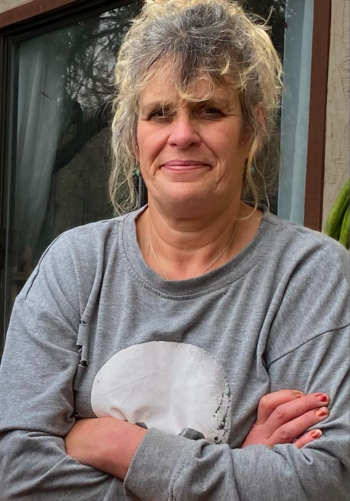
LAKE COUNTY, Calif. — The Lake County Sheriff’s Office is continuing its efforts to locate a Middletown woman who was last seen nearly a year ago.
Anne Marie Jamieson, 59 — also known as Anne Marie Mancini — was reported missing on Nov. 29, as Lake County News has reported.
The sheriff’s office said Jamieson is missing under suspicious circumstances.
Lake County Sheriff’s Office Major Crimes Unit detectives have continued to work closely with her family and are following up on any available leads.
During the course of the investigation, detectives learned Jamieson was last heard from sometime in May or June of 2024.
Authorities have added her to the state’s database of missing persons.
Jamieson’s family is offering a $1,000 reward to anyone who provides information that leads to locating her.
She is described as having blonde hair, standing 6 feet 2 inches tall, and around 200 pounds. S
Officials said she is known to specifically frequent the Middletown, Cobb and Calistoga areas.
If anyone was in contact with Jamieson during mid to late 2024 or has any information regarding Anne’s whereabouts, please contact the Lake County Sheriff’s Office Major Crimes Unit Tip Line at 707-262-4088.
- Details
- Written by: LAKE COUNTY NEWS REPORTS
Through the state’s Counter Drug Task Force operations statewide, California National Guard Task Force members have been strategically deployed statewide, including at ports of entry, to combat transnational criminal organizations and trafficking illegal narcotics like fentanyl, in support of federal, state and local law enforcement partners.
“I’m proud of the work we are doing across the state to educate Californians on the dangers of fentanyl, remove this addictive drug off our streets and provide treatment — like naloxone — to save lives,” said Gov. Gavin Newsom.
Service members helped confiscate 557 pounds and 319,732 pills of this dangerous drug in January alone, accounting for a street valuation of $3.6 million.
In addition, Cal Guard service members continue to transform drug prevention in elementary, middle, and high schools statewide through the Task Force’s Drug Demand Reduction Outreach program.
Between October and December 2024, servicemembers visited 45 high-risk schools, engaging 33,437 students. By conducting in-person outreach and understanding students’ beliefs about their own health using a Health Belief Model, Cal Guard is implementing an impactful initiative in the fight against opioid abuse.
Within the last year, Gov. Newsom announced continued augmentation in staffing and enforcement of Cal Guard’s illicit fentanyl operations.
Addressing the opioid crisis
The state has launched various initiatives in recent years to combat illicit opioids through the Governor’s Master Plan for Tackling the Fentanyl and Opioid Crisis, which provides a comprehensive framework to support overdose prevention efforts, hold the opioid pharmaceutical industry accountable, crack down on drug trafficking, and raise awareness about the dangers of opioids like fentanyl.
The Campus Opioid Act, signed by Governor Newsom in 2022, requires that every public college campus in California distribute a federally approved opioid overdose reversal medication like naloxone, and include information about opioid overdoses in their orientation process. Building on this effort, the governor last year signed AB 2429, requiring that fentanyl education be included in high school health classes starting in the 2026-27 school year.
Serving as a one-stop tool for Californians seeking resources for prevention and treatment, the website opioids.ca.gov provides information on how California is working to hold Big Pharma and drug traffickers accountable in this crisis.
The public education campaign Facts Fight Fentanyl informs Californians about the dangers of fentanyl and how to prevent overdoses and deaths. This effort will provide critical information about fentanyl and life-saving tools such as naloxone.
Latest laboratory testing from the federal Drug Enforcement Agency indicates five out of 10 pills tested in 2024 contain a potentially deadly dose of fentanyl, which is down from seven of 10 pills in 2023.
Providing lifesaving emergency treatment
Through the Naloxone Distribution Project, over-the-counter CalRx-branded naloxone is now available across the state.
The CalRx-branded over-the-counter naloxone HCL nasal spray, 4 mg, is available for free to eligible organizations through the state and for sale for $24 per twin-pack through Amneal.
Since 2018, there have been over 334,000 reversals reported from the Naloxone Distribution Project naloxone since 2018.
How we got here
In 2024, Gov. Newsom expanded the deployment of the Cal Guard’s Counterdrug Task Force by more than doubling the number of service members supporting fentanyl interdiction, and seizing other drugs, at California ports of entry to nearly 400. Fentanyl is primarily smuggled into the country by U.S. citizens through ports of entry.
Cal Guard’s coordinated drug interdiction efforts in the state are funded in part by California’s $60 million investment over four years to expand Cal Guard’s work to prevent drug trafficking by transnational criminal organizations.
This adds to the governor’s efforts to address fentanyl within California, including by cracking down on fentanyl in communities across the state, including San Francisco.
- Details
- Written by: Elizabeth Fernandez
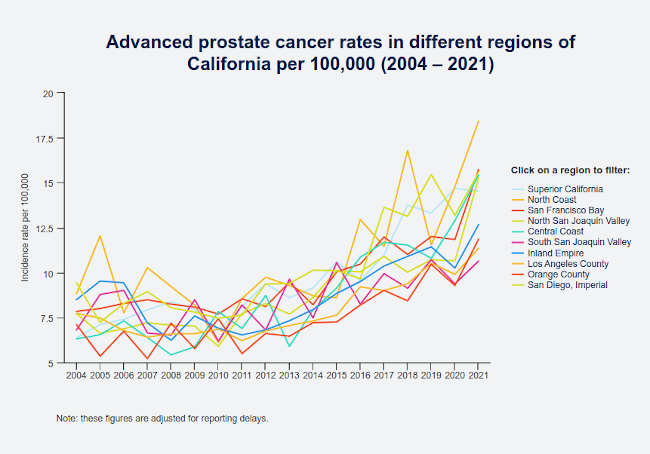
Following a change in screening guidelines, the incidence went up across the state, even more than it has nationally.
The incidence of advanced prostate cancer in California rose markedly in the decade since doctors stopped routinely screening all men for the disease, according to a new study by UC San Francisco.
After declining for many years, the death rate from the disease also plateaued in most regions across the state.
The findings reinforce the need for screening that can identify potentially fatal tumors without raising false alarms about ones that pose no threat to the patient.
The study appears Jan. 27 in JAMA Network Open.
“This overall rising trend is alarming and has occurred across age groups, regions of California, races and ethnicities,” said lead author Erin L. Van Blarigan, ScD, UCSF associate professor of Epidemiology & Biostatistics and Urology.
“Our data point to how urgent this problem is,” said Van Blarigan, who is also with the UCSF Helen Diller Family Comprehensive Cancer Center. “Figuring out the best way to screen for prostate cancer continues to be a challenge for researchers and doctors. Without screening, the number of men diagnosed with advanced prostate cancer – when treatments are less effective – increases fast.”
The challenge of screening for prostate cancer
Among men in the U.S., prostate cancer is the most common cancer and second-leading cause of cancer deaths. While some tumors are aggressive and can lead to death, the majority are low-grade and never spread.
The most frequently used screening tool is PSA testing (prostate specific antigen), which does not differentiate between aggressive or non-aggressive tumors, leading many men to be diagnosed with cancers that would not hurt them in the long run.
On the other hand, if screening isn’t done, timely diagnosis of more advanced cancers can be missed – those cancers might have been successfully treated if found early.
After years of screening all men for prostate cancer, the U.S. Preventative Services Task Force stopped recommending it in 2012. They hoped to prevent unnecessary and potentially harmful interventions, like surgery, for men whose disease was not serious.
In 2018, they began recommending that men between the ages of 55 and 69 discuss possible benefits and harms of screening with their doctors. But, as the authors note, this may not always be happening.
Prostate cancer mortality stops falling
UCSF researchers analyzed data involving nearly 388,000 men with prostate cancer in California between 2004 and 2021. Almost 28,000 (7.2%) had advanced disease, which has a five-year survival rate of just 37%. During the study timeframe, there were 58,754 deaths from prostate cancer.
Investigators looked at 10 regions spanning the state to see if rates in certain areas were increasing faster or slower.
They found that serious disease, which had been stable or dropping until 2010, grew 6.7% a year from 2011 to 2021. By contrast, national rates grew by 4.5% a year from 2011 to 2019. The lowest annual increase was in the Southern San Joaquin Valley (2.3%), the highest was in the Central Coast (9.1%).
Prostate cancer mortality dropped by 2.6% a year between 2004 and 2012; but after that, it plateaued in 7 out of 10 regions in the state. Mortality was highest in the Inland Empire followed by San Diego-Imperial and North Coast. It was lowest in the San Francisco Bay Area.
“It’s important to continue monitoring prostate cancer trends both in California and nationally as we learn more about the impact of screening guidelines on different populations,” said senior author Scarlett L. Gomez, PhD, MPH, UCSF professor in the Department of Epidemiology & Biostatistics.
Additional authors: Meg A. McKinley, MPH; Samuel L. Washington III, MD, MAS; Matthew R. Cooperberg, MD, MPH; Stacey A. Kenfield, ScD; and Iona Cheng, PhD, all with UCSF.
Funding: California Department of Public Health; Centers for Disease Control and Prevention’s National Program of Cancer Registries (1NU58DP007156); the National Cancer Institute’s Surveillance, Epidemiology and End Results Program (HHSN2612018000321, HHSN2612018000151, HHSN2612018000091).
Elizabeth Fernandez writes for the University of California at San Francisco.