How to resolve AdBlock issue?
Refresh this page
How to resolve AdBlock issue?
Refresh this page
Lake County News,California
  • Home
    • Registration Form
  • News
    • Education
    • Veterans
    • Community
      • Obituaries
      • Letters
      • Commentary
    • Police Logs
    • Business
    • Recreation
    • Health
    • Religion
    • Legals
    • Arts & Life
    • Regional
  • Calendar
  • Contact us
    • FAQs
    • Phones, E-Mail
    • Subscribe
  • Advertise Here
  • Login
How to resolve AdBlock issue?
Refresh this page

News

I’m an economist. Here’s why I’m worried the California insurance crisis could trigger broader financial instability

Details
Written by: Gary W. Yohe, Wesleyan University
Published: 23 January 2025


The devastating wildfires in Los Angeles have made one threat very clear: Climate change is undermining the insurance systems American homeowners rely on to protect themselves from catastrophes. This breakdown is starting to become painfully clear as families and communities struggle to rebuild.

But another threat remains less recognized: This collapse could pose a threat to the stability of financial markets well beyond the scope of the fires.

It’s been widely accepted for more than a decade that humanity has three choices when it comes to responding to climate risks: adapt, abate or suffer. As an expert in economics and the environment, I know that some degree of suffering is inevitable — after all, humans have already raised the average global temperature by 1.6 degrees Celsius, or 2.9 degrees Fahrenheit. That’s why it’s so important to have functioning insurance markets.

While insurance companies are often cast as villains, when the system works well, insurers play an important role in improving social welfare. When an insurer sets premiums that accurately reflect and communicate risk — what economists call “actuarially fair insurance” — that helps people share risk efficiently, leaving every individual safer and society better off.

But the scale and intensity of the Southern California fires — linked in part to climate change, including record-high global temperatures in 2023 and again in 2024 — has brought a big problem into focus: In a world impacted by increasing climate risk, traditional insurance models no longer apply.

How climate change broke insurance

Historically, the insurance system has worked by relying on experts who study records of past events to estimate how likely it is that a covered event might happen. They then use this information to determine how much to charge a given policyholder. This is called “pricing the risk.”

Many California wildfire survivors face insurance struggles, as this CBS Evening News report shows.

When Americans try to borrow money to buy a home, they expect that mortgage lenders will make them purchase and maintain a certain level of homeowners insurance coverage, even if they chose to self-insure against unlikely additional losses. But thanks to climate change, risks are increasingly difficult to measure, and costs are increasingly catastrophic. It seems clear to me that a new paradigm is needed.

California provided the beginnings of such a paradigm with its Fair Access to Insurance program, known as FAIR. When it was created in 1968, its authors expected that it would provide insurance coverage for the few owners who were unable to get normal policies because they faced special risks from exposure to unusual weather and local climates.

But the program’s coverage is capped at US$500,000 per property – well below the losses that thousands of Los Angeles residents are experiencing right now. Total losses from the wildfires’ first week alone are estimated to exceed $250 billion.

How insurance could break the economy

This state of affairs isn’t just dangerous for homeowners and communities — it could create widespread financial instability. And it’s not just me making this point. For the past several years, central bankers at home and abroad have raised similar concerns. So let’s talk about the risks of large-scale financial contagion.

Anyone who remembers the Great Recession of 2007-2009 knows that seemingly localized problems can snowball.

In that event, the value of opaque bundles of real estate derivatives collapsed from artificial and unsustainable highs, leaving millions of mortgages around the U.S. “underwater.” These properties were no longer valued above owners’ mortgage liabilities, so their best choice was simply to walk away from the obligation to make their monthly payments.

Lenders were forced to foreclose, often at an enormous loss, and the collapse of real estate markets across the U.S. created a global recession that affected financial stability around the world.

Forewarned by that experience, the U.S. Federal Reserve Board wrote in 2020 that “features of climate change can also increase financial system vulnerabilities.” The central bank noted that uncertainty and disagreement about climate risks can lead to sudden declines in asset values, leaving people and businesses vulnerable.

At that time, the Fed had a specific climate-based example of a not-implausible contagion in mind – global risks from sudden large increases in global sea level rise over something like 20 years. A collapse of the West Antarctic Ice Sheet could create such an event, and coastlines around the world would not have enough time to adapt.

In a 2020 press conference, Federal Reserve Chair Jerome Powell discusses climate change and financial stability.

The Fed now has another scenario to consider – one that’s not hypothetical.

It recently put U.S. banks through “stress tests” to gauge their vulnerability to climate risks. In these exercises, the Fed asked member banks to respond to hypothetical but not-implausible climate-based contagion scenarios that would threaten the stability of the entire system.

We will now see if the plans borne of those stress tests can work in the face of enormous wildfires burning throughout an urban area that’s also a financial, cultural and entertainment center of the world.The Conversation

Gary W. Yohe, Huffington Foundation Professor of Economics and Environmental Studies, Wesleyan University

This article is republished from The Conversation under a Creative Commons license. Read the original article.
Clearlake City Council approves new community wildfire protection plan

Details
Written by: Elizabeth Larson
Published: 22 January 2025
LAKE COUNTY, Calif. — The Clearlake City Council has joined a collaborative effort in support of a new community wildfire protection plan for the Lake County Fire Protection District.

At its meeting on Thursday, the council heard a presentation from Autumn Lancaster, the district’s fire marshal, on the new plan.

Lancaster explained that a community wildfire protection plan, or CWPP, identifies and addresses the risks of wildfire in a community.

She said the development of a CWPP can help clarify and refine priorities to protect life, property, infrastructure and valued resources. It also identifies and prioritizes fuels treatment and other projects.

“This is actually the first fire district-specific community wildfire protection plan in the county,” Lancaster said. “The county does have one, but by making it district specific we’ve been able to go into more detail about our community resources and potential projects.”

The plan’s contents include an overview of the fire district, communities at risk, fire severity maps, wildland urban interface and fire history maps, critical facilities at risk including infrastructure, and other county fire protection resources and agreements in place with them, Lancaster said.

Lancaster said the plan’s Appendix A includes fuel reduction and prevention priorities. Those include:

• A shaded fuel break in the Chapman Tract, southeast of Davis Avenue toward the Eastlake Landfill to Dam Road in Clearlake;
• A prescribed fire for the Sulphur fire area in Clearlake, including Windflower Point.
• Fuel reduction and shaded fuel break for Highway 53 in Clearlake, which is an evacuation route.
• Fuel reduction and defensible space for Clearlake Park.
• A shaded fuel break, fuel reduction or prescribed burn for Sulfur Bank/Borax Lake and surrounding areas.
• A fuel break and prescribed burn for Clearlake Highlands, between the city of Clearlake and Cache Creek Wilderness and Anderson Marsh areas to the northwest behind Highlands Village.
• A shaded fuel break, fuel reduction or prescribed burn along Point Lakeview Road for ingress/egress and maintenance.

Regarding critical infrastructure, Lancaster said the Clear Lake Environmental Research Center, or CLERC, has been administering community wildfire defense grant funds to utilize the Hogback Ridge Fuels Crew to complete vegetation abatement projects throughout the county.

The fire district assisted CLERC in assessments of Obsidian Middle School and Woodland Community College for improving defensible space up to National Fire Protection Association guidelines for reducing structural ignitions from wildland fires.

Lancaster showed before and after photos of trees and vegetation that were trimmed back and at Woodland Community College’s Lake County Campus in Clearlake.

The plan’s Appendix D includes a scope of work that makes projects more shovel-ready. Lancaster said the scopes of works are based on Lake County’s hazardous vegetation ordinance.

An example where they did such work is Panorama Drive, which is the only secondary means of access to Jago Bay that was impassible after winter storms, Lancaster said.

She said CLERC was able to use Community Wildfire Defense Grant funds to abate Panorama based on the Appendix D scope of work. She also showed the before and after photos of the road, which had vegetation cleared from its banks.

The Healthy Forest Restoration Act governs the CWPP, Lancaster said, explaining that it requires three entities to mutually agree on the contents. So far, that includes the fire district, the county of Lake and Cal Fire.

Lancaster said the district was asking the city to join in on the cooperative effort.

Mayor Russ Cremer clarified that the CWPP covers all of the Lake County Fire Protection District, not just Clearlake. Lancaster confirmed that was correct.

Vice Mayor Dirk Slooten moved to approve the CWPP, with Councilmember Tara Downey seconding.

The council voted 5-0 to give the plan final approval.

Email Elizabeth Larson at This email address is being protected from spambots. You need JavaScript enabled to view it.. Follow her on Twitter, @ERLarson, and on Bluesky, @erlarson.bsky.social. Find Lake County News on the following platforms: Facebook, @LakeCoNews; X, @LakeCoNews; Threads, @lakeconews, and on Bluesky, @lakeconews.bsky.social.

Police to enforce new ‘daylighting’ law

Details
Written by: Elizabeth Larson
Published: 22 January 2025
LAKEPORT, Calif. — The Lakeport Police Department said it is planning to focus on enforcement of a new law with an aim to make the city more safe and walkable.

California's new “daylighting law” went into effect on Jan. 1.

The law, created by Assembly Bill No. 413, is now California Vehicle Code Section 22500(n). It was approved by the governor in October 2023.

The Legislative Counsel’s Digest explained, “Existing law prohibits the stopping, standing, or parking of a vehicle in certain places and under certain conditions, including within an intersection, on a sidewalk or crosswalk, or in front of a fire station. Existing law additionally authorizes local jurisdictions to, by ordinance, restrict parking in certain areas, at certain times, and for certain reasons, and to establish metered parking.

The new bill, according to the Legislative Counsel, prohibits “the stopping, standing, or parking of a vehicle within 20 feet of the vehicle approach side of any unmarked or marked crosswalk or 15 feet of any crosswalk where a curb extension is present, as specified. The bill would, prior to January 1, 2025, authorize jurisdictions to only issue a warning for a violation, and would prohibit them from issuing a citation for a violation, unless the violation occurs in an area marked using paint or a sign.”

“This law is designed to improve pedestrian safety by ensuring drivers and pedestrians have a clearer view of vehicles and drivers have a clearer view of pedestrians, reducing accidents and near-misses,” the Lakeport Police Department reported on its Facebook page.

“LPD will focus enforcement efforts in school zones and the downtown business corridor to help protect our community’s most vulnerable pedestrians. Please do your part to stay safe and obey the law. Together, we can make our streets safer for everyone!” the agency said.

Email Elizabeth Larson at This email address is being protected from spambots. You need JavaScript enabled to view it.. Follow her on Twitter, @ERLarson, and on Bluesky, @erlarson.bsky.social. Find Lake County News on the following platforms: Facebook, @LakeCoNews; X, @LakeCoNews; Threads, @lakeconews, and on Bluesky, @lakeconews.bsky.social.

Mendocino National Forest seeks public comment on McIsaac Ranch Land Exchange Project

Details
Written by: LAKE COUNTY NEWS REPORTS
Published: 22 January 2025
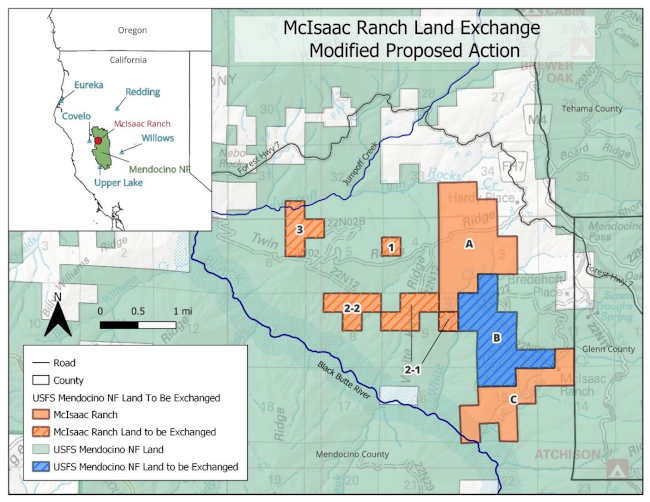
Location of McIsaac Ranch Land Exchange project showing federal land and private lands to be exchanged. Image courtesy of the Mendocino National Forest.

MENDOCINO NATIONAL FOREST, Calif. — Mendocino National Forest officials are requesting public comment on the draft environmental assessment for the proposed McIsaac Ranch Land Exchange Project.

The project area is located in eastern Mendocino County just west of Forest Highway 7 and Mendocino Pass.

Based on comments received during the scoping period, a revised proposed action was created.

Under the revised proposed action, the land that would come into federal ownership consists of four parcels with a total area of 561 acres. Three of these parcels are surrounded by federal land and one of the parcels borders private land on the northeast but borders federal land on the other sides.

The land that would be transferred into private ownership consists of a single parcel with a total area of 560 acres that borders private land on the north and south and federal land on the east and west.

The purpose of this land exchange is to consolidate federal ownership within the Mendocino National Forest’s Management Area 26 (Twin Rocks).

Consolidation of federal ownership would improve management efficiency, reduce long-term management costs and improve management of multiple wildlife, fish and recreational resources.

Forest leadership encourages all interested parties, organizations, agencies, and state, local and tribal governments to review the environmental analysis and share their thoughts or concerns regarding the revised proposed action.

Comments should be emailed to This email address is being protected from spambots. You need JavaScript enabled to view it. in one of the following formats: Microsoft Word, rich text format (rtf) or Adobe Portable Document Format (pdf). Emails should include “McIsaac Ranch Land Exchange” in the subject line.

Comments can also be mailed to Wade McMaster c/o Hilda Kwan, Mendocino National Forest, 825 N. Humboldt Ave., Willows, CA 95988.

Additional information related to this exchange, including the draft environmental analysis and resource analysis reports are available online at https://www.fs.usda.gov/project/?project=61640.

A public meeting is planned for Feb. 12. Additional details about the public meeting will be shared in the coming weeks. If you would like to participate or have questions about the project, please reach out to Hilda Kwan, Forest NEPA Planner at This email address is being protected from spambots. You need JavaScript enabled to view it. or 530-473-9160.
  1. California attorney general sues Trump Administration over birthright citizenship order
  2. Clearlake City Council approves sale of tax defaulted lots to Special Districts
  3. Clearlake Planning Commission to hold special Jan. 23 meeting
  • 472
  • 473
  • 474
  • 475
  • 476
  • 477
  • 478
  • 479
  • 480
  • 481
How to resolve AdBlock issue?
Refresh this page
