 How to resolve AdBlock issue?
News
- Details
- Written by: LAKE COUNTY NEWS REPORTS
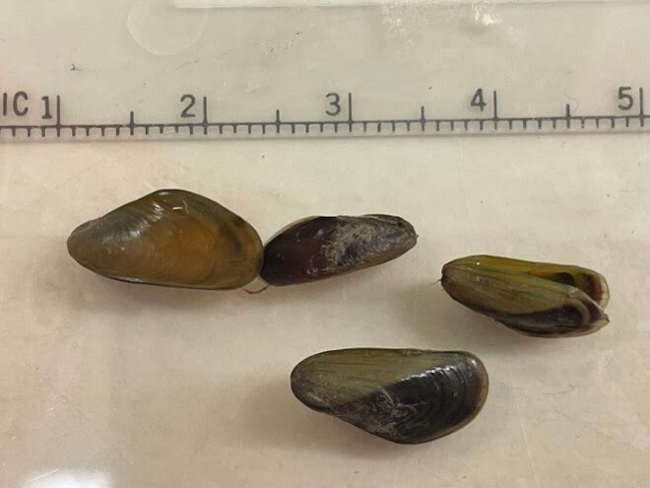
The California Fish and Game Commission has taken emergency action to protect state waters against an invasive mussel that’s been discovered in Northern California.
The actions to address the discovery of the golden mussel came at the commission’s meeting in Sacramento on Dec. 11 and 12.
To protect California against the spread of the invasive golden mussel (Limnoperna fortunei) discovered Oct. 17 at the Port of Stockton, and in the days following as far south as San Luis Reservoir’s O'Neill Forebay, the commission added the golden mussel to the list of species restricted from live importation, transportation and possession.
This discovery is North America’s first; the golden mussel is native to China and Southeast Asia and was likely transported across the ocean on large ships.
The discovery is a concern for Lake County officials.
Angela DePalma-Dow, invasive mussel coordinator for Lake County Water Resources, told Lake County News this fall that golden mussels are similar in shape and size as quagga and zebra mussels, and have potential to cause just as much damage if introduced into freshwater lakes and streams.
DePalma-Dow updated the Lake County Board of Supervisors about the discovery of the mussels in Northern California at the board’s Dec. 10 meeting.
“Golden mussels are a bigger threat to California waters than quagga and zebra mussels because they can thrive in a wider range of water quality conditions,” said Jay Rowan, chief of the California Department of Fish and Wildlife’s Fisheries Branch. “Putting golden mussels on the restricted species list is an important first step toward containment and prevention of spread of this non-native species.”
The emergency listing will reduce the potential for people to introduce the bivalves to other waters of the state, officials said.
The species poses an immediate threat to the ecological health of the Delta — into which the waters of Clear Lake flow — and all waters of the state, water conveyance systems, infrastructure and water quality.
The commission’s action makes it illegal to be in possession or transport golden mussels in California.
- Details
- Written by: LAKE COUNTY NEWS REPORTS
The average price of gasoline in the Golden State has continued to drop for a sixth straight week, according to AAA.
The average price for self-serve regular gasoline in California is $4.31, which is three cents lower than a week ago and 28 cents lower than a year ago, AAA reported.
But AAA said that trend may not stick around for long, as fuel prices are starting to rise nationally.
The average national price per gallon this week is $3.04, two cents higher than a week ago.
“Lower gas prices are great news for those planning year-end holiday travel,” said AAA Northern California spokesperson Doug Johnson. “With nearly 90 percent of travelers driving to their holiday destinations, that’s a lot of fuel — and a lot of savings.”
Here’s what the average price of self-serve regular gasoline is in each city:
San Francisco: $4.46.
Oakland: $4.30.
San Jose: $4.26.
Sacramento: $4.21.
Fresno: $4.21.
Stockton: $4.09.
AAA’s records show Lake County’s prices are falling about the middle range of prices in the state, coming in around $4.385 to $4.266 per gallon.
Meanwhile, the national average per kilowatt hour of electricity at a public EV charging station remained at 34 cents. In California, that average cost is 37 cents, AAA reported.
Drivers can find current gas and electric charging prices along their route using AAA Mobile.
- Details
- Written by: Victoria Colliver
A review of some 3,000 studies implicates these particles in a variety of serious health problems. These include male and female infertility, colon cancer and poor lung function. The particles also may contribute to chronic pulmonary inflammation, which can increase the risk of lung cancer.
“These microplastics are basically particulate matter air pollution, and we know this type of air pollution is harmful,” said Tracey J. Woodruff, PhD, MPH, a professor of obstetrics, gynecology and reproductive sciences at UCSF.
Woodruff directs the Program on Reproductive Health & the Environment (PRHE) and is the senior author of the study, which appears Dec. 18 in the journal Environmental Science & Technology.
Small particles, big problem
Microplastics are less than 5 millimeters – smaller than a grain of rice – and they are ubiquitous in the environment. Each year, companies around the world produce nearly 460 million metric tons of plastic. That is projected to reach 1.1 billion by 2050.
A major source of plastic in the air is driving. Friction wears down tires along with the road surface, sending plastic fragments into the air.
Major sources of microplastics
Plastic pellets: Pellets are used in the manufacturing of other plastic products.
Personal care products: Products often contain plastic microbeads used for abrasion.
Paint: Paints and resins use polymers that are difficult to recycle.
Synthetic textiles: Fibers from synthetic textiles can be inhaled when they become airborne.
Tires: Wear and tear from tires releases airborne particles that are inhaled.
Macroplastics: Items like plastic bags and single-use containers eventually fragment into microplastics.
Animal studies believed to apply to humans, too
The paper is the first systematic review of microplastics using gold standard methods approved by the National Academy of Sciences.
Most of the studies in the review were based on animals. But the researchers said the conclusions likely also apply to humans since they share many of the same exposures.
The study expands on a report the researchers worked on last year with the California State Policy Evidence Consortium (CalSPEC). The Consortium includes experts across the UC system and provides evidence for policymakers in the California State Legislature.
“We urge regulatory agencies and policy leaders to consider the growing evidence of health harms from microplastics, including colon and lung cancer,” said Nicholas Chartres, PhD.
Chartres, the study’s first author, led the science and policy team at PRHE and is now at the University of Sydney. “We hope state leaders will take immediate action to prevent further exposures.”
Authors: Additional authors include Sheiphali Gandhi, MD, MPH, Abena BakenRa, MPH, Courtney B. Cooper, MPH, Katherine E. Pelch, PhD, and Garret Bland, PhD.
Funding: The CalSPEC pilot was funded through the University of California Office of the President Major Projects and Initiatives Fund (UCOP proposal number 202110-121-AA) and a grant from the JPB Foundation (G-2022-3608).
- Details
- Written by: e
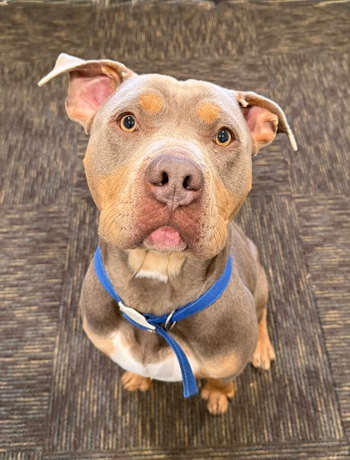
CLEARLAKE, Calif. — Clearlake Animal Control has dozens of dogs waiting for their new homes for the holidays.
The shelter has 45 adoptable dogs listed on its website.
This week’s dogs include “Marty,” a male pit bull terrier mix that is a year and nine months old, with a chocolate and copper coat.
The shelter is located at 6820 Old Highway 53. It’s open from 9 a.m. to 6 p.m. Tuesday through Saturday.
For more information, call the shelter at 707-762-6227, email
This week’s adoptable dogs are featured below.
Email Elizabeth Larson at