Obituaries preserve what families most want remembered about the people they cherish most. Across time, they also reveal the values each era chose to honor.
In a study published in the journal Proceedings of the National Academy of Sciences, we analyzed 38 million obituaries of Americans published from 1998 to 2024. We identified the values families most often highlight, and how those values shift across generations, regions and major historical events.
Specifically, working with psychologists Liane Young and Thomas Mazzuchi, we examined the language used on Legacy.com, an online platform where families often post obituaries and share memories of loved ones.
During their lifetime, most people tend to be guided by a small set of broad values like caring for others, honoring tradition, keeping loved ones safe and seeking personal growth. To understand how these values showed up in remembrance, we used text-analysis tools built on curated lists of everyday words people use when talking about those themes.
By analyzing the words that appeared again and again in memorials, we could see which values communities chose to emphasize when looking back on the lives of their loved ones, and how those patterns changed over time. Because the dataset included 38 million obituaries, the analysis ran on a supercomputer.
Across nearly 30 years of obituaries, words related to the value “tradition” appeared most often – many tributes described religious participation and enduring customs. Words related to the value “benevolence” – caring for the welfare of others – were also consistently prominent. In fact, tradition and benevolence formed the dominant value profile across the dataset: They appeared in more than 70% of the obituaries. By contrast, words related to values like “achievement” and “power” appeared far less often.
Historical events did leave a mark. After the attacks of Sept. 11, 2001, the language families used to remember loved ones shifted compared with the period just before the attacks – and those shifts persisted for at least a year. Words related to the value “security” – including terms like “surviving,” “health” and “order” – showed up less often. At the same time, families used more language related to values like “benevolence” and “tradition.” Terms like “caring,” “loyal” and “service” showed up more often. These changes were especially strong in New York, where the attacks had the most direct impact.
COVID-19, however, produced the most dramatic shifts. Beginning in March 2020, benevolence-related language – including terms like “love,” “sympathy” and “family” – declined sharply, and hasn’t been the same since. Tradition-related language – terms like “service,” “faith” and “heritage” – initially declined as well, then rose above baseline levels during later stages of the pandemic.
These changes show that collective disruptions impact the moral vocabulary families use when commemorating loved ones. They shift what it means to have lived a good life.
We also saw differences that reflect stereotypes about gender and age. Obituaries for men contained more language linked to achievement, conformity and power. Meanwhile, obituaries for women contained more language associated with benevolence and enjoying life’s pleasures.
Older adults were often remembered more for valuing tradition. Younger adults, on the other hand, were often remembered more for valuing the welfare of all people and nature, and for being motivated to think and act independently. Value patterns in men’s obituaries shifted more across the lifespan than those in women’s. In other words, the values highlighted in younger and older men’s obituaries differed more from each other, while women’s value profiles stayed relatively consistent across age.
Why it matters
The most visited parts of print newspapers and online memorial sites, obituaries offer a window into what societies value at different points in time.
This study contributes to the broader scientific understanding of legacy. People often hold strong preferences about how they want to be remembered, but far less is known about how they actually are remembered, in part because large-scale evidence about real memorials is rare. Our analysis of millions of obituaries helps fill that gap.
What’s next
Obituaries allow researchers to trace cultural values across time, geography and social groups. Future work can examine differences across race and occupation, as well as across regions. It could also look to earlier periods using historical obituary archives, such as those preserved in older newspapers and local records.
Another direction is to examine whether highlighting how often kindness shows up in obituaries could inspire people to be more caring in daily life.
Understanding what endures in memory helps clarify what people consider meaningful; those values shape how they choose to live.
The Research Brief is a short take on interesting academic work.
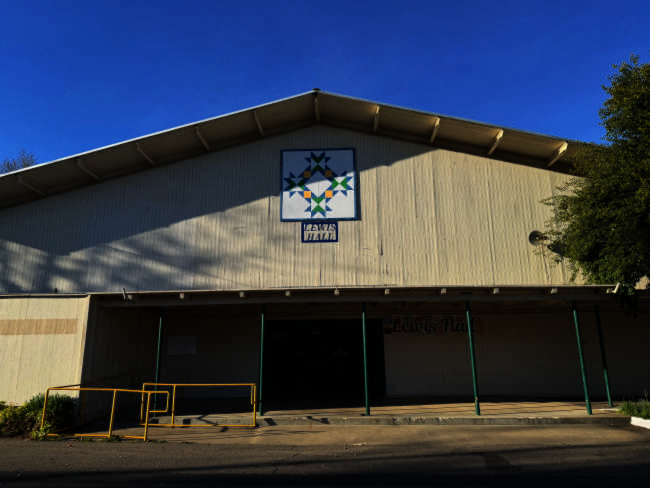
Lewis Hall at the Lake County Fairgrounds is one of the buildings expected to get upgrades with a $1 million allocation from the state. Photo by Lingzi Chen/Lake County News.
LAKEPORT, Calif. — State officials on Monday announced a $1 million investment to address long-standing facility repairs and upgrades at the Lake County Fairgrounds.
“We've secured a million dollars that will be invested with the Lake County Fair that will allow the Fair Board to be able to get to work on some critical projects,” said Sen. Mike McGuire at the Sponsor Building of the Lake County Fairgrounds.
The funding will address “deferred maintenance” built up over the decades, McGuire said, including fixing leaky roofs, renovating bathrooms and rehabilitating the commercial kitchen.
Lake County Board of Supervisors Chair Eddie Crandell and supervisors Brad Rasmussen, Jessica Pyska and Bruno Sabatier attended the announcement event, along with Lakeport City Council members Stacey Mattina and Brandon Disney.
“It's not easy, especially since the money isn't always there for deferred maintenance, and they have been tenacious,” McGuire said of the Lake County Fair Board that has been pushing for funding. “They've been laser-focused on bringing positive change to the fairgrounds, and I want to say thank you to your board for stepping up time and time again.”
McGuire later told Lake County News that the funding comes from the state general fund. The dollars will flow to the Lake County Fairgrounds, which plans to go out to bid on the projects by mid-2026, with construction expected to begin by the end of the year.
“We're super excited to be able to go out to bid and see what we can do with this money. And we're so grateful,” said Lake County Fair Board President Traci Medina, reflecting on decades of pushing for these improvements. “It’s taken us 20 years to make this kind of a dent in anything."
Fair Board member Nara Dahlbacka told Lake County News that the fairgrounds’ funding needs predate her time on the board, and she has focused on communicating those needs to local, state and federal officials.
The board has applied for grants in the past, including a resilience grant a few years ago, but was not awarded funding. “The need hasn’t decreased,” Dahlbacka said.
About a month ago, “Sen. McGuire found money in the budget,” Dahlbacka said. “It was an awesome surprise.”
“This is so exciting, and it's about damn time,” McGuire said in a brief interview after the announcement, standing in the winter’s sunny breezes against the backdrop of the fairgrounds’ open race track, where green fields stretched beneath a clear blue sky.
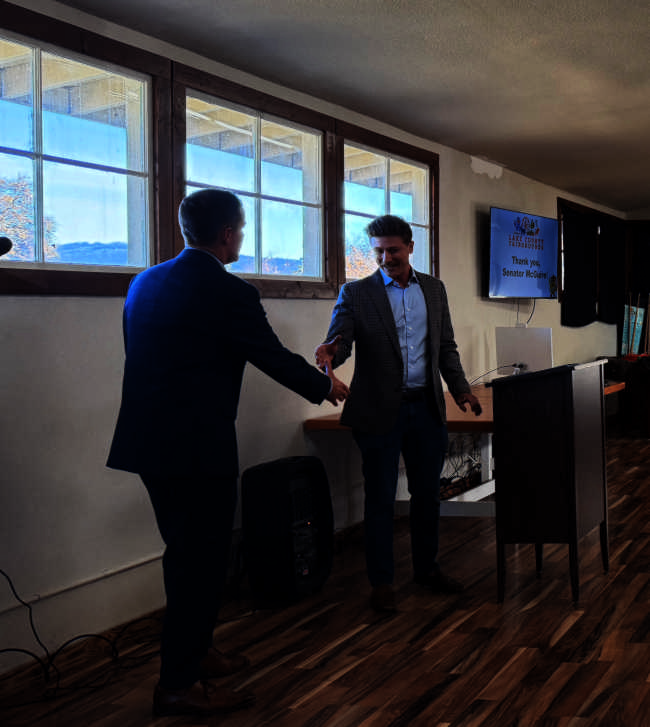
Sen. Mike McGuire, left, shakes hands with Lake County Fair Chief Executive Officer Drew Jacoby on Monday, Dec. 8, 2025, during an announcement about a $1 million allocation of funds to upgrade the Lake County Fairgrounds. Photo by Lingzi Chen/Lake County News.
Significance of $1 million for the community hub
“That money is going to go a long way,” said Lake County Fair Chief Executive Officer Drew Jacoby at the announcement event.
“And for me, it's not only about fixing the roofs — It's once that roof is fixed, all of a sudden this hall can be a warming center for the county. Once the kitchens are fixed here in Barty’s cafe, they can be a commercial kitchen,” Jacoby said.
Jacoby said food vendors have been asking monthly if there is a commercial kitchen they can use, and he hasn’t been able to say yes — until now.
He added that the state’s investment will help repair critical infrastructure, support long-term success for the facility and allow the fairgrounds to develop new projects.
“Today is about economic development,” McGuire added. “The more work that we do here at the fairgrounds, the better off.”
He also noted the role of the fairgrounds as the hub for evacuation during disasters such as wildfires.
“It just helps us to be that place that the community can come to and feel safe in the buildings,” Medina told Lake County News. “We're trying to get it back to the point where the community thinks of this as a place to have their events.”
Lake County Fair is one of the longest-running fairs in California, with the first fair held in 1880 in Lower Lake. In 1938, its governing body — the 49th District Agricultural Association, now commonly known as the Lake County Fair Board — was formed through the state Legislature.
In 1947, the board purchased the first piece of the current fairgrounds on Martin Street with $14,000 and held the first fair on the new site the following year.
Several key structures were added in the 1950s, including Lewis Hall and Barty’s Café in 1950 and the Little Theater in 1955 — all of which Sen. McGuire highlighted as priorities for upcoming repairs.
“Some of these buildings probably haven't had any major refreshments since they were built,” Medina of the Fair Board told Lake County News, referring to facilities built in the 1950s and 1960s.
“It’s very exciting,” she said, adding that it brings tears to the eyes “because it's such a blessing.”
Email staff reporter Lingzi Chen at This email address is being protected from spambots. You need JavaScript enabled to view it..
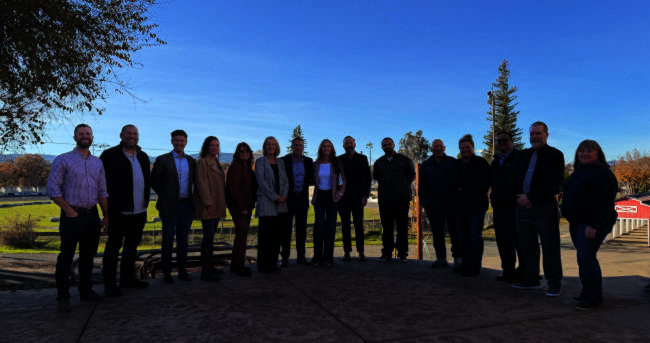
Members of the Lake County Fair Board, the Lake County Board of Supervisors, the County Administrative Office and the Lakeport City Council joined with Sen. Mike McGuire for an announcement on Monday, Dec. 8, 2025, about funds to upgrade the Lake County Fairgrounds. Photo by Lingzi Chen/Lake County News.
To speak on an agenda item, access the meeting remotely here; the meeting ID is 814 1135 4347, pass code is 847985.
To join by phone, dial 1-669-444-9171; for one tap mobile, +16694449171,,81411354347#,,,,*847985#.
Comments can be submitted by email to This email address is being protected from spambots. You need JavaScript enabled to view it.. To give the city clerk adequate time to print out comments for consideration at the meeting, please submit written comments before 4:30 p.m. on Wednesday, Dec. 10.
The commission’s main item of business is its annual election of officers for the calendar year of 2026.
The commission will next meet on Jan. 14.
Email Elizabeth Larson at This email address is being protected from spambots. You need JavaScript enabled to view it.. Follow her on Twitter, @ERLarson, and on Bluesky, @erlarson.bsky.social. Find Lake County News on the following platforms: Facebook, @LakeCoNews; X, @LakeCoNews; Threads, @lakeconews, and on Bluesky, @lakeconews.bsky.social.
LAKEPORT, Calif. — The Lakeport Economic Development Advisory Committee will hold its final meeting of the year this week.
The committee, or LEDAC, will meet from 7:30 to 9 a.m. Wednesday, Dec. 10, in the council chambers at Lakeport City Hall, 225 Park St.
The meeting also will be available via Zoom; meeting ID is 842 2886 1335, pass code is 594383 or join by phone, 1 669 900 6833.
LEDAC’s meetings are open to the public.
On the agenda are economic development updates from Ben Rickelman, Lake County deputy county administrative officer for economic development, and Nicole Flora, executive director of the Lake County Economic Development Corp. and the Lake County Chamber of Commerce.
The group also will discuss the 2025 Business Walk.
Other business will include the addition of new members in 2026. At its meeting last week, the Lakeport City Council reappointed Pam Harpster and Lissette Hayes, and made a new appointment of Victoria Pulido to two-year terms, which go into effect in January.
Three new permanent voting seats also were added by the council to LEDAC, representing the Lake County Fair, the Big Valley Band of Pomo Indians and the Scotts Valley Band of Pomo Indians.
The committee will next meet on Jan. 14.
LEDAC advocates for a strong and positive Lakeport business community and acts as a conduit between the city and the community for communicating the goals, activities and progress of Lakeport’s economic and business programs.
Members are Chair Wilda Shock, Vice Chair Laura Sammel, Secretary JoAnn Saccato, Bonnie Darling, Candy De Los Santos, Pam Harpster, Lissette Hayes, Euline Olinger, Carl Porter, Marie Schrader and Tim Stephens. City staff who are members include City Manager Kevin Ingram and Community Development Department Director Joey Hejnowicz, Associate Planner Victor Fernandez and Chief Building Officer Bethany Moss Childers.
Email Elizabeth Larson at This email address is being protected from spambots. You need JavaScript enabled to view it.. Follow her on Twitter, @ERLarson, and on Bluesky, @erlarson.bsky.social. Find Lake County News on the following platforms: Facebook, @LakeCoNews; X, @LakeCoNews; Threads, @lakeconews, and on Bluesky, @lakeconews.bsky.social.
Health insurance premiums in the U.S. significantly increased between 1999 and 2024, outpacing the rate of worker earnings by three times, according to our newly published research in the journal JAMA Network Open.
Premiums can rise if the costs of the medical services they cover increase. Using consumer price indices for the main components of medical care – such as services provided in clinics and hospitals as well as administrative expenses – based on federal data and data from the Kaiser Family Foundation, we found that the cost of hospital services increased the most, while the cost of physician services and prescription drugs rose more slowly.
Some of the premium increases can be attributed to an increase in hospital outpatient visits and coverage of GLP-1 drugs. But research, including our own, suggests that premiums have rapidly escalated mostly because health system consolidation – when hospitals and other health care entities merge – has led hospitals to raise prices well above their costs.
One study found that for nonprofit health systems, the greatest pay increases between 2012 and 2019 went to hospital CEOs who grew the profits and size of their organizations the most. However, the financial reward of delivering above-average quality of care declined. Increased charity care – free or discounted health services nonprofit hospitals must provide some of their patients who cannot afford medical care – was not significantly tied to CEO compensation.
Board members set performance criteria that determine the base salary and bonus payments for CEOs. Over half of board members at top U.S. hospitals have professional backgrounds in finance or business. As a result, researchers and advocates have raised concerns that financial success is the dominant priority at these institutions.
One way to help ensure that nonprofit hospitals make the health of their local communities a top priority is to require their boards to disclose their executive compensation guidelines for salary and bonuses, similar to the information that for-profit health care companies disclose to their stockholders. The general public could pressure companies to put greater weight on affordability and quality of care when setting performance targets for nonprofit hospital executives.
Some economists suggest that hospital prices be regulated. This approach involves capping prices for health care services at the most expensive hospitals and restricting price growth for all hospitals. Regulators would also focus on flexible but service-specific oversight to quickly respond to unintended market disruptions.
What employers can do
Costs for health insurance coverage provided by employers are expected to surge by 9.5% in 2026.
Employers, who bear the bulk of premium increases when purchasing insurance for their workers, could include more price sensitivity when designing benefits for their employees to help keep insurance affordable for workers.
One study found that a health insurance plan that introduced three copayment levels corresponding to three hospital tiers of low, medium and high prices achieved savings of 8% per hospital stay after three years, with no evidence of a reduction in quality.
Roughly one-third of large employers are offering nontraditional health plans in 2026. For example, a variable copay plan has no or low deductibles and sets higher copayments for services at providers charging higher fees.
Restraining price growth among nonprofit hospitals would introduce greater price competition to the health care market, likely forcing for-profit providers to lower their prices as well.
LAKE COUNTY, Calif — As two major departments grapple with budget shortfalls and reimbursement delays, the Board of Supervisors on Tuesday will revisit the Community Development Department’s $390,000 loan repayment plan, review Behavioral Health’s “fiscal recovery plan,” and consider expanding staff authority over bidding exemptions in the county’s purchasing ordinance.
The board will meet beginning at 9 a.m. Tuesday, Dec. 9, in the board chambers on the first floor of the Lake County Courthouse, 255 N. Forbes St., Lakeport.
The meeting ID is 865 3354 4962, pass code 726865. The meeting also can be accessed via one tap mobile at +16694449171,,86533544962#,,,,*726865#. The meeting can also be accessed via phone at 669 900 6833.
Returning to the board is a discussion on the Community Development Department, or CDD’s budget deficit and plan to repay a $390,000 county loan approved in November, along with the financial oversight measures imposed on the department.
This appears to be an untimed item.
On Nov. 18 — less than two months after the board adopted a “balanced” final budget for the new fiscal year — the CDD reported a budget deficit in its Building Division and requested a $390,000 loan from the county to pay employee salaries for the next three months.
Supervisors approved the loan, although they said they did not believe the department would be able to repay it by the end of the fiscal year as promised.
According to figures presented in the November meeting, the division had generated $571,565 in permitting revenue — 65% of its projected year-to-date revenue — leaving it short of covering $658,425 in expenses, most of which are salaries.
“Although the original 2025–26 budget projected moderate increases, the division has generated only 28% of expected revenue to date,” staff wrote for Tuesday’s meeting — a percentage that appears inconsistent with the November figures and is unclearly worded in the memo.
The memo called the decline “particularly impactful,” noting that staffing accounts for 64% of the division’s budget, “greatly limiting the division’s ability to reduce expenditure without affecting service delivery.”
In June, the board approved more than $5 million in raises for nine county employee groups.
The department is currently implementing a spending and hiring freeze. Proposed oversight measures require all of its purchasing documents to be routed through the County Administrative Office for review and approval, according to the memo.
At 10:30 a.m., the board will consider an update on Behavioral Health Services’ “fiscal recovery plan” that the department has implemented over the past months on managing expenses.
The staff memo said that the department has taken steps to stabilize its finances following the “cash flow challenges” created by delayed state reimbursements and front-loaded cost structure of the Medi-Cal intergovernmental transfer process.
On Jun. 17, the board approved authorizing a $2 million loan to Behavioral Health requiring repayment within 90 days — a deadline the department ultimately missed. On Sep. 16, the board approved a 180-day extension for their repayment.
At 11:35 a.m., the board will hold a public hearing on the County Administrative Officer’s request to amend the county’s “purchasing ordinance” which governs bidding and purchasing process for public projects.
Key changes proposed include allowing staff to approve bidding exemptions for contracts up to $100,000 and removing the Board of Supervisors from decisions to exempt projects from competitive bidding when it is deemed not in the public interest.
The staff memo said these changes will improve “efficiency and clarify purchasing for further transparency.”
At 1:30 p.m., the board will hear an appeal challenging the Planning Commission’s May approval of a major use permit for a commercial cannabis cultivation project at 10535 High Valley Road.
The appellant raised concerns specific to legal violations, procedural eros and public safety concerts, according to the staff memo.
Staff determined that they did not identify inconsistencies between the project and the county code and recommended the board to deny the appeal and uphold the Planning Commission's decision.
In untimed items, the board will consider executing program funding for the Behavioral Health Continuum Infrastructure Program Round 1 grant, which includes a county match of $1,212,019.80 in Opioid Settlement Funds.
The grant will fund predevelopment and startup of the Lake Behavioral Health Center, including a Mental Health Rehabilitation Center and an outpatient behavioral health and substance use clinic.
The board will also consider authorizing Behavioral Health Director Elise Jones to serve as the county’s legal authorized representative and signer for the program.
In the untimed item, the board will also consider increasing the approved purchase amount for 11 generators for Special Districts, after grant-related delays caused costs to rise from $560,000 to $625,000.
The project is funded through a federal hazard mitigation grant program award covering 75% of costs, with a 25% local match.
The full agenda follows
CONSENT AGENDA
5.1, Approve travel exceeding 1,500 miles to Washington DC and associated costs for Katherine VanDerWall to attend the California Agricultural Commissioner and Sealers Association’s DC Delegation Trip from March 23–27, 2026, in an amount not to exceed $5,300.
5.2, Approve Amendment No.1 to the Agreement Between the County of Lake and Kno’Qoti Native Wellness, Inc. for Fiscal Years 2025-2030, authorizing a one-time advance payment of up to $65,000 for the purchase of an approved program vehicle, and authorize the Board Chair to sign.
5.3, Approve the First Amendment to the Memorandum of Understanding Between the Lake County Department of Social Services and Lake County Behavioral Health Services for the shared provision of Lanterman-Petris-Short (LPS) Conservatorship Services.
5.4, Approve Board of Supervisors meeting minutes June 24, 2025, June 25, 2025, October 28, 2025, November 4, 2025, and November 18, 2025.
5.5, (Second reading) Adopt ordinance amending Chapter 21, Articles 11 and 12 of the Lake County Zoning Code to implement General Plan Sixth Cycle Housing Element Policy HE-58 pertaining to affordable housing.
5.6, Approve request to close the Community Development Department to the public on Thursday, December 18, 2025, from 12 p.m. to 5 p.m. for all-staff training.
5.7, Adopt resolution approving County of Lake Health Services to apply for funding in the amount of $465,591 through the California Department of Public Health for fiscal years 2025–2026 and authorize the director of Health Services to sign said application.
5.8, Adopt resolution amending Resolution 2025-119 establishing position allocations for FY 2025-2026 to conform to the adopted budget and approve a salary grade adjustment based on inappropriate relationship between supervisory and classification level staff.
5.9, Approve a multi-year agreement with Peterson Tractor Company for the servicing and repairs of County-owned heavy equipment at the Eastlake Landfill for an annual amount not to exceed $300,000, and authorize the Chair to sign.
5.10, Approve award of bid for Kelseyville Sidewalks Project, Bid No. 251335, Federal Aid Project No. HIPL-5914(133), with Zara Construction Inc., of Sacramento, CA, in the amount of $757,163.00.
5.11, (a) Adopt “Resolution Accepting Official Canvass of the Statewide Special Election held on November 4, 2025”; and (b) Accept the certification of the official canvass results prepared by the Registrar of Voters.
5.12, Accept the Easement Modification Agreement for the overhead utilities from the Pacific Gas and Electric Company and authorize the Clerk of the Board to record a certificate of acceptance.
5.13, Approve request to close the Lake County Special District Department on December 19, 2025, for an all-staff training.
5.14, (Sitting as the Lake County Watershed Protection District Board of Directors) Adopt resolution approving the acceptance of general fund grants for the evaluation of aquifer conditions in Scotts Valley.
5.15, (Sitting as the Lake County Watershed Protection District Board of Directors) Adopt resolutions approving the acceptance of general fund grant funds for: Lake County Storm Water Infrastructure and Program Improvement Project; Clear Lake Harmful Algal Bloom Monitoring, Prediction, and Control System; Clear Lake Management Plan Development; Limnological Sampling of Clear Lake; Enhancing Implementation of a Natural Shoreline Stewards Program; and Dredging Boating Ways and Stream Mouths of Clear Lake.
5.16, (Sitting as the Lake County Watershed Protection District Board of Directors) Adopt resolution approving the acceptance of general fund grant funds for improving restoration efforts at Clear Lake with in-lake management of phosphorus.
TIMED ITEMS
6.1, 9:02 a.m.: Public input.
6.2, 9:03 a.m.: Pet of the week.
6.3, 9:04 a.m.: New and noteworthy at the library.
6.4, 9:06 a.m.: Consideration of presentation of the 2024 Crop and Livestock Report.
6.5, 9:15 a.m.: Public hearing—Consideration of an ordinance amending Section 56.3 of Chapter 14 (Personnel) of the Lake County Code to establish a County Counsel Attorneys Unit and add attorney positions to the District Attorney Unit to reflect changes in membership.
6.6, 9:45 a.m.: (Second reading) Consideration of ordinance amending Article VI of Chapter 18 of the Lake County Code to include enforcement measures and associated due process requirements for cannabis cultivation-related taxes.
6.7, 10:30 a.m.: Consideration of Lake County Behavioral Health Services Fiscal Recovery Plan: status update and board endorsement of ongoing implementation.
6.8, 11:30 a.m.: Public hearing—Consideration of a resolution amending the Master Fee Schedule for departmental services rendered by the County.
6.9, 11:35 a.m.: Public hearing—Consideration of an ordinance amending the Purchasing Ordinance: Article X of Chapter Two of the Lake County Code to clarify powers and duties, additional exemptions from competitive bidding, and include increased purchasing limits for public projects.
6.10, 1:30 p.m.: Public hearing—(Continued from October 21, 2025) Consideration of Appeal (PL-25-198) of Planning Commission’s approval of Major Use Permit (PL-25-68) for (UP 23-09), Poverty Flats Ranch / Kurt and Robert Barthel; location: 10535 High Valley Road, Clearlake Oaks (APN: 006-004-22); Appellant: Maria Kann and Associates.
NON-TIMED ITEMS
7.1, Supervisors’ weekly calendar, travel and reports.
7.2, Consideration of three-year repayment plan for agencies impacted by tax-defaulted land sales.
7.3, Consideration to adopt resolution authorizing execution of program funding agreement and participation in the Behavioral Health Continuum Infrastructure Program (BHCIP) Round 1—Launch Ready Program.
7.4, Consideration of the following advisory board appointment: Maternal, Child, Adolescent Health Board.
7.5, Consideration of Community Development Department repayment plan and proposed oversight strategies.
7.6, Consideration of direction to staff on the water connection standby status.
7.7, Consideration of (a) authorization for Special Districts Administrator/Assistant Purchasing Agent to issue a purchase order not to exceed $625,000 to Energy Systems (Generac Industrial Power) and (b) Special Districts staff effectively applied federal procurement standards for the purchase of 11 standalone appropriately sized generators ranging from 30Kw to 150Kw capacity.
7.8, Consideration of resolution authorizing the Chair of the Board to approve and direct the Tax Collector to sell, at public auction via internet, tax-defaulted property which is subject to the power to sell in accordance with Chapter 7 of Part 6 of Division 1 of the California Revenue and Taxation Code and approving sales below minimum price in specified cases.
CLOSED SESSION
8.1, Public employee discipline/dismissal/release.
8.2, Conference with legal counsel: significant exposure to litigation pursuant to Gov. Code section 54956.9(d)(2), (e)(1)—one potential case.
8.3, Sitting as Lake County Air Quality Management District Board of Directors: Conference with legal counsel: decision whether to initiate litigation pursuant to Gov. Code Sec. 54956.9(d)(4)—one potential case.
8.4, Conference with legal counsel: decision whether to initiate litigation pursuant to Gov. Code Sec. 54956.9(d)(4)—one potential case.
Email staff reporter Lingzi Chen at This email address is being protected from spambots. You need JavaScript enabled to view it..
LAKE COUNTY, Calif. — The Federal Energy Regulatory Commission has extended the public comment period on Pacific Gas and Electric’s plan to surrender the license for the Potter Valley hydroelectric project.
The commission, or FERC, will now accept public comment through 2 p.m. Friday, Dec. 19.
Originally, the deadline had been set for Dec. 1.
The Potter Valley Project, which PG&E has owned since 1930, consists of the Scott Dam and the Cape Horn Dam, both of which are located on the upper main stem of the Eel River, as well as the Potter Valley powerhouse, the 80,000-acre-foot Lake Pillsbury in Lake County, the Van Arsdale Reservoir, a fish passage structure and salmon and steelhead counting station at the Cape Horn Dam, and and 5,600 acres of land.
If PG&E is successful in its efforts, both the Cape Horn and Scott dams would be removed. In the case of the Scott dam, it would spell an end to Lake Pillsbury, the reservoir created by the dam.
Opponents of the plan, including the county of Lake and the Lake Pillsbury Alliance, said they have been largely kept out of the discussion process since it started several years ago.
They also have argued that the loss of the reservoir would impact the environment, the economy, the county’s property tax revenue as well as firefighting efforts in the region as Lake Pillsbury has been used extensively as a water source for major fire incidents, including the 2020 August Complex.
To submit a comment, go to FERC Online, fill out the form, draft comments in a separate file and copy and paste them into the boxes on the web form. The docket number for the proceeding is P-77-332.
For those opposing the surrender plan, the Lake Pillsbury Alliance has detailed information on how to submit public comments with sample documents that can be found here.
Email Elizabeth Larson at This email address is being protected from spambots. You need JavaScript enabled to view it.. Follow her on Twitter, @ERLarson, and on Bluesky, @erlarson.bsky.social. Find Lake County News on the following platforms: Facebook, @LakeCoNews; X, @LakeCoNews; Threads, @lakeconews, and on Bluesky, @lakeconews.bsky.social.

 How to resolve AdBlock issue?