 How to resolve AdBlock issue?
News
- Details
- Written by: Elizabeth Larson
Cal Fire said the fire remained at 417 acres by Sunday night, with containment up to 43%.
The fire began on Friday morning in the area of Highway 20 and Glenhaven Drive near Clearlake Oaks.
Cal Fire said ongoing damage assessment has revealed two residential structures have been destroyed and one additional single-family residence was damaged.
Assigned resources include 285 personnel, 24 engines, nine water tenders, two dozers and 10 hand crews, Cal Fire reported.
All evacuation orders have been downgraded at this point. Evacuation warnings remain in place for the following zones: GLE-E072, GLE-E094-A, GLE-E094-B, CLO-E073, CLO-E082, CLO-E098, CLO-E099, CLO-E102 and CLO-E106.
Information on evacuation zones can be found here.
Email Elizabeth Larson at
- Details
- Written by: Elizabeth Larson
The board will meet beginning at 9 a.m. Tuesday, Oct. 8, in the board chambers on the first floor of the Lake County Courthouse, 255 N. Forbes St., Lakeport.
The meeting can be watched live on Channel 8, online at https://countyoflake.legistar.com/Calendar.aspx and on the county’s Facebook page. Accompanying board documents, the agenda and archived board meeting videos also are available at that link.
To participate in real-time, join the Zoom meeting by clicking this link.
The meeting ID is 865 3354 4962, pass code 726865. The meeting also can be accessed via one tap mobile at +16694449171,,86533544962#,,,,*726865#. The meeting can also be accessed via phone at 669 900 6833.
In an untimed item, the board will consider a presentation from the Treasurer-Tax Collector’s Office regarding a preliminary proposal for a tax defaulted sale.
Treasurer-Tax Collector Patrick Sullivan said the list consists of 3,323 parcels. “Should your Board approve this preliminary proposal, the Treasurer-Tax Collector’s office will continue preparation of this sale and return with a resolution to finalize the offering,” Sullivan wrote.
In another untimed item, the board will consider responses to the 2023-24 Lake County Grand Jury report.
Also on Tuesday, the board will present several proclamations, including to honor Indigenous Peoples' Day, Code Enforcement Appreciation Week, Ageism Awareness Day, Head Start Awareness Month and Domestic Violence Awareness Month.
The full agenda follows.
CONSENT AGENDA
5.1: Adopt proclamation declaring the second Monday in October as Indigenous Peoples' Day in Lake County.
5.2: Adopt proclamation designating the month of October 2024 as Head Start Awareness Month in Lake County.
5.3: Adopt proclamation designating October 9, 2024, as Ageism Awareness Day in Lake County.
5.4: Adopt proclamation designating the month of October 2024 as Domestic Violence Awareness Month in Lake County.
5.5: Adopt proclamation designating the week of Oct. 6 to 12, 2024, as Code Enforcement Officer Appreciation Week in Lake County.
5.6: Adopt resolution approving Agreement No. 24-0132-016-SF with the State of California Department of Food and Agriculture for insect trapping for FY 2024-25 for $36,547.
5.7: Approve long-distance travel for Health Services Emergency Preparedness Coordinator Dean Eichelmann to attend the National Healthcare Coalition Preparedness Conference in Orlando, Florida, from Dec. 9 to 13, 2024.
5.8: Approve long-distance travel for Deputy Public Health Director Kim Tangermann to perform an on-site final inspection of the Public Health Mobile Medical Unit in Wakarusa, Indiana, from October 14-16, 2024.
5.9: Approve long-distance travel for Chief Probation Officer Wendy Mondfrans to attend the Office of Juvenile Justice and Delinquency Prevention Conference in Washington, D.C., in November 2024.
5.10: Approve Amendment One to the agreement with GSM Landscape Architects Inc. for professional design services for the Hammond Park Improvements Project, an increase of $35,641 and a revised total amount not to exceed $210,341, and authorize the chair to sign the agreement.
5.11: Approve the plans and specifications for the Hill Road Correctional Facility Perimeter Fencing Project, and authorize the public services director to advertise for bids.
TIMED ITEMS
6.2, 9:03 a.m.: Pet of the Week.
6.3, 9:04 a.m.: New and noteworthy at the library.
6.4, 9:05 a.m.: Presentation of proclamation declaring the second Monday in October as Indigenous Peoples' Day in Lake County.
6.5, 9:06 a.m.: Presentation of proclamation designating the week of Oct. 6 to 12, 2024, as Code Enforcement Appreciation Week in Lake County.
6.6, 9:07 a.m.: Presentation of proclamation designating Oct. 9, 2024, as Ageism Awareness Day in Lake County.
6.7, 9:08 a.m.: Presentation of proclamation designating the month of October 2024 as Head Start Awareness Month in Lake County.
6.8, 9:09 a.m.: Presentation of proclamation designating the month of October 2024 as Domestic Violence Awareness Month in Lake County.
6.9, 9:30 a.m.: Public hearing, discussion and consideration of the community and economic development allocations of the California Community Development Block Program.
6.10, 10:15 a.m.: Public hearing, receive public comments regarding the application to the U.S. Department of Housing and Urban Development FY24 Pathways to Removing Obstacles to Housing (PRO Housing) Grant.
6.11, 1 p.m.: Consideration of proposed findings of fact and decision in the appeal of Michael Wegner (AB 23-04).
6.12, 1:05 p.m.: Consideration of proposed findings of fact and decision in the appeal of Roberto Estrada (AB 23-02).
6.13, 1:10 p.m. – Consideration of proposed findings of fact and decision in the appeals of Legendary Farms LLC, United Investment Ventures LLC, Melissa Smith, and Justin Smith.
UNTIMED ITEMS
7.2: Consideration of response to the 2023-24 Lake County Civil Grand Jury Final Report.
7.3: Consideration of agreement between county of Lake and Hilltop Recovery Services for ASAM Levels 1.0, 2.1, 3.2, and 3.5 services in the amount of $697,500 for FY 2024-25.
7.4: Consideration of appointments to various Local Area Plan Advisory Committees, or LAPACs.
7.5: Appoint Plans Examiner II Jack Smalley to serve as interim chief building official at Advance Step 2, effective Oct. 11, 2024.
7.6: Consideration of patch payment on a public guardian conservatee “BB” from general funds in an amount not to exceed $30,000 at $5,000 per month.
7.7: Consideration of proposed Chapter 7 tax-defaulted land sale.
CLOSED SESSION
8.1, 11 a.m.: Public employee evaluation: Public Health director.
8.2, 2 p.m.: Public employee evaluation: Public Health officer.
Email Elizabeth Larson at
- Details
- Written by: LAKE COUNTY NEWS REPORTS
At 4 p.m. Thursday, FAYCCD and its supporters will meet in the Yuba College cafeteria (Building 300) before attending the board of trustees meeting at 5 p.m. in the 300 Building Conference Room.
“After nearly three years of negotiations and wasteful litigation by the District, FAYCCD members demand a new contract that addresses key issues such as seniority rights and a salary enhancement during this time of historic inflation,” the union said in its announcement about the event.
FAYCCD faculty are reported to be among the lowest-paid community college educators in the state, while their healthcare costs have nearly doubled in just the last few years.
“FAYCCD faculty class sizes have increased in the name of ‘efficiency.’ All the while, the district has wasted an egregious amount of money on failed litigation to strip FAYCCD faculty of long-held rights and delay contract negotiations,” the union said.
The union said the faculty are united in their call for a contract that recognizes their invaluable contributions to student success and the overall quality of education in the district.
“Our educators deserve to be treated with respect and fairness. We’ve given our time, energy, and dedication to our students, and it’s time for the district to prioritize its faculty,” said Dr. Travis Smith, president of FAYCCD. “We’re fighting for a contract that reflects our commitment to high-quality education, equity, and the well-being of our faculty.”
The protest is open to the public, and FAYCCD encourages students, community members and allies to join in solidarity.
“We are not only fighting for ourselves, but for the students and the future of high-quality education in this district,” said Professor Kevin Ferns, FAYCCD lead negotiator.
- Details
- Written by: LINGZI CHEN

KELSEYVILLE, Calif. — For three decades, the last weekend of September has been a time of celebration for Kelseyville's farming industry, in particular, its famed pears.
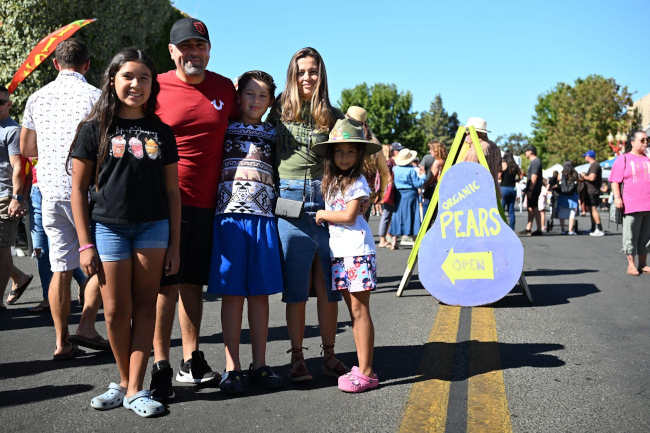
On Saturday, Sept. 28, downtown Kelseyville buzzed with excitement as over 180 vendors came together with tens of thousands of residents and visitors to celebrate the 30th anniversary of the Kelseyville Pear Festival.
Food purveyors, local farmers, artists and community organizations filled up sides of the Main Street, with live band music blasting through the day.
Since its launch in 1993, the Kelseyville Pear Festival has grown into a cherished annual tradition for local residents and incoming tourists. It has endured through wildfires and economic challenges, with just one brief pause in 2020 due to the COVID pandemic.
Tracing back to its first launch in 1993, “We were not just celebrating the pear; we were celebrating our agricultural history of this big valley. It’s also about the Kelseyville community pride,” said Marilyn Holdenried, who chaired the pear festival for 23 years until 2015 when she retired.
“I always had a big white tent. We rented it and covered that whole parking lot, but it got too expensive to rent,” Holdenried said, recalling the old days holding the festival outside the Westamerica Bank. Now, she was delighted to see these bright colored umbrellas: “I think it’s charming and colorful.”
‘Small towns, big families’
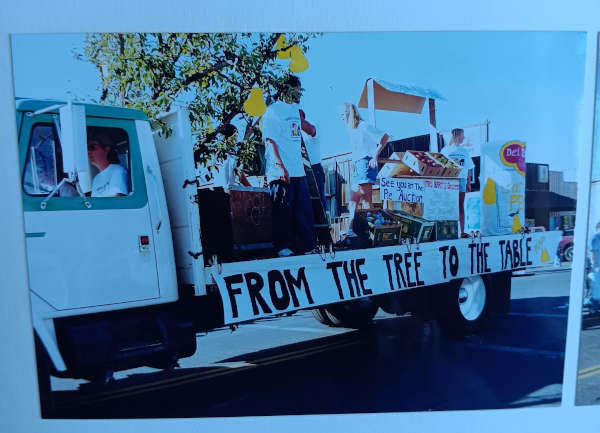
“Probably my favorite part of the festival is still the parade,” Holdenried said of the event’s unique showcase of the pride in community and agriculture during a phone call with Lake County News.
“The children, the adults, the floats, the carts, the tractors …” Holdenried said in a delighted tone. “I probably love the children the most.”
But she couldn’t leave out her other favorite.
“I love the tractors being a farmer’s wife,” she said, laughing. “I always felt like those tractors belonged in the parade, and now especially with the women drivers, it’s just so fun.”
This year Toni and Phil Scully of Scully Packing Co., Lake County’s only remaining pear packing company, sat on an antique tractor in the parade as the appointed grand marshals for the first time.
They moved their young family to Lake County in 1974 and started the company 10 years after that.
Now, Scully Packing ships 40% of California’s Bartlett pears going into the fresh market, according to Toni Scully.
This year’s festival also was 7-year-old Adrian Rojas’ first time taking part in the parade together with his siblings Mila and Mira.
Their grandmother, Julie Tibbetts, a former Kelseyville resident, has been coming to the pear festival every year since 2004, even after she moved to Sonoma County in 2011, except for last year when the family had a death.
This year, Tibbetts was joined with her two daughters, a son-in-law and three grandchildren. For the day, they watched the parade and shopped with the local merchants.
“And now we’re gonna listen to some of the local talents that we’ve been hearing for years since they were kids,” Tibbetts said, sitting with the family under a big red umbrella at the Westamerica Bank parking lot.
What she loved the most about the festival is “the small town community,” Tibbetts said with a smile.
Alvaro Gonzalez with his family of five came out from their home on Second Street to join the festive crowd as early as 8:30 a.m.
They had breakfast at the fire department. “We do that every year,” Gonzalez said of the family tradition.
It’s hard for Gonzalez to pick a favorite part of the event: The kids were in the parade. The church sold really good tamales and the Lions club oysters and beer. “It’s really nice for the community.”
As the interview went on, Gonzalez was constantly stopped by longtime friends who went to Kelseyville High School with him decades back, all with their own families. “Small towns, big families!” they shouted and laughed.
Eat up the pies
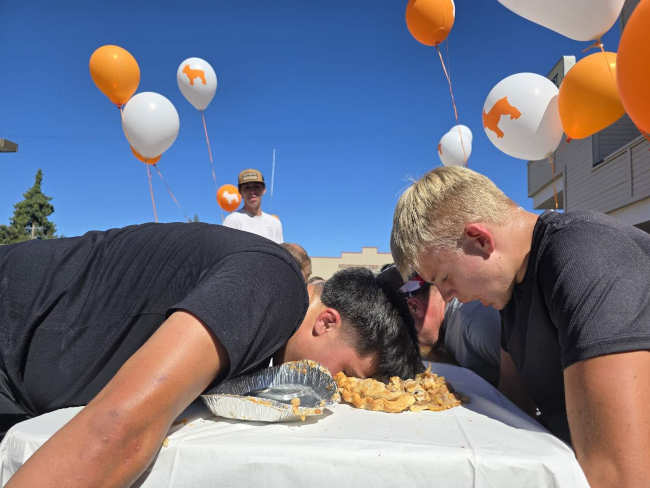
At noon, the pear pie eating competition kicked off under the hottest sunlight of the day. Twelve contestants, each representing a nonprofit, were getting ready to compete for the shortest time to eat up a freshly-made pear pie.
Organizer Trista Fossa, a Realtor with NextHome who’s also substitute teaching at Kelseyville High, said she would donate $250 to the winning nonprofit.
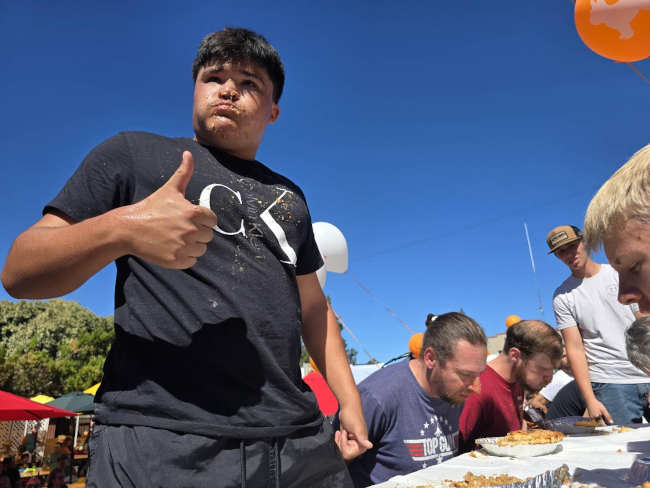
After intense wrestling with the pies, Elijah Watkins of Kelseyville High School won the crown and the donation for his school’s Boosters Club.
Watkins’ strategy to win involved starving.
“I didn’t eat last night,” he disclosed to another contestant before the race started. And he flexed his biceps to the audience to show his strength and determination while his varsity football teammates cheered by the huge trailer donated by Lauenroth Trucking that served as a stage for the competition.
Use of hands was prohibited by the rules, so Watkins immediately pressed his face into the pie when the game started. Soon he stood up while he kept eating off the pie, as if that would speed up the process.
“I really don’t like cinnamon, so I almost threw up,” he told Lake County News after the competition. But the will to win prevented that from happening — “I looked around the trophy and I was like, I want that,” he said. “I got it.”
After all, he won the beautifully designed pear-shape trophy.
Fossa has known Watkins since he was little. “He's a super sweet kid,” Fossa said. “I told him this is a returning trophy. You have to bring it back next year.”
Will Watkins win again? “Hopefully. Stay tuned,” Fossa said and laughed. “It’s just a fun event to get people together and it’s a conversation starter for sure.”
Pears, more pears!
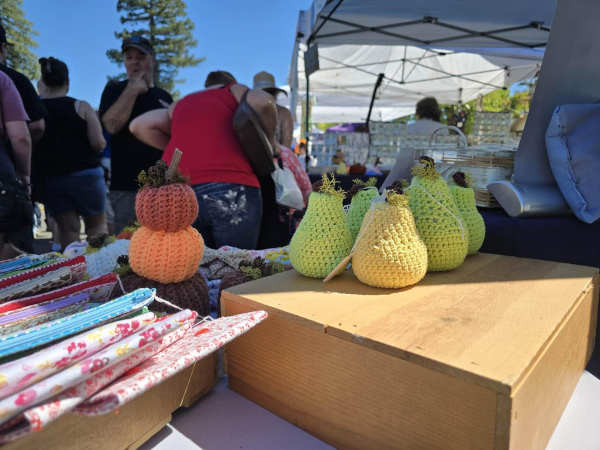
By 1:40 p.m. almost all official souvenirs specially designed for the 30th anniversary at the “Pearaphernalia” booth had been picked away. Aprons and women’s T-shirts were completely sold out; only four men’s T-shirts and a few caps were left, said Kathy Windrem, a volunteer at the booth.
Although Windrem had only volunteered for recent years, she had been a loyal attendee for decades as a Keylseville native. She wore a pair of pear-shaped earrings that sparkled under the sun.
“I’ve come every year and my earrings are from maybe 20 years ago,” Windrem said with a proud smile, showcasing the vintage earrings she bought at one of the old pear festivals.
Kelly Moe of Kelly’s Designs makes and sells her own art. This was her third year coming into the festival as a vendor with her craft in all forms from plushes, purses to earrings.
Moe started out four years ago at The Mercantile before the farmer’s market and then ventured out at some of the “bigger shows” such as the Blackberry Festival. “I try to stay local,” she said.
“I was disabled, and so I started making earrings just for myself, and then you know, it escalated,” Moe said and laughed, adding that she was expecting to come back next year again at the same spot.
Animal friends
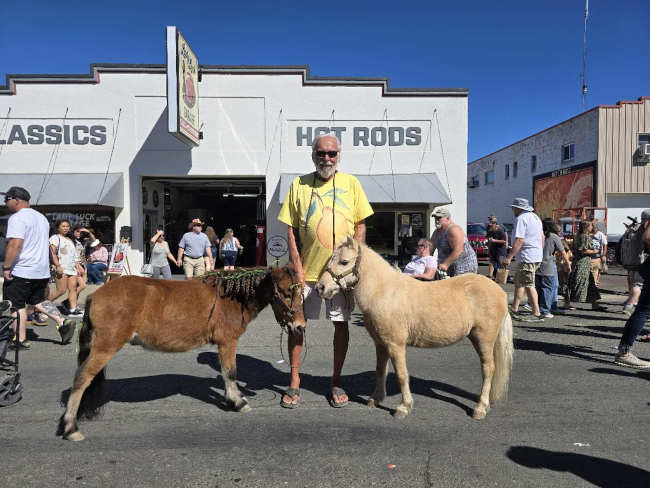
Not only children and adults, but donkeys and horses also took their part. Steve Robinson walked along the street with his two miniature horses, Biscuits and Gravy, and was constantly stopped by visitors who wanted to pet the two and take photos.
Robinson said the two little horses were pulling a wagon with him and another four people on it for the parade. “It’s nothing for these guys; they can pull five times their weight,” said Robinson.
Whitney Braito of Whitney’s Ranch Care went a step further with a makeover of herself as Princess Fiona from the Shrek movies, wandering the streets with her best donkey friend who’s 23 years old and a horse friend who’s 25.
“Both of these guys have been rescued,” Braito said. “They both came to me needing dietary corrections and rubber hoof trimming.”
Braito said she was going to send them back and come out again, since she was going to remove the makeup and “be a human.”
“When the donkey goes, the costume goes,” Braito said.
“Oh well, did we dream of it lasting 30 years?” Holdenried repeated the question that was asked of her in the phone call as she recollected memories of starting the festival at the very beginning.
“Probably not,” she said with a joyful chuckle.
Email Lingzi Chen at