 How to resolve AdBlock issue?
News
- Details
- Written by: Marcus Woo
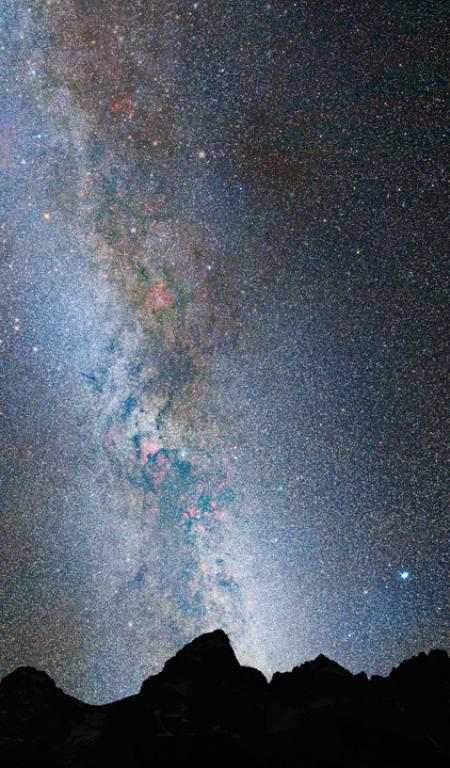
Look up at the night sky and you’ll see stars, sure. But you’re also seeing planets – billions and billions of them. At least.
That’s the conclusion of a new study by astronomers at the California Institute of Technology (Caltech) that provides yet more evidence that planetary systems are the cosmic norm.
The team made their estimate while analyzing planets orbiting a star called Kepler-32 – planets that are representative, they say, of the vast majority in the galaxy and thus serve as a perfect case study for understanding how most planets form.
“There’s at least 100 billion planets in the galaxy – just our galaxy,” said John Johnson, assistant professor of planetary astronomy at Caltech and coauthor of the study, which was recently accepted for publication in the Astrophysical Journal. “That’s mind-boggling.”
“It’s a staggering number, if you think about it,” added Jonathan Swift, a postdoc at Caltech and lead author of the paper. “Basically there’s one of these planets per star.”
The planetary system in question, which was detected by the Kepler space telescope, contains five planets. The existence of two of those planets have already been confirmed by other astronomers.
The Caltech team confirmed the remaining three, then analyzed the five-planet system and compared it to other systems found by the Kepler mission.
The planets orbit a star that is an M dwarf – a type that accounts for about three-quarters of all stars in the Milky Way.
The five planets, which are similar in size to Earth and orbit close to their star, are also typical of the class of planets that the telescope has discovered orbiting other M dwarfs, Swift says.
Therefore, the majority of planets in the galaxy probably have characteristics comparable to those of the five planets.
While this particular system may not be unique, what does set it apart is its coincidental orientation: the orbits of the planets lie in a plane that’s positioned such that Kepler views the system edge-on.
Due to this rare orientation, each planet blocks Kepler -32’s starlight as it passes between the star and the Kepler telescope.
By analyzing changes in the star’s brightness, the astronomers were able to determine the planets’ characteristics, such as their sizes and orbital periods.
This orientation therefore provides an opportunity to study the system in great detail – and because the planets represent the vast majority of planets that are thought to populate the galaxy, the team says, the system also can help astronomers better understand planet formation in general.
“I usually try not to call things ‘Rosetta stones,’ but this is as close to a Rosetta stone as anything I’ve seen,” Johnson said. “It’s like unlocking a language that we’re trying to understand—the language of planet formation.”
One of the fundamental questions regarding the origin of planets is how many of them there are. Like the Caltech group, other teams of astronomers have estimated that there is roughly one planet per star, but this is the first time researchers have made such an estimate by studying M-dwarf systems, the most numerous population of planets known.
To do that calculation, the Caltech team determined the probability that an M-dwarf system would provide Kepler-32’s edge-on orientation.
Combining that probability with the number of planetary systems Kepler is able to detect, the astronomers calculated that there is, on average, one planet for every one of the approximately 100 billion stars in the galaxy.
But their analysis only considers planets that are in close orbits around M dwarfs – not the outer planets of an M-dwarf system, or those orbiting other kinds of stars.
As a result, they say, their estimate is conservative. In fact, says Swift, a more accurate estimate that includes data from other analyses could lead to an average of two planets per star.
M-dwarf systems like Kepler-32’s are quite different from our own solar system. For one, M dwarfs are cooler and much smaller than the sun.
Kepler-32, for example, has half the mass of the sun and half its radius. The radii of its five planets range from 0.8 to 2.7 times that of Earth, and those planets orbit extremely close to their star.
The whole system fits within just over a tenth of an astronomical unit (the average distance between Earth and the sun) – a distance that is about a third of the radius of Mercury’s orbit around the sun.
The fact that M-dwarf systems vastly outnumber other kinds of systems carries a profound implication, according to Johnson, which is that our solar system is extremely rare.
“It’s just a weirdo,” he said.
The fact that the planets in M-dwarf systems are so close to their stars doesn’t necessarily mean that they’re fiery, hellish worlds unsuitable for life, the astronomers say. Indeed, because M dwarfs are small and cool, their temperate zone – also known as the “habitable zone,” the region where liquid water might exist – is also further inward.
Even though only the outermost of Kepler-32’s five planets lies in its temperate zone, many other M dwarf systems have more planets that sit right in their temperate zones.
As for how the Kepler-32 system formed, no one knows yet. But the team says its analysis places constraints on possible mechanisms.
For example, the results suggest that the planets all formed farther away from the star than they are now, and migrated inward over time.
Like all planets, the ones around Kepler-32 formed from a proto-planetary disk – a disk of dust and gas that clumped up into planets around the star.
The astronomers estimated that the mass of the disk within the region of the five planets was about as much as that of three Jupiters.
But other studies of proto-planetary disks have shown that three Jupiter masses can’t be squeezed into such a tiny area so close to a star, suggesting to the Caltech team that the planets around Kepler-32 initially formed farther out.
Another line of evidence relates to the fact that M dwarfs shine brighter and hotter when they are young, when planets would be forming.
Kepler-32 would have been too hot for dust – a key planet-building ingredient – to even exist in such close proximity to the star.
Previously, other astronomers had determined that the third and fourth planets from the star are not very dense, meaning that they are likely made of volatile compounds such as carbon dioxide, methane, or other ices and gases, the Caltech team said.
However, those volatile compounds could not have existed in the hotter zones close to the star.
Finally, the Caltech astronomers discovered that three of the planets have orbits that are related to one another in a very specific way.
One planet’s orbital period lasts twice as long as another’s, and the third planet’s lasts three times as long as the latter’s.
Planets don’t fall into this kind of arrangement immediately upon forming, Johnson said. Instead, the planets must have started their orbits farther away from the star before moving inward over time and settling into their current configuration.
“You look in detail at the architecture of this very special planetary system, and you’re forced into saying these planets formed farther out and moved in,” Johnson explained.
The implications of a galaxy chock full of planets are far-reaching, the researchers say. “It’s really fundamental from an origins standpoint,” said Swift, who notes that because M dwarfs shine mainly in infrared light, the stars are invisible to the naked eye. “Kepler has enabled us to look up at the sky and know that there are more planets out there than stars we can see.”
Marcus Woo writes for Caltech's news service.
- Details
- Written by: Elizabeth Larson
CLEARLAKE OAKS, Calif. – Two women were injured in a Saturday crash east of Clearlake Oaks.
The single-vehicle wreck occurred on Highway 20 near Walker Ridge Road shortly before 2:30 p.m. Saturday, according to the California Highway Patrol.
Northshore Fire Protection District Deputy Chief Pat Brown said the small passenger vehicle in which the two women were riding went off the road and traveled about 150 feet down an embankment.
Radio reports indicated the vehicle rolled several times while going down the hill.
Northshore Fire brought in its own rescue unit and also received mutual aid from Williams Fire, which sent a heavy rescue unit, Brown said.
The two women were extricated and brought up the hill with the help of a rope rescue, an operation that Brown said requires a lot of manpower, which was one of the reasons for bringing in mutual aid.
He said both women sustained head injuries.
Due to the weather, Brown said an air ambulance was not available to transport the patients.
In addition, because of the terrain, “We couldn’t have landed anything up there,” he said.
Northshore Fire and Lake County Fire each transported one of the women to St. Helena Hospital Clear Lake by ambulance, Brown said.
The crash occurred in an area of Highway 20 that saw a number of similar crashes several years ago, with vehicles going off the road and down the embankment, particularly in rainy weather.
Caltrans has since installed a rumble strip, signage and other safety measures to reduce the number of crashes, as Lake County News has reported.
“That’s the first one I’ve had there in a while,” Brown said of Saturday’s wreck.
Email Elizabeth Larson at
- Details
- Written by: Elizabeth Larson
NORTH COAST, Calif. – In the wake of an appeals court hearing that overturned a rape conviction based on a more than century old loophole, the state senator representing Lake and several other North Coast counties said on Friday she would introduce legislation to fix the law.
Sen. Noreen Evans (D-Santa Rosa), who chairs the Senate Judiciary committee and the California Legislative Women’s Caucus, said she would introduce the legislation in reaction to a Second District Court of Appeal decision filed Wednesday.
That decision, People v. Julio Morales, reversed a rape conviction of a Southern California man based on a law codified in 1872.
Morales was accused of entering the dark bedroom of a female acquaintance after her boyfriend left and having sex with her while she slept, without disclosing his identity.
When the woman woke up and realized it was not her boyfriend, she pushed him away and began to cry and yell, and he left, the decision explained.
California Penal Code 261(a)(5) states that rape includes situations “where a person submits under the belief that the person committing the act is the victim’s spouse, and this belief is induced by any artifice, pretense, or concealment practiced by the accused, with intent to induce the belief.”
By referencing a “spouse,” the law does not cover single women.
The appeals court’s decision explains it this way: “A man enters the dark bedroom of an unmarried woman after seeing her boyfriend leave late at night, and has sexual intercourse with the woman while pretending to be the boyfriend. Has the man committed rape? Because of historical anomalies in the law and the statutory definition of rape, the answer is no, even though, if the woman had been married and the man had impersonated her husband, the answer would be yes.”
The justices pointed out that while Penal Code Section 261 has been amended numerous times over the past 140 years, two subdivisions – one, (a)(4), relating to a person “unconscious of the nature of the act, and this is known to the accused,” and the second being (a)(5), relating to a person submitting believing the person committing the act is their spouse – have not been changed.
“Therefore, we reluctantly hold that a person who accomplishes sexual intercourse by impersonating someone other than a married victim’s spouse is not guilty of the crime of rape of an unconscious person under section 261, subdivision (a)(4),” according to the decision.
The appeals court decision also noted that the record did not make clear if the jury made its decision based on a legally invalid theory of the case presented by the prosecutor.
“I am shocked and appalled that the court didn’t see fit to uphold justice for this rape survivor,” Evans said. “The fact that such an outdated loophole still exists is baffling but I will introduce legislation this session that will bring uniform clarity. The definition of rape is found in the act itself and having sex with an unconscious person is rape. Period.”
California Attorney General Kamala Harris, whose office argued against the conviction being overturned before the appeals court, also decried the decision.
“The evidence is clear that this case involved a nonconsensual assault that fits within the general understanding of what constitutes rape,” Harris said in a Friday statement. “This law is arcane and I will work with the Legislature to fix it.”
Email Elizabeth Larson at
- Details
- Written by: Lake County News reports
Nine bills authored by Assemblymember Mariko Yamada (D-Davis) in 2012, ranging in topic from religious freedom to reporting of elder abuse to pilot safety, become effective in 2013.
Yamada now represents Lake County, as part of the Fourth District, in the California Assembly.
The bills include the following.
AB 1964: Workplace religious freedom
Prohibits employers from segregating an employee from coworkers or the public due to the employee’s religious attire, grooming, or other observance.
AB 40: Criminal physical abuse of an elder or dependent adult
Requires nursing home staff and other mandatory reporters to report directly to law enforcement any suspected incidents of abuse resulting in serious bodily injury.
AB 511: Meteorological evaluation tower: Markings for pilot safety
Establishes a statewide standard for marking Meteorological Evaluation Towers (METs), which developers of wind farms use to measure wind velocity.
METs are invisible to low-flying agricultural pilots without such safety markings.
AB 999: Long-term care insurance: Rate increase controls
Modifies the long-term care (LTC) insurance ratemaking process to protect consumers from excessive rate increases by giving the insurance commissioner the discretion to allow a lower premium increase if he or she determines that it is in the interest of policyholders.
In addition, allows the insured, if the premium becomes too expensive, to convert paid-up coverage to a lifetime benefit equal to the amount of premiums paid to date for the coverage, instead of canceling, ensuring that the policyholder will not lose all their money or all their coverage.
AB 1623: Weights and measures: Consumer protections
Ensures that consumers receive the true amount of what they buy by raising the fee collection limitation on county weights and measures programs to allow fees that fully cover the costs of annually inspecting vendor and manufacturing measuring equipment, such as scales in grocery stores.
AB 1710: The Nursing Home Administrator ‘Right Sizing’ Act of 2012
Maintains state enforcement standards for nursing home care by requiring the annual adjustment of Nursing Home Administrator licensing program fees to fully support state costs of screening, testing, and investigating nursing home administrators.
AB 1793: Emergency preparedness: Nursing homes
Ensures that nursing homes are included in the planning and providing of emergency medical care during a disaster and that they are reimbursed from federal disaster funds for their services, like other entities providing such services.
AB 1823: Veterans homes: Notice of financial obligation
Requires quarterly financial statements sent to California’s veterans home residents to include clearly written information about prospective health-related charges due upon the death of a veteran and payable by his or her estate.
AB 1626: Contesting false and misleading ballot statements
Allows a county clerk to contest in court possible false and misleading arguments on a ballot.
Visit Yamada online at www.asm.ca.gov/yamada .