 How to resolve AdBlock issue?
News
- Details
- Written by: Lake County News reports
LAKE COUNTY, Calif. – The Lake County Literacy Task Force is pursuing several new initiatives in the coming year as it pursues the goal that everyone in the county – young, adults and elders – not only be able to read, but desire to read.
The task force, established in 2011, represents educators and business and community leaders, and is focused on supporting countywide literacy activities and initiatives.
The group views literacy as a fundamental foundation of freedom, democracy, personal satisfaction, and a contribution to one’s society and personal life, and believes that everyone who has a desire to read should have an avenue to become literate.
The group has selected the following four initiatives that will drive the focus of the group in the coming year.
The Big Read
The Big Read began with a matching grant from the National Endowment for the Arts.
The inaugural annual effort was held in October 2011 and focused on the works of Edgar Allen Poe. Activities included film festivals, events and book clubs around the county.
Planning is now under way for the next Big Read initiative, slated for October 2013.
For more information and to get involved, contact Robin Shrive at
Lake County Reads
Modeled after the successful Kelseyville Sunrise Rotary Club Reading Program, now in its sixth year, Lake County Reads inspires volunteerism and reading both from service club/organization members and high school students, who together volunteer to read to students each week in a elementary school classroom.
The selected books are then donated to the school and help build a library and a love for reading for the students.
The long-term vision for this initiative is that every elementary school in Lake County has a sponsored Lake County Reads program.
For more information on Lake County Reads, contact Wally Holbrook at 707-262-4100.
Schools of Hope
This pilot program partners with Lakeport Unified School District and United Way.
Volunteers are trained and then spend 30 minutes in the elementary school classroom each week tutoring students throughout the school year.
The program is focused on middle to low readers in the primary grades.
For more information and to volunteer, email Janine Smith-Citron at
Imagination Library
For a $25 annual sponsorship, one child will receive one high quality, hard cover book per month, delivered to their home.
The program promotes reading through the active participation of the parents.
The Literacy Task Force is launching the program by sponsoring 100 children, and community members and organizations can participate by sponsoring children.
The program goal is to sponsor each child from birth through 5 years, inspiring a love of reading by receiving a book in their home each month.
The final book each child receives sends them off to kindergarten with an exciting book about starting school.
For more information on the Imagination Library contact Shelly Mascari at
The Literacy Task Force meets approximately one time per month at Lake County Office of Education in Lakeport.
It welcomes participation from anyone who shares its vision of expanding literacy.
For more information and to get involved, contact Lake County Superintendent of Schools Wally Holbrook at 707-262-4100 or
- Details
- Written by: Lake County News reports
FORT BRAGG, Calif. – While international attention focused on the dismantling of nuclear weapons in Cuba and the formation of British rock sensation, the Rolling Stones, a major scientific endeavor was under way among the redwoods on the Jackson Demonstration State Forest, just south of Fort Bragg, Calif.
In November 1962, stream water began to flow over two gaging weirs constructed on the North and South Forks of Caspar Creek.
Researchers and forest managers from the U.S. Forest Service Pacific Southwest Research Station (PSW) and the California Department of Forestry and Fire Protection (Cal Fire) had chosen Caspar Creek and its surrounding watershed as the site for a major long-term study of logging effects on streamflow, sedimentation and salmon habitat.
Over the past 50 years, the Caspar Creek study has provided a continuous record of streamflow, sediment and rainfall that has been used by researchers around the globe to expand our understanding of watershed science.
Major experiments at the site showed the effects of 1970s road construction and tractor logging on water quality and measured the cumulative effects of 1990s clear-cutting on downstream flows and sediment loads.
During these experiments, researchers also studied many parts of the system in more detail, measuring such things as fog drip, channel changes, and juvenile salmon.
Findings have contributed to the design and modification of forest practice rules, and study results are used by foresters in northwest California to predict changes in peak flows after logging and to help reduce logging-related sediment.
Methods developed at Caspar Creek are now used internationally to monitor water quality.
Current research includes modeling the potential effects of climate change on aquatic habitat and water resources; evaluating the long-term effects of selective logging on dry-season flows; and documenting the effects of road decommissioning on sediment production.
According to PSW scientist Dr. Leslie Reid, “Much of our understanding of watershed-scale forest hydrology comes from research in experimental watersheds because they provide a setting where we can isolate and observe the effects of particular management activities.”
PSW watershed manager Elizabeth Keppeler noted that Caspar Creek is a particularly important research site because of its 50-year record.
“Sustainable forest management relies on understanding the interactions between disturbance, recovery, and environmental change, and many of these interactions take a very long time to become visible,” she said. “Caspar Creek is one of only a few experimental watersheds that provide this long-term perspective.”
Additional information about past and ongoing research at Caspar Creek can be found at http://www.fs.fed.us/psw/topics/water/caspar/ .
In addition to PSW and Cal Fire, cooperators include the AmeriCorps Watershed Stewards Project, California Department of Fish and Game and university faculty.
A 100-year memorandum of understanding between PSW and CAL FIRE was signed in 1999, providing for continuation of the cooperative Caspar Creek project throughout this century and ensuring that the Caspar Creek Experimental Watersheds will continue to provide information for the benefit of all.
Headquartered in Albany, Calif., the Pacific Southwest Research Station develops and communicates science needed to sustain forest ecosystems and other benefits to society. It has research facilities in California, Hawaii and the U.S.–affiliated Pacific Islands.
For more information, visit www.fs.fed.us/psw/ .
- Details
- Written by: Dr. Tony Phillips
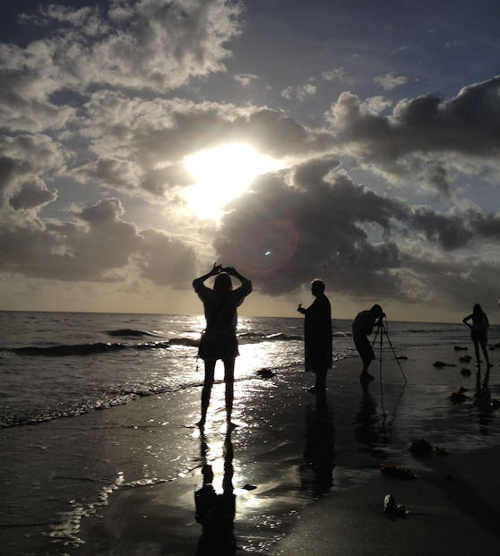
This is a personal eye-witness account of the Nov. 14 solar eclipse by Science@NASA production editor Tony Phillips.
Astrophysicist and legendary eclipse chaser Fred Espenak has a rating scheme for natural wonders. “On a scale of 1 to 10,” he said, “total eclipses are a million.”
Apparently, this true even when the eclipse is almost completely clouded out.
Last week, I experienced such an eclipse on Four Mile Beach outside the resort town of Port Douglas in Queensland, Australia.
For years, tourists, astronomers and eclipse chasers had been anticipating a fantastic show over the Coral Sea on Nov. 14, 2012.
Just after daybreak, the Moon would pass directly in front of the low-hanging sun, producing a total eclipse in plain view of many resort towns along the coast. More than 100,000 people (me and my family included) converged to witness the event.
The night before the eclipse was crystal clear, with all of the stars of the southern sky twinkling brightly overhead.
As dawn broke, however, there were clouds on the horizon, and by 6:30 a.m. local time, less than 10 minutes before totality, thousands of people on the beach watched in dismay as a patchy bank of fluffy white clouds rolled right in front of the sun.
That’s when I learned that even a cloudy eclipse is off the scale.
Even as we were urgently wishing the clouds away, I realized their benefit: Clouds act as a natural filter.
The partially-eclipsed sun burned an auburn crescent through the gray fluff overhead. Onlookers unwisely but irresistibly took off their eclipse glasses for the kind of direct view that would have been impossible under clear skies. It was mesmerizing.
At that point, only one thing could tear our eyes off the sky: The arrival of the Moon’s shadow. We felt it before we saw it. Even at 6:30 in the morning, the beach was hot and humid.
Suddenly, we were enveloped by an unexpected chill. We looked around to see the landscape rapidly darkening. Tropical birds that had been flitting noisily back and forth in the canopy of nearby trees paused, and an otherworldly silence descended on the beach.
The operative word is “otherworldly.” The Moon’s shadow lances more than a quarter million miles across the dark vacuum of space, and when it lands on a beach in Australia, it seems to bring a bit of the silent cold with it. Something undeniably cosmic was in the air.
At that moment, with the tide surging around our feet, the clouds parted to reveal the Moon and sun in almost perfect alignment.
Through a tiny gap, we watched the thin, bright crescent narrow and vanish. The solar corona popped out around the black lunar disk, just like the centerfold of an astronomy textbook.
I turned to my daughter, 16 year old Amelia, and involuntarily cried out in a loud voice, “Oh my God, look!” (As if she wasn’t already.)
The beach erupted in cries of delight for ... one-one thousand, two-one thousand, three one-thousand ... a long count of three, and then the clouds closed again. The eclipse vanished.
Totality was supposed to last two minutes, and we had only seen three seconds of it. Remarkably, no one seemed to mind.
Along the Four Mile Beach, thousands of people stood in the cool center of the Moon’s shadow, wrapped in lunar darkness, staring mesmerized at the cloudy spot where the eclipse was playing out behind a puffy gray veil of water droplets.
One brief glimpse of the sun’s corona had sent an electric jolt through the crowd, and we were frozen to the spot.
One minute and 57 seconds later (an interval that seemed much shorter) the Moon slid off the solar disk. The clouds abruptly blossomed with light. It looked like an explosion had taken place in the atmosphere not far above our heads. Iridescent colors appeared around the edge of the clouds as water droplets diffracted the rays of surging light.
I’m pretty sure that no one on the beach was disappointed.
As totality ended, the dark core of the moon’s shadow swept off the beach, kicking off a fast 9000 mile journey across the uninhabited south Pacific. Birds started singing again as we rubbed our arms to hasten away the departing cold.
There was only one last thing to do: Run a marathon.
For the first time ever, runners had organized a 26.2 mile race with an eclipse as its starting gun. The end of totality was our signal to assemble at the starting line and high-tail it through the verdant forests and cane fields of northeast Queensland.
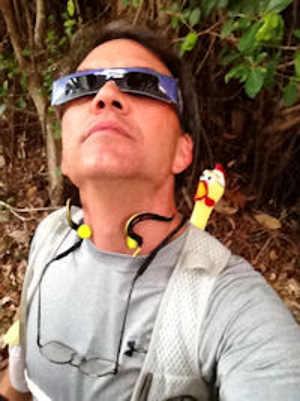
My running partner was NASA’s rubber chicken Camilla, who would complete the marathon in support of the space agency’s “Train Like an Astronaut” program, the first rubber chicken to accomplish such a feat.
The partial eclipse was still under way as hundreds of runners flooded through the starting gate, so most of the athletes still had their eclipse glasses with them.
As the clouds dispersed, we could look up and see the sun reshape itself from a thin sliver to a fat crescent, and ultimately a complete circle again.
Experienced runners are accustomed to seeing empty packets of energy gels littering the path of long races. In this marathon, the path was lined instead with discarded eclipse glasses.
Before long, the sky was completely clear and the hot Australian sun beamed down on the runners. Temperatures climbed to nearly 90 degrees, and the Queensland humidity pushed the Heat Index close to 100 F. We were definitely missing our clouds!
To combat the heat, I remembered the feel of the Moon’s cool shadow and in my mind replayed over and over again the three seconds of totality I had witnessed – a mental movie that was still playing when Camilla and I crossed the finish line more than four hours later. Even now, I can’t quite get it out of my mind.
Maybe a million is an underestimate, after all.
Dr. Tony Phillips works for the National Aeronautics and Space Administration.
- Details
- Written by: Elizabeth Larson
LOWER LAKE, Calif. – A travel trailer was burned in a Saturday afternoon fire near Lower Lake.
The fire was first dispatched just after 3:15 p.m. at 17050 Morgan Valley Road, according to radio reports.
Smoke and flames were reported by witnesses, and firefighters were informed early on that the blaze was threatening multiple structures.
Lake County Fire responded, initially asking for mutual aid from Kelseyville Fire and Cal Fire, reports from the scene indicated.
The battalion chief arriving on the scene reported a fully involved travel trailer.
While the fire initially was threatening other buildings, the battalion chief canceled the mutual aid requests as he said firefighters could contain the fire before it damaged any other structures.
The fire was reported contained just after 3:30 p.m. No immediate cause was given.
Email Elizabeth Larson at