 How to resolve AdBlock issue?
News
- Details
- Written by: Lake County News reports
Warmer air temperatures high above the Antarctic led to the second smallest seasonal ozone hole in 20 years, according to NOAA and NASA satellite measurements.
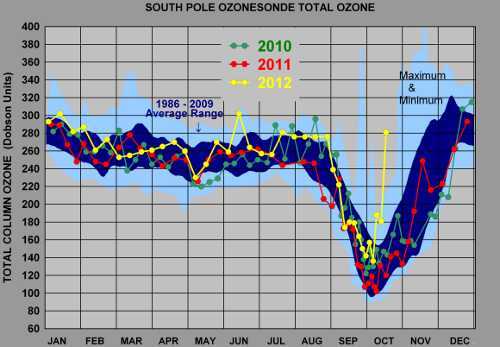
This year, the average size of the ozone hole was 6.9 million square miles. The ozone layer helps shield life on Earth from potentially harmful ultraviolet (UV) radiation that can cause skin cancer and damage plants.
The Antarctic ozone hole forms in September and October, and this year, the hole reached its maximum size for the season on Sept. 22, stretching to 8.2 million square miles, roughly the area of the United States, Canada and Mexico combined.
In comparison, the largest ozone hole recorded to date was in 2000 at 11.5 million square miles.
The Antarctic ozone hole began making a yearly appearance in the early 1980s, caused by chlorine released by manmade chemicals called chlorofluorocarbons or CFCs.
The chlorine can rapidly break apart ozone molecules in certain conditions, and the temperature of the lower stratosphere plays an important role.
“It happened to be a bit warmer this year high in the atmosphere above Antarctica, and that meant we didn’t see quite as much ozone depletion as we saw last year, when it was colder,” said Jim Butler with NOAA’s Earth System Research Laboratory in Boulder, Colo.
Even 25 years after an international agreement was signed to regulate production of ozone-depleting chemicals, the ozone hole still forms each year.
In fact, it could be another decade before scientists can detect early signs of Antarctic ozone layer recovery, according to a paper by NOAA researchers and colleagues published last year.
The ozone layer above Antarctica likely will not return to its early 1980s state until about 2060, noted NASA atmospheric scientist Paul Newman.
The length of time needed for this full recovery is due in part to the large quantity and long lifetime of ozone-depleting substances in the atmosphere.
Climate change may also affect the rate of ozone recovery by cooling the stratosphere, which has several competing effects on ozone depletion.
Monitoring the ozone’s state remains important because the ozone layer acts as Earth’s natural shield from DNA-mutating UV radiation.
Under the mandate of the Clean Air Act, NOAA and NASA scientists keep a close eye on the ozone layer’s health with satellite data, ground-based measurements and balloon-borne instruments.
A new ozone-monitoring instrument on Suomi-NPP weather satellite, the Ozone Mapping Profiler Suite (OMPS), will be key to that effort. OMPS will extend the satellite record of ozone hole extent, which dates back to the early 1970s, and will provide more detail about ozone levels at various layers in the atmosphere and around the globe.
“OMPS Limb instrument looks sideways, and it can measure ozone as a function of height,” says Pawan Bhartia, NASA atmospheric physicist and OMPS instrument lead.
“This OMPS instrument allows us to more closely see the vertical development of Antarctic ozone depletion in the lower stratosphere where the ozone hole occurs.”
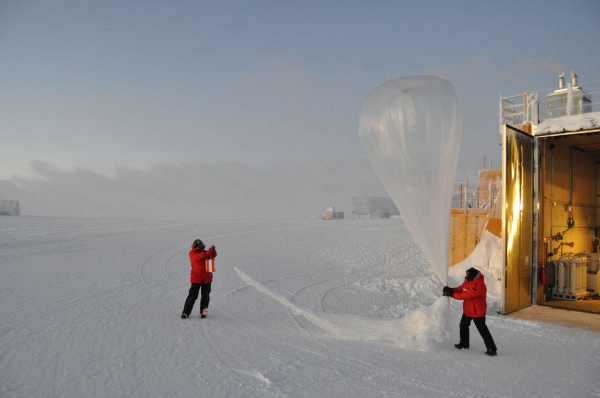
Balloon-borne and ground-based instruments provide ozone data when darkness prevents satellite observations. “The sun doesn’t rise above the South Pole horizon until about Sept. 22, by which time ozone depletion has already begun,” said NOAA atmospheric scientist Irina Petropavlovskikh.
NOAA’s mission is to understand and predict changes in the Earth's environment, from the depths of the ocean to the surface of the sun, and to conserve and manage our coastal and marine resources. Visit them at www.noaa.gov and join them on Facebook, Twitter and other social media channels.
- Details
- Written by: Lake County News reports
LAKE COUNTY, Calif. – The Lake County community will come together this weekend during the annual Veterans Day celebration to honor those who have served their country.
The public is invited to the event, which will take place beginning at 11 a.m. Sunday, Nov. 11, at Konocti Visa Casino. Doors open at 10 a.m.
The Veterans Day ceremony will include presentations of the County’s annual “Friend of the Veteran” and United Veterans Council’s “Veteran of the Year” awards.
Konocti Vista Casino will provide a complimentary lunch to those who attend.
Konocti Vista Casino is located at 2755 Mission Rancheria Road in Lakeport.
For more information call 707-274-9512.
- Details
- Written by: Lake County News reports
SANTA ROSA, Calif. – In response to the overwhelming amount of needed support, the American Red Cross continues to provide aid, supplies and comfort to the disaster victims of Hurricane Sandy.
The local Red Cross sent 31 volunteers to the East Coast, where they are helping to feed and shelter the thousands of people displaced by the hurricane. More local volunteers are ready to go and expected to deploy in the next four weeks.
On Thursday night, more than 2,600 people occupied 38 Red Cross shelters across New York, New Jersey, Pennsylvania and West Virginia.
On Nov. 10 and 11, the Red Cross will be teaming up with Goodwill during the donation drive, “From Sonoma With Love.” The fundraiser will take place at Coddingtown Mall from 10 a.m. to 4 p.m.
Red Cross volunteers will be accepting cash donations; Goodwill will be accepting slightly used household items and clothing, and donating to the Red Cross the value of the items.
Other ways to provide financial donations to the Red Cross relief efforts include:
- visit www.redcross.org ;
- call 1-800-RED CROSS (1-800-733-2767);
- call 707-577-7620;
- text the word REDCROSS to 90999 to make a $10 donation;
- mail or hand-deliver to The American Red Cross 5297 Aero Drive, Santa Rosa, CA 95403;
- mail donations to P.O. Box 37243, Washington, DC 20013.
- Details
- Written by: Dr. Tony Phillips and Dauna Coulter
NASA has found a cure for a common phobia – the fear of asking “stupid” questions.
It’s not a pill. No therapy is required. The cure is a rubber chicken.
That’s right, school kids and even their teachers can find themselves tongue-tied when they come face to face with an astronaut or astrophysicist. This interferes with NASA’s mission to reach out, inspire and educate.
“But nobody’s afraid to talk to a rubber chicken,” said Romeo Durscher of Stanford University, executive secretary for a fowl NASA ambassador named “Camilla” who’s taking classrooms by storm.
Outfitted in her own personal spacesuit, Camilla travels far and wide to meet with kids at schools, science centers and even sci-fi conventions. She helps break the ice for astronauts and other space-celebrities when they meet the general public.
“Camilla is the perfect NASA spokes-chicken!” said astronaut Clayton Anderson. “I am one of her biggest fans. Always a big hit with the kids, she makes science, engineering, technology and math seem appealing, not threatening, to youth of all ages.”
Camilla is willing to go almost anywhere for science.
Earlier this year she flew to the edge of space to investigate a solar radiation storm.
A group of high school students in Bishop, Calif., attached radiation sensors to Camilla and sent her into the storm clinging to the payload of a helium balloon.
She flew so high – 124,000 feet on one flight – that the daytime sky turned as black as space. Later, Camilla parachuted back to Earth where the kids continue to study the data she gathered.
“We had so much fun working with Camilla on this experiment,” said Rachel Molina, a senior at Bishop Union High School and a member of the launch team. “She is one cool chick.”
One of Camilla’s prime missions is to inspire girls to enter the sciences, and it seems to be succeeding.
Molina plans to major in physics when she goes to college next year. “Should I ask Camilla for a letter of recommendation?” she wondered.
More than 20,000 people follow Camilla on Facebook, Twitter and Google+, where every adventure is an opportunity for science education.
“During one visit to Johnson Space Center, Clayton Anderson showed her the space toilet trainer,” Durscher recalled. “Camilla insisted on trying it out. She ended up getting sucked into the hose – and stuck in the toilet. Luckily, we were able to free her. And we used the incident to teach how space toilets work.”
On Nov. 14, Camilla will be in Australia to observe a total eclipse of the sun. At the end of totality, she’s going to run “the Solar Eclipse Marathon,” a 26.2-mile race that begins when the first ray of sunlight lances over the edge of the retreating Moon.
As far as anyone knows, this is the first time a rubber chicken has run such a race.
Camilla’s travel budget is very small, so certain measures are necessary for reasons of economy. For instance, on airplane flights Camilla travels in the overhead compartment.
“I ask her to keep quiet,” said Durscher, “but every now and then she lets out a disgruntled squawk. I just sit there like I don’t hear anything.”
Ultimately, Durscher would like Camilla to join the crew of the International Space Station. In particular, he’s angling for a berth on Soyuz Expedition 40/41. If this happens, astronaut chats from orbit with school kids and reporters might never be the same.
With a space-suited chicken floating in the background, “no one will ever be afraid to ask a ‘stupid’ question again.”
Educators are encouraged to follow Camilla on Twitter, Facebook and Google+.
Dr. Tony Phillips and Dauna Coulter work for the National Aeronautics and Space Administration.