 How to resolve AdBlock issue?
News
- Details
- Written by: Lake County News reports
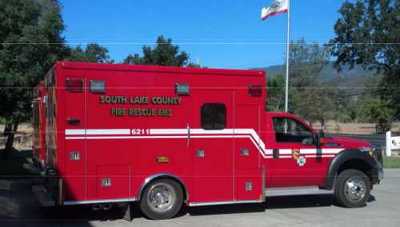
MIDDLETOWN, Calif. – A grant has allowed the South Lake County Fire Protection District to purchase a brand new ambulance.
The district recently took delivery of the new Ford F-450 four-wheel drive ambulance that was built to the district’s specifications.
The new ambulance adds to the fire district’s existing fleet, allowing it to cycle older vehicles into reserve status.
The district said the ambulance purchase would not have been possible without the assistance of the Redbud Health Care District.
The Redbud Health Care District, which provides important support for the health needs of south Lake County, agreed to repay the amount financed to South Lake County Fire to purchase the ambulance.
Established in 1964, Redbud Health Care District has been striving to improve health care services to the communities of south Lake County.
Redbud Community Hospital, now called St. Helena Hospital Clear Lake, was purchased by the Adventist Medical Group in 1997, with profits from the sale invested into the Local Agency Investment Fund in Sacramento.
Investment income from that fund is utilized for health care program grants throughout southern Lake County.
The fire district thanked the Redbud Health Care District for its assistance and support.
- Details
- Written by: Lake County News reports
LAKE COUNTY, Calif. – The Lake County Horse Council is asking community members to take part in a survey to determine the local economic impacts of the horse industry.
The survey can be found at the council’s Web site, www.lakecountyhorsecouncil.com .
Horses are a significant industry in Lake County affecting the economy of the area.
The council said an accurate knowledge of the economic impact of the horse industry in Lake County is vital for making decisions that will affect the entire county.
There are 9.2 million horses in the United States, with the industries around the sales and servicing of horses and their owners resulting in a total value of $39 billion.
The 2009 gross domestic product contribution from horse production and entertainment services was $25.3 billion – more than the motion picture industry.
Additionally, the horse industry employed 339,000 people, more than is employed by the radio and television broadcasting industries and by the petroleum industry.
In California alone there are almost 700,000 horses, making it the second-largest horse population in the U.S.
More than 311,000 people in California participate in horse events annually, and California hosts more than 170 major regional or national horse shows each year.
Neighboring Sonoma County is home to 22,000 horses and 30,000 equestrians.
Revenues produced by the equine industry amounts to 75 percent of that produced by Sonoma County grapes, and grapes are viewed as the most significant industry in Sonoma County. The horse industry in Sonoma County is second only to grapes.
Horse industry economic impact studies have led to initiatives to open trail access, pass feed assessments, provide for educational grants and to laws limiting liability lawsuits related to equestrian activities.
Visit the Lake County Horse Council’s Web site at www.lakecountyhorsecouncil.com . There you can view their Lake County horse industry video and take the anonymous survey.
- Details
- Written by: Lake County News reports
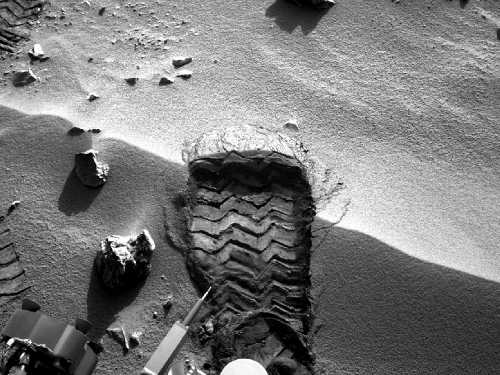
NASA’s Curiosity rover is in a position on Mars where scientists and engineers can begin preparing the rover to take its first scoop of soil for analysis.
Curiosity is the centerpiece of the two-year Mars Science Laboratory mission.
The rover’s ability to put soil samples into analytical instruments is central to assessing whether its present location on Mars, called Gale Crater, ever offered environmental conditions favorable for microbial life.
Mineral analysis can reveal past environmental conditions. Chemical analysis can check for ingredients necessary for life.
“We now have reached an important phase that will get the first solid samples into the analytical instruments in about two weeks,” said Mission Manager Michael Watkins of NASA’s Jet Propulsion Laboratory in Pasadena, Calif. “Curiosity has been so well-behaved that we have made great progress during the first two months of the mission.”
The rover’s preparatory operations will involve testing its robotic scooping capabilities to collect and process soil samples.
Later, it also will use a hammering drill to collect powdered samples from rocks. To begin preparations for a first scoop, the rover used one of its wheels Wednesday to scuff the soil to expose fresh material.
Next, the rover twice will scoop up some soil, shake it thoroughly inside the sample-processing chambers to scrub the internal surfaces, then discard the sample.
Curiosity will scoop and shake a third measure of soil and place it in an observation tray for inspection by cameras mounted on the rover’s mast.
A portion of the third sample will be delivered to the mineral-identifying chemistry and mineralogy (CheMin) instrument inside the rover.
From a fourth scoopful, samples will be delivered to both CheMin and to the sample analysis at Mars (SAM) instrument, which identifies chemical ingredients.
“We’re going to take a close look at the particle size distribution in the soil here to be sure it’s what we want,” said Daniel Limonadi of JPL, lead systems engineer for Curiosity’s surface sampling and science system. “We are being very careful with this first time using the scoop on Mars.”
The rinse-and-discard cycles serve a quality-assurance purpose similar to a common practice in geochemical laboratory analysis on Earth.
“It is standard to run a split of your sample through first and dump it out, to clean out any residue from a previous sample,” said JPL’s Joel Hurowitz, a sampling system scientist on the Curiosity team. “We want to be sure the first sample we analyze is unambiguously Martian, so we take these steps to remove any residual material from Earth that might be on the walls of our sample handling system.”
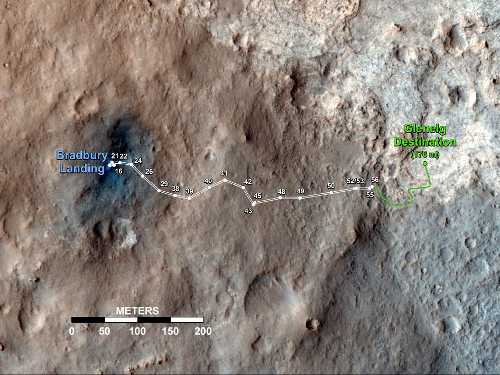
Rocknest is the name of the area of soil Curiosity will test and analyze. The rover pulled up to the windblown, sandy and dusty location Oct. 2.
The Rocknest patch is about 8 feet by 16 feet (2.5 meters by 5 meters). The area provides plenty of area for scooping several times.
Diverse rocks nearby provide targets for investigation with the instruments on Curiosity’s mast during the weeks the rover is stationed at Rocknest for this first scooping campaign.
Curiosity’s motorized, clamshell-shaped scoop is 1.8 inches wide, 2.8 inches long, and can sample to a depth of about 1.4 inches. It is part of the collection and handling Martian rock analysis (CHIMRA) device on a turret of tools at the end of the rover’s arm.
CHIMRA also includes a series of chambers and labyrinths for sorting, sieving and portioning samples collected by the scoop or by the arm’s percussive drill.
Following the work at Rocknest, the rover team plans to drive Curiosity about 100 yards eastward into the Glenelg area and select a rock as the first target for use of its drill.
JPL, a division of the California Institute of Technology, manages the Mars Science Laboratory Project and built Curiosity.
For more about Curiosity, visit www.nasa.gov/msl or http://mars.jpl.nasa.gov/msl .
You can follow the mission on Facebook and Twitter at www.facebook.com/marscuriosity and www.twitter.com/marscuriosity .
- Details
- Written by: Dennis Fordham
A living trust is meant to provide a comprehensive solution to the needs of the settlor, or settlors, and subsequent beneficiaries.
During the settlors’ lifetimes, assets are held in the “settlor’s trust” for the benefit of the settlors and their dependents.
When the settlors die, different beneficiaries, purposes and priorities come into play. Not surprisingly, additional trusts may for various reasons then become necessary.
Assets in the original settlor’s trust are then transferred into these subsequent trusts.
Let us examine how the same trust instrument used to establish the original settlors trust can create further trusts.
Multiple trusts are more commonly found in a married couple’s joint trust instrument, but can also be created in a sole settlor’s trust.
At the death of the first spouse, the couple’s joint trust estate may be divided according to California’s Community Property laws. That is, the settlor’s trust is divided according to each spouse’s own one half shares of the community property assets and all of his or her own separate property assets.
Each share may then be transferred into different trusts, typically for the lifetime benefit of the surviving spouse.
Sometimes, however, the joint trust provides that it does not terminate at the death of the first spouse but continues for the surviving spouse’s lifetime.
Often when the settlors trust terminates, the assets of each spouse, minus any gifts by the deceased spouse, are transferred into a so-called “survivor’s trust,” which is another revocable trust but under the sole control of the surviving spouse.
With blended families and large estates, however, the deceased spouse’s share of the settlor’s trust may be transferred into one or more irrevocable trusts, such as the “bypass trust” and the “marital trust” (if necessary for estate tax purposes), for the lifetime benefit of the surviving spouse and perhaps also for their descendants.
When the sole settlor, or surviving spouse, dies, any existing trusts that had been established for the benefit of the settlors terminate. Distributions are then made to the remainder beneficiaries (often to the settlor(s)’s family). Some, or all, of these distributions may be held in further trusts within the original trust document.
Such trusts, for example, might include a minor’s trust for dependent minors; a special needs trusts for beneficiaries with special needs; and discretionary trusts for beneficiaries with creditors, marital problems or an inability to manage funds.
Having all these trusts within the same document reduces the legal costs associated with drafting the instrument. Nonetheless, when assets are transferred from one trust to another administration expenses are incurred. Appraisals and legal documents are involved in the process of transferring assets.
Sometimes having multiple trusts contained within one trust is not appropriate.
If, for example, a married settlor wants to keep his or her substantial separate property assets discrete from those of his or her spouse, particularly in a second marriage, then a sole settlor trust contain that spouse’s separate property.
Also, if several family members plan to contribute to a special needs trust for a person with disabilities, then a standalone special needs trust may be preferable.
Moreover, a standalone special needs trust will be better suited to the trust’s particular purpose. Provisions that are either not relevant or not suitable to its sole purpose will be omitted.
Thus, the living trust, like an onion, can have multiple layers, each layer dealing with a separate phase within the settlors’ estate plan.
Consult a qualified estate planning attorney to see what works best for your family’s circumstances.
Dennis A. Fordham, attorney (LL.M. tax studies), is a State Bar Certified Specialist in Estate Planning, Probate and Trust Law. His office is at 55 First St., Lakeport, California. Dennis can be reached by e-mail at