 How to resolve AdBlock issue?
News
- Details
- Written by: National Aeronautics and Space Administration
They were perhaps some of the most visible images of the end of each Apollo mission: Giant orange and white parachutes unfurled high above the spacecraft, gently descending toward the ocean.
As NASA continues to build the Orion spacecraft and head toward its first unmanned test flight in 2014, it will once again descend under parachutes to a water landing. But even though the orange and white chutes remain, their design and testing is quite different than in the past.
Orion will be the most advanced spacecraft ever flown, and its parachutes have been designed with a return from exploration missions in mind.
The spacecraft will weigh more than 21,000 pounds as it descends through the air. Each of the main chutes only weighs 300 pounds, so it is quite a feat of engineering that they are able to catch the heavy weight of the spacecraft underneath them.
“Because each of our main parachute chutes has a large diameter of 116 feet, it gives us a huge surface area to capture air and provide a smooth descent toward the ground,” said Chris Johnson, NASA’s project manager for the Orion parachute assembly system.
Johnson adds that safety of the crew is the key driver in parachute design and performance.
Because of that, NASA’s engineers have tested Orion’s parachutes high above the Arizona desert at the U.S. Army Yuma Proving Ground.
Each test has taken a look at different conditions or failures that could happen as each chute is deployed.
The teams have basically pushed the parachute system to its limits to prove that – even if things don’t go according to plan – Orion’s parachutes will work as designed.
Orion’s parachutes are deployed in a series. The first ones that appear are the drogue chutes, two smaller chutes that help stabilize and slow down the spacecraft. These drogues are deployed at approximately 20,000 feet and each one is 23 feet in diameter. Those are cut away after approximately 30 seconds, and three pilot chutes are briefly deployed, which help pull out and deploy the main parachutes.
For even more stability and safety, the main chutes inflate in stages, with what are called “reefs” keeping the canopy of the chutes bound until the proper time.
Initially, the chutes are opened and held to 3.5 percent of their full capacity by the first set these reefs. They are cut, and the chutes are opened to 11 percent of their capacity and held there by another set of reefs. Once that second reef is cut on each chute, all three canopies open to full diameter.
At Yuma, the engineers have been testing what happens if a drogue fails to deploy, or if one of the reefing stages is skipped.
In all cases, Orion’s parachutes have performed well, and the spacecraft touched down as expected. This has demonstrated that not only is the design of the parachutes acceptable, but the models and analysis the engineers have completed are also working as expected and are reliable.
NASA’s team also has been testing the actual material that makes up the parachutes. Orion’s parachutes are made of Kevlar and nylon, and the goal has been to make them as rugged as possible, while still keeping them lightweight.
Engineers at NASA’s Johnson Space Center in Houston have been ensuring that the parachute material holds up to the extreme environment of a spacecraft descent and that normal wear and tear on the material – even in intense scenarios – doesn’t impact how they operate.
“The canopy itself is nylon, but the risers and other cords that attach to the chute are Kevlar, and the spacecraft is metal, so you have the potential for the material to rub and to degrade during the deployment process or even as Orion descends toward the ground,” said Koki Machin, NASA’s chief engineer for the Orion parachute assembly team.
“The chutes themselves are an extremely lightweight, delicate collection of pieces that absolutely must act together simultaneously or fail with disastrous results. They must assemble themselves in midair at a variety of possible velocities and orientations,” Machin said. “They are amazing pieces of technology.”
Another challenge: How do you pack these enormous parachutes into the top of the spacecraft? After all, Orion has to take its chutes with it on whatever journey it goes on. The answer to that question comes down to a technique anyone who has packed for vacation has learned: You just have to squeeze them in.
“The parachute manufacturer has this enormous tool that pushes and compresses the parachutes down to where we basically end up with a small square block of parachute with a density close to that of wood,” Machin said. “We are then able to place each of the chutes into the parachute compartment at the top of the spacecraft.”
NASA continues to practice recovery methods for Orion once it is in the water, but the teams are also looking at the best way to recover the parachutes after splashdown. The teams recently used NASA’s Neutral Buoyancy Laboratory in Houston to examine how long the parachutes floated in the water, and the best ways to approach the chutes and get them out of the water.
“We verified that the drogues actually sink fairly quickly, with the main chutes staying afloat a bit longer,” Johnson said. “We believe the best way to secure the chutes after landing will be for a small team to approach the chutes and attach a buoy onto the top of the parachutes to keep them from totally sinking. That allows for a larger team to come back later and attempt to recover all of the chutes from the water.”
Eventually, the recovery teams will test the parachutes and the spacecraft in the open waters of the ocean to verify the best approach for recovering the crew and Orion and its chutes.
All of this testing – in the skies, in the water, and in the labs – is helping ensure that Orion is the safest spacecraft ever designed in all phases of the flight – launch, orbit and the return home.
- Details
- Written by: Elizabeth Larson
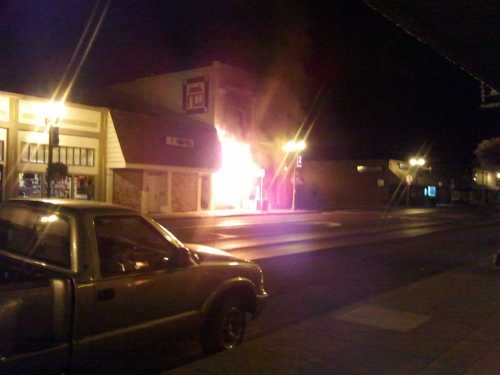
LAKEPORT, Calif. – Fire officials and police remained on scene throughout the day on Friday, continuing the investigation into an early morning fire that damaged a historic downtown building and destroyed one of the businesses housed within it.
The Lunas building, located at the corner of Third and Main streets, sustained major damage in the fire, which was reported shortly before 6 a.m., according to Lakeport Fire Chief Ken Wells.
The interior of the building’s bottom story, occupied by the Penny Lane Emporium, was a total loss, said Wells. He didn’t have a full cost estimate of the damages.
Firefighter Dan Copas of Lakeport Fire Protection District, the lead investigator on the fire, continued digging through the charred ruins on Friday afternoon, searching for clues as to the ultimate cause.
The building’s structural integrity did not appear to have been affected by the fire. Barricades and police crime scene tape surrounded the building, and a portion of Third Street was closed while work continued on the investigation.
Copas said that the point of origin was determined to be at the front of the store.
It will take at least a few days to narrow in on a final cause, Copas said.
“It’s going to be a process until we get to the bottom of it,” he said.
Lakeport Fire won’t bring in the arson task force unless something criminal is found, Copas explained.
Upstairs, where attorney judicial candidate Michael Lunas and the firm of Feeney & Feeney have their offices, the damage was limited to smoke and heat, Wells said.
Servpro was conducting cleanup upstairs, said Wells, and on the first floor workers began boarding up the blown out front windows on the building late Friday afternoon.
Lunas, whose mother and uncle own the historic building, was still surveying the damage on Friday afternoon after removing his personal items from the top floor earlier in the day.
He said there was some fire damage on the left front side of the building’s second floor. The fire had climbed up to the second floor and damaged a room behind the one facing Main Street.
“It could have been way worse than it was upstairs,” said Lunas, crediting firefighters for doing “an amazing job” of stopping the fire from advancing further.
Nobody was present in the building at the time of the fire, and no injuries were reported. “That’s the good news,” said Lunas.
Wells said once the cause and origin is determined, then they will call in experts to assist with fine tuning that final conclusion.
Lakeport Police maintained a presence at the building throughout the day, with Det. Bob Jordan assisting with the investigation and Chief Brad Rasmussen also on scene.
“The chain of evidence is really important in these types types of cases,” Wells said.
Early in the day, officials had received reports of a vehicle throwing a Molotov cocktail through Penny Lane Emporium’s front window.
However, Wells and Rasmussen both said that they were able to discount that report.
“We have no indication at this time that it was even a malicious act,” said Wells.
Rasmussen said the vehicle reportedly involved was found and the driver identified. He said the driver was passing by the fire and it’s believed that at that point the front window broke as a result of the fire burning inside the building.
“The fire could have been smoldering in that building for hours,” said Wells.
When the fire reaches the point of “free burning,” it takes up as much fuel and oxygen as it can, and can result in explosions and breaking windows, Wells explained.
Lunas said he and the other upstairs tenants will be relocating temporarily while repairs take place on the building.
The grand old building dates to 1876, and survived the 1906 earthquake, which had reduced some of downtown Lakeport’s buildings to rubble.
“This is quite a building,” Lunas said. “It’s been through it all.”
Email Elizabeth Larson at
- Details
- Written by: Lake County News reports

LAKE COUNTY, Calif. – The Lake County Sheriff’s Narcotics Task Force seized 1.5 pounds of methamphetamine, $977 and arrested two subjects this past Monday.
The task force arrested Santa Rosans Carlos Moreno Guzman, 29, and 34-year-old Alma Nava, according to Sgt. Steve Brooks.
On Sunday, Sept. 16, the Lake County Sheriff’s Narcotics Task Force developed information that a pound of methamphetamine was going to be delivered and sold the following day in Middletown, Brooks said.
On Monday, Sept. 17, the task force developed additional information that the delivery and sale of the methamphetamine had been changed to take place in Calistoga. Brooks said they also learned that the quantity of methamphetamine to be delivered had been increased to 1.5 pounds.
At 4 p.m. that day the Lake County Sheriff’s Narcotics Task Force, with assistance from the Calistoga Police Department, located and detained Guzman and Nava. Brooks said Guzman was standing next to a 2005 Acura sedan and Nava was sitting inside the vehicle on the passenger side. The vehicle was in the parking lot of a restaurant in Calistoga.
The Calistoga Police Department deployed their drug certified K9, which Brooks said alerted to the interior of the Acura. A search of the vehicle revealed approximately 1.5 pounds of crystal “Ice” methamphetamine and $977. The methamphetamine was concealed inside the packaging of a men’s underwear box.
Brooks said narcotics detectives estimated the street value of the methamphetamine to be $68,000. The $977 was seized pending asset forfeiture.
Guzman was arrested for possession of a controlled substance for sale, transportation of a controlled substance and conspiracy to commit a crime. Nava was arrested for possession of a controlled substance and conspiracy to commit a crime. Brooks said they were both transported to the Lake County Hill Road Correctional Facility and Booked.
Both Guzman and Nava remained in custody Friday with immigration holds, Brooks said.
The Sheriff’s Narcotics Task Force can be contacted through its anonymous tip line at 707-263-3663.

- Details
- Written by: Elizabeth Larson
COBB, Calif. – A 3.3-magnitude earthquake was reported in the Cobb area early Saturday morning.
The US Geological Survey’s preliminary report said the quake occurred at 1:23 a.m.
It occurred at a depth of a half a mile two miles west southwest of Cobb, three miles northeast of The Geysers geothermal steamfield and five miles northwest of Anderson Springs, the survey reported.
Just before 2 a.m., the survey had received two shake reports – one from Kelseyville and one from Lower Lake.
A 3.3-magnitude quake was reported on Aug. 3 in the Cobb area, as Lake County News has reported.
Email Elizabeth Larson at