How to resolve AdBlock issue?
News
- Details
- Written by: Lake County News reports
MIDDLETOWN, Calif. – The service of a search warrant by the Sheriff’s Narcotics Task Force Tuesday morning resulted in five arrests, the seizure of 198 marijuana plants as well as approximately 20 pounds of processed marijuana, three firearms, illegal fireworks and $53,096 for asset forfeiture.
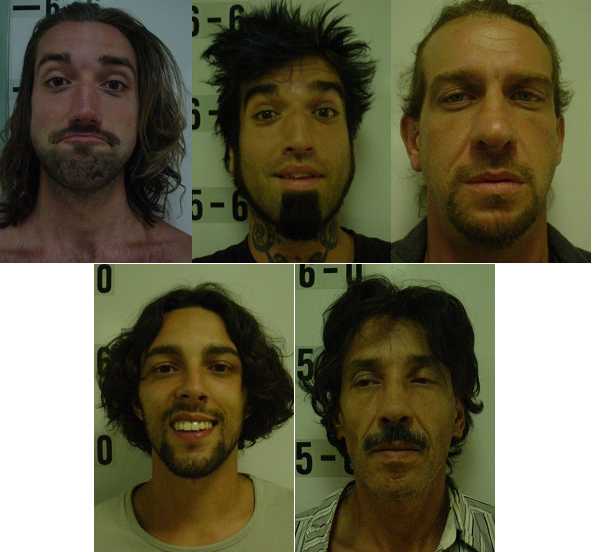
Sgt. Steve Brooks of the Lake County Sheriff’s Office said the warrant service resulted in the arrests of 53-year-old Ronald Joseph Whitney of Middletown; Aaron Daniel Alexander, 25, of Lancaster, Penn.; Austin David Alexander, 30, of Maui, Hawaii; and Middletown residents Aaron Whitney, 25, and Ernest Eldridge Cosse, 38, of Middletown.
On Monday narcotics detectives secured a search warrant for Whitney’s person as well as his home, located in the 24,000 block of Highway 29 in Middletown, and served it the following day at approximately 7 a.m., Brooks said.
When narcotics detectives approached the property, two subjects ran from the marijuana grow attempting to get away. Brooks said detectives entered the residence and detained five individuals without incident.
He said the subjects detained were Ronald Whitney, Aaron Alexander, Austin Alexander, Aaron Whitney and Cosse.
During a search of the home, detectives located approximately 20 pounds of processed marijuana, nine ounces of concentrated cannabis, 37 growing marijuana plants inside the garage and three firearms, Brooks said.

Brooks said they also seized a total of $53,096 in cash, which was located in three different safes inside the residence.
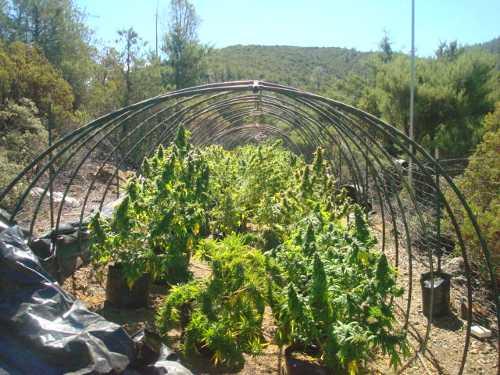
In addition, detectives located a digital scale, packaging materials and illegal fireworks, and outside the residence found 95 marijuana plants inside three light deprivation greenhouses and 66 marijuana plants growing in various areas outside, Brooks said.
Brooks said Ronald Whitney told detectives that he was growing the marijuana for a dispensary called “Mary Jane,” which is located in the Los Angeles area.
Whitney also said he was diverting water from the creek to water his plants, believing the water in the creek belonged to him because the creek runs through his property, Brooks said.
Brooks said Whitney was arrested for cultivating marijuana, possession of marijuana for sale, being armed while in the commission of a felony and possession of illegal fireworks.
He reported that Aaron Alexander was arrested for cultivating marijuana and possession of marijuana for sale; Austin Alexander was arrested for cultivating marijuana and possession of marijuana for sale; Aaron Whitney was arrested for cultivating marijuana and possession of marijuana for sale; and Ernest Cosse was arrested for cultivating marijuana, possession of marijuana for sale and being armed while in the commission of a felony.
All of the subjects were transported to the Lake County Hill Road Correctional Facility and booked, Brooks said.
The Sheriff’s Narcotics Task Force can be contacted through its anonymous tip line at 707-263-3663.
- Details
- Written by: Dennis Fordham
On Jan. 1, 2013, amendments to California’s statutory law regarding revocation of trusts take effect.
The purpose is to allow a surviving spouse to revoke – i.e., takes back – some or all the assets held in a joint trust established while the couple were both alive that remained revocable after the first spouse’s death.
Let us examine the law as it exists and as amended.
First some basics: Revocation of a trust occurs when a contributing settlor revokes some or all of the property that he or she once transferred to the trust.
Revocation is not to be confused with a trust amendment which changes some or all of the trust’s terms (provisions) but still leaves the assets inside the trust. Under California law, a trust is revocable unless it says otherwise.
Presently, “[u]nless otherwise provided in the instrument, if a trust is created by more than one settlor, each settlor may revoke the trust as to the portion of the trust contributed by that settlor, except as provided in Section 761 of the Family Code [i.e., either spouse alone may revoke the couple’s community property in addition to his or her separate property].” Once revoked, trust assets are returned to the contributing settlor(s).
In 1990, the California Court of Appeals decided that such existing statutory language did not allow a surviving husband to revoke the half of the trust which belonged to his deceased wife’s estate – even though the trust assets were all community property right before the wife’s death.
This was because when the wife died the couple’s community property ceased being community property and instead became their undivided separate property.
Thus the surviving spouse’s power of revocation extended only to his one-half separate property share.
Had the couple’s joint trust expressly authorized the surviving spouse to revoke the deceased wife’s separate property then the entire trust would have been revoked.
Many existing revocable joint trusts similarly lack such authority for the surviving spouse.
As amended the new law permits that, “a settlor may grant to another person, including, but not limited to, his or her spouse, a power to revoke all of part of that portion of the trust contributed by the settlor.”
Interestingly, the foregoing allows a settlor to delegate someone other than his or her spouse to be the power holder. It does not even require the delegated person to be a co-settlor of the trust or even the settlor’s agent.
Also, the authority does not need to be inside the trust instrument itself. This may create unintended problems of their own.
Once revoked, the affected trust assets are disposed of “as provided in the trust instrument.” Otherwise, if the trust is silent the revoked assets instead are disposed of, “as directed by the person exercising the power of revocation.” In which case the power holder, presumably the surviving spouse, has power of ownership over the assets.
Furthermore, the delegated power of revocation will now be effective over all trust assets, “regardless of whether [they are] separate property or community property of that settlor, [and also] regardless of whether that power to revoke is exercisable during the lifetime of that settlor or continues after the death of that settlor, or both.”
That allows the surviving spouse/co-settlor authority to revoke a deceased spouse’s separate property inside a joint trust that remains revocable after the death of the first spouse.
The amended law contains its own technical ambiguities and creates its own potential pitfalls. These are certain to be litigated once the law is applied to decedent’s dying after 2012.
Dennis A. Fordham, attorney (LL.M. tax studies), is a State Bar Certified Specialist in Estate Planning, Probate and Trust Law. His office is at 55 First St., Lakeport, Calif. Dennis can be reached by e-mail at
- Details
- Written by: Stuart Wolpert
For years, many scientists had thought that plate tectonics existed nowhere in our solar system but on Earth.
Now, a UCLA scientist has discovered that the geological phenomenon, which involves the movement of huge crustal plates beneath a planet’s surface, also exists on Mars.
“Mars is at a primitive stage of plate tectonics. It gives us a glimpse of how the early Earth may have looked and may help us understand how plate tectonics began on Earth,” said An Yin, a UCLA professor of Earth and space sciences and the sole author of the new research.
Yin made the discovery during his analysis of satellite images from a NASA spacecraft known as THEMIS (Time History of Events and Macroscale Interactions during Substorms) and from the HIRISE (High Resolution Imaging Science Experiment) camera on NASA’s Mars Reconnaissance Orbiter. He analyzed about 100 satellite images – approximately a dozen were revealing of plate tectonics.
Yin has conducted geologic research in the Himalayas and Tibet, where two of the Earth’s seven major plates divide.
“When I studied the satellite images from Mars, many of the features looked very much like fault systems I have seen in the Himalayas and Tibet, and in California as well, including the geomorphology,” said Yin, a planetary geologist.
For example, he saw a very smooth, flat side of a canyon wall, which can be generated only by a fault, and a steep cliff, comparable to cliffs in California’s Death Valley, which also are generated by a fault. Mars has a linear volcanic zone, which Yin said is a typical product of plate tectonics.
“You don’t see these features anywhere else on other planets in our solar system, other than Earth and Mars,” said Yin, whose research is featured as the cover story in the August issue of the journal Lithosphere.
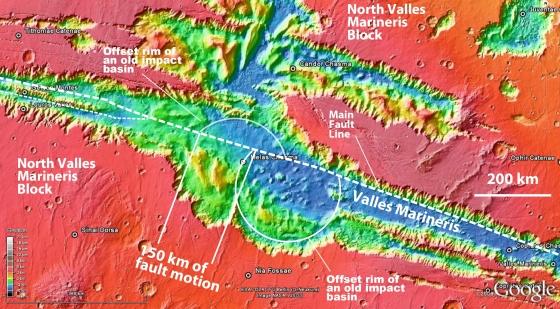
The surface of Mars contains the longest and deepest system of canyons in our solar system, known as Valles Marineris (Latin for Mariner Valleys and named for the Mariner 9 Mars orbiter of 1971, which discovered it). It is nearly 2,500 miles long – about nine times longer than the Earth’s Grand Canyon. Scientists have wondered for four decades how it formed. Was it a big crack in Mars’ shell that opened up?
“In the beginning, I did not expect plate tectonics, but the more I studied it, the more I realized Mars is so different from what other scientists anticipated,” Yin said. “I saw that the idea that it is just a big crack that opened up is incorrect. It is really a plate boundary, with horizontal motion. That is kind of shocking, but the evidence is quite clear.
“The shell is broken and is moving horizontally over a long distance,” Yin said. “It is very similar to the Earth’s Dead Sea fault system, which has also opened up and is moving horizontally.”
The two plates divided by Mars’ Valles Marineris have moved approximately 93 miles horizontally relative to each other, Yin said.
California’s San Andreas Fault, which is over the intersection of two plates, has moved about twice as much – but the Earth is about twice the size of Mars, so Yin said they are comparable.
Yin, whose research is partly funded by the National Science Foundation, calls the two plates on Mars the Valles Marineris North and the Valles Marineris South.
“Earth has a very broken ‘egg shell,’ so its surface has many plates; Mars’ is slightly broken and may be on the way to becoming very broken, except its pace is very slow due to its small size and, thus, less thermal energy to drive it,” Yin said. “This may be the reason Mars has fewer plates than on Earth.”
Mars has landslides, and Yin said aStuart Wolpert writes for the UCLA news service. fault is shifting the landslides, moving them from their source.
Does Yin think there are Mars-quakes?
“I think so,” he said. “I think the fault is probably still active, but not every day. It wakes up every once in a while, over a very long duration – perhaps every million years or more.”
Yin is very confident in his findings, but mysteries remain, he said, including how far beneath the surface the plates are located.
“I don’t quite understand why the plates are moving with such a large magnitude or what the rate of movement is; maybe Mars has a different form of plate tectonics,” Yin said. “The rate is much slower than on Earth.”
The Earth has a broken shell with seven major plates; pieces of the shell move, and one plate may move over another. Yin is doubtful that Mars has more than two plates.
“We have been able to identify only the two plates,” he said. “For the other areas on Mars, I think the chances are very, very small. I don’t see any other major crack.”
Did the movement of Valles Marineris North and Valles Marineris South create the enormous canyons on Mars? What led to the creation of plate tectonics on Earth?
Yin, who will continue to study plate tectonics on Mars, will answer those questions in a follow-up paper that he also plans to publish in the journal Lithosphere.
Stuart Wolpert writes for the UCLA news service.
- Details
- Written by: Elizabeth Larson
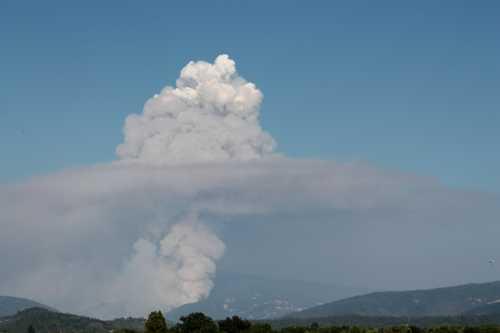
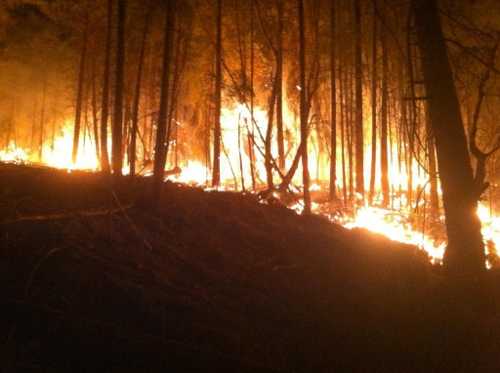
NORTH COAST, Calif. – A pair of lightning-caused wildland fires in northern Mendocino County scorched more acreage on Friday as firefighters also made a gain in containment.
The North Pass Fires, burning since early last Saturday morning, had burned 21,558 acres by Friday night, with containment increasing to 18 percent, according to Cal Fire and the US Forest Service’s unified command on the incident.
The fires, burning 10 miles northeast of Covelo in the Williams Valley, continued to threaten dozens of residences east of Covelo, where officials said evacuations remained in effect on Friday.
Approximately 1,191 fire personnel were assigned to the fire on Friday. Other resources included 110 engines, 26 fire crews, two airtankers, seven helicopters, 32 bulldozers and 23 water tenders, unified command reported.
Officials said the fires were actively burning in heavy timber into the Yolla Bolly Middle Eel Wilderness and continuing to spread to the East to Forest Road M1, south towards Anthony’s Ridge, north to Cedar Springs Ridge and northeast towards Pothole Creek and Steel Bench.
Firefighters continued to establish and improve containment lines while defending structures. They also made good progress on the west and southwest perimeter of the fire along Asa Bean Road, and the fires moved to within half a mile of Anthony Ridge along the Buck Creek drainage, according to the Friday evening report.
Incident command reported that smoke was likely to be especially heavy in the Covelo/Round Valley areas, where smoke concentrations have reached levels considered to be “hazardous” under state and federal air quality standards.
Those air quality conditions are expected to remain unchanged Saturday and for a few days afterward, fire officials reported.
Email Elizabeth Larson at